
Continuity Metal
Apple Silicon fork of Continuity: one node for MiniMax H3, LTX 2.5 and the still families on Metal / MPS
Nodes (29)
Continuity Guide Frames — where a ControlNet drawing becomes frames
Continuity Job is the node you're not supposed to add — it's the pack's engine room
The DLSS 5 node you never place — Continuity's whole-reel refine pass
NVIDIA's DLSS 5 as a ComfyUI node — the material pass that isn't an upscaler
Continuity Seam Hold is the node that fixes the masked seam's two-pass bug — and you'll never add it yourself
The 3×3 cheat sheet that stops your video forgetting the room
The node that saved your shots before your render failed
Swapping H3's attention for Video Delta Net (and the shot size where it's worth it)
The clip's opening or closing seconds — the audio side of a seam around supplied footage
The first or last frames of a clip you attached
The one node in the chain that never decodes anything
Write a sentence, attach media with @, press Render
Re-draw the face big, paste it back small
The Loader Switch That Decides Whether a Guide LoRA Actually Lands
Your Clip, Generated Again With Itself as the Guide
Why your spinning kick is a smear, and the node that slows it down to redraw it
The tail of a shot's soundtrack — the bit that makes the next shot's room sound the same
A decoded pass's tail frames
Stills for H3, without leaving the node
The node that saves you from holding 18 GB of video in RAM
The two-pass upscale that refines the picture without re-noising the sound
The last node of every H3 render — and why the pack wrote its own instead of using core's
The tiny node that writes your pre-stage still and keeps the canvas clean
The hidden node that keeps long H3 videos from going soft
Slice one latent frame out of an H3 sample
The Timeline node is the Creator now — here's what that means for your old workflows
What the Creator emits for each card
LTX 2.5 Segment — the whole shot in one internal node
You Don't Place This Node — ReDetail Repaints Your Render at 2x on Its Own
Continuity Metal
Apple Silicon fork of ComfyUI-Continuity optimized for Metal / MPS
NVIDIA / CUDA users: this is not that pack. Install the original instead: roadmaus/ComfyUI-Continuity.
One node for AI video and stills. Write a prompt, attach media with @,
press Render. Everything is local open weights. The one thing that can talk
to the outside is the prompt refiner, and only if you point it at your own
server or provider — LM Studio, Ollama, or a hosted API with your key.
Who this is for
- Apple Silicon Mac (M-series), ComfyUI Desktop or a local ComfyUI on MPS
- One Continuity install: this folder, named
continuity
Do not install this beside the CUDA pack. The node ids are the same on purpose (saved workflows keep loading), so two folders register the same ids and neither node shows up.
Install
In ComfyUI Desktop the custom-nodes folder is usually
~/Documents/ComfyUI/custom_nodes. Remove any existing Continuity /
MiniMax Creator folder first, then:
cd ~/Documents/ComfyUI/custom_nodes
git clone https://github.com/audiohacking/ComfyUI-Continuity-Mac continuity
The folder must be named continuity: ComfyUI serves the UI from
/extensions/continuity/. Restart ComfyUI. Search for Continuity Metal
and drop it on an empty canvas — that is the whole start. An optional
example graph is under example_workflows/.
From ComfyUI Manager / the registry the node id is continuity-metal
(publisher audiohacking). After that install, rename the folder to
continuity and remove the CUDA pack if it is also present.
Nothing to pip install.
Weights are not downloaded. Put files in ComfyUI's models/ tree (or leave
them where they already are). A prestartup also registers the Hugging Face
hub cache and a sibling h3-ws checkout
when those exist. Turbo on this fork offers TaoMate as a filename
preset (strength 0.8, Euler/simple, 3 steps). Leave attention
on default. See docs/models.md.
What it does
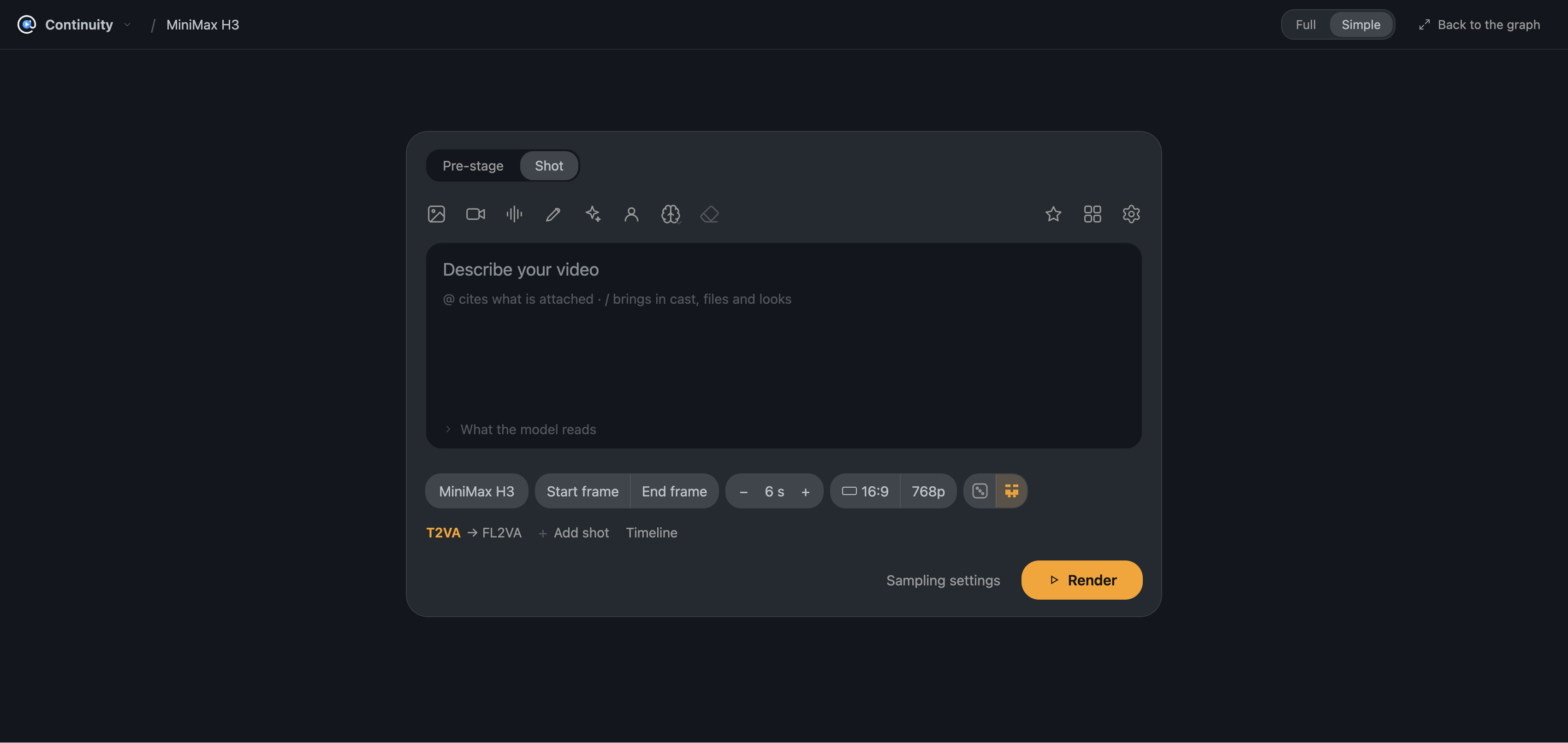
One node, one prompt
Drop the node, type, press Render. Files you attach get an @ name and you
cite them in the sentence, so the prompt says which picture is the person and
which is the room. The pills under the box are the whole setup: duration,
aspect, resolution, the model, and a sampler row for when you want it.
The node walks every control.
References and the cast
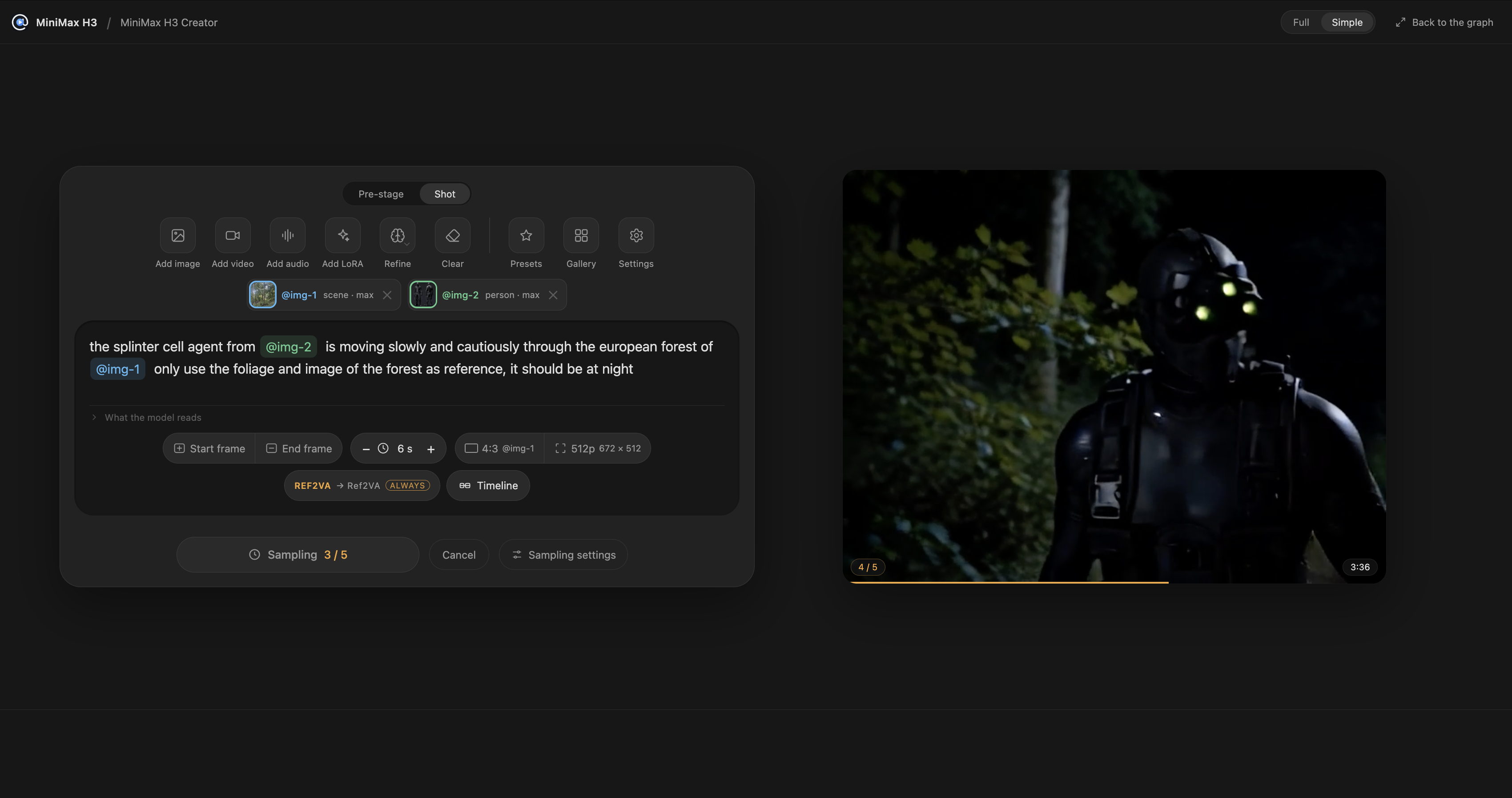
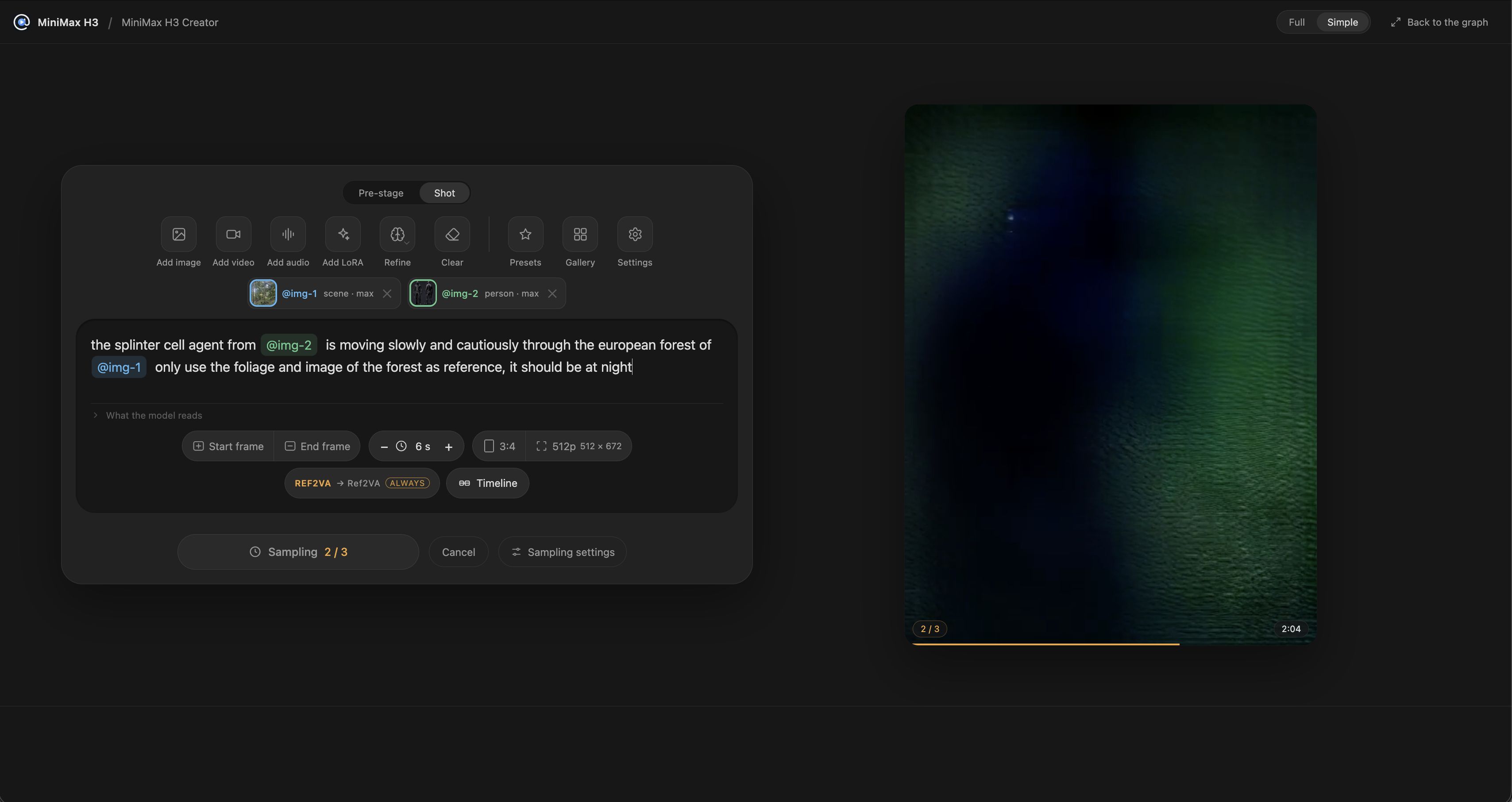
A reference contributes what you say it contributes - the person, the place, the look - and the same face can be saved once and brought back into any piece by name. Two references cited in one prompt:
The pre-stage
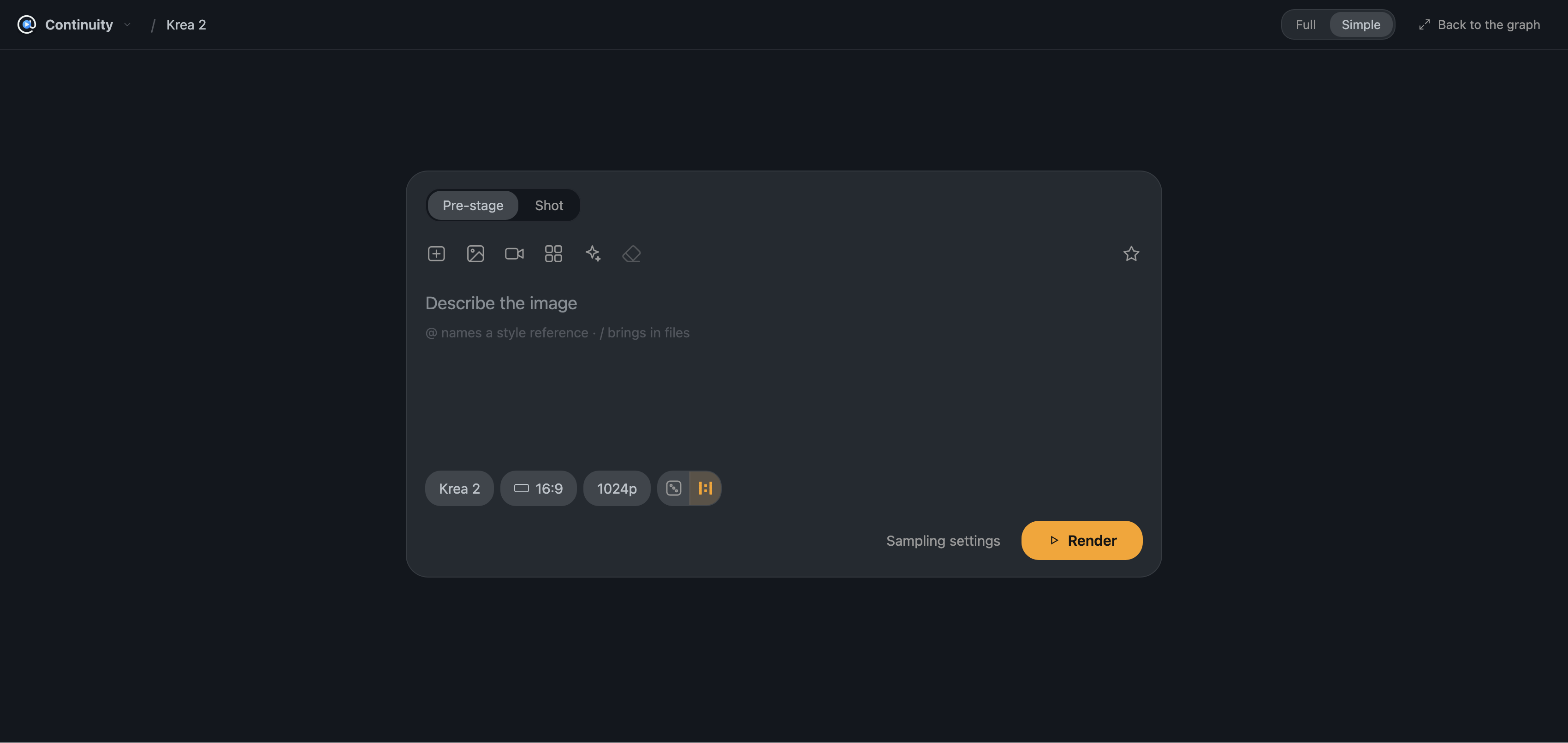
Video models eat stills: start frames, end frames, references. The pre-stage is a second card on the same canvas that makes them, with any of the stills families or H3 itself, and hands the result straight into the shot. One Queue runs both; an untouched pre-stage doesn't re-render.
Timelines
Under the prompt: Write the next shot. Every shot on the strip is a whole generation with its own prompt, references, LoRAs and even its own family - a pre-stage on Krea 2 feeding start frames into shots on LTX 2.5 is one strip. Seams carry picture and sound across the cut, or don't, independently. Timelines.
Chat
The other way in. A room where you say what you want - a fox in a snowy wood at dusk, then now a clip of it, she looks up, then bluer - and the refiner model writes the prompt and renders. Every picture and clip gets a handle you can cite in the next line, so a still becomes a shot's first frame by naming it. It is the same node underneath, on the same queue, and everything lands in the same output folder. Chat.
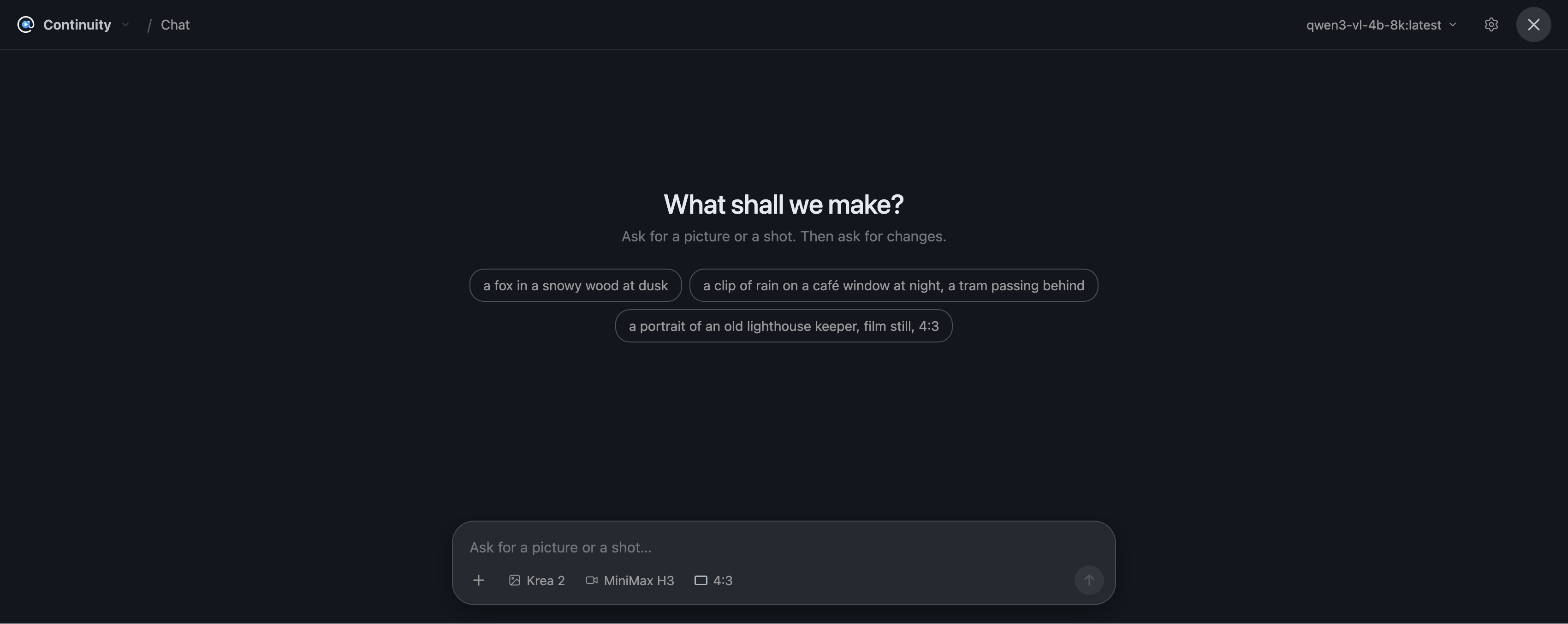
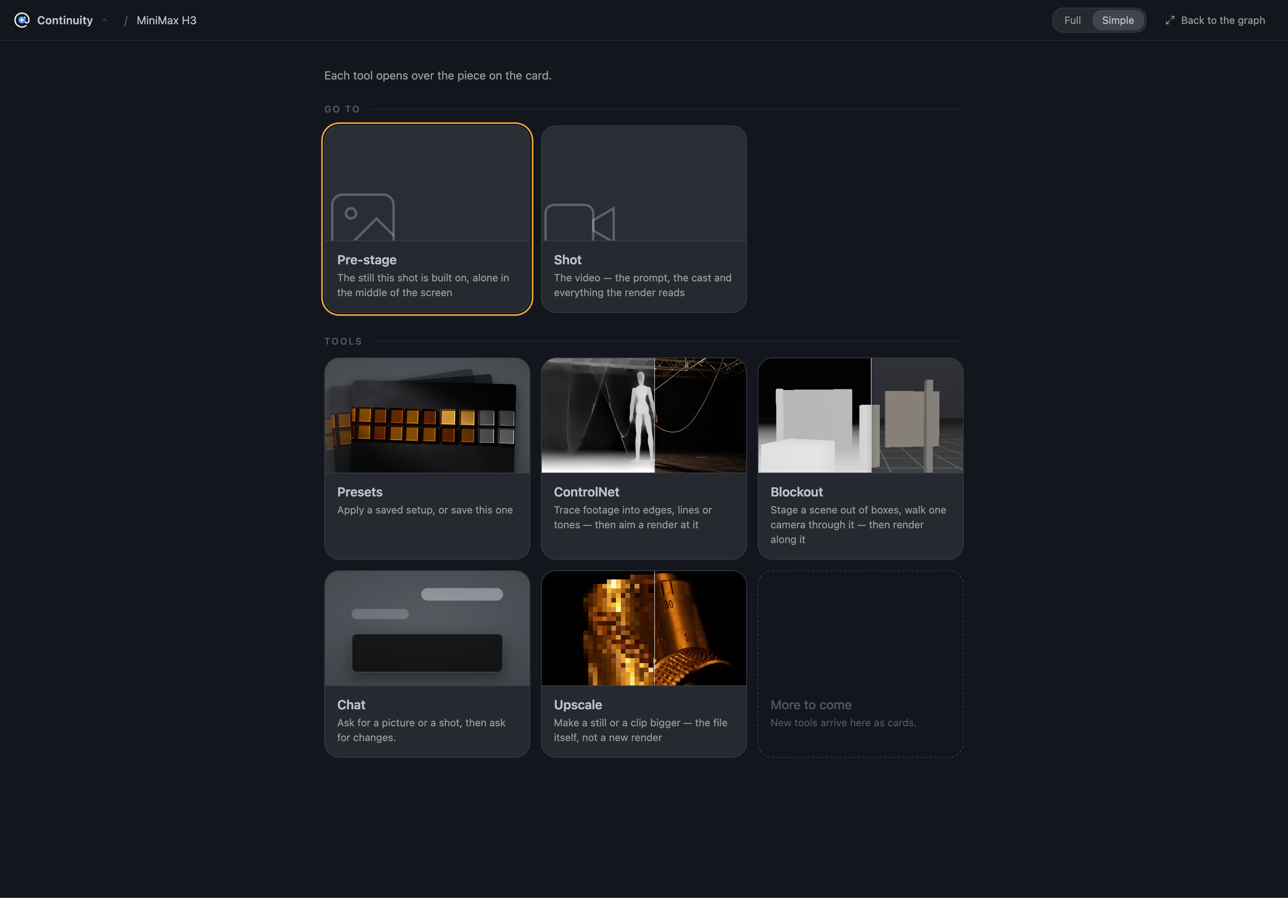
Tools
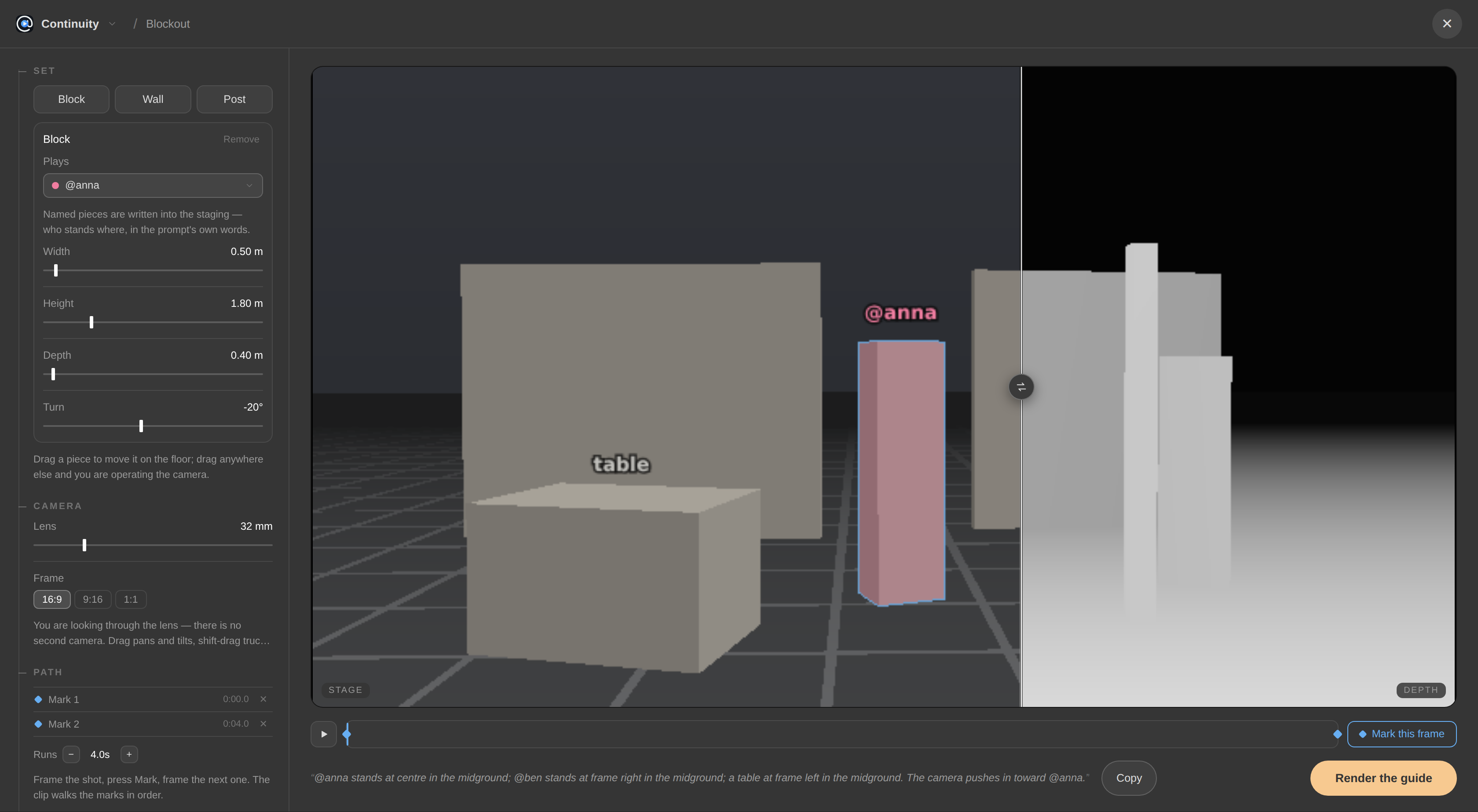
The wordmark opens a dashboard of tools that work over the piece: presets, a ControlNet bench, a blockout bench for staging a scene out of boxes and walking a camera through it, and an upscale bench. Tools.
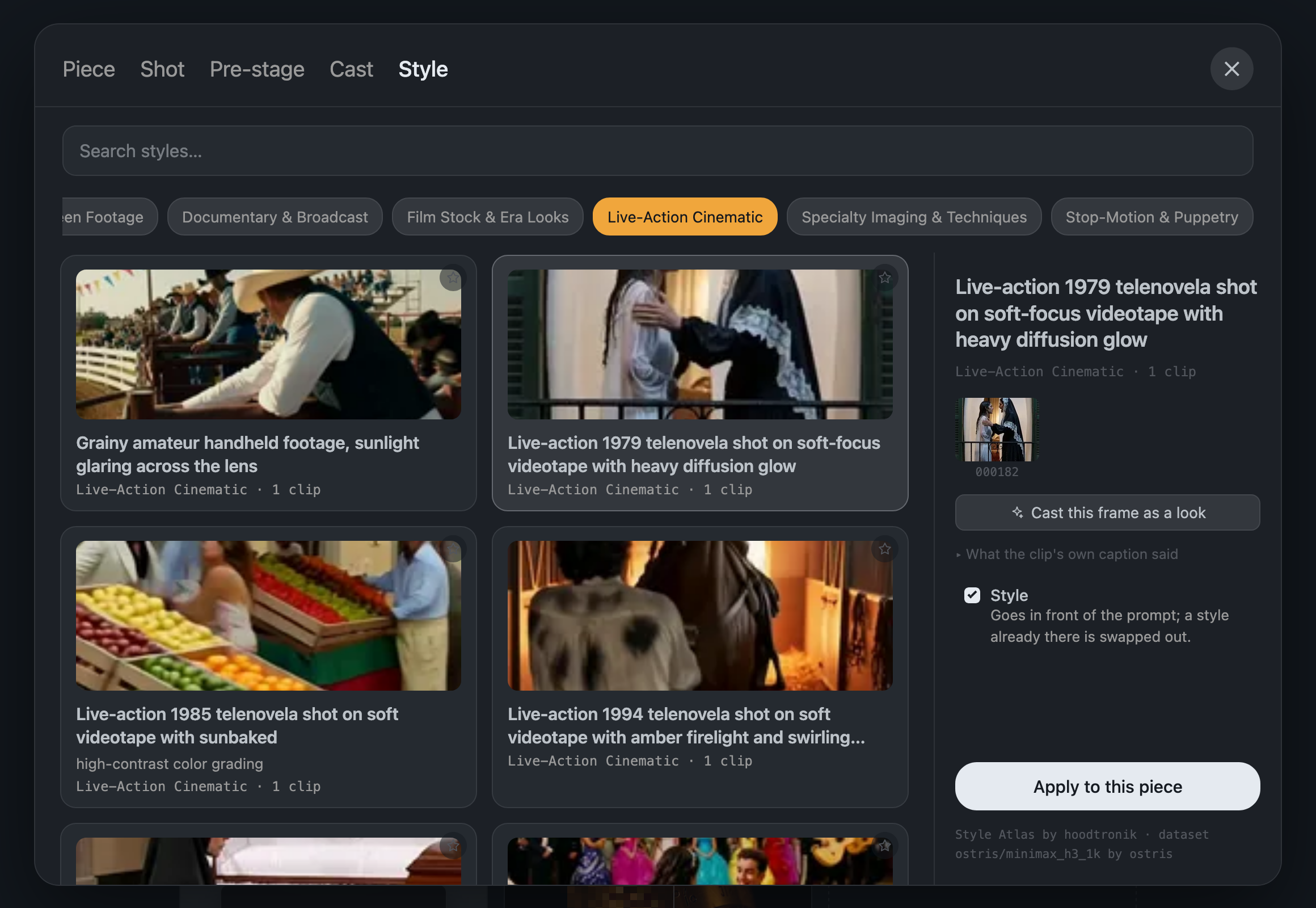
The style atlas is 941 looks captioned from real clips, applied as a prefix to the prompt:
Where it is headed
The name is the goal. A single shot from an open video model is a solved problem; a piece made of many shots that still looks like one piece is not. Every continued shot comes out a little brighter and a little harder than the one it continues, and after a handful of seams the strip has drifted somewhere you never asked for. Most of the work now goes there: measuring the drift on real strips rather than guessing, and pushing the number of shots a piece can hold before it shows.
The other direction is getting the graph out of the way. The chat room and the blockout bench are both ways of saying what you want without touching a pill, and the pre-stage plus the timeline are what let one prompt become a scene. There is no cloud in any of that, and there won't be: everything renders on your hardware from weights you already have.
Documentation
- Getting started
- Model downloads - every file, and the folder it goes in
- The node - prompting, references, the cast, Refine
- Timelines - pieces with more than one shot
- Model families - what each model can do
- Tools - chat, ControlNet, upscaling, presets, LoRAs
- FAQ and troubleshooting
- Changelog - what changed, release by release
Models
| Family | Makes | Weights | |---|---|---| | MiniMax H3 | video with sound, and stills | Comfy-Org/MiniMax-H3 | | LTX 2.5 | video with sound | Lightricks/LTX-2.5 | | Krea 2 | stills | Comfy-Org/Krea-2 | | Ideogram 4.0 | stills | Comfy-Org/Ideogram-4 | | Qwen Image Edit | stills, edited from a picture | Comfy-Org/Qwen-Image-Edit_ComfyUI | | Flux 2 Klein | stills, edited from a picture | Black Forest Labs |
See docs/models.md for which files you need and where they go.
On this fork, turbo for H3 offers TaoMate
(taomate_h3_3step_comfy.safetensors in models/loras) at strength 0.8
and 3 steps; LightX2V and Tutu keep the family's quality counts.
There is also an optional neural refiner: NVIDIA's DLSS 5 neural renderer as a material pass over finished stills and clips (skin, hair, fabric, contact shadows), through the open-source MLX-DLSS port, which travels with the pack. It is not an upscaler and it ships with nothing of NVIDIA's — the weights are extracted from your own copy of the DLSS DLL on the settings page. See docs/tools.md.
Thanks
This pack is glue. The work underneath it belongs to other people:
- ComfyUI-Continuity by roadmaus - the node this fork is
- ComfyUI by Comfy Org - every family here lives in core, this node drives them
- h3-ws - which MiniMax-H3 files and LoRAs this Mac checkout already has
- Lightricks - LTX 2.5, its IC-LoRAs, the duration head and the two-stage pipeline
- ComfyUI-Spectrum-MiniMax-H3 by xmarre - an accelerator on the sampler row
- ComfyUI-MiniMaxH3-FirstBlockCache by duckyshell - an accelerator on the sampler row
- ComfyUI-MiniMaxH3-TeaCache by Icyoung - an accelerator on the sampler row
- ComfyUI-KJNodes by Kijai - the live preview decoder, sage attention, the low vram pill
- ComfyUI-MultiGPU by pollockjj - the device chip on the weights popover
- ComfyUI-GGUF by city96 - loads the
.gguffiles the weights popover offers - ComfyUI#15416 by matlowai - the fix behind H3 single-frame stills
- ComfyUI-MiniMaxH3_LatentUpscaler by Tr1dae - pioneered the two-pass upscale our refine pass reimplements
- Minimax_h3_latent_Upscaler by LBH-123-AI - the trained latent upscaler behind the refine's "trained" road; the network is re-implemented here, the weights are theirs (Apache-2.0)
- ComfyUI-H3-FaceRefine by Carasibana, and zuanfilm's graph on it - worked out the face pass ours reimplements
- ComfyUI-MAINodes by matlowai - the Motion Lab de-rope, whose method and measured dials the motion fix reimplements
- minimax-h3-style-atlas by hoodtronik, over minimax_h3_1k by ostris - the 941 looks on the style tab
- taehv by madebyollin - the tiny decoder behind the live preview
- BiRefNet by ZhengPeng7 - the matte behind every one-click cutout
- ComfyUI-H3-PowerLoraStack by cicalooo - the H3-safe LoRA loader, vendored (Apache-2.0)
- MLX-DLSS by iamwavecut - the DLSS 5 refiner's inference and weight extraction, vendored (Apache-2.0)
- ComfyUI-VDN-H3 by Saganaki22 - the port behind the VDN-H3 pill, vendored (Apache-2.0)
- ComfyUI-PlagueKind-Nodes by PlagueKind - SLA sparse attention on the attention pill
- OpenVDN - Video Delta Net itself: the hybrid attention, the training and the stages the pill loads
- NVIDIA - the DLSS 5 neural renderer itself. Nothing of theirs ships here; the weights are extracted from your own driver DLL
- ReDetail by Bambushu - the graph and the measurements behind the ReDetail upscale
- Minimax-H3-ComfyUI by Alissonerdx - the guide LoRAs behind the guide pass, and the rig they run in; trained on ostris's ai-toolkit fork with guide-latent support
- Raylight by Karmabu - H3 across two GPUs
- MiniMax - H3 itself, and the reference guide this pack's prompts are written to
- Krea, Ideogram, Black Forest Labs and the Qwen team - the four still families beside H3 and LTX 2.5
- Meta - SAM 3, behind click-to-select cutouts, the faces pass and the Matte tracing
- ByteDance - SeedVR2, the Restore backend on the upscale bench
- Depth Anything 3 and SDPose - the two model-backed tracings, both loaded through core
- alibaba-pai - the MiniMax-H3-Acc-LoRAs whose 32 output heads the accelerator reads
- TaoMate, larryvrh and lightx2v - the H3 distillation LoRAs behind turbo
- CiviMeta - the sidecar format the LoRA cards read
Every node pack on that list is optional: if one is installed, the matching pills light up, and if it is not, they say what is missing. The models are optional in the same way — none of them is downloaded for you, and nothing on this list ships inside the pack except the three vendored libraries it names.
License
MIT. ComfyUI itself is GPL-3.0 and this pack imports it; if you redistribute the two together rather than as a node pack people install themselves, that combination is what the GPL has an opinion about.