
ComfyUI-StaticPipeline
Static multi-GPU split for large quantized DiTs - transformer blocks are placed across GPUs once at load time and never move during inference, with hybrid residency for long sequences and activation-space LoRA for packed-int8 models.
ComfyUI-StaticPipeline
English | 中文说明
Static pipeline split for multi-GPU ComfyUI: place DiT blocks across GPUs once, never move weights again.
A drop-in custom node that splits a large DiT across multiple GPUs statically — weights are placed at load time and never move during inference. Includes hybrid residency (resident + CPU-streamed blocks) for long sequences, activation-space LoRA for quantized models, and chunked compute for long-video workloads.
Built and battle-tested on MiniMax H3 video DiT (34 GB int8_convrot) across 2× RTX 3080 20 GB, generating up to 15-second single-segment videos with zero crashes.
Why: the problem with dynamic layer sharding
The popular dynamic-sharding approach (ComfyUI-MultiGPU DisTorch) streams weight blocks between devices on demand. On recent ComfyUI forks with DynamicVRAM/aimdo virtual-VRAM internals combined with packed quantized weights (int8_convrot etc.), this is fundamentally unstable — we reproduced deterministic access violation crashes from three different paths:
- VAE eviction crash — loading the video VAE evicts the DiT →
unpatch_modeltouches dangling quantizedqdata→ segfault - Reload crash — a second prompt re-partially-loads the model →
patch_weight_to_devicetouches freed vbar memory → segfault - Block-move crash — even a fresh load crashes when the block-moving dance (dequant→requant through comfy_kitchen) hits a bad page
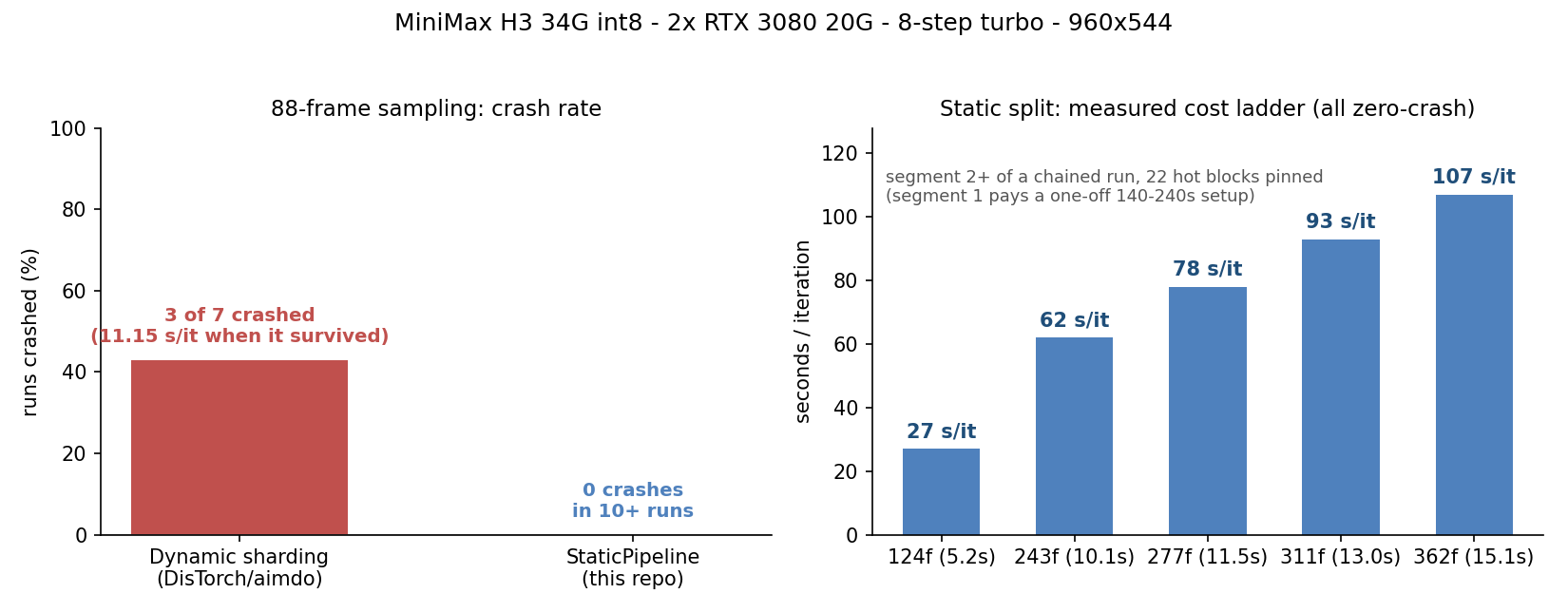
Our record with dynamic sharding on this stack: 3 successes, 4 hard crashes — every crash left a faulthandler trace pointing at the same root: dangling pointers into the quantized-weight virtual memory after any move.
The killer detail: vbar_free_memory in the aimdo ledger started returning negative garbage values. Python-level guards can't fix a corrupted kernel-side ledger.
The fix: stop moving weights. Ever.
Static placement: split the 50 transformer blocks once at load time (e.g. 23 + 27 across two 20 GB cards), then treat the DiT as load-bearing furniture:
partially_load→ no-op (patches/counters only)partially_unload→ report freed (lie), so nothing ever evicts itunpatch_model→ forbidden from moving weightsfree_memoryguard → static models are never eviction candidates- Activations cross the PCIe bus once per step at the block boundary (~140 MB)
Hybrid residency for long sequences
Weights don't grow with video length — activations do (~linear in tokens). For longer clips the node automatically switches profiles:
| Profile | Frames | Layout | Measured (segment 2+ of a chained run) |
|---|---|---|---|
| short | ≤88f | all-resident 23/27 | 73f: 6.80 s/it (0.093 s/it·frame, zero streamed blocks) |
| mid | 110–259f | 22/23 resident + 5 CPU-streamed | 124f: ~27 s/it · 243f: ~62 s/it |
| long | ≥260f | 19/21 resident + 9 CPU-streamed | 277f: ~78 · 311f: ~93 · 362f: ~107 s/it |
Measured cost curve on a directed chained run (steps=8 + turbo, 960×544, segment 2+): 124f ≈ 27 s/it · 243f ≈ 62 · 277f ≈ 78 · 311f ≈ 93 · 362f ≈ 107. Segment 1 carries a one-off ~140–240 s cost (Triton compile + first LoRA move + static placement).
Two knobs matter for long clips: 22 hot blocks stay pinned resident per card (the rest can stream), and the loaded model survives across prompts (LRU model cache) — the second and later submissions on the same instance skip reload, Triton recompile and the first LoRA move, saving ~5.7 min per clip at the same tier.
(2× RTX 3080 20 GB, MiniMax H3 34 GB int8, 8-step turbo. CPU-streamed blocks are lossless packed-int8 copies; overhead ~1 s/step.)
Four levels of chunking for long sequences
- MLP swiglu: 16k-row chunks (peak transient 2.9 GB → ~250 MB)
- LoRA delta: 1k-row chunks, in-place
add_into the layer output (zero full-size delta allocation) - Attention qkv/out_proj projections: 4k-row chunks into preallocated buffers
- Attention core: query chunking (k,v stay full — that's the math)
Activation-space LoRA (bypass mode)
Instead of weight_function hooks (which dequantize every layer every step: +5 s/it tax at 208 layers), LoRA is applied in activation space: y = W·x + α·B(A·x). Weights stay packed; the int8 fast path is preserved; the comfy_kitchen requant minefield is never touched. Uses the bypass infrastructure already shipped in ComfyUI's weight_adapter/bypass.py, with three fixes: per-card adapter placement, activation-dtype lazy casting (blind fp32 pre-cast = 448 MB transients), and chunked in-place accumulation.
Bugs found & fixed along the way (highlights)
- Activation-space LoRA cache thrash: the adapter cache was single-slot; on long sequences (
x.deviceflipping cuda:0 ↔ cuda:1 within one step) it missed on every call and re-copied the whole ~1 GB adapter set — a single step took >21 minutes (~8.8 TB moved). Fixed by bucketing the cache per(dtype, device)with ≥2 entries per adapter. Tell-tale signature: PCIe device-1 TX at ~7.8 GB/s (GPU→host flooding). Short clips never trigger it — the key never flips. adaln_t_tablewascast_to'd every forward call — 9 calls × 496 MB of duplicate tables alive simultaneously (4.46 GB!) on a 360-frame job. Fixed with an instance-level cache.- comfy_kitchen's cublas workspace is bound to
torch.cuda.current_device()— kernels on cuda:1 got cuda:0's workspace →cudaErrorIllegalAddress. Fixed by running every block undertorch.cuda.device(its_home). - ComfyUI-MultiGPU's dlpack guard loads
libcudart.so— instant crash on Windows. Patch included (loadscudart64_13.dllfrom torch/lib). - Streamed blocks originally did an H2D hop and a D2H hop per forward. The D2H hop was the access-violation site (it reads GPU pages that aimdo may have remapped). Since weights are read-only during forward, the D2H copy is now eliminated entirely — the saved CPU parameter objects are swapped back by reference (one-way transfer).
- TE encoding leaves a fragmented dead-block pool; sampling then OOMs at 16.5 GB allocated with 3 GB "free" per the ceiling.
empty_cache()at load completion fixes it. - WDDM effective VRAM ceiling is ~19.0 GiB on 20 GB cards;
PYTORCH_CUDA_ALLOC_CONF=expandable_segments:Trueis mandatory.
Full gory details: patches/ and the debug methodology (MGPU_STATIC_MEM_DEBUG=1 gives per-block VRAM curves + top-tensor attribution).
Installation
cd ComfyUI/custom_nodes
git clone https://github.com/<YOU>/ComfyUI-StaticPipeline.git
Optional but recommended patches (see patches/):
comfy-core_minimax-model_adaln-cache-embed-free.patch— kills the 496 MB/call table duplication + frees embed intermediates (benefits single-GPU too)comfy-core_weight-adapter-bypass_inplace-support.patch— in-place support required by chunked LoRAmultigpu_p2p-registry_windows-cudart.patch— Windows fix for ComfyUI-MultiGPU (only if you also run that pack)
Usage
Insert the node after your DiT loader:
UNETLoader → StaticPipelineSplit(frames=<your frame count>) → ... → sampler
framesmust be the length of a single sampling pass (max segment length for multi-segment Director chains, not the chain total) — it selects the residency profile (<110 all-resident / 110–259 mid / ≥260 long). Passing a multi-segment chain total over-streams the model and multiplies the kitchen.to()dispatch count per step, which is the same crash-class this node exists to avoid.- Asymmetric GPU pairs (20 GB + 48 GB, 3090 + 4090, …): set
primary_gb/secondary_gbto the weight budget you want on each card (rule of thumb: VRAM minus ~4 GB of activation headroom). The split is byte-budget driven, so the bigger card simply receives more blocks — no other change needed. Leave both at 0 to use the built-in profiles (2× 20 GB). Not yet tested on an asymmetric pair on our side (we only have 2× 20 GB) — the placement logic has no symmetry assumption, but report back if you try it. - Launch with:
MGPU_CPU_THRESHOLD_PERCENT=999 PYTORCH_CUDA_ALLOC_CONF=expandable_segments:True - Restart the instance when switching frame-count tiers — placement is one-shot per loaded model
- The video VAE (7.9 GB) won't fit alongside; it runs lowvram-streamed. That's expected.
Notes & limits
- Requires the ComfyUI fork runtime this was developed against (DynamicVRAM/aimdo builds; tested on torch 2.10.0+cu130). Stock ComfyUI works too — the overrides simply no-op gracefully — but the target use case is packed-quantized DiTs that crash under dynamic sharding.
- Measured segment tiers (current dev0 budget + 22 pinned blocks): chained segments passed every tier we tested — 124 / 243 / 277 / 311 / 362 frames, validated end-to-end. Notes quoting a 226f single-shot / 124f chained ceiling came from the pre-pin dev0 budget and no longer apply. A chained segment still costs ~384 MiB more than the same length as a standalone shot — "the standalone probe passed" does not imply the chain will.
- SageAttention allocates a 513.97 MiB fp32 temporary over the full k (∝ token count, hence ∝ frames) — the largest single OOM trigger on long segments; intrinsic, unrelated to LoRA/streaming/VAE.
- Three ways to free VRAM that we measured and killed: (a) rebalancing weights across cards — streamed blocks hop back onto their home card during their own forward, so the peak is conserved; (b) moving the audio VAE to cuda:1 — aimdo's vbar is only registered on device 0; (c) moving the text encoder to GPU — CUDA-context-level crash.
- Keep the VAEs on the GPU: giving the video VAE ~3 GiB of headroom cut decode from 137 s → 46 s.
- Windows + WDDM: effective ceiling ≈ 19 GiB per 20 GB card. Linux may allow more headroom (untested).
Support
If this saved your quantized multi-GPU stack from segfaulting, a tip is appreciated:
USDT (TRC20): TXLHM7dayYa7qHzHXWSqfrDhwZfLRT69oT
Acknowledgments
- pollockjj/ComfyUI-MultiGPU — DisTorch; the dynamic approach this project replaces for quantized stacks (and whose
p2p_registryWindows bug we patch here) - Fannovel16/ComfyUI-Frame-Interpolation — RIFE arch used in our companion interpolation script
- Comfy-Org — repacked RIFE weights
- MiniMax — H3 video model
- comfy_kitchen / aimdo authors — for the (buggy but fascinating) virtual-VRAM stack that motivated all this
License
MIT