
ComfyUI Minimax H3 Latent Upscaler
Learned MiniMax H3 latent upscaling with integrated low-sigma refinement for ComfyUI.
Nodes (4)
Sharper MiniMax H3 video without paying for a VAE round-trip
The MiniMax H3 upscaler node that does nothing by itself (on purpose)
MiniMax H3's two-stage trick, welded into one node
One input, one output, done
ComfyUI Minimax H3 Latent Upscaler
Neural Latent Upscaler for Minimax H3 Video Generation
Learned · High-fidelity · 2D & 3D Variants
📰 News
- [2026-09-04] 🔁 Sampler-internal learned handoff provider: added an API-v1 exact-target 3D clean-video provider for Flow-Aligned Regenerate progressive handoff. Real-media validation showed strong artifact reduction around 1 MP with zero extra H3 NFEs;
source_scale=0.70was the best tested quality/speed point around 1 MP, while0.65began losing likeness/tonal stability. - [2026-08-21] 🔧 Selective LBH upstream sync: fixed dual-axis output alignment while preserving aspect-ratio lock, added opt-in learned-model offload for standalone and integrated refinement workflows, and deliberately rejected non-equivalent temporal chunking / forced per-run offload. See Upstream sync policy.
- [2026-08-20] 🧩 Integrated MiniMax H3 refinement: the H3-aware 3D node now performs the complete learned-upscale + low-sigma H3 sampling pass internally. H3 Continuum V3.4 interop uses exact per-chunk
refine_statefrom the companion Continuum implementation; no external BasicGuider, DisableNoise, or SamplerCustomAdvanced is required. - [2026-08-19] 🚀 3D node overhaul: all three resize modes (
scale by multiplier,target dimensions,megapixels) merged into a single node; fixed aspect-ratio mismatch in certain modes and edge artifacts at specific sizes. - [2026-08-18] 🔥 Precision selector: both 2D and 3D nodes support
fp32/fp16/bf16inference. - [2026-08-17] 🎉 Initial release: Minimax H3 Latent Upscaler 2D + 3D nodes.
This project upscales MiniMax H3 24-channel video latents with a trained neural network instead of naive interpolation. It can skip the expensive VAE decode → pixel upscale → VAE encode round-trip and supports a two-stage generation strategy: generate at lower resolution, perform the learned latent upscale, then optionally run a short H3 refinement pass at the target resolution.
The learned upscale saves time, not VRAM. Any H3 refinement pass still executes the transformer on the target-resolution latent grid.
Nodes
Four nodes are registered under video/MinimaxH3:
- Minimax H3 Latent Upscaler (2D) — lightweight learned spatial upscale with temporal layers.
- Minimax H3 Latent Upscaler (3D) — fully 3D learned upscale with scale, target-dimensions, and megapixel modes.
- MiniMax H3 Latent Upscaler + Refine (3D) — complete MiniMax H3 two-stage path: learned video upscale, AV reconstruction, exact H3 conditioning/masks, fresh enlarged-grid noise, and the actual second sampling pass.
- MiniMax H3 Latent Upscaler Provider (3D) [Experimental] — immutable, versioned side-input configuration for compatible sampler-internal handoffs.
The standalone 2D/3D nodes remain ordinary LATENT → LATENT upscalers. The integrated refine node is for workflows that intentionally perform a second H3 pass.
📸 Examples
Video upscale comparison
<video src="examples/Minimax_h3_latent_Upscaler_001.mp4" controls width="640"></video>
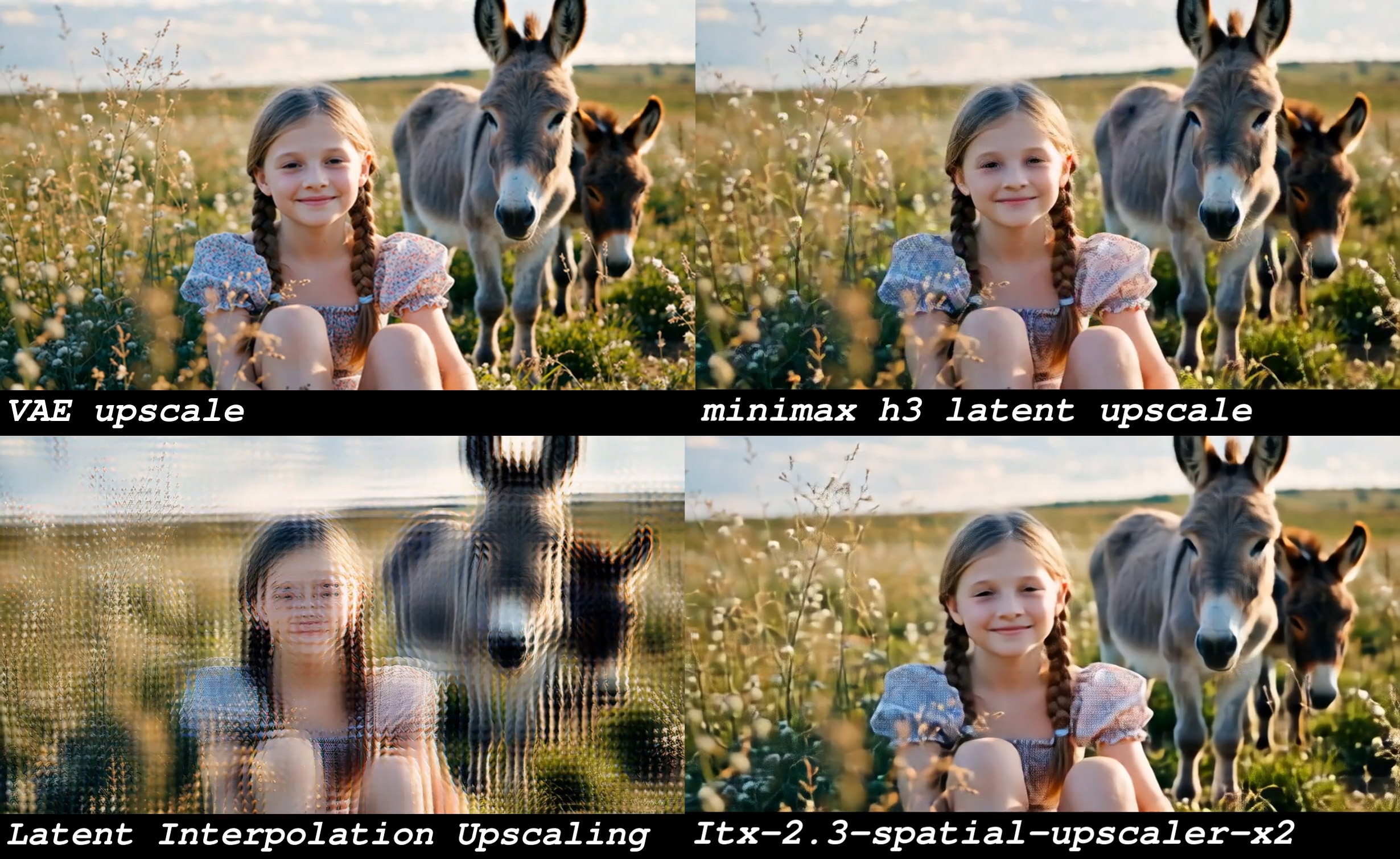
Image upscale comparison
📁 Project Structure
Comfyui_Minimax_h3_latent_Upscaler/
├── .github/workflows/tests.yml
├── examples/
│   ├── Minimax_h3_latent_Upscaler_001.mp4
│   └── Minimax_h3_latent_Upscaler_002.jpg
├── workflow_templates/
│   └── minimax_h3_r2v_Latent Upscaler example workflow.json
├── nodes/
│   ├── __init__.py
│   ├── minimax_h3_latent_upscaler_2d.py
│   ├── minimax_h3_latent_upscaler_3d.py
│   ├── minimax_h3_handoff_provider.py    # versioned exact-target side-input API
│   ├── minimax_h3_refine_support.py       # H3 AV/mask/conditioning helpers
│   └── minimax_h3_refine.py               # complete H3 learned-upscale + refinement
├── tests/
│   ├── conftest.py
│   ├── test_h3_refine_node.py
│   ├── test_h3_refine_sequence.py
│   ├── test_h3_refine_support.py
│   ├── test_handoff_provider.py
│   ├── test_native_comfyui_fixture.py
│   └── test_upstream_sync.py
├── README.md
├── README_zh.md
└── __init__.py
The model weights are not included in this repository.
🚀 Key Features
- Learned latent upscaling instead of bilinear/bicubic latent interpolation.
- Two learned backbones: fast 2D and temporally coherent 3D.
- Integrated H3 refinement: the H3-aware node performs the second sampler internally and returns a final decode-ready LATENT.
- Exact H3 Continuum V3.4 interop with the companion
ComfyUI-H3-Continuumrefinement-state output. - Native AV handling: only video is spatially upscaled; audio is preserved or deliberately refined.
- Exact target-conditioning geometry: target
minimax_keyframesfollow H3's padded target grid while independentminimax_refsretain their own latent/RoPE grids. - Native-Masked continuation safety: exact per-chunk video/audio denoise masks are retained and the protected prefix is not accidentally re-denoised.
- Dual-axis output alignment: 3D output dimensions use a common pixel grid compatible with both the requested
alignvalue and H3's 16× VAE grid. - Aspect-ratio-aware sizing:
keep_proportion=Trueremains supported; the 3D node chooses a nearby valid aligned W/H pair rather than fixing alignment by independently distorting both axes. - Memory-conscious checkpoint loading: direct safetensors loading to the selected device/precision, meta-device construction,
load_state_dict(assign=True), reduced input cloning, and model caching. - Optional learned-model offload:
offload_after_upscalecan free the learned 3D upscaler after inference; it is deliberately off by default to avoid repeated CPU↔GPU transfers on high-VRAM/repeated workflows. - Flexible output sizing: multiplier, target dimensions, or megapixels on the 3D nodes.
- Flexible precision/device: CUDA/CPU and fp32/fp16/bf16.
Inference forces learned-upscaler attention off (attn=False) for speed/stability. Loaded learned models are cached by (name, device, precision). If an optionally offloaded cached model is used again, it is moved back to the requested device before inference.
📦 Installation
cd ComfyUI/custom_nodes
git clone https://github.com/xmarre/Comfyui_Minimax_h3_latent_Upscaler.git
A normal ComfyUI installation already provides the main runtime dependencies (torch, einops, safetensors). Restart ComfyUI after installing or updating the node.
Model placement
Put the learned upscaler checkpoint in:
ComfyUI/models/latent_upscale_models/
Pre-trained checkpoints are available from:
https://huggingface.co/LBH-123-AI/Minimax_h3_latent_Upscaler
The loader auto-detects the stored architecture.
🧩 Usage
Standalone latent upscale
MiniMax H3 latent
→ Minimax H3 Latent Upscaler (2D or 3D)
→ VAE Decode
This path does not run another H3 transformer pass.
For the 3D node, enable offload_after_upscale only when reclaiming the learned upscaler's VRAM matters more than avoiding a later CPU→GPU reload. The default is False.
Integrated native H3 refinement
For a native joint H3 AV LATENT:
clean low-resolution joint H3 AV latent
             │
             ▼
MiniMax H3 Latent Upscaler + Refine (3D)
  + MODEL
  + positive CONDITIONING
  + RandomNoise
  + KSamplerSelect
  + partial-denoise SIGMAS
             │
             ▼
      final H3 LATENT
             │
             ▼
         VAE Decode
negative remains optional for deliberate CFG-style workflows on the explicit native fallback path. Native MiniMax H3 normally uses positive-only BasicGuider semantics; the integrated node constructs that guider internally when negative is not connected.
On the integrated path, offload_after_upscale=True moves the cached learned 3D upscaler to CPU after the learned upscale and before sampler 2. This can reduce peak residency when sampler 2 needs the target-resolution H3 transformer, but it remains opt-in because repeated runs otherwise pay the model reload/transfer cost every time.
H3 Continuum V3.4 refinement
Use the companion H3 Continuum PR/release that exposes refine_state:
https://github.com/xmarre/ComfyUI-H3-Continuum/pull/15
Correct wiring:
H3 Continuum Sampler V3.4
  video_latents -----> MiniMax H3 Latent Upscaler + Refine.latent
  audio_latents -----> MiniMax H3 Latent Upscaler + Refine.audio_latent
  refine_state ------> MiniMax H3 Latent Upscaler + Refine.refine_state

RandomNoise ---------> MiniMax H3 Latent Upscaler + Refine.noise
KSamplerSelect ------> MiniMax H3 Latent Upscaler + Refine.sampler
partial SIGMAS ------> MiniMax H3 Latent Upscaler + Refine.sigmas

MiniMax H3 Latent Upscaler + Refine.latent
  -------------------> VAE Decode / downstream assembly
Do not add an external BasicGuider, DisableNoise, or SamplerCustomAdvanced. The integrated node performs that sampling stage itself.
The Continuum video_latents, audio_latents, and refine_state outputs are parallel lists. ComfyUI maps corresponding chunk indices together.
A valid Continuum refine_state is authoritative. If an upgraded workflow still has old model, positive, or negative fallback wires attached, those manual conditioning inputs are ignored. Invalid/malformed refine_state still fails closed instead of silently falling back to the stale connections.
What refine_state contains
A correct Continuum second pass needs more than the sampled tensors. For each chunk, refine_state supplies:
- a fresh MODEL clone preserving the exact chunk-specific Continuum model options/context hint and a fresh Continuum APPLY_MODEL wrapper;
- the exact positive CONDITIONING object that sampler 1 actually received.
If Native Masked continuation used an AV denoise mask, Continuum also attaches the exact video/audio mask members to the matching split LATENT outputs. The integrated upscaler resizes only the target video mask to the enlarged grid and preserves the audio mask.
This is why a separate generic MiniMaxH3ImageToVideo conditioning node or unrelated raw H3 MODEL is not considered equivalent to Continuum's real per-chunk state.
Run Storage
Raw runtime MODEL/CONDITIONING state is deliberately not persisted in H3 Continuum Run Storage. If refine_state is requested and Continuum reuses an old chunk prefix, Continuum fails closed rather than pairing new runtime state with reused latents.
For an exact refinement run use either:
Run Storage = Off, or- regenerate from Chunk 1 so every output chunk is sampled in the current execution.
Sampling semantics
The integrated node follows ComfyUI's normal advanced-sampler contract:
- perform the learned video upscale;
- optionally offload the learned 3D upscaler when
offload_after_upscale=True; - rebuild clean high-resolution joint H3 AV state;
- generate independent fresh noise directly on that enlarged AV grid;
- build the positive-only H3 guider for Continuum, or an optional CFG guider on the explicit native fallback when
negativeis connected; - call the supplied ComfyUI
SAMPLERwith the clean latent, generated noise, suppliedSIGMAS, and denoise mask; - let ComfyUI perform the model's normal
model_sampling.noise_scaling(...)internally; - return the sampler result as the final LATENT.
There is no manual pre-noising/inverse-noise handoff and therefore no DisableNoise stage.
Because a full-noise start gives the clean learned latent zero weight for H3's CONST parameterization, the refinement node requires:
0 <= sigmas[0] < 1
A full-denoise schedule beginning at 1.0 is rejected. Use a partial-denoise second-pass schedule.
The exact optimal refinement schedule is workload-dependent. A short pass is the intended use; even a short 2× spatial refinement can still be expensive because doubling latent H and W produces roughly four times as many video tokens for every H3 transformer step. Benchmark the second pass on your hardware rather than treating the learned upscaler itself as the dominant cost.
Progressive handoff provider (experimental)
Connect MiniMax H3 Latent Upscaler Provider (3D) [Experimental] to a compatible
H3_LATENT_UPSCALER input, such as Flow-Aligned Regenerate's Target Input progressive handoff,
and select that consumer's learned transfer mode. The provider applies exactly one learned 3D
transform to the consumer's clean B×24×T×H×W video estimate at the geometry boundary. It accepts
the consumer's already-resolved exact latent H/W, preserves batch/channels/time, and never receives
audio or runs H3 sampling.
The provider uses the same package-owned checkpoint cache and precision/device policy as the 3D
node. offload_after_upscale=False remains the default; enable it only when reclaiming VRAM is worth
the transfer cost on every physical chunk. The training distribution includes arbitrary 1–4× scales,
but sampler-internal handoff quality still has to be established by decoded media rather than by the
training range alone.
In the coordinated Flow-Aligned Regenerate path, learned transfer is now decoded-media validated at
aggressive progressive transitions. Around a 0.995 MP target, replacing bicubic with learned_3d at
roughly 54×40→72×54 latent geometry fixed the majority of the observed handoff artifacts in the tested
prompt. source_scale=0.70 resolved to 800×608→1152×864 and was judged excellent; 0.65 resolved to
736×576→1152×864 and began losing reference likeness / tonal stability. A later 0.70 run resolved to
832×640→1184×896 (~1.061 MP target) and was again judged very good, although the generated action was
different. The BF16 provider added only about 0.6–0.9 s of learned inference per physical chunk and
zero H3 NFEs in these runs. This is evidence for the coordinated progressive boundary, not a universal
quality claim for every consumer or prompt.
Audio control
lock_audio has two states:
- True — preserve pass-1 audio exactly, zero audio refinement noise, use an audio denoise mask of zero, and restore the clean pass-1 audio after sampling.
- False — generate normal H3 audio noise and allow sampler 2 to refine/remix audio while preserving any existing audio denoise mask.
Audio never enters the learned spatial upscaler.
Conditioning geometry
minimax_keyframesare target-grid conditions and are resized to H3's internally padded even latent H/W.minimax_refsare independent reference blocks with their own latent dimensions/RoPE grids and are deliberately left unchanged.- conditioning metadata is cloned rather than mutated;
- list/tuple container type and additional entry fields are preserved.
3D alignment semantics
The align value is a pixel-space requirement. H3's VAE also requires a 16× pixel grid. The 3D node therefore uses the common grid:
alignment_grid = lcm(align, 16)
For the default align=32, both output axes are therefore 32-pixel aligned. For a non-divisor such as align=24, both axes are aligned to 48 pixels so they satisfy both requirements.
With keep_proportion=False, width and height are rounded independently on this common grid. With keep_proportion=True, the node searches nearby valid grid pairs and selects the result that best preserves the source aspect ratio while staying close to the requested target. It does not make one axis valid and leave the other axis only VAE-aligned, and it does not solve the problem by silently stretching the image.
Node Reference — 2D
| Parameter | Type | Default | Description |
| :--- | :--- | :--- | :--- |
| latent | LATENT | — | Input MiniMax H3 latent |
| model_name | dropdown | auto | Checkpoint in latent_upscale_models/ |
| scale | FLOAT | 2.0 | Spatial upscale factor, 1.0–4.0 |
| device | dropdown | cuda | cuda / cpu |
| precision | dropdown | fp32 | fp32 / fp16 / bf16 |
Output: final learned-upscaled LATENT.
Node Reference — 3D
| Parameter | Type | Default | Description |
| :--- | :--- | :--- | :--- |
| latent | LATENT | — | Input MiniMax H3 latent |
| model_name | dropdown | auto | Checkpoint in latent_upscale_models/ |
| mode | dropdown | scale by multiplier | multiplier / target dimensions / megapixels |
| scale | FLOAT | 2.0 | 1.0–4.0 in multiplier mode |
| width / height | INT | 1280 / 704 | target pixel size |
| megapixels | FLOAT | 1.0 | target megapixel budget |
| align | INT | 32 | requested pixel-grid alignment; combined with the 16× H3 VAE grid via lcm(align, 16) |
| keep_proportion | BOOLEAN | True | preserve source aspect ratio while choosing a nearby valid dual-axis aligned size |
| offload_after_upscale | BOOLEAN | False | move the cached learned 3D model to CPU after inference to reclaim VRAM; later reuse moves it back to the requested device |
| device | dropdown | cuda | cuda / cpu |
| precision | dropdown | fp16 | fp32 / fp16 / bf16 |
Output: final learned-upscaled LATENT.
Node Reference — MiniMax H3 Latent Upscaler + Refine (3D)
The integrated node includes the same learned 3D sizing/model/device/precision controls and adds:
| Parameter | Type | Required? | Description |
| :--- | :--- | :---: | :--- |
| noise | NOISE | yes | fresh enlarged-grid refinement noise |
| sampler | SAMPLER | yes | actual sampler executed internally |
| sigmas | SIGMAS | yes | partial-denoise second-pass schedule |
| offload_after_upscale | BOOLEAN | yes | defaults to False; when enabled, offloads the learned 3D model before sampler 2 |
| audio_latent | LATENT | no* | matching audio stream for split H3/Continuum input |
| refine_state | H3_CONTINUUM_REFINE_STATE | no** | preferred authoritative Continuum model + conditioning contract |
| model | MODEL | no** | native/non-Continuum fallback MODEL; ignored when refine_state is connected |
| positive | CONDITIONING | no** | native/non-Continuum fallback positive conditioning; ignored when refine_state is connected |
| negative | CONDITIONING | no | optional native-fallback CFG input; ignored when refine_state is connected |
| cfg | FLOAT | yes | advanced CFG value for the native fallback when negative is used |
| lock_audio | BOOLEAN | yes | preserve or refine pass-1 audio |
* audio_latent is required at runtime when latent contains only a plain 24-channel video stream. Leave it disconnected when latent already contains native joint [video,audio] samples.
** For native/non-Continuum use, connect model + positive. For Continuum, connect refine_state; a valid refine_state takes precedence if old manual fallback wires are still present.
Output: one final decode-ready LATENT.
🧪 Model / Architecture
- Latent format: 24-channel MiniMax H3 video latent, normalized with the checkpoint's training channel statistics for learned inference.
- Default detected architecture:
in_channels=24,in_blocks=12,out_blocks=12,base_channels=512,dropout=0.1,temporal_every=2,temporal_kernel=5,attn=False. - Interpolation: 2D uses bilinear feature interpolation; 3D uses trilinear.
- Temporal handling: learned variants preserve T and scale only H×W. The 3D path intentionally runs the complete temporal extent rather than silently splitting long sequences into independent chunks.
- H3 DiT grid: H3 pads target video H/W to its 2×2 patch grid internally and crops back to the requested latent shape. The refinement node leaves the learned output shape unchanged and adjusts target keyframe conditioning instead of adding physical latent cells.
Upstream sync policy
This fork tracks useful LBH upstream changes selectively, not by mechanically merging every upstream commit. A clean Git graph is not more important than preserving numerically sound behavior.
The 2026-08-21 upstream changes were reviewed as follows:
Adopted, with redesign:
- Dual-axis alignment fix. The underlying upstream concern was valid: both output axes should satisfy the requested pixel alignment, not just one axis. This fork uses
lcm(align, 16)so the user-requested grid and H3's 16× VAE grid are both satisfied. - Model offload. The useful low-VRAM behavior is available as
offload_after_upscale, but it is opt-in and defaults toFalse. On the integrated node it happens between learned upscale and sampler 2, where freeing the learned model can be most useful. - Cache rehoming. If an optionally offloaded learned model is reused, the cached model is moved back to the requested device before inference.
Deliberately not adopted:
- 16-frame temporal chunking with only
temporal_kernel // 2overlap. This is not numerically equivalent to full-sequence execution. The 3D network contains repeated Conv3d/TemporalConv layers, and GroupNorm computes statistics across temporal/spatial dimensions. Splitting the sequence therefore changes normalization statistics and receptive context; merely overlapping two frames for a kernel-5 temporal convolution does not restore equivalence and can introduce chunk-boundary differences. - Forced CPU offload after every run. This needlessly adds CPU↔GPU transfer/reload latency for repeated runs and high-VRAM systems. Offload is explicit instead.
- Replacing private-copy in-place normalization/denormalization solely for claimed precision. The arithmetic dtype is unchanged, so this does not improve numerical precision and would allocate additional full-latent intermediates.
- Removing
keep_proportion. Correct dual-axis alignment does not require deleting aspect-ratio lock; the fork keeps the option and solves the actual geometry problem.
Because of these intentional choices, this fork may remain logically diverged from LBH upstream even after all useful upstream changes have been evaluated.
Validation scope
Synthetic tests cover native/split AV validation, learned-upscaler delegation, exact target geometry, keyframe/reference behavior, denoise-mask reconstruction, Continuum refinement-state resolution and precedence over stale manual fallback wires, actual internal guider/sampler invocation, optional native-fallback CFG behavior, partial-denoise guards, exact locked-audio restoration, dual-axis/common-grid alignment, long-video non-chunked execution, cached-model device restore, and integrated pre-refinement offload targeting.
GitHub Actions validates Python 3.10–3.13 and multiple reviewed ComfyUI source revisions using the native repository-root fixture, Ruff on the clean integration/test surfaces, compileall, native ComfyUI source-contract tests, and the full refinement regression suite. The integrated path has also been exercised successfully in a real MiniMax H3 CUDA workflow with the LBH learned checkpoint; exact quality and performance remain workload- and hardware-dependent.
📊 Training Data
The upscaler was trained on ~80,000 paired samples (low-resolution latent + high-resolution target), weighted heavily toward video and 2× scaling.
| Modality | Pairs | Share | | :--- | :--- | :--- | | Video clips | ~70,000 | ~87.5% | | 2K images | ~8,000 | ~10% |
Approximate scale distribution:
| Scale | Share | | :--- | :--- | | 2× | 40% | | 1.5× | 10% | | 2.5× | 10% | | 3× | 10% | | 4× | 10% | | arbitrary 1.0×–4.0× | 10% |
🙏 Acknowledgments
This node follows the neural-latent-upscaling approach pioneered by ComfyUi_NNLatentUpscale by Ttl. The model architecture also draws on the LTX 2.3 Spatial Upscaler (ltx-2.3-spatial-upscaler-x2-1.1.safetensors).
The H3 refinement integration was independently implemented after studying Tr1dae/ComfyUI-MiniMaxH3_LatentUpscaler and current ComfyUI MiniMax H3 sampling code. This repository continues to use the LBH learned upscaler/checkpoints and does not depend on Tr1dae's or Mamad8's learned-upscaler packages.