
MiniMax H3 Draft Continue
Review a predicted first frame, then continue the same MiniMax H3 sampling state with Preview/GO safety, Reference, structured BBOX, and Multi-Key support.
Nodes (5)
The GO button that finishes the clip you already approved
Look at frame one before you pay for the whole clip
Prove the boxes you approved are the boxes you're sampling
Finish the clip and get a video out the other side
The all-in-one node that shows you frame zero first
MiniMax H3 Draft Continue
Review one predicted first frame, then continue the same H3 generation.
日本語 · Workflow integration · Reference GPU gate · Validation
Why preview T2VA instead of switching to I2VA?
Speed is the main reason. In the author's tested workflows, text-to-video/audio (T2VA) generation is substantially faster than image-conditioned generation (I2VA). I2VA gives you an input image to inspect from the start, but switching to it just to see the composition would give up that speed advantage. Draft Continue instead shows a predicted first-frame image partway through the T2VA generation, so you can check the rough composition and subject placement before committing to the remaining steps. Actual speed differences depend on your model, settings and hardware.
The recommended 6-step workflow pauses after 3 preview steps as a practical balance between review speed and readability. At this early stage, the image is deliberately rough and blurry: it is useful for judging broad layout and spatial relationships, not fine detail or final image quality. Raising the preview point to 4 or 5 steps can make the estimate clearer and more detailed, but takes longer before you can review it. This changes how far sampling has progressed, not the output's pixel resolution.
After approval, GO continues the same generation from the saved Draft state; it does not turn the preview image into a new I2VA input or restart sampling. With the total step count unchanged, moving the preview later leaves fewer steps for Continue.
I2VA is supported too: previewing multiple image references
The later tutorial section also includes a two-image I2VA workflow. In that example, the input images act as subject references; they do not directly specify the generated first frame. The Draft preview is therefore still useful: it lets you inspect how the model combines those references into the actual scene, including composition and the subjects' spatial relationships, before continuing the generation. See Two-image I2VA · Cyberpunk below. This is a separate I2VA example, not a switch from T2VA to I2VA halfway through sampling.
Basic workflow — no BBOX
Download the no-BBOX workflow — a normal ComfyUI workflow JSON. Preview the first-frame estimate, then click GO to continue through video/audio Decode and Save. No Structured Canvas or BBOX nodes are needed.
Select your installed H3 model, text encoder, VAEs and compatible Turbo LoRA before running. Defaults: Euler/simple, 6 total steps, 3 preview steps, 24 fps, approximately 5 seconds. This addition was checked structurally; this exact template was not rerun on GPU.
Watch the tutorial · Download the template
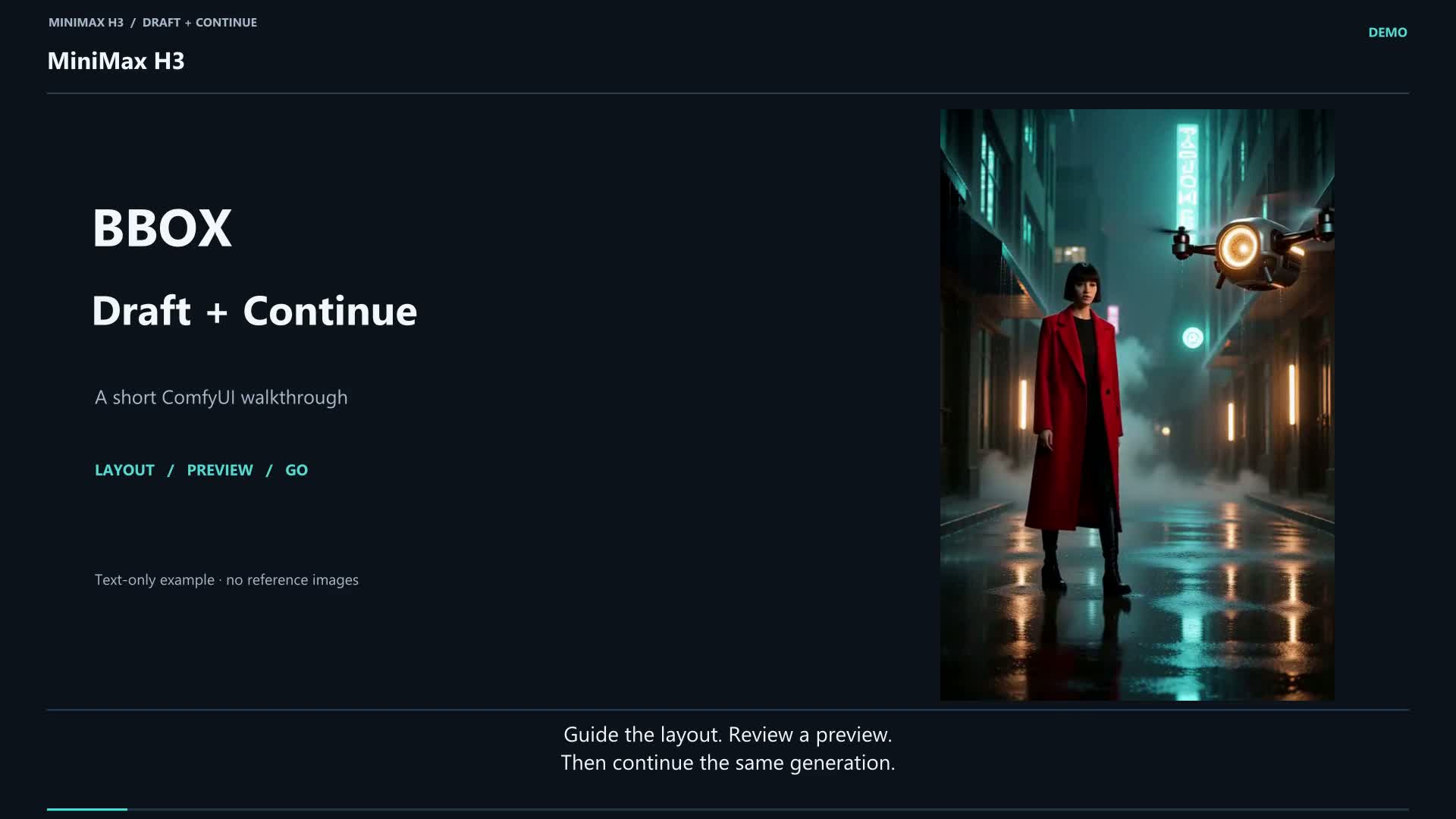
Watch on YouTube: BBOX Layout, Preview & Continue — a 94-second walkthrough with English narration and captions.
Download the T2VA Neon workflow · Setup and model settings
Use this clean, grouped workflow as the tutorial template: set START/END boxes, generate a 3-step Preview, review the first-frame estimate, then GO to finish the remaining 3 steps of the same generation. The distributed version has a larger BBOX editor than the recorded take. It uses text only; no reference images are needed.
Runtime / UI build: 1.7.10. Continue reaches COMPLETE only after the queued output chain succeeds. Phase 4C C0–C11 is GPU/UI PASS / COMPLETE. The five-cycle C9 endurance gate found no significant cumulative VRAM growth or leak trend, and the final C11 production regression passed. Qualification status · C9 evidence
Two-image I2VA · Cyberpunk

Watch the two-image I2VA tutorial — about 1 minute 55 seconds, with English female narration, captions and quiet original music. Recorded and exported at 2560 × 1440, with enlarged controls and shortened, labeled generation waits.
Download the cyberpunk workflow + both reference images · JSON only · Reference setup and recorded result
The courier and rover references connect to Canvas slots A/B. This example completed Preview → GO → Decode/Save on the real GPU backend. The references define subjects, not the first and last video frames. The generated example is 768 × 512; the tutorial's 1440p resolution is for the workflow UI.
v1.7.6 — Lifecycle / Stale-State Management (Phase 4B)
Phase 4B keeps reviewed UI state across normal switches between already-open Workflow tabs, without serializing approval into the workflow file.
Stable session phases (READY, STALE, COMPLETE) are cached only in browser memory. v1.7.4 captures/restores them around ComfyUI's app.loadGraphData() using the live workflow changeTracker as the session key. Closing and reopening a saved workflow still requires a new Preview.
While a Draft is READY, ComfyUI's graphChanged event now triggers a debounced upstream signature re-check. Execution-relevant edits immediately move the UI to PREVIEW STALE / NEW PREVIEW REQUIRED; the existing GO-time signature check remains the final guard.
Phase 4B B0–B10 is GPU/UI PASS / COMPLETE. v1.7.6 adds a page-local approval provenance boundary so Ctrl+F5/full reload cannot reuse READY/COMPLETE from the previous page, while normal open-tab B2/B7 restore remains supported.
v1.6.0 — Preview / GO State UX (Phase 4A)
Draft and Continue now render as one synchronized browser review gate.
The UI exposes a small explicit state machine:
PREVIEW REQUIREDPREVIEW RUNNINGREADY TO GOPREVIEW STALECONTINUINGCOMPLETE- error
Preview / New Seed / GO controls now live inside the status panel. GO is disabled unless the directly connected Draft has a valid reviewed Preview. GO still performs the full upstream graph signature check immediately before Queue, so the UI does not replace the existing safety contract.
Saved workflows never restore approval. Reopen always returns to Preview-required state.
Phase 4A is frontend-only: SamplerEngine, Draft State, Reference/Structured hashes, SIGMAS, noise and resume math are unchanged.
Phase 4A A0–A7 is GPU/UI PASS on RTX 5060 Ti. The final A4 retest verified terminal REVIEWED / COMPLETE, GO disabled, successful SaveVideo, and an empty Queue after completion.
Phase 3D — Reference + Structured combined integration
Phase 2 Native Reference and Phase 3C Multi-Key have now been exercised together on the real GPU backend.
Phase 3D: GPU PASS / COMPLETE.
Passing combined cases include static START, START→END, 3-key and 7-key Multi-Key, two References, sparse A+C References, and a corrected re-Preview/Continue run after a per-slot Key-time change. All executed cases resumed at step 3 with no new noise, conditioning/Reference re-encode, or schedule rebuild.
Browser stale-state rejection D5–D9 is PASS, and browser valid GO→Continue→Save plus saved-workflow reload are PASS (G11/G12). The separately defined Phase 3D visual-quality gate is also user-confirmed PASS. All Phase 3D gates are now closed.
v1.5.0 — Multi-Key Timeline Transparency (Phase 3C)
Draft-Continue now audits the H3 Structured Canvas Multi-Key v4 timeline without generating or interpolating keys itself.
Supported contract:
- A/B/C independent tracks
- START + up to 7 intermediate keys + END per slot
duration_seconds5.0–15.0canonical_time = normalized_0_1interpolation = piecewise_linear- provider offscreen overscan up to -1000..2000
- exact compiled prompt remains bound to the same reviewed Draft
The report adds scope=multi_key, timeline_hash, keyframe_hash, key_count, key_times, and duration_seconds. Changing any key position/time/count/order, Duration, START, END or compiled prompt after Preview invalidates the old GO before Continue sampling.
Phase 3C GPU gate · Multi-Key workflow example
Phase 3A and 3B remain supported. Phase 3C M0–M6 is GPU PASS on RTX 5060 Ti 16 GB: one/two-slot Multi-Key, maximum seven keys, stale Key/Duration rejection, and re-Preview continuation all completed. Subjective path-following quality was not graded.
v1.4.0 — START → END Layout Transition (Phase 3B)
The structured audit now accepts real START→END geometry from H3 Structured Canvas. The upstream Prompter already compiles matching transition.end_boxes into model-facing start_bbox / end_bbox; Draft-Continue now fingerprints that same transition instead of rejecting it.
Supported Phase 3B contract:
- 1–3 slots A/B/C
- same slot set at START and END
- fixed Canvas width/height and normalized 0..1000 xyxy coordinates
- known Timeline Experimental v3/v4 wrapper
- no explicit MID
- no Multi-Key keyframes
The report adds start_hash, end_hash, transition_hash, and moved_slots. Changing START, END or the exact compiled prompt after Preview invalidates the old GO before Continue sampling.
Phase 3B details · START→END workflow example
Phase 3A static START + Timeline no-op compatibility remains supported and has user-confirmed GPU/video PASS. Phase 3B T0–T4 is also GPU PASS on RTX 5060 Ti 16 GB. T1/T2 exercised the same backend through server queue payloads; T0/T3/T4 included browser workflow runs. Subjective motion quality was not graded.
v1.3.1 — START layout audit + Timeline Experimental compatibility
Timeline Experimental automatically serializes a loaded static Canvas as transition + timeline_experimental. v1.3.1 accepts that wrapper only when it is semantically a no-op: END must equal START and there must be no explicit MID or Multi-Key data. The wrapper is then canonicalized to the same START IR/hash as the original static Canvas.
Real END movement, explicit MID, Multi-Key data, unknown transition metadata, and unsupported timeline versions still fail closed instead of being discarded.
v1.3.0 — START layout audit (Phase 3A)
An optional H3 Structured Layout Audit (START) node attaches existing Canvas layout and exact compiled-prompt provenance to native CONDITIONING. Draft/Continue ports, conditioning tensors, the sampler, Reference processing and model selection are unchanged. The Canvas repository is not modified or imported by this package.
Connect the same Prompter STRING to the native H3 conditioner and the audit node, then connect audited CONDITIONING to your existing Guider. Changed layout/prompt metadata rejects stale GO. This is an integrity check, not stronger BBOX enforcement or proof that arbitrary conditioning was encoded from the supplied text.
START wiring and scope · 日本語ガイド · UI workflow example
Phase 3A supports 1–3 static START boxes in A/B/C and has user-confirmed Preview → GO → final-video GPU PASS. Real END movement is handled by Phase 3B; MID/Multi-Key remains later.
v1.2.0 — Native Reference Transparency
The generic Draft/Continue pair now formally preserves MiniMax H3 native Reference conditioning.
No Reference ports are added to these nodes. Keep using the normal upstream H3 conditioning nodes.
MiniMax H3 native conditioning / Reference
                  ↓
      NOISE / GUIDER / SAMPLER / SIGMAS / AV LATENT
                  ↓
           H3 Draft Sampler
              Preview
                  ↓ state
          H3 Continue Sampler
                  ↓ standard LATENT
      your normal Decode / postprocess / Save
Core minimax_refs blocks remain inside CONDITIONING. Draft-Continue snapshots and fingerprints them without converting or re-encoding them.
An approved Draft is invalidated if native Reference content, count, order, kind or native metadata changes after Preview.
The Draft report includes:
- Reference count and kind distribution
- original ordered Reference list
- Reference tensor shapes/dtypes
- Reference payload SHA-256
reference_reencoded=false
Phase 1 Generic Draft/Continue is user GPU PASS. Phase 2 Native Reference Transparency is also GPU PASS.
Existing workflow integration
Replace the sampling block, not the whole workflow:
Your NOISE / GUIDER / SAMPLER / SIGMAS / H3 AV LATENT
                             ↓
                      H3 Draft Sampler  ← video VAE
                      one-image Preview
                             ↓ state
                     H3 Continue Sampler
                             ↓ standard LATENT
        Your video/audio VAE Decode → postprocess → Save
The pair does not rebuild prompts, conditioning, CFG, geometry, noise sources or schedules. Model loading, Turbo LoRA, native H3 Reference/Guide/Keyframe conditioning remain upstream. Decoding and saving remain downstream.
Recommended proven concept baseline: shared 4-step Turbo LoRA at 1.0, 6 total steps, Preview after 3, Continue for the remaining 3. The generic sampler pair currently resumes native Core Euler without churn.
Scope
- native MiniMax H3 joint AV latent, batch=1
- Core BasicGuider / CFGGuider / DualCFGGuider
- Core Euler without churn
- external H3 flow SIGMAS
- native tensor/scalar
minimax_refs - state bound to the current ComfyUI backend session
- 512 MiB Draft-state payload budget
Live ControlNet/hook objects, noise masks, custom/multi-model guiders and multistep solver history need dedicated adapters.
No additional pip/runtime dependencies or model downloads are required.
Installation and package metadata
Clone this repository into your ComfyUI custom_nodes directory, then restart ComfyUI:
git clone https://github.com/ukr8b3g-cmyk/MiniMax-H3-T2VA-Draft-Continue.git
Use a ComfyUI installation with native MiniMax H3 support and the models required by your workflow. This extension declares no additional pip dependencies; ComfyUI provides the host runtime. Models are not bundled.
The package metadata identifies minimax-h3-t2va-draft-continue version 1.7.11, publisher ukr8b3g-cmyk. Metadata preparation does not indicate that a Registry release has been published. .comfyignore excludes development tests, GitHub configuration and the duplicate example ZIP from Registry packages, while retaining runtime Python, h3draft/, web/, documentation, example JSON and reference PNG files. The ZIP download above remains available from GitHub.
License
Apache License 2.0. Copyright 2026 ukr8b3g-cmyk. Separately installed ComfyUI, model weights and other extensions remain subject to their own licenses.