
KSR-Unofficial (Kandinsky ImageSR 2.0)
Unofficial native ComfyUI nodes for Kandinsky ImageSR 2.0 (one-step diffusion super-resolution, x2/x4).
ComfyUI-KSR-Unofficial
Unofficial community nodes, not affiliated with Kandinsky Lab.
ComfyUI nodes for Kandinsky ImageSR 2.0 by Kandinsky Lab, a 5B one-step diffusion super-resolution model (x2 / x4) without a text encoder.
The transformer is implemented natively on ComfyUI's ops and memory management. It supports partial offloading,
fp8 weights and ComfyUI's attention backends (--use-sage-attention etc.), and it uses the regular FLUX.1 VAE through
the core Load VAE node. No extra Python packages are needed.
Installation
cd ComfyUI/custom_nodes
git clone https://github.com/the-aSak/ComfyUI-KSR-Unofficial
Or install it from ComfyUI-Manager: Search for KSR-Unofficial.
Models
| File | Size | Download | Folder |
|---|---|---|---|
| kandinsky_imagesr_2.0.safetensors (transformer, bf16) | ~10.3 GB | hmdlsk/Kandinsky-ImageSR-2.0-ComfyUI | models/diffusion_models/ |
| FLUX.1 VAE ae.safetensors (most FLUX users already have it) | 335 MB | black-forest-labs/FLUX.1-schnell | models/vae/ |
The VAE that ships with Kandinsky ImageSR is the FLUX.1 VAE, stored as bf16. tools/compare_vae.py checks this
tensor by tensor.
Or build the transformer file yourself from the original release. The script uses only Python's standard library and copies all tensors byte-for-byte, so the result is identical to the download:
hf download kandinskylab/Kandinsky-ImageSR-2.0 --local-dir Kandinsky-ImageSR-2.0 --exclude "assets/*"
python tools/merge_kandinsky_sr.py Kandinsky-ImageSR-2.0 ComfyUI/models/diffusion_models/kandinsky_imagesr_2.0.safetensors --verify
Workflow
Load Image → Kandinsky ImageSR Upscale ← Kandinsky ImageSR Model Loader + Load VAE → Save Image
Example workflows in workflows/:
kandinsky_sr_basic.json: the minimal graph abovekandinsky_sr_test_groundtruth.json: downscales a high-res image to 512² (area filter) and upscales it x4 with Kandinsky and with bicubic, so you can compare both against the original
Kandinsky ImageSR Model Loader: weight_dtype default (bf16 as stored) or fp8_e4m3fn / fp8_e5m2.
Memory: on CUDA the transformer takes ~9.1 GB in bf16. The fp32 modulation layers are stored as bf16, which is exactly
what the reference computes under autocast anyway. fp8 applies only to the attention and feed-forward weights
(7.9 → 3.9 GB, ~5.2 GB in total). It saves memory, not time: the weights are cast back to bf16 for each matmul.
Kandinsky ImageSR Upscale
| Input | Meaning |
|---|---|
| upscale_factor | 2 or 4 |
| creativity | 0–8, calibrated presets. 4 = default (t = 0.15 at x2, 0.244 at x4). Higher values let the model change the input more: depending on content this can add texture (e.g. hatching) or smooth it away (e.g. skin) |
| overlap | tile overlap as a fraction of the low-res tile; 0.25 = reference |
| tile_batch_size | tiles per transformer pass (slightly faster, more VRAM); the VAE always gets up to 8 tiles per call |
How it works: the image is cut into tiles that become 1024 px at output size. The node then runs three phases
(VAE encode of all tiles → one transformer step per tile → VAE decode with Hanning-window blending), so each model is
loaded only once. The output image is assembled in system RAM. The model is deterministic: no seed, no noise.
Arbitrary t values are not possible, because the release only ships conditioning tables for the 18 calibrated
timesteps.
After each run the console logs the total time, the time per phase and the VRAM in use.
Examples
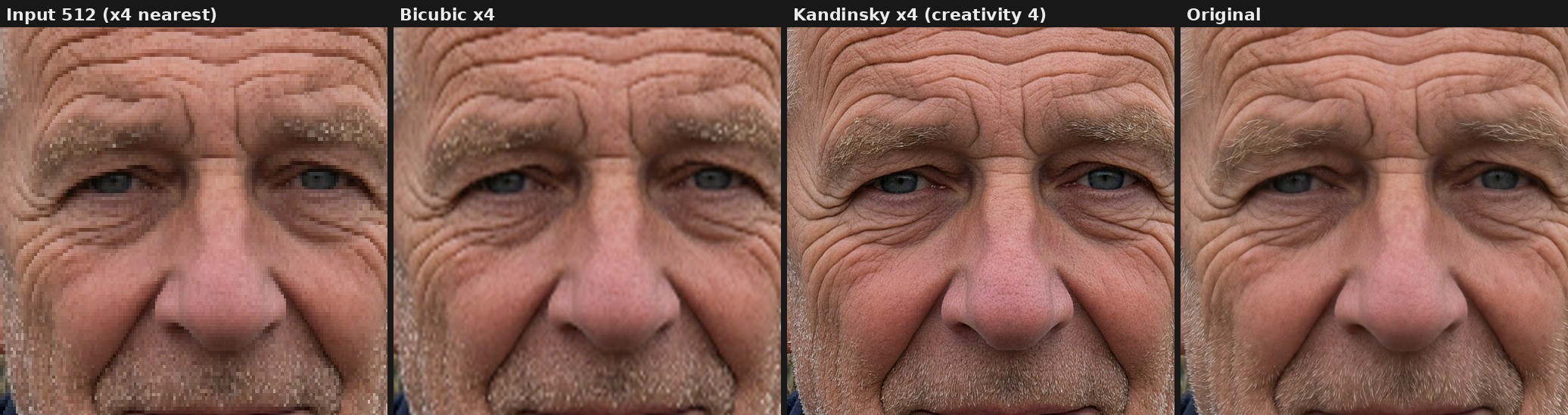
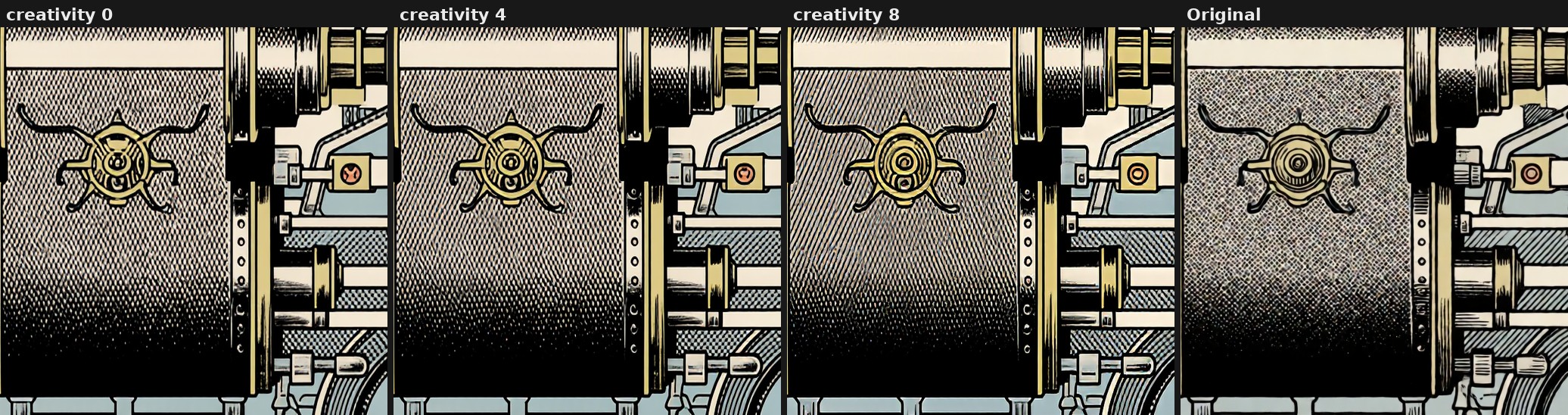
All examples: a 2048 px image downscaled to 512 px, then upscaled x4 (creativity 4). Crops at full output resolution.
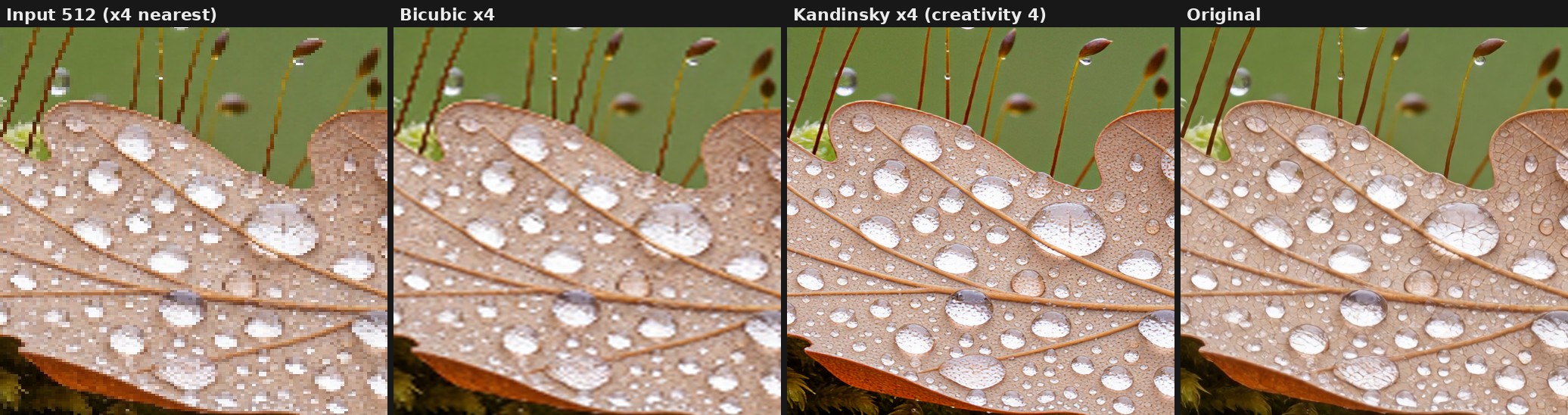
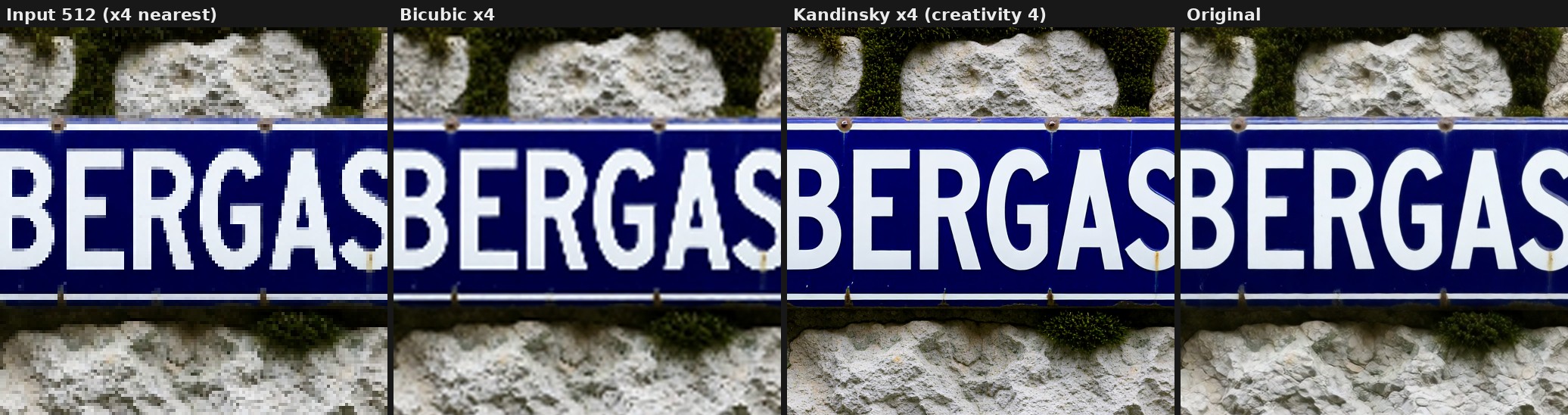

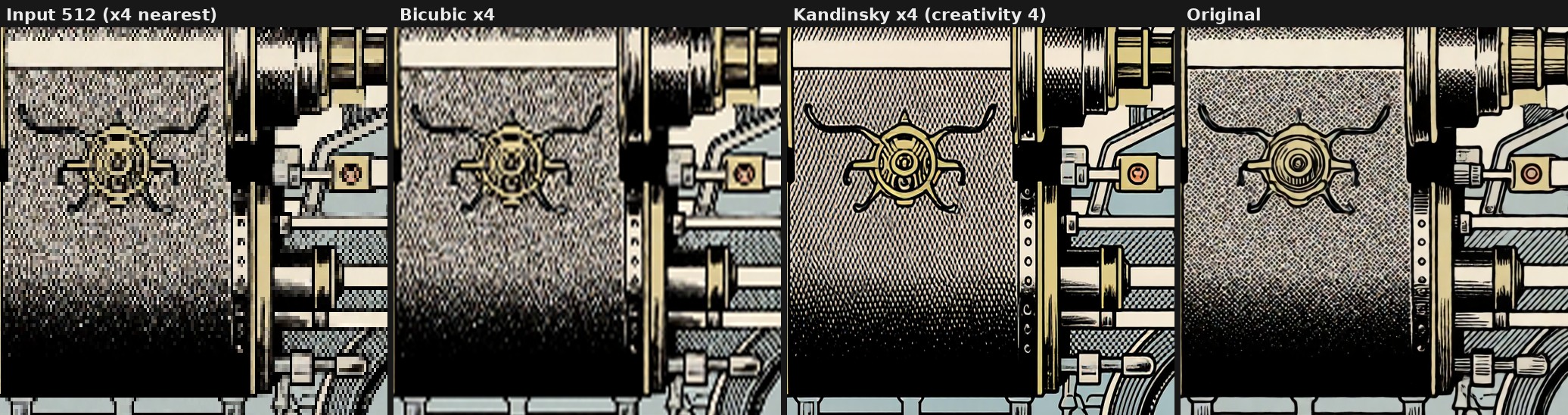
Text. On the test chart, text stays correct down to lines that were ~6.5 px high in the 512 px input. Smaller text turns into plausible-looking but wrong letters, the typical failure of generative upscalers. Don't use it where small print has to be exact.
creativity controls how strongly the model re-synthesizes the input. Higher values stray further from the original; whether that adds or removes fine texture seemingly depends on the content:
Performance
RTX 4070 Ti SUPER 16 GB, 32 GB RAM, Windows, ComfyUI portable (0.45.0), x4, creativity 4, tile_batch_size 1.
| Weights | Input → output | Tiles | Time | VRAM (whole device, Task Manager) | |---|---|---|---|---| | bf16 | 512² → 2048² | 9 | 13.0 s (model not yet on GPU) | – | | bf16 | 2048² → 8192² | 121 | 158 s (encode 28 / transformer 91 / decode 39) | ~14.85 GB peak | | fp8 | 2048² → 8192² | 121 | 159 s | ~13.5 GB peak |
ComfyUI keeps models and cache in VRAM when it can, so the device-wide figure is an upper bound, not a requirement. Timings were taken before the VAE batching was added; encode/decode should now be somewhat faster.
Accuracy
- Native vs. original pipeline, real weights: the test chart upscaled x4 by these nodes and by the original Diffusers pipeline differs by 50.5 dB PSNR (mean 0.23/255); both score identically against the ground truth.
- fp8 vs. bf16: 46.5 dB PSNR on the 8192² test chart output.
- Against bicubic: pixel metrics (PSNR/SSIM) against the original usually favour bicubic on photos, because invented detail is penalised more than blur. This is the known perception–distortion trade-off (Blau & Michaeli, CVPR 2018). Judge the crops above, not the numbers.
Credits & license
- Model, original pipeline and tiling code: Kandinsky Lab, MIT
- Kandinsky 5 building blocks in Diffusers: Hugging Face, Apache-2.0 (basis of
native/model.py) - VAE (not included): FLUX.1-schnell by Black Forest Labs, Apache-2.0
- Example images: generated with Krea 2 Raw (bf16) + Turbo LoRA, 7 steps, ~4 MP native; test chart: own work, text from Kafka, Die Verwandlung (1915, public domain)
- This node pack: MIT, © 2026 the-aSak. Developed with Claude by Anthropic.
All third-party code and every change made to it are listed in NOTICE.md.