
LTX-2 MLX (Apple Silicon)
ComfyUI nodes for running Lightricks LTX-2.3 video generation natively on Apple Silicon via MLX (ltx-2-mlx), including text-to-video, image-to-video, and audio-to-video.
Nodes (5)
Loading the Audio-to-Video Pipeline
\"Song Mode\" Is a Bit of a Lie — Here's What It Really Does
Text or Image In, Video Out — and It Saves Itself
LoRAs for LTX-2 on MLX — Stack Them, But Know They Reload the Model
LTX-2 on a Mac Only Runs If You Load It Like This
ComfyUI-LTX2-MLX
ComfyUI nodes for running Lightricks LTX-2.3 video generation natively on Apple Silicon, using the MLX port provided by dgrauet/ltx-2-mlx.
The official ComfyUI-LTXVideo nodes rely on PyTorch, and the fp8 checkpoints Lightricks
ships (e.g. ltx-2.3-22b-dev-fp8.safetensors) require CUDA — PyTorch's MPS backend has no
kernel support for the float8_e4m3fn dtype, so those checkpoints only run on CUDA or (very
slowly) on CPU. This package sidesteps that entirely by running the model through MLX, which
has its own quantization built for Apple's unified memory, instead of waiting on PyTorch/MPS
to support fp8.
Requirements
-
macOS on Apple Silicon (M1/M2/M3/M4). There is no CUDA/Windows/Linux backend — MLX only runs on Apple GPUs.
-
Python >= 3.11
-
Enough unified memory for the model tier you pick:
| Model dir | Size | RAM needed | |--------------------------------|--------|---------------------| |
dgrauet/ltx-2.3-mlx-q4| ~12 GB | 16 GB+ (low_ram on) | |dgrauet/ltx-2.3-mlx-q8| ~21 GB | 32 GB+ | |dgrauet/ltx-2.3-mlx(bf16) | ~42 GB | 64 GB+ |Enable
low_ramon the loader nodes to use block streaming and fit larger tiers on smaller machines, at some speed cost.
Installation
cd ComfyUI/custom_nodes
git clone https://github.com/tanis2000/comfyui-ltx2-mlx.git
cd comfyui-ltx2-mlx
pip install -r requirements.txt
Model weights are pulled automatically from Hugging Face the first time a loader node runs
(dgrauet/ltx-2.3-mlx-q8, -q4, or the bf16 default), or point custom_model_dir at a local
path / different Hugging Face repo.
Nodes
- LTX2MLXModelLoader — loads a text/image-to-video pipeline (
two_stage,two_stage_hq,one_stage, ordistilled). Pipelines are cached by(model_dir, pipeline_type, low_ram, loras). - LTX2MLXLora — picks a LoRA from ComfyUI's
lorasfolder with a strength. Connect one or more to thelorasinput of either loader; they are fused into the transformer when the pipeline loads. Takes ComfyUI-format LTX-2 LoRAs (diffusion_model.*keys). - LTX2MLXGenerate — text-to-video, or image-to-video if an
IMAGEis connected. Frame count is snapped to8k+1to match the VAE's 8x temporal compression. - LTX2MLXAudioModelLoader — loads the audio-to-video pipeline.
- LTX2MLXAudioToVideo — generates video driven by an
AUDIOinput (and an optional conditioningIMAGE), for song-driven / music-video workflows.
Only one pipeline is kept resident at a time — loading a new one (or switching between the T2V/I2V and A2V loaders) evicts the previous pipeline from memory, since the 22B model doesn't comfortably fit twice even at q8/q4.
Example workflow
examples/ltx2mlx_text_to_video.json —
a minimal LTX2MLXModelLoader → LTX2MLXGenerate graph using the cached
dgrauet/ltx-2.3-mlx-q8 tier with the distilled pipeline (fastest option).
LTX2MLXGenerate saves and previews the video itself (is_output_node) — no
separate SaveVideo/PreviewVideo node is needed downstream. Load it in
ComfyUI via Workflow → Open (or drag the file onto the canvas).
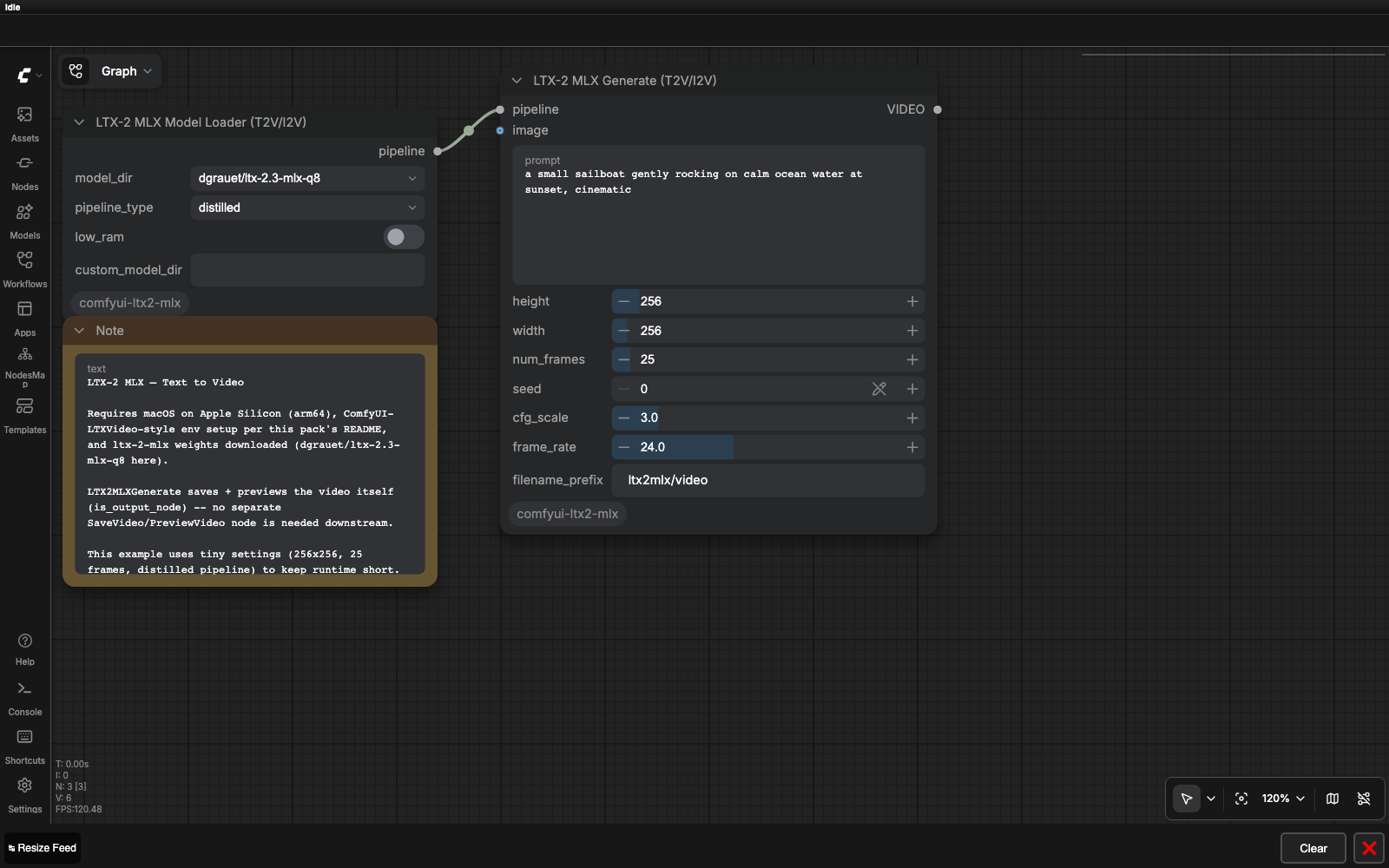
Ran end-to-end against a real ComfyUI server (/prompt → /history, zero
node_errors) at tiny settings (256×256, 25 frames) to keep runtime short.
The output (examples/ltx2mlx_t2v_output.mp4):

examples/ltx2mlx_text_to_video_lora.json —
the same graph with an LTX2MLXLora node feeding the loader's loras input. It uses the
Apache-2.0 crtanim LoRA:
download crtanim_10000.safetensors into ComfyUI/models/loras and start the prompt with
its trigger word crtanim,.
Benchmark
Measured with the direct Python API (pipeline.generate_and_save(...), no ComfyUI server
overhead), one pipeline at a time so no tier/type shared cached weights:
- Hardware: Apple M4 Max, 64 GB unified memory, macOS 26.3
- Model tier:
dgrauet/ltx-2.3-mlx-q4,low_ram_streamingoff - Settings: 704x480 (two-stage pipelines snap the intermediate/output to a multiple of 64,
landing at 704x448), 49 frames (
8*6+1, ~2s @ 24fps),cfg_scale=3.0, seed 42, single fixed prompt, cold pipeline load per run (no warm cache reuse between pipeline types)
| Pipeline type | Model/text-encoder load | Generate time | Frames/sec | Notes |
|----------------|-------------------------:|---------------:|-----------:|-------|
| distilled | ~34s | 88s | 0.56 | 8-step + 3-step denoise, fastest by a wide margin |
| two_stage | ~41s | 964s (~16.1 min) | 0.051 | 30-step guided denoise per stage |
| two_stage_hq | ~40s | 968s (~16.1 min) | 0.051 | Same step count as two_stage; HQ pass cost didn't show up at this resolution/frame count |
| one_stage | ~24s | 2465s (~41.1 min) | 0.02 | 30-step guided denoise at full resolution (no half-res first stage) — the slowest option here |
Takeaways:
distilledis roughly 11x faster thantwo_stage/two_stage_hqand 28x faster thanone_stageat this resolution/frame count — the right default for iteration and previews.two_stage/two_stage_hqrun their expensive guided denoise at half resolution first, then a short refinement pass, which is why they land far belowone_stagedespite doing "two passes" —one_stagepays full 30-step guided denoise cost at full resolution instead.- These numbers are for the q4 tier only; q8/bf16 will be slower and use proportionally more
unified memory (see the RAM table above), and a prior session on this same machine saw q8 at
1920x1080/8s exceed an 8-hour render budget under heavy swap pressure — keep resolution/frame
count modest, or enable
low_ram, on tighter-memory machines. - Load time includes the Gemma text encoder load + prompt encoding + transformer weight load; it's a fixed one-time cost per pipeline (re)instantiation, not per-generation, and is small relative to generate time for every pipeline type above.
Status
Early / alpha, mirroring the maturity level of the upstream ltx-2-mlx port. Retake/extend,
keyframe interpolation, and IC-LoRA conditioning from the upstream CLI are not yet wrapped as
nodes here — contributions welcome.
License
MIT