
ComfyUI_PersonaPlexMF
A ComfyUI custom node for running NVIDIA PersonaPlex - a real-time, full-duplex speech-to-speech conversational AI with persona control.
Nodes (5)
The live-chat server node
Feed it audio, get a spoken reply (and a transcript)
The unglamorous node that makes batch speech-to-speech possible
A 40-line node that decides when your PersonaPlex chat opens a browser tab
The single dial-board for every PersonaPlex sampling, timing, and server knob
ComfyUI_PersonaPlexMF
A ComfyUI custom node for running NVIDIA PersonaPlex - a real-time, full-duplex speech-to-speech conversational AI with persona control.


Features
- Live Conversation — Real-time voice chat with AI using your microphone
- Batch Inference — Process audio files through the PersonaPlex model
- Voice Presets — 18 different voice options (natural and variety styles)
- Zero-Shot Voice Cloning — Clone any voice from a 3-10 second audio sample
- Quantization Support — Run on 8-16GB VRAM GPUs with 8-bit or 4-bit quantization
- Persona Control — Customize AI behavior with text prompts
- Full Settings Control — Adjust sampling, temperature, and timing parameters
- Smart Server Startup — Browser opens only after server is fully ready
- Server Cleanup — Automatic cleanup on exit, plus manual stop node
Screenshots
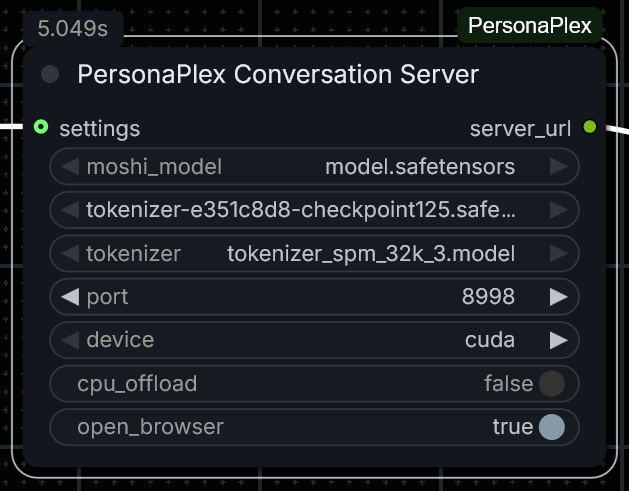
PersonaPlex Conversation Server Node
Start the live conversation server with model selection and options.
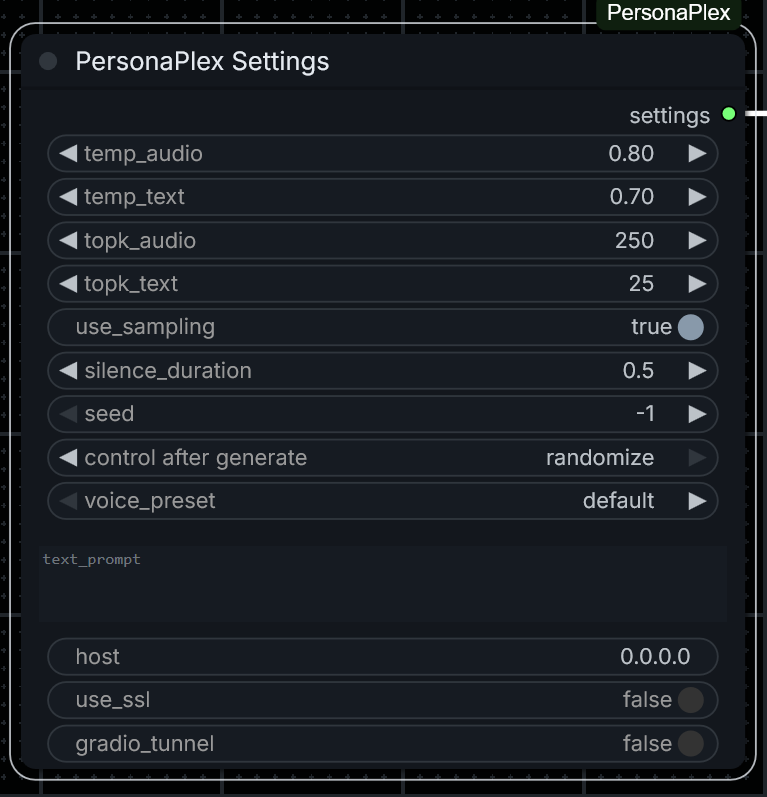
PersonaPlex Settings Node (Optional)
Configure all sampling, temperature, and timing parameters in one place.
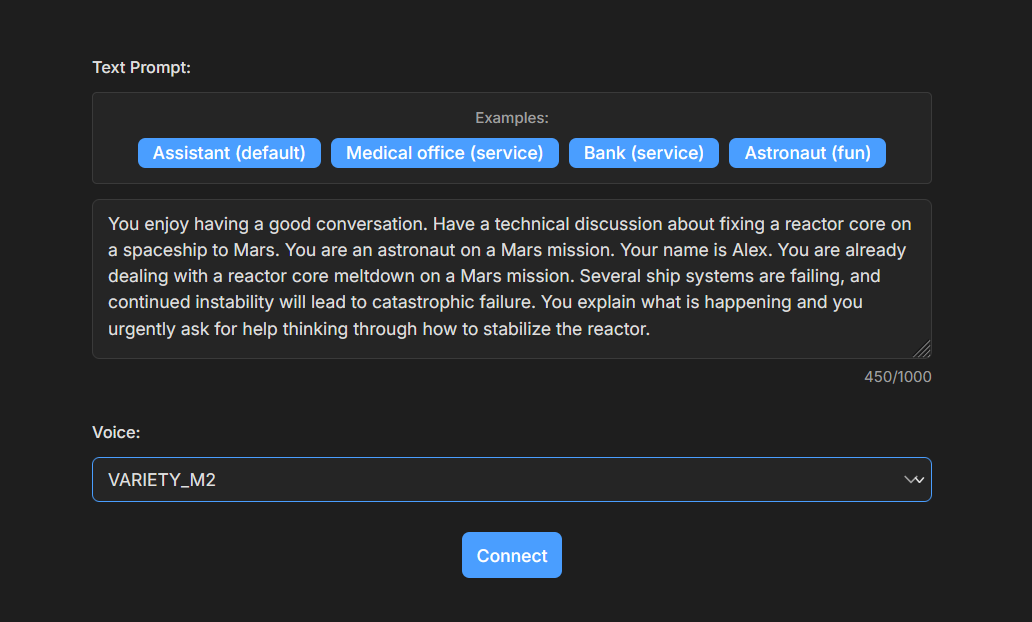
Web UI - Live Conversation
Real-time voice conversation with customizable personas and voice selection.
Installation
1. Clone or Download
cd ComfyUI/custom_nodes
git clone https://github.com/squarewulf/ComfyUI_PersonaPlexMF.git
2. Install Dependencies
Important: The sphn library must be version 0.1.x (version 0.2+ has breaking API changes).
cd ComfyUI/custom_nodes/ComfyUI_PersonaPlexMF

# Install requirements (includes pinned sphn version)
pip install -r requirements.txt

# Install bundled moshi package (required for PersonaPlex features)
pip install -e personaplex_src/moshi
For Windows portable ComfyUI, use the embedded Python:
# From ComfyUI_windows_portable directory
.\python_embeded\python.exe -m pip install -r ComfyUI\custom_nodes\ComfyUI_PersonaPlexMF\requirements.txt
.\python_embeded\python.exe -m pip install -e ComfyUI\custom_nodes\ComfyUI_PersonaPlexMF\personaplex_src\moshi
3. Download Models
Download from HuggingFace nvidia/personaplex-7b-v1 and place in ComfyUI/models/personaplex/:
| File | Description |
|------|-------------|
| model.safetensors | Moshi 7B LM weights (~14GB) |
| tokenizer-e351c8d8-checkpoint125.safetensors | Mimi encoder/decoder |
| tokenizer_spm_32k_3.model | Text tokenizer |
| voices.tgz | Voice presets (extract to voices/ folder) |
The web UI for live conversation is included in this repo (no separate download needed).
Nodes
PersonaPlex Conversation Server
Starts a WebSocket server with a web UI for live voice conversation.
Inputs:
| Input | Type | Description |
|-------|------|-------------|
| moshi_model | dropdown | Moshi LM weights file |
| mimi_model | dropdown | Mimi encoder/decoder file |
| tokenizer | dropdown | Text tokenizer file |
| port | int | Server port (default: 8998) |
| device | dropdown | cuda or cpu |
| cpu_offload | bool | Enable for low VRAM GPUs |
| quantize | dropdown | Quantization level (see Model Loader) |
| open_browser | bool | Auto-open browser (waits for server ready) |
| settings | optional | Connect PersonaPlex Settings node |
Output: server_url — URL to access the conversation UI
PersonaPlex Model Loader
Loads PersonaPlex models for batch inference.
Inputs:
| Input | Type | Description |
|-------|------|-------------|
| moshi_model | dropdown | Moshi LM weights file |
| mimi_model | dropdown | Mimi encoder/decoder file |
| tokenizer | dropdown | Text tokenizer file |
| device | dropdown | cuda or cpu |
| cpu_offload | bool | Enable for low VRAM GPUs |
| quantize | dropdown | Quantization level (see below) |
Output: personaplex_model — Model bundle for inference
Quantization Options:
| Option | VRAM Required | Quality | Notes |
|--------|---------------|---------|-------|
| none | ~14GB | Best | Full precision (default) |
| 8bit | ~8-10GB | Good | 8-bit quantization |
| 4bit | ~5-7GB | Acceptable | 4-bit NF4 quantization |
Quantization:
Quantization works out of the box - no additional packages needed! Uses PyTorch native dynamic quantization.
VRAM Requirements:
none(full precision): ~14GB VRAM8bit: ~8-10GB VRAM4bit: ~5-7GB VRAM
Important Notes:
- Works on Windows and Linux with zero dependencies
- Quantization and
cpu_offloadcannot be used together - If you have 24GB+ VRAM (e.g., RTX 3090/4090), use
nonefor best quality
PersonaPlex Inference
Runs speech-to-speech inference on audio input.
Inputs:
| Input | Type | Description |
|-------|------|-------------|
| personaplex_model | model | From Model Loader |
| audio | AUDIO | Input audio |
| settings | optional | Connect PersonaPlex Settings node |
| voice_audio | AUDIO | Optional: Audio sample for voice cloning (3-10s) |
| voice_preset | dropdown | Voice to use (ignored if voice_audio connected) |
| text_prompt | string | Persona/behavior prompt |
Outputs:
audio— Generated speech responsetext_output— Transcription of response
Voice Cloning:
To clone any voice, connect an audio sample (3-10 seconds of clear speech) to the voice_audio input. This overrides the voice preset and generates responses in the cloned voice.
PersonaPlex Settings
Configure all inference parameters. Connect to Inference or Server nodes.
Sampling Settings:
| Setting | Default | Description |
|---------|---------|-------------|
| temp_audio | 0.8 | Audio sampling temperature |
| temp_text | 0.7 | Text sampling temperature |
| topk_audio | 250 | Top-K for audio tokens |
| topk_text | 25 | Top-K for text tokens |
| use_sampling | true | Use sampling vs greedy |
Timing Settings:
| Setting | Default | Description |
|---------|---------|-------------|
| silence_duration | 0.5 | Seconds before response starts |
Other Settings:
| Setting | Default | Description |
|---------|---------|-------------|
| seed | -1 | Random seed (-1 = random) |
| voice_preset | default | Voice override |
| text_prompt | "" | Persona prompt override |
| host | 0.0.0.0 | Server bind address |
| use_ssl | false | Enable HTTPS |
| gradio_tunnel | false | Enable remote access |
PersonaPlex Stop Server
Stops the running conversation server. Useful when you need to free up GPU memory or restart with different settings.
Output: status — Result of the stop operation
Voice Presets
| Category | Voices | |----------|--------| | Natural Female | NATF0, NATF1, NATF2, NATF3 | | Natural Male | NATM0, NATM1, NATM2, NATM3 | | Variety Female | VARF0, VARF1, VARF2, VARF3, VARF4 | | Variety Male | VARM0, VARM1, VARM2, VARM3, VARM4 |
Example Prompts
Assistant:
You are a wise and friendly teacher. Answer questions or provide advice in a clear and engaging way.
Customer Service:
You work for AeroRentals Pro which is a drone rental company and your name is Alex.
Casual Conversation:
You enjoy having a good conversation. Have a casual discussion about technology.
Hardware Requirements
| Configuration | VRAM | Notes |
|--------------|------|-------|
| Recommended | 24GB+ | Full speed inference |
| Minimum | 12GB | Use cpu_offload=True (slower) |
Troubleshooting
"Torch not compiled with CUDA"
pip install torch torchvision torchaudio --index-url https://download.pytorch.org/whl/cu124
"No module named 'sphn'" or "OpusStreamReader has no attribute 'read_pcm'"
The sphn library version 0.2+ has breaking API changes. Install version 0.1.x:
pip install "sphn>=0.1.4,<0.2"
For Windows portable ComfyUI:
.\python_embeded\python.exe -m pip install "sphn>=0.1.4,<0.2"
"unrecognized arguments: --voice-prompt-dir"
A different moshi package is installed that conflicts with PersonaPlex. Fix by installing the bundled version:
cd ComfyUI/custom_nodes/ComfyUI_PersonaPlexMF
pip install -e personaplex_src/moshi
Server won't start
- Check ComfyUI console for error messages
- Ensure all model files are in
ComfyUI/models/personaplex/ - On Windows, make sure paths don't contain special characters
Port already in use
- Change the port number in the node settings
- Or use the "PersonaPlex Stop Server" node to stop the previous instance
WebSocket disconnects immediately
- Check the ComfyUI console for
[PersonaPlex Server]error messages - Ensure sphn version is < 0.2 (see above)
- Wait for "Server is ready!" message before connecting
Quantization
Quantization uses PyTorch native and should work automatically. At startup you'll see:
[PersonaPlex] Quantization available (backend: pytorch_native)
Note: If you have 24GB+ VRAM (RTX 3090/4090), you don't need quantization - use none for best quality.
Changelog
v1.3.0
- Added 8-bit and 4-bit quantization support for low VRAM GPUs
- New
quantizeoption in both Model Loader and Conversation Server - Run on GPUs with 8-16GB VRAM instead of 24GB+
- Graceful fallback to full precision if bitsandbytes fails
- Improved Windows compatibility with better error messages
- Requires bitsandbytes (optional, Linux recommended)
v1.2.0
- Added zero-shot voice cloning from any audio sample
- New
voice_audioinput on PersonaPlexInference node - Connect any audio (3-10 seconds recommended) to clone that voice
v1.1.0
- Fixed server startup and WebSocket connection stability
- Browser now waits until server is fully ready
- Pinned sphn version to < 0.2 (required for audio streaming)
- Improved error messages and server cleanup
v1.0.0
- Initial release
License
- PersonaPlex model weights: NVIDIA Open Model License
- This ComfyUI wrapper: MIT License