
H3 LongTake
Long MiniMax H3 videos clip by clip with continuity: motion/identity transfer (Ref2VA) and style transfer / retexture (guide latent + StyleTransfer LoRA), resumable, one clip in VRAM at a time.
Nodes (4)
One Photo, Thirty Seconds of Video, Without Batching Your Way Off a 16 GB Card
The Second Pass Is Where Your H3 Video Stops Looking Like Plastic
MiniMax H3 taps out at 15 seconds. This node gets you a minute.
Glue the clips together and get your audio back
ComfyUI-H3-LongTake
Long videos with MiniMax H3, rendered clip by clip with continuity between clips, on consumer GPUs: VRAM and RAM only ever hold one clip, however long the video. Three nodes:
- Motion / identity transfer — a reference video drives the performance, one or more pictures define who is in it (Ref2VA).
- Style transfer and retexture — the source video is re-rendered in a new style (Ghibli, Van Gogh, GTA, pop-art, The Simpsons…) or an outfit's material/colour is changed, keeping motion, framing and scene, with NRDX's StyleTransfer LoRA.
- Image to Video — a long video from a single picture, one prompt block per 5 s, with identity references against drift; the audio is the one H3 generates.
- Refine — a second pass at a higher resolution, clip by clip, on any finished project.
Every clip is written to disk as soon as it is done: you can stop, resume, redo a single clip, and assemble the final video with the original audio. The full workflow is stored inside the project folder and inside the final mp4, so any output can be dropped back onto ComfyUI to reopen the graph.
Depends on ComfyUI core ≥ 0.34 only (no other node packs required; the Refine can use an optional latent upscaler pack, see Models). Tested on a 16 GB GPU (RTX 4080-class) with 25 GB of Qwen text-encoder weights staged in system RAM.
Examples
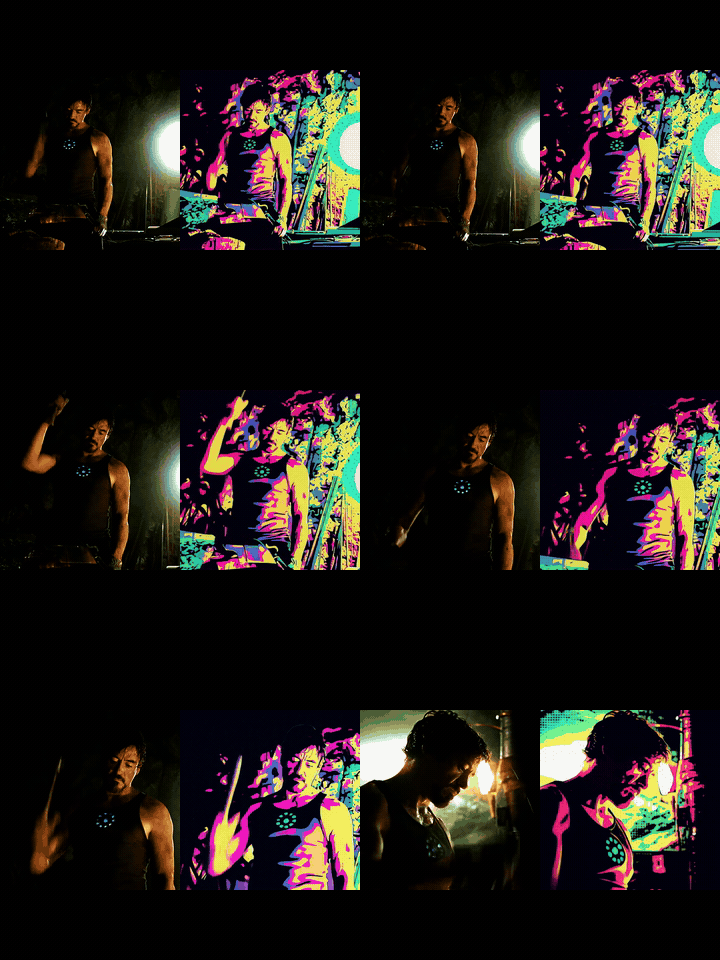
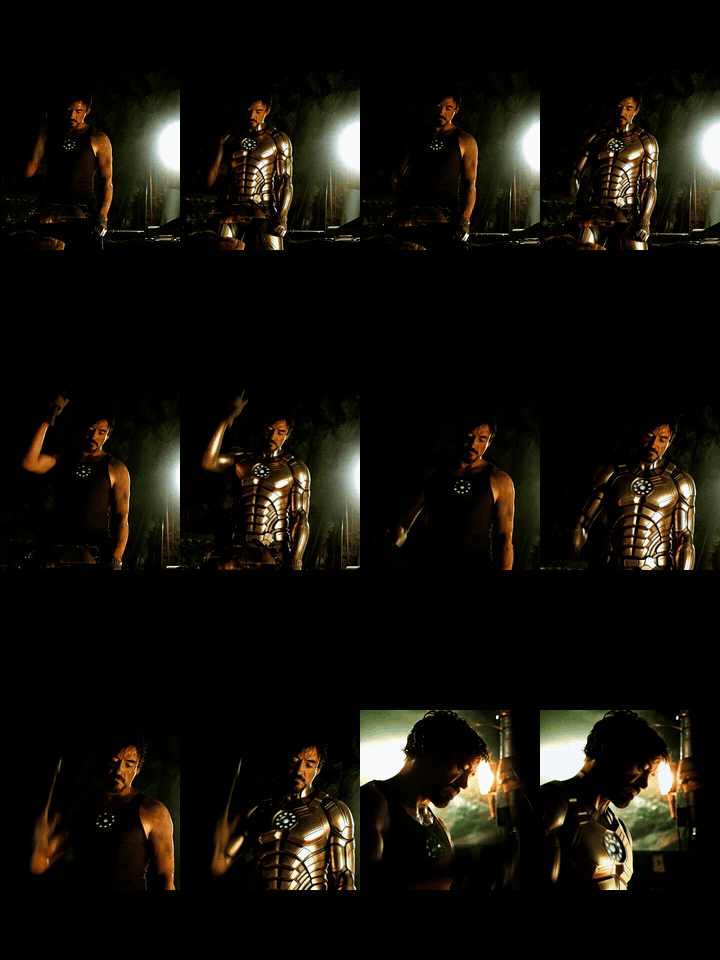
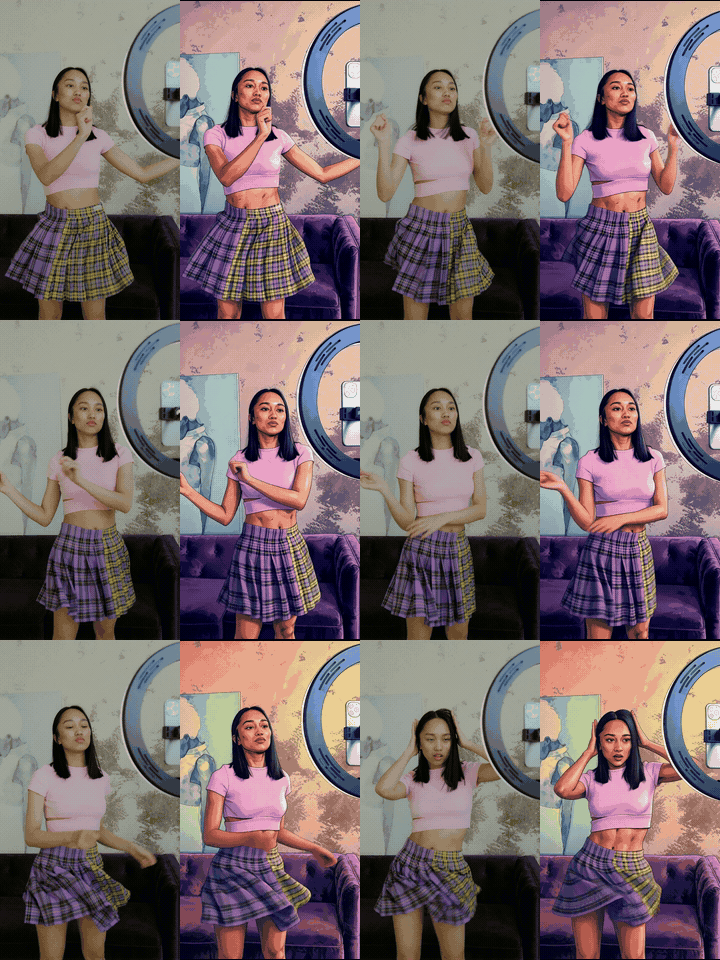
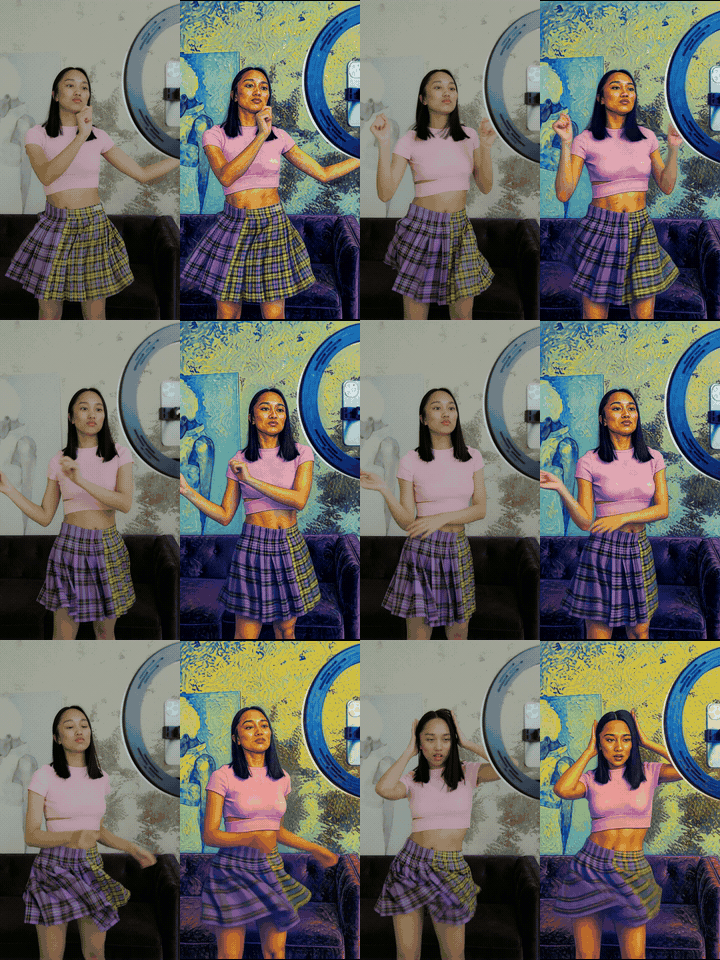
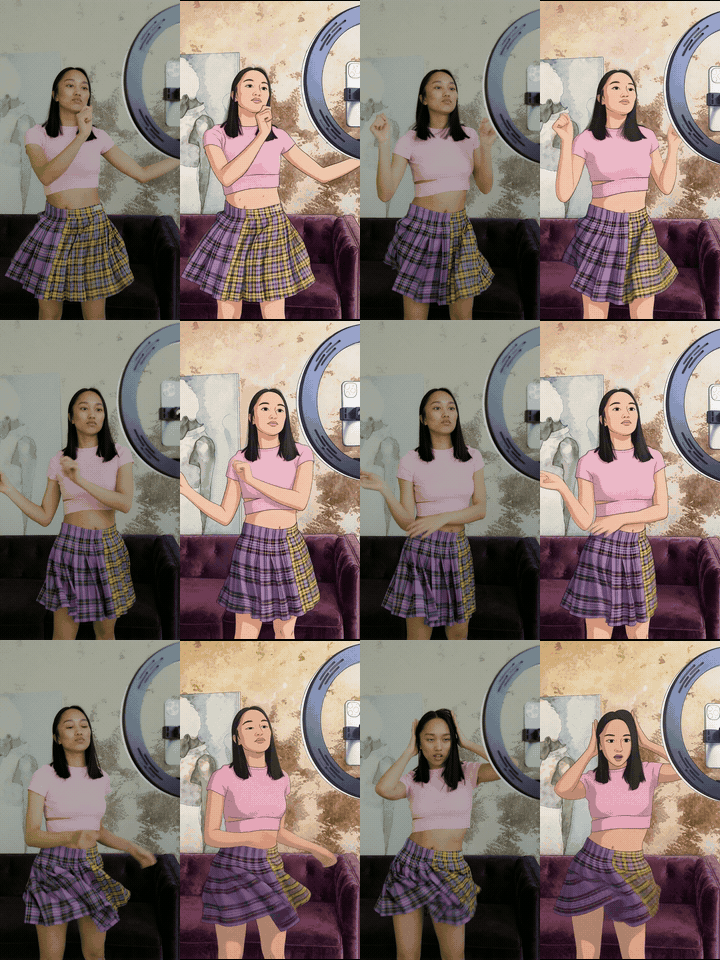
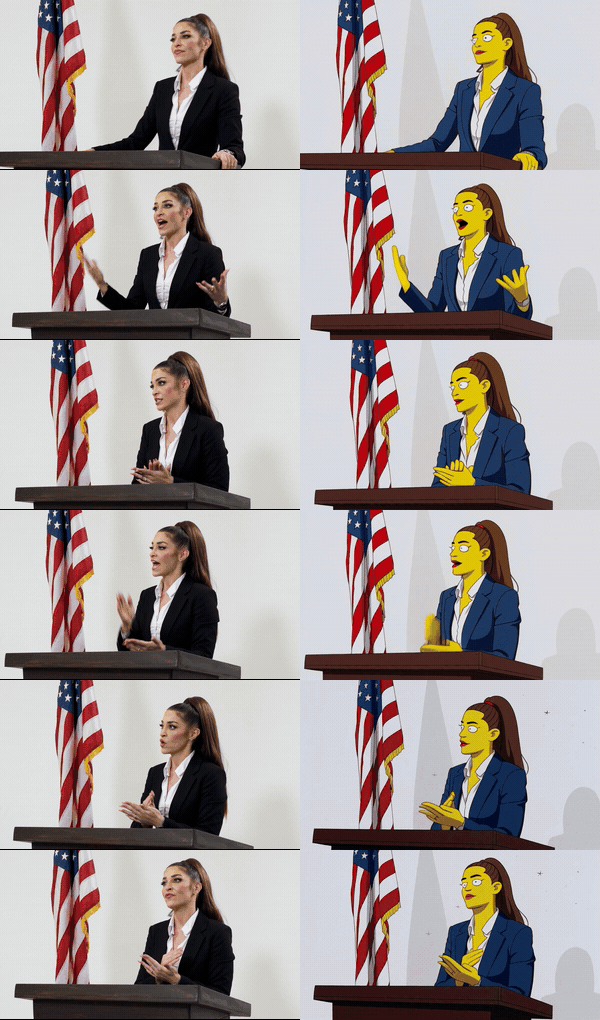
Source on the left, result on the right (8 s excerpts, 10 fps GIFs; full clips with audio in
examples/video/). Style examples rendered with source_role = guide, the character swap
with source_role = reference; 4 Turbo steps, context_frames = 5, seam_match = color, on a 16 GB GPU.
| Pop-art from a swatch | Outfit retexture (text only) | GTA from a swatch |
|---|---|---|
|  |
|  |
|  |
|
|
| style_transfer: … the style of <Picture 1>: bold graphic style, vibrant flat colours, clean black outlines, flat shading, halftone dots. with this swatch | retexture: change the tank top to shiny gold metallic armour plating, keeping face, hair, arc reactor, background, lighting and motion unchanged. | style_transfer: … the style of <Picture 1>: cel-shaded illustration, thick clean outlines, flat saturated pastel palette… Keep the original indoor room… with this swatch |


| Van Gogh (text only) | Studio Ghibli (text only) | The Simpsons (text only) |
|---|---|---|
|  |
|  |
|  |
|
|
| … in the style of Vincent van Gogh: thick swirling impasto brushstrokes, visible paint texture… | … in the style of a Studio Ghibli anime film: hand-drawn 2D animation look, soft clean linework… | … in the style of The Simpsons cartoon: flat 2D cel animation, thick clean black outlines, yellow skin… |
| Character swap (reference, no StyleTransfer LoRA) | | |
|---|---|---|
|  | <img src="examples/ref_charswap.jpg" width="180" alt="reference"> |
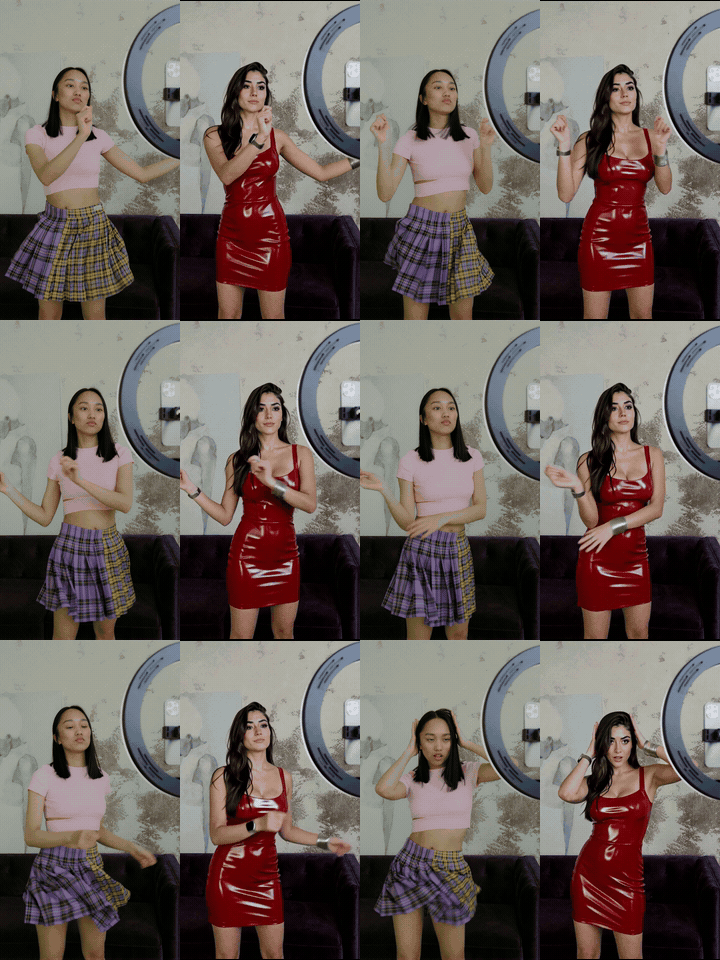
 <Video 1> provides the full performance, motion, timing, camera distance and framing. Replace the dancer with the woman from <Picture 1>: long dark brown wavy hair, thick eyebrows, a fitted glossy red latex mini dress, silver bangles and rings, photorealistic. Keep the room, lighting, sofa and background exactly as in <Video 1>; do not use the graffiti wall or neon lights from <Picture 1>. |
| Image to Video (fl2va, 15 s from one picture, 3 prompt blocks) + Refine (1.0 MP, denoise 0.25) | | |
|---|---|---|
| 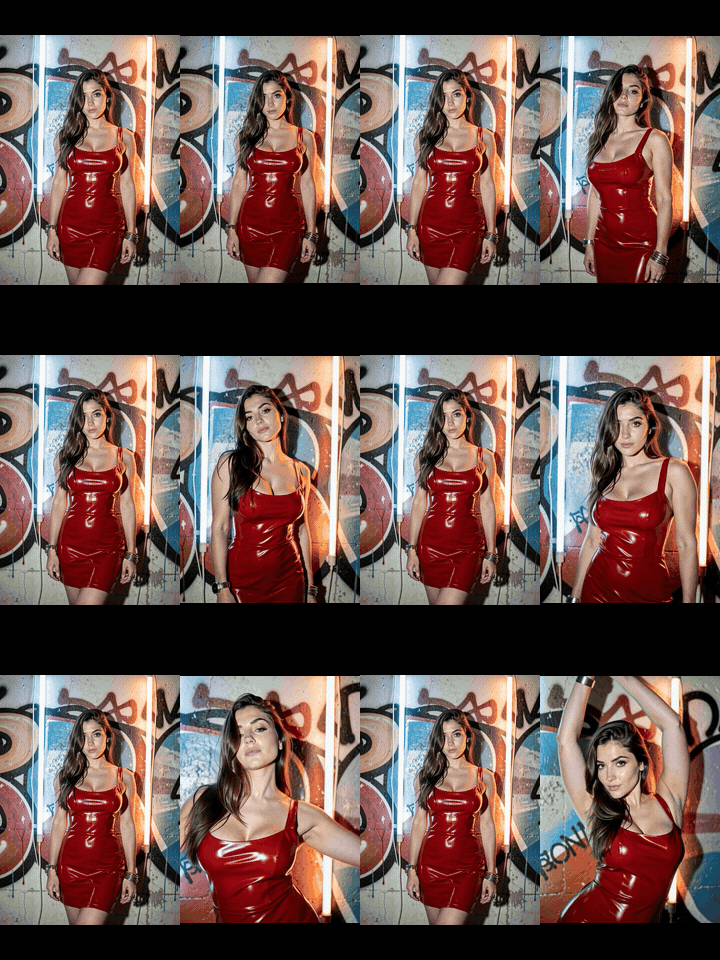 | the still on the left is the only input; audio generated by H3 (full clip with sound in
 examples/video/i2v.mp4) | …she looks at the camera and slowly starts to sway to the music, subtle camera push-in — --- — She raises her arms and dances…the camera slowly orbits to the left — --- — She turns her back to the camera, walks a few steps toward the wall, then looks back over her shoulder and smiles |
Full prompts in the use-case table below. The dancer and press-conference clips are free Pexels videos (no audio track on the dancer clip); the cave clip is a film excerpt; the character-swap reference and the image-to-video still are AI-generated pictures.
Installation
ComfyUI-Manager: Custom Nodes Manager → search H3 LongTake → Install (or Install via Git URL with the address below). Manually:
cd ComfyUI/custom_nodes
git clone https://github.com/mark9009/ComfyUI-H3-LongTake
Restart ComfyUI. On ComfyUI builds with comfy-aimdo's dynamic VRAM (the default since September 2026) the Render
and Image to Video free the VRAM before each heavy phase and unload the models from the first clip on: without
that, a second run in the same session could slow down until it hung. ffmpeg must be reachable: the node uses VideoHelperSuite's ffmpeg if that pack is installed,
otherwise the imageio-ffmpeg binary (pip install imageio-ffmpeg into ComfyUI's Python), otherwise ffmpeg on
the PATH. No other Python dependency.
Models
| slot | file (ComfyUI folder) | notes |
|---|---|---|
| diffusion model | minimax_h3_ref2va_pruned_fp8_scaled.safetensors (models/diffusion_models) | from the official Comfy-Org MiniMax-H3 release |
| text encoder | a MiniMax H3 Qwen3-VL-32B build (models/text_encoders), loaded with CLIPLoader, type minimax | int8 (~26 GB) and NVFP4 (~16 GB) builds both work and give the same output; with 64 GB of RAM prefer NVFP4 (see Face fidelity) |
| video VAE | minimax_h3_video_vae_fp16.safetensors (models/vae) | |
| audio VAE | minimax_h3_audio_vae_fp32.safetensors (models/vae) | |
| Turbo LoRA | minimax_h3_ref2v_turbo_4step_v0.1_comfyui_bf16.safetensors (models/loras) | 4 steps, the node samples positive-only (CFG 1) |
| Turbo LoRA, 8 steps (optional) | minimax_h3_ref2v_turbo_8step_v1.0_768p_comfyui_bf16.safetensors (models/loras) | lightx2v v1.0, strength 1.0, steps = 8: steadier video and better faces in profiles, 2× the sampling time — recommended for the Refine (see Face fidelity) |
| H3 latent upscaler (optional, Refine) | minimax_h3_latent_upscaler_3d_fp16.safetensors (models/latent_upscale_models) + the Comfyui_Minimax_h3_latent_Upscaler node pack | used by the Refine's upscale = latent_model (default): faster and much more detail; without it the Refine falls back to the pixel upscale and says so in its report |
| StyleTransfer LoRA (optional) | minimax_h3_style_transfer_v1.0_r64.safetensors (models/loras) | NRDX on Civitai — needed only for source_role = guide |
The example workflows reference these file names; pick your own text-encoder file in the CLIPLoader.
Quick start
- Load
workflow/H3_LongTake_example.json(motion + identity),workflow/H3_LongTake_character_swap.json(a picture's character performs the video),workflow/H3_LongTake_style.json(style transfer / retexture) orworkflow/H3_LongTake_i2v.json(a long video from a single image, one prompt block per clip, with the second pass). - Put your source video in
ComfyUI/input/and select it insource_file; connect your picture(s) toref_image_1..3. - Set
dry_run = trueand queue: the node prints the slicing plan (how many clips, how long). - Set
dry_run = false,max_clips = 2, queue: check identity/style and the seam in the node's preview. - Set
max_clips = 0,mode = continue, queue: the whole video. If ComfyUI stops, queue again — it resumes from the first missing clip. - A clip came out wrong?
mode = redo_one,redo_from_clip = N, change the seed. Want to change direction from clip N on?mode = redo_from. - Unmute H3 LongTake Stitch (Ctrl+M): it concatenates the chunks without re-encoding and puts the original
audio back. Output:
ComfyUI/output/<output_name>.mp4.
Timing on a 16 GB GPU at 544×960, 124-frame clips, Turbo 4 steps: ~4:40 per clip (VAE encode 26 s, Qwen 58 s, sampling 2:35, decode 40 s). A 60 s video ≈ 12 clips ≈ 1 hour.
How it works
L = clip_frames (17k+5)          C = context_frames

clip 0 : source [0, L)                                   → all of it goes out
clip i : source [i·(L−C), i·(L−C)+L)  anchor = tail of i−1 → first C frames trimmed
For every clip, the matching slice of the source (24 fps, decoded by ffmpeg just for that clip) becomes
<Video 1> — or a guide latent in style mode — and the pictures become <Picture 1..3>. The last C latent
frames (video + audio) of the previous clip are anchored at frame 0 as a native H3 keyframe. The node samples,
decodes, trims the C overlapping frames, and writes clip_NNN.mp4 + clip_NNN.latent.pt to
output/h3_longtake/<project_name>/. The last clip is padded to the next 17k+5 length by freezing the last
source frame, then trimmed: the output has exactly the source's duration.
Between clips the node evicts the models from VRAM (they stay staged in RAM and reload in a second): with the DiT resident, the 25 GB Qwen encoder goes from 1 minute to 10 minutes per clip.
Use cases (all tested, prompts verbatim)
Settings unless noted: source_role = guide, context_frames = 5, anchor_mode = keyframe,
seam_match = color, Turbo 4 steps, StyleTransfer LoRA 1.0, 0.5–0.7 MP.
| case | <Picture 1> | prompt | result |
|---|---|---|---|
| Motion + identity (Ref2VA, source_role = reference) | photo of the person, same framing as the video | see workflow/H3_LongTake_example.json | the person of the picture performs the video; seam 0.96, motion correlation 0.57 |
| Character swap, photoreal (reference, no StyleTransfer LoRA; dancer clip, 10 s, 2 clips) | full-body AI photo of a woman in front of a graffiti wall | <Video 1> provides the full performance, motion, timing, camera distance and framing. Replace the dancer with the woman from <Picture 1>: long dark brown wavy hair, thick eyebrows, a fitted glossy red latex mini dress, silver bangles and rings, photorealistic. Keep the room, lighting, sofa and background exactly as in <Video 1>; do not use the graffiti wall or neon lights from <Picture 1>. | identity faithful (face, dress, bangles), room kept, the picture's graffiti wall and neon excluded by the text constraint alone; motion lag −2 frames, frame similarity 0.86 |
| Character swap, anime (reference) | full-body 3D render of an anime character, neutral background | same structure, character described in words (an anime girl with long orange hair and blue flower hairpins, white cropped top with a mint collar, long white skirt, barefoot, cel-shaded anime look) | faithful character, room and framing kept; motion follows loosely (correlation 0.60, lag +12 frames) |
| Character swap with guide+reference + StyleTransfer LoRA | same pictures | style_transfer: Re-render this video replacing the dancer with the character of <Picture 1>: … Keep the original room, background, framing and motion exactly as in the video; do not add … | motion and timing exact (lag 0, similarity constant across clips) but the face is more generic and the look more "3D render"; +25 % time. Use it only when pose-by-pose sync matters |
| Character swap with guide alone + LoRA | same | same | do not: clip 0 barely changes, clip 1 jumps to the character — the LoRA alone carries no identity |
| Pop-art from an image | synthetic halftone swatch, no figures | style_transfer: Re-render this video with the style of <Picture 1>: bold graphic style, vibrant flat colours, clean black outlines, flat shading, halftone dots. | style applied, room and people of the video kept; seam ΔE 0.9 |
| Outfit retexture (guide_retexture) | none | retexture: change the dress to red glossy latex, keeping face, hair, background and motion unchanged. | only the garment changes, consistent across clips; ΔE 3.4. Name the exact garment ("the dress", not "the outfit") |
| GTA from text | none | style_transfer: Re-render this video in the style of GTA V cover artwork: cel-shaded comic illustration, thick dark outlines, flat saturated colours, hard-edged shadows, glossy highlights. Keep the original indoor room, furniture and background exactly as in the video; do not add any new scenery. | works; without the last sentence the model may invent a city skyline; "loading screen" in the prompt adds HUD boxes |
| GTA from a full artwork (skyline, water, characters) | the whole poster, prompt without attributes | — | fails: the room becomes a skyline in clips 0–1 and a room again in clip 2 |
| GTA from a swatch | crop of the artwork with no scenery (a shirt/torso) | style_transfer: Re-render this video with the style of <Picture 1>: cel-shaded illustration, thick clean outlines, flat saturated pastel palette, hard-edged shadows, glossy highlights. Keep the original indoor room, wooden ceiling, furniture and background exactly as in the video; do not add any scenery, buildings or water from <Picture 1>. | room kept for 15 s over 3 clips, ΔE 0.8 / 0.2 |
| Van Gogh from text | none | style_transfer: Re-render this video in the style of Vincent van Gogh: thick swirling impasto brushstrokes, visible paint texture, bold complementary colours with deep blues and warm yellows, expressive dark outlines. Keep the original indoor room, wooden ceiling, furniture, people and framing exactly as in the video; do not add any new scenery. | impasto strokes, Starry-Night swirls on flat surfaces; room, people and motion kept; ΔE 2.1 / 0.8 |
| Studio Ghibli from text | none | style_transfer: Re-render this video in the style of a Studio Ghibli anime film: hand-drawn 2D animation look, soft clean linework, flat cel shading with gentle gradients, warm pastel palette, painterly watercolour backgrounds. Keep the original indoor room, wooden ceiling, furniture, people and framing exactly as in the video; do not add any new scenery. | clean 2D anime look, faces redrawn yet recognisable, watercolour background; ΔE 0.6 / 0.6 |
| The Simpsons from text (press conference at a podium, 19.8 s, 4 clips, 16:9) | none | style_transfer: Re-render this video in the style of The Simpsons cartoon: flat 2D cel animation, thick clean black outlines, flat bright colours, yellow skin, simplified cartoon faces with large round white eyes, no shading. Keep the original setting, podium, flags, wall, framing and motion exactly as in the video; do not add any new scenery or characters. | yellow skin and caricature face, flags/podium/gestures kept; ΔE 1.2 / 0.9 / 0.3 |
| The Simpsons from the family artwork | the whole poster (house + 5 characters) | same as above with <Picture 1> and "do not add any scenery, house or characters from <Picture 1>" | with the constraint the scene is kept; the picture pushes the palette (flatter, more saturated) and caricatures the face less |
Prompting rules that came out of the tests
- Named styles work from text alone (Ghibli, Van Gogh, GTA, The Simpsons): list 3–5 visual attributes and say what to keep. Use an image when the style has no name, or to impose a specific palette.
- Never mix a style name and
<Picture 1>in the same sentence — the model follows the text and ignores the image (LoRA author's note, confirmed). - With
<Picture 1>, always list the attributes to copy and say what to keep of the video. Without that, the LoRA copies scenery from the picture (a poster with a skyline turns the room into a city). - Style images without faces or scenery: crop a swatch (fabric, shading, palette) if needed. Pictures with prominent figures transfer identity.
retexture:changes material/colour of one item while keeping motion — no masks needed. Name the exact item.- Character swap: use
reference, describe the character in words as well as<Picture 1>(hair, outfit, accessories, art style), and if the reference photo has a recognisable background forbid it explicitly ("do not use the graffiti wall or neon lights from<Picture 1>"). A photo framed like the video (full body vs full body) keeps the motion nearly in sync; a different framing tends to win over the video after 1–2 s. - A ready-made system prompt for an LLM that writes these prompts from a plain request is in
docs/PROMPTING.md.
Node reference
H3 LongTake Render
| input | notes |
|---|---|
| model, clip, vae, audio_vae | LoRAs already applied to model |
| source_file | video in input/; ffmpeg decodes only each clip's slice |
| start_seconds / end_seconds | range of the source to use (0 = all). Cut useless tails such as TikTok end cards; the Stitch takes the audio from the same point |
| source_video / source_fps / source_audio | alternative: IMAGE batch, only for short tests (float32 ≈ 6 MB/frame) |
| ref_image_1..3 | <Picture N> |
| ref_mask_1 | subject mask of ref_image_1 (1 = subject, e.g. a rembg node's output): the still is composited on a flat background of the source's first-frame mean colour, so its scenery does not end up in the video (measured: a still with a graffiti wall → graffiti in the video; with the mask → the video's room is kept) |
| prompt / prompt_text | use <Video 1> and <Picture N> (Ref2VA) or the style_transfer: / retexture: templates (guide). prompt_text is a socket for an external text node and, when connected, replaces the field. Changing source_role fills the field with the role's template unless you already wrote your own |
| source_role | reference (default): the slice is <Video 1>, a motion suggestion. guide: the slice is a guide latent anchored at frame 0 for the whole clip — frame-accurate motion and framing, for the StyleTransfer LoRA with <Picture 1> = style. guide_retexture: like guide, text-only retexture: template. guide+reference: both — for style transfer no gain (+50 % time); for a character swap it gives exact motion at the cost of identity |
| aspect / megapixels | output canvas: source = the source's aspect ratio (default). A canvas with a different aspect makes H3 copy <Video 1> and ignore <Picture 1>. width/height only count with manual |
| clip_frames | 124 = 5.2 s (default), 243 = 10.1 s. Longer clips ≈ proportionally longer sampling |
| context_frames | 5 (default): clean seam and reference adherence equal to no anchor. 22: longer anchor, measured worse for adherence. Every clip yields L−C new frames |
| anchor_mode | keyframe (default): latent tail as H3 guide on frames 0..C−1, then trimmed. inpaint: tail copied into the latent and protected by the denoise mask (fine with 5, a cut with 22; leaves a faint smear on the copied frames). none: independent clips. Changing it changes the plan → restart |
| seam_match | off (default) / color / luminance: corrects the first 24 frames of each clip towards the previous clip's last frames (exposure ±0.25 EV and, in color, a per-channel hue offset), cosine fade. Pixels only. Measured with guide + keyframe 5: seam ΔE 5.8 → 0.9. Recommended color for style transfer |
| mode | continue: skip clips already on disk · restart: delete everything · redo_from: redo from redo_from_clip on · redo_one: redo only redo_from_clip, head anchored to the previous clip and tail to the next (seams stay) |
| max_clips | render only the first N |
| dry_run | print the plan only |
| use_source_audio | source audio as <Video 1>'s soundtrack (lip-sync; costs tokens) |
| ref_video_size | match (default): <Video 1> scaled to the output area · native: the core node's 768 canvas |
| text_cond | experimental: frozen text embedding of a MiniMax H3 finetune (e.g. Viggle-Animate's Load Text Conditioning) instead of clip; the prompt is ignored and only ref_image_1 is used. Not recommended for production: the finetune we tested syncs motion frame-accurately but renders softer faces and needs a still matching the first frame.
Outputs: last_clip, project_dir, report. The node shows a preview of every chunk present (preview.mp4,
no audio) and the plan.
If you change canvas, clip_frames, context, source role or source, the node refuses to continue an existing
project: use restart or another project_name.
Getting back to a project. At the start of every run (before clip 0) the node writes into the project folder
workflow.json (the full graph — drop it onto ComfyUI), api_prompt.json and settings.json (readable summary:
prompt, source, images, LoRA chain, parameters); the *_first.json copies belong to the first run and are never
touched again. The preview and the Stitch output carry workflow/prompt tags inside the mp4 exactly like core
SaveVideo: dropping the final video onto ComfyUI reopens the graph.
H3 LongTake Stitch
Concatenates the chunks without re-encoding, puts the original audio back and shows the result
(output/<output_name>.mp4). Connect the Render's project_dir to the project_dir socket: project and audio
(audio_file = (auto from project), from the same start_seconds) come from there. Alternatively pick/upload a
video in audio_file or connect an AUDIO. Audio is cut to the video's length, never the other way round.
Existing files are never overwritten (_001, _002… suffixes). With project_dir linked to a Render in
dry_run, the Stitch (like the Refine) stops with a message instead of re-assembling the old project under
project_name; while project_dir is linked, project_name is greyed out.
H3 LongTake Image to Video
A long video from a single image (fl2va), with the Render's machinery: one clip in memory, chunks on disk,
redo_one, seam match, Stitch. There is no source video: clip 0 starts from start_image as a keyframe at
frame 0 (like the core MiniMax H3 Image to Video node), the following clips from the previous clip's tail.
H3 generates the audio: it is decoded per clip, trimmed to the new frames and written into the chunk's mp4;
the preview and the Stitch concatenate it.
| input | notes |
|---|---|
| model, clip, vae, audio_vae | fl2va + Turbo fl2v (no references) or ref2va + Turbo ref2v (with identity_reference / face_image) |
| start_image | first frame; end_image optional = keyframe on the last frame of the last clip (fl2va) |
| prompts | one block per clip (5.2 s with clip_frames=124), separated by a --- line; the last block repeats. The dry run prints the clip → time → prompt table. prompt_text from an external node replaces the field |
| duration_seconds | length of the video; the plan covers it with clip_frames clips (the last one may be short) |
| identity_reference | start_image also as <Picture 1> in every clip (ref2va): an anchor against drift |
| face_image | a close-up of the face as <Picture 2> (or <Picture 1> alone) in every clip: the strongest anchor for the face. The node prepends the reference tags to the prompt |
| character_sheet | a character sheet (several views in one image) as the last <Picture N> in every clip. The node tags it "the same person seen from several angles in", so the model reads the views as one person instead of several. Use it on top of identity_reference / face_image, not instead of them (see below) |
| aspect / megapixels | canvas: source = start_image's aspect |
| the rest | as the Render (context_frames, anchor_mode, seam_match, mode, redo_from_clip, max_clips, dry_run, chunk_crf) |
Workflow: workflow/H3_LongTake_i2v.json (Refine and Stitch muted, Ctrl+M to enable them). Every shipped workflow
carries a README note inside the graph with the setup, the steps and the measured defaults.
Identity drift, measured (30 s = 6 clips, ArcFace similarity to the reference face, one sample per second, 0.5 MP, seed 0, the same 6 prompt blocks):
| references in every clip | model | mean | by quarter (0–7 / 8–15 / 16–22 / 23–30 s) | seam |
|---|---|---|---|---|
| none | fl2va | 0.27 | 0.44 → 0.30 → 0.16 → 0.15 (a different person by 20 s) | 0.059 |
| <Picture 1> whole image | ref2va | 0.40 | 0.55 → 0.46 → 0.39 → 0.16 | 0.047 |
| image + face | ref2va | 0.55 | 0.71 → 0.58 → 0.47 → 0.35 | 0.043 |
| face only | ref2va | 0.60 | 0.77 → 0.57 → 0.54 → 0.46 | 0.037 |
Without a reference the face is lost and never comes back; with one it returns even after profile stretches. The close-up raises fidelity from clip 0 (0.75–0.8 vs 0.6 with the keyframe alone). Recommended: image + face (face only pulls the framing towards a close-up). 15 s = 9.7 min at 0.5 MP.
Character sheets (character_sheet, added in 1.2.0). A sheet holding several views of the subject can be
fed as an extra reference in every clip. Measured on a deliberately hard case — 15 s = 3 clips, one seed, the
prompt blocks written so that clip 1 ends on a tight shot with no face in frame and clip 2 opens wide, which
is where identity usually breaks:
| references | mean | clip 0 | clip 1 | clip 2 (the wide reopen) | min |
|---|---|---|---|---|---|
| identity_reference + face_image | 0.599 | 0.701 | 0.708 | 0.414 | 0.160 |
| sheet alone | 0.470 | 0.625 | 0.577 | 0.221 | 0.064 |
| both + sheet | 0.627 | 0.709 | 0.712 | 0.480 | 0.259 |
A sheet on its own is clearly worse than the photo + face pair: in the wide reopen it is visibly a
different person. Added on top of them it helps — it raises the floor and holds the identity about a
second longer after the framing opens — and it costs no measurable time. Panels being small was not a
problem (a dense 12-panel sheet did slightly better than a trimmed 3-view one), but keep the background flat
and avoid panels shot in a location other than the video's: reference composition is known to bleed into the
output. None of this rescues the underlying case — every variant still drops in clip 2. A clip that ends
on a framing containing neither the face nor the place leaves the next clip with nothing to continue from,
and no reference fixes that; context_frames does not either (22 measured the same as 5, at the cost of an
extra clip).
Steps, Turbo strength and sigma shift do not change the grain (flat-area noise < 1 level of 8 bit at 4 / 6 / 8 steps, strength 0.85, shift 9): what you see at 0.5 MP is softness, and the cure is the second pass.
H3 LongTake Refine (second pass)
Video "hires fix", clip by clip, on an already rendered project (Render or Image to Video): latent → upscale to
the new canvas (H3 latent upscaler, or decode → lanczos → re-encode) → partial denoise (the same sigmas as the core KSampler with
denoise < 1) → new chunk in <project>/hr, with the original chunk's audio (the latent's audio branch is
protected by the mask). The hr folder has its own plan.json: the Stitch assembles it like the original (connect project_dir from the Refine, or project_name = name/hr).
| input | notes |
|---|---|
| model, clip, vae | ref2va + Turbo (with ref_image_1) or fl2va + Turbo |
| project_name / project_dir | source project (or the project_dir output of the Render / Image to Video) |
| megapixels | second-pass canvas, same aspect (1.0 MP = 864×1184 from 608×832) |
| denoise | 0.25 recommended: adds detail while keeping content and motion; 0.4 regenerates more (same identity); beyond that the scene changes |
| steps | second-pass steps (schedule over steps/denoise, the tail is used: 4 steps at 0.25 → sigmas 0.80 → 0.45 → 0) |
| prompt | empty: Image to Video projects use their per-clip blocks, otherwise a generic quality prompt |
| ref_image_1 | <Picture 1>: puts (or restores) the identity even on a project generated without it |
| face_image | a close-up of the face as <Picture 2> (or <Picture 1> alone): the second pass restores the picture's face on the whole video, even where the first pass lost it |
| character_sheet | the same sheet you gave the Render, as the last <Picture N>: connecting it to only one of the two passes leaves them working from different references |
| upscale | latent_model (default, 1.3.0): the H3 latent upscaler, without going through the VAE. Needs the Comfyui_Minimax_h3_latent_Upscaler pack and minimax_h3_latent_upscaler_3d_fp16.safetensors in models/latent_upscale_models. Without them, with frames_from = mp4 or with a canvas smaller than the source it uses pixel (decode, lanczos, re-encode); the report says which one ran |
| frames_from | latent (default) or mp4: with mp4 the clip's new frames are read from its clip_XXX.mp4 chunk instead of the latent, to refine chunks you edited in pixels (a face fix, a colour grade); the context frames stay from the latent |
Latent upscaler against pixel (416×608 → 832×1216, denoise 0.4 / 4 steps, same references and seed): 253 s
against 375 s per clip, face sharpness 222 against 85 (grain 5.5 against 4.0), identity 0.838 against
0.836, hands +60 %.
Measured on a 15 s I2V project (3 clips, 608×832 → 864×1184, denoise 0.25, <Picture 1>): real skin, hair and
make-up where 0.5 MP looked "plastic"; face 0.31 → 0.49; seams 0.059 → 0.048 (clips refined on their own do not
create cuts); ~5.7 min per clip on 16 GB with the pixel upscale (1.0 MP with 4 partial steps + two VAE round
trips; about a third less with the latent upscaler). High-contrast
textures (graffiti) stay a touch softer than the original.
Face coherence through the second pass alone (30 s I2V project rendered with fl2va and no references, ArcFace similarity to the picture): original 0.27 (0.44 → 0.30 → 0.16 → 0.15, a different person by 20 s) → refined with image + face 0.62 (0.72 → 0.67 → 0.49 → 0.59, min 0.29), face only 0.61; seams 0.059 → 0.047. Motion and framing are the first pass's; the identity comes from the second. So a practical two-step flow is: a fast first pass without references, identity and detail in the Refine.
Face fidelity: what we measured (character swap from a video)
Nothing here needs new code — only what you connect and which LoRA / encoder you pick. Private test: a 13.7 s
vertical dance video, the character replaced by a picture (<Picture 1>), ArcFace similarity between the video's
face and a close-up of the picture's face (one sample per second; higher is better, 1.0 = the same photo).
| step | what changes | face similarity (mean / worst second) |
|---|---|---|
| first pass, 0.5 MP, <Picture 1> only | baseline | 0.60 / 0.51 |
| + the face close-up as ref_image_2 (<Picture 2>), named in the prompt | +0.12 | 0.72 / 0.52 |
| + the same close-up again as ref_image_3 | +0.01, one minute more | 0.73 / 0.53 |
| first pass with Turbo 8-step v1.0 768p (8 steps, strength 1.0) instead of 4-step v0.1 | flicker −18 %, worst second +0.11, 2.1× the time | 0.74 / 0.63 |
| Refine 1.0 MP (denoise 0.25, ref_image_1 + face_image) on the 4-step first pass | | 0.79 / 0.68 |
| Refine with the 8-step v1.0 LoRA (8 partial steps) on the 8-step first pass | best identity and stability | 0.81 / 0.70 |
| fal Realism-People LoRA in the Refine | no gain (−0.02) | 0.77 / 0.63 |
Recommendations that follow:
- Character swap: connect a face close-up as
ref_image_2(512×512 is enough) and say so in the prompt: "Replace the dancer with the character from<Picture 1>, whose face is the face shown in<Picture 2>: …". The whole-body picture gives the clothes and the build, the close-up gives the face. Repeating the close-up asref_image_3does not pay. - Turbo LoRA:
minimax_h3_ref2v_turbo_8step_v1.0_768p_comfyui_bf16(lightx2v, 8 steps, strength 1.0) gives a steadier video and a better face in profiles than the 4-step v0.1, at twice the sampling time. Use it at least in the Refine (steps = 8), where it costs ~2 minutes more per clip; keep the 4-step for fast first passes. - Text encoder: on 64 GB of RAM the int8 build (26 GB) leaves ~5 GB free with the model and the VAEs staged; an NVFP4 build (~16 GB) gives the same output (pixel difference 6.5/255 at the same seed, same similarity) and 11 GB of headroom. On Ada GPUs it runs de-quantised (the prompt encode is a few seconds longer, nothing else).
- After the second pass: a classic face swap (ReActor
inswapper_128+ GPEN-BFR-512) on the refined video reaches 0.88 / 0.85 with the most faithful face, at the price of a "restored" skin; a face detailer that re-generates only the face with H3 (ComfyUI-H3-FaceRefine) keeps H3's skin but gains only +0.05 on a 1.0 MP video, and needs a guard that puts the original frame back where no face is visible (hair, turned head), or H3 paints the wall where the face should be. Both are post-production, outside this node pack.
Measurements (124-frame clips × 2, seed 0, vertical TikTok source, 16 GB GPU)
Ref2VA (source_role = reference):
| anchor | seam (1 = no cut) | follows the motion (corr.) | |---|---|---| | none | 0.02 | 0.56 | | keyframe, 22 | 0.96 | 0.38 | | keyframe, 5 | 0.96 | 0.57 | | inpaint, 5 | 0.97 | 0.56 | | inpaint, 22 | 0.04 | 0.70 | | keyframe at negative indices | 0.02 | 0.69 |
Ref2VA treats <Video 1> as a suggestion: framing drifts towards <Picture 1> after 1–2 s when the picture has
a different framing than the video. Use a picture with the same framing and say so in the prompt — or use
source_role = guide for rigid control.
Guide latent (source_role = guide, StyleTransfer LoRA):
| anchor | seam | follows the motion (corr. / frame similarity) | colour jump at the seam (ΔE) |
|---|---|---|---|
| none | 0.87 | 0.80 / 0.93 | 25 (palette changes) |
| inpaint, 5 | 0.99 | 0.78 / 0.93 | 10 (smear on copied frames) |
| keyframe, 5 | 0.96 | 0.78 / 0.93 | 6 → 0.9 with seam_match = color |
| keyframe, 5 + <Video 1> | 0.98 | 0.75 / 0.92 | 10, +50 % time |
| inpaint, 5, 8 steps | 0.99 | 0.72 / 0.92 | 9, +50 % time |
With the guide, framing drift disappears (frame similarity 0.93 constant vs 0.57 for Ref2VA); the anchor is still
needed to keep the palette between clips. Every clip also saves clip_NNN_ref.mp4: the reference exactly as the
model saw it.
Limits
- Ref2VA:
<Video 1>is a motion guide, not frame-accurate control; useguidefor that. - The prompt defines who is who: a second person entering the source without a
<Picture 2>gets invented. Ref2VA regenerates the whole scene, it does not replace a single person. - Guide mode regenerates the whole scene as well: a scene change in the source is a scene change in the output.
- Positive-only sampling (CFG 1), designed for the Turbo LoRA.
- Long chains degrade slowly (each clip is generated from the previous one's output); the latent context avoids one VAE round trip per link. Restart the project at a natural cut for very long material.
Credits
- Motion-context idea: NikoDemon80 (Motion-Context) and the Banodoco MiniMax H3 seamless-extension thread; ethanfel (Context-Loop) for slicing the reference with overlap = context.
- Seam exposure match idea: nikaskeba (ComfyUI-Minimax-H3-Reference-Library), extended here to hue.
- StyleTransfer / retexture LoRA: NRDX.
- MiniMax H3 core support: ComfyUI team.
License: MIT.