
ComfyUI-JEV
在 ComfyUI 中运行 JEV-27B-VL 决策协议(jev27-bare-v1):JEVModelLoader / JEVDecide / JEVChat 三个节点,支持文本+图像输入,输出概率分布、选择与完整协议 JSON。
ComfyUI-JEV
ComfyUI custom plugin for JEV-27B-VL (Qwen3.8-27B-VL backbone + decision LoRA + decision head),
implementing the jev27-bare-v1 decision protocol from the model's serve_decide.py.
📖 Step-by-step how to use the nodes (installation, every parameter, API calling, FAQ): see the English Usage Guide. 中文:README-zh / 中文使用说明.
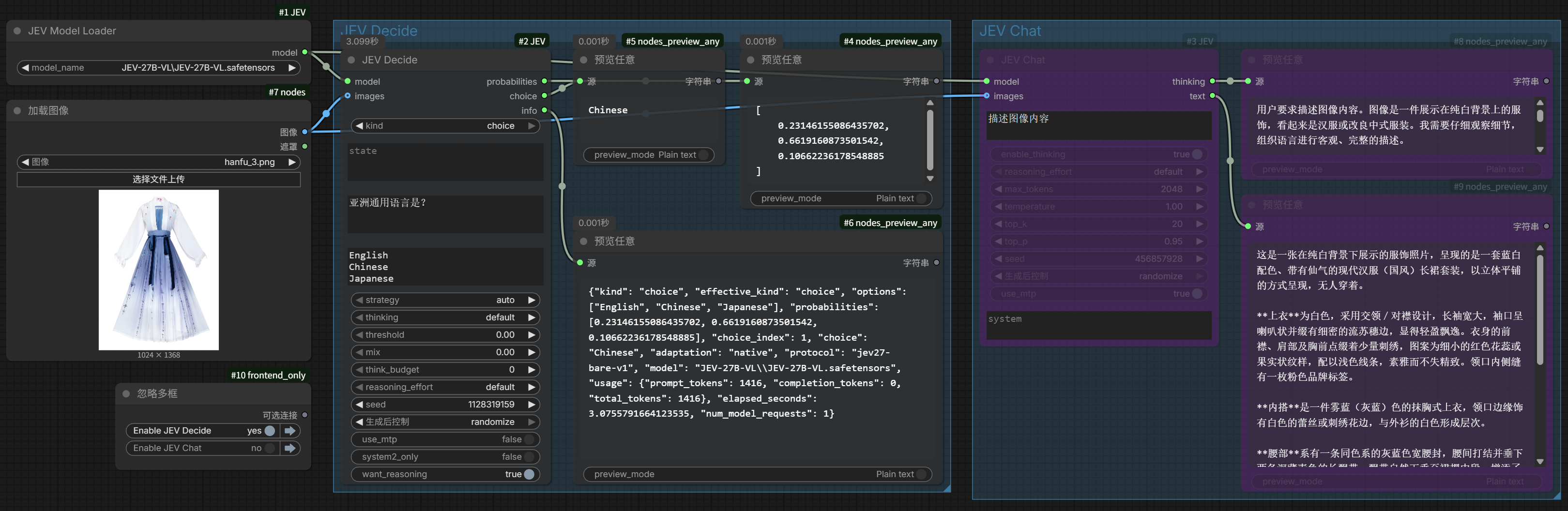
Workflow preview
JEVModelLoader feeds both consumers from a single load: JEVDecide runs a
vision choice task on the loaded image (→ Chinese, probabilities
[0.231, 0.662, 0.107] in 3.1 s), while JEVChat describes the same image
with the thinking channel split into its own preview.
Model files
The model is packaged per ComfyUI convention as a single .safetensors in the normal model
folders, plus the tokenizer/config sidecars in the same directory:
models/LLM/JEV-27B-VL/
    JEV-27B-VL.safetensors        merged backbone + vision + lm_head + MTP (int8 convrot, 26.5 GB)
    character_lora_bf16.safetensors  decision LoRA (401 modules, r32/alpha64)
    decision_head.json             S1 verbalizer ids, per-kind bias
    calibration.json               per-kind softmax temperatures
    adapter_config.json
    tokenizer.json / tokenizer_config.json
    config.json / generation_config.json
    preprocessor_config.json / video_preprocessor_config.json
    chat_template.jinja
The loader registers models/LLM as a new model folder named llm, so any merged
qwen35-style .safetensors dropped there is selectable.
Downloading the model
| Source | Link | |---|---| | ModelScope (recommended) | https://modelscope.cn/models/mailzwj/JEV-27B-VL-quant | | Quark netdisk | https://pan.quark.cn/s/33396d927094 |
Download the whole JEV-27B-VL directory (the merged single file alone is 26.5 GB) and place it at models/LLM/JEV-27B-VL/.
At load time the vision tower's int8-quantized pos_embed table (~5 MB) is dequantized to a
dense bf16 matrix: in service mode (NORMAL_VRAM) the quantized-embedding dequant kernel finds
the qdata as bf16 and has no capable backend, so image prompts crash without this. The dense
table is bit-identical to the kernel output and makes the image path work in every VRAM mode.
Nodes (V3)
| Node | Purpose |
|---|---|
| JEVModelLoader | Loads the merged text encoder, the JEV tokenizer (no BOS; atomic special tokens verified at load), and builds the 401 LoRA bypass hooks (not injected yet). |
| JEVDecide | Runs the decision protocol: kind noul / score / choice (2–256 options), optional state images, strategy single / permute / tournament (choices >16), adaptive System 2 thinking (default/off/auto/on, threshold, mix, budget, reasoning_effort). Outputs: probabilities (aligned with the options), choice, info (full protocol JSON). |
| JEVChat | Plain chat through the base model with the official Qwen 3.8 chat template (thinking channel split into a separate output; reasoning_effort, temperature/top_k/top_p, max_tokens, seed, MTP toggle). |
Custom link types: JEVMODEL (model handle), JEVPROB (probability list).
Quick start
- Restart ComfyUI once so the
JEVnode category appears. - Add a
JEVModelLoader(combo pre-selectsJEV-27B-VL/JEV-27B-VL.safetensors). - Wire its
modelintoJEVDecide(setkind,question,optionsfor choice, optionallyimagesfrom aLoad Imagenode) orJEVChat(setprompt). - Queue the prompt —
JEVDecideprints probabilities / choice / the full protocol JSON,JEVChatprints the thinking channel and the answer separately.
Every parameter with its default and gotcha (e.g. threshold/mix of 0 means
"protocol default", not zero) is documented in the Usage Guide,
together with the V3 /prompt API conventions and a minimal JSON example.
Protocol semantics (parity with serve_decide.py)
- System 1: one prefill over the bare frame
[kind] {kind}\n[state] {state}{image triples}\n[question] {q}\n[options]\n{lines}\n[decision]:(no chat template — the vLLM raw path), then a one-token readout at the last position. The decision LoRA (401 modules incl. lm_head, scale alpha/r = 2.0) is applied bypass-style with manual toggle: all hooks are injected right before the S1 pass and ejected infinallyright after it, so System 2 and chat always run on the unmodified base model. The trained A–P head labels are asserted againstdecision_head.jsonat load. - System 2: the base model thinks over
pre + state + {image triples} + tail + post(official chat template, thinking forced on,reasoning_efforthonored), stops at the think-close token (id 248069), and the answer-letter distribution is read in one prefill afterthought + think-close + "\n\nAnswer: (".noulflips to[P(false), P(true)]. Seed =crc32(question + options)unless the node seed is set; sampling is temperature 1.0 / top_k 20 / top_p 0.95, exactly as serve. - Adaptive thinking: S1 first; when
thinking=onorautowith max(p1) < threshold (node 0 = protocol default 0.8), p2 is computed and foldedp = (1-w)·p1 + w·p2(node mix 0 = protocol default 0.5). Response JSON mirrors the hosted API (kind,effective_kind,options,probabilities,choice_index,choice,adaptation,protocol,model,usage,elapsed_seconds,num_model_requests,thinking{mode,threshold,budget,used,think_tokens,think_seconds,finished_within_budget,reasoning}). - Defaults matching serve:
strategy auto → single,thinking default → off,threshold → 0.8,mix → 0.5,think_budget 0 → 32768,seed -1 → crc32 protocol seed.
MTP
The merged checkpoint contains the MTP draft head and ComfyUI auto-detects it.
JEVDecide.use_mtp defaults to False: serve.sh runs plain vLLM decode without
speculative decoding, so the decision node matches the reference server by default.
JEVChat.use_mtp defaults to True (pure speed for free-form chat).
JEVDecide and JEVChat are output nodes, so they can be submitted through the /prompt
API directly (no extra preview node needed). The images input accepts a tensor from a
LoadImage node, a string filename from the ComfyUI input directory, or a list of filenames
(API usage: POST /upload/image first, then pass the returned name).
Verification performed
tools/verify_model_dir.py— model dir completeness;comfy.sd.load_clipof the merged file detectsqwen35_27b(Qwen35, 64 layers, MTP on, int8 convrot active); 16 atomic special tokens round-trip; image triple = ids [248053, 248056, 248054]; think-close = 248069.tools/smoke_load.py— engine load (401 hooks, 256 choice labels, 256 answer labels, A–P head assert), real S1 forwards: noul[0.014, 0.986] → true, score, choice[0.9998, …] → Paris; S1 bit-deterministic across runs.tools/validate.py— LoRA bypass: readout shifts 0.848 → 0.986 with hooks and restores bit-exactly after eject (residual 0.0); S2 deterministic under the protocol seed, correct answers on obvious cases; system2_only path; image path (prompt tokens 36 → 998 for one smart-resized image); chat path (thinking channel split, thinking-off stays clean, math correct).tools/compare_with_serve.py— user-side: run the model package'sserve.sh(vLLM) and POST the same cases to/v1/decide; prints per-option deltas. S1 should agree to float precision (differences only from int8 convrot backbone on the ComfyUI side). S2 is intentionally not compared: the two runtimes' samplers diverge token-for-token even with equal seeds.- Live API (running ComfyUI,
tools/api_run.py) — all 7 cases submitted throughPOST /promptand verified: noul[0.015, 0.985] → true(7.7 s incl. first weight stream), score→ 5, choice[0.9998, …] → Paris(~2 s, warm), S2thinking=oncorrect with reasoning ininfo, adaptiveauto/threshold 0.9 triggered System 2 (S1 max 0.856 < 0.9, folded p2 in), chat thinking on/off channel split, and image (1 uploaded image → 999 prompt tokens,[0.24, 0.76] → true).
Memory
The text encoder is ~26.5 GB in int8 (backbone 26.1 GB + vision 0.4 GB). With the MinVram hook mode, weights stream from system RAM into VRAM per forward; expect ~28 GB of system RAM in use and roughly 15–25 GB VRAM peaks (a 32 GB card is comfortable; on tighter cards expect slow fault-in). Adapter weights (bf16, ~0.4 GB) move to the GPU only while the S1 hooks are injected.
Requirements
ComfyUI ≥ 0.45 (native qwen35_27b text encoder), Python deps already in a standard ComfyUI
env (torch, transformers, safetensors). No new third-party dependencies are added.