
ComfyUI_Spectrum4LTXV_DL
customized comfyui integration of Spectrum for LTXV by DL
[CVPR 2026] Adaptive Spectral Feature Forecasting for Diffusion Sampling Acceleration
Jiaqi Han* $^1$, Juntong Shi* $^1$, Puheng Li $^1$, Haotian Ye $^1$, Qiushan Guo $^2$, Stefano Ermon $^1$
$^1$ Stanford University $^2$ ByteDance
<p> <a href='https://arxiv.org/abs/2603.01623'><img src='https://img.shields.io/static/v1?&logo=arxiv&label=Paper&message=Arxiv:Spectrum&color=B31B1B'></a> <a href='https://hanjq17.github.io/Spectrum/'><img src='https://img.shields.io/badge/Project-Page-blue'></a> </p> </div>🎯 Overview
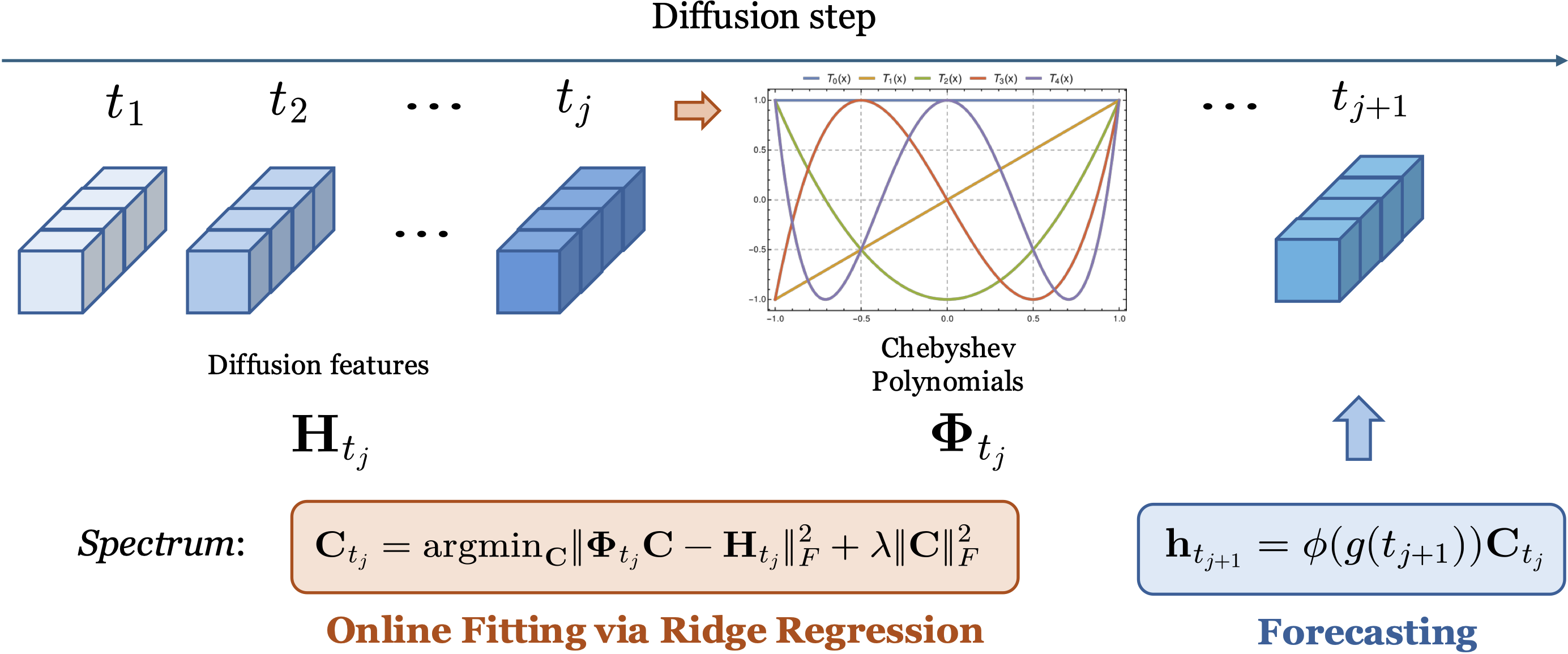
We propose Spectrum, a training-free spectral diffusion feature forecaster that enables global, long-range feature reuse with tightly controlled error. We view the latent features of the denoiser as functions over time and approximate them with Chebyshev polynomials. Specifically, we fit the coefficient for each basis via ridge regression, which is then leveraged to forecast features at multiple future diffusion steps. We theoretically reveal that our approach admits more favorable long-horizon behavior and yields an error bound that does not compound with the step size.
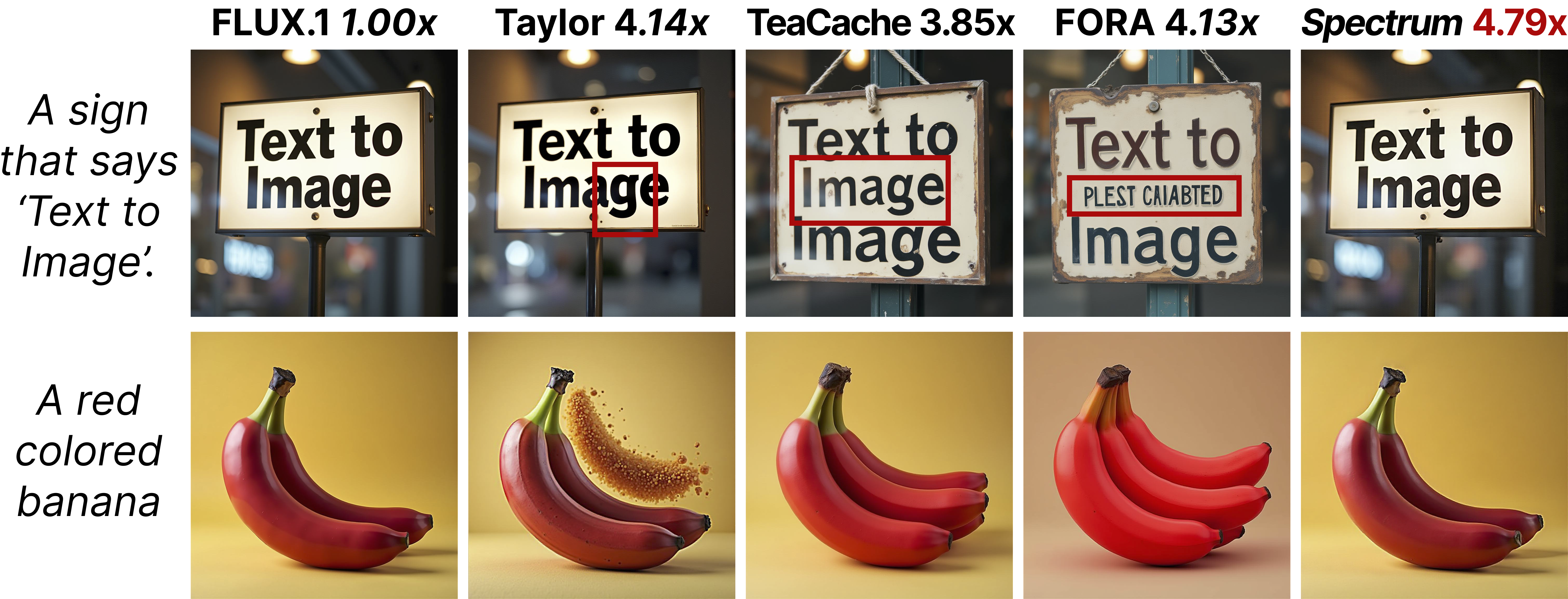
Extensive experiments on various state-of-the-art image and video diffusion models consistently verify the superiority of our approach. Notably, we achieve up to $4.79\times$ speedup on FLUX.1 and $4.67\times$ speedup on Wan2.1-14B, while maintaining much higher sample quality compared with the baselines. See more demos on our Project Page.
Please give us a star ⭐ if you find our work interesting!
🚀 Also checkout our previous work CHORDS on multi-core diffusion sampling acceleration, accepted at ICCV 2025!
🛠 Dependencies
Our code relies on the following core packages:
torch
transformers
diffusers
hydra-core
imageio
imageio-ffmpeg
For the specific versions of these packages that have been verified as well as some optional dependencies, please refer to requirements.txt. We recommend creating a new virual environment via the following procedure:
conda create -n spectrum python=3.10
conda activate spectrum
pip install -r requirements.txt
🚀 Running Inference
Prior to running inference pipeline, please make sure that the models have been downloaded from 🤗 huggingface. We provide the download script for some example models for image and video generation in download.py.
We use hydra to organize different hyperparameters for the image/video diffusion model as well as the sampling algorithm. The default configurations can be found under configs folder. The entries to launch the sampling for image and video generation are src/text_to_image.py and src/text_to_video.py, respectively. For SDXL, please refer to src/text_to_image_sdxl.py.
⭐ Text-to-Image (T2I)
The command below is an example to perform image generation on Flux using 1 GPU.
CUDA_VISIBLE_DEVICES=0 \
python src/text_to_image.py \
    model=flux \
    algo=spectrum \
    algo.w=0.5 \
    algo.lam=0.1 \
    algo.m=4 \
    window_size=2 \
    flex_window=0.75 \
    exp_name=temp \
    ngpu=1 \
    total_prompt_num=1000 \
    output_base_path=output_samples_image \
    prompt_file=prompts/DrawBench200.txt
For model we currently support:
flux: Fluxsd3-5: Stable Diffusion 3.5-Largesdxl: SDXL (please usepython src/text_to_image_sdxl.pyto launch)
algo.w is by default set to 1.0, which recovers our Chebyshev predictor. Post publication, we also find that a convex mixture of our spectral predictor with linear interpolation slightly enhances robustness across a wider range of acceleration ratios. We recommend setting algo.w between 0.5 and 1.0, with a relatively larger value of algo.w when enabling more aggressive speedups (see flex_window).
algo.lam refers to the regularization strength $\lambda$ in the paper. By default set to 0.1.
algo.m refers to the number of Chebyshev bases. By default set to 4.
window_size refers to the initial window size $\mathcal{N}$ in the paper.
flex_window refers to the hyperparameter $\alpha$ in the paper. Notably, $\mathcal{N}$ and $\alpha$ defines the sequence of diffusion steps to perform actual forward pass of the denoiser. More details are in Appendix B.1 and Table 6 in the paper. A larger value of $\alpha$ corresponds to fewer actual network forwards, leading to larger speedup.
ngpu corresponds to the number of GPUs to use in parallel. We split all prompts equally to several gpus to speedup the benchmark for all methods. Note that it should match CUDA_VISIBLE_DEVICES.
output_base_path is the directory to save the generated samples.
prompt_file stores the list of prompts, each per line, that will be sequentially employed to generate each image.
For full functionality of the script, please refer to the arguments and their default values (such as the number of inference steps, the resolution of the image, etc.) under the configs folder, which is parsed by hydra.
Remarks: window_size=2 and flex_window=0.75 recovers the $\alpha=0.75$ setting in the paper with 14 full network passes ($\approx 3.5\times$ speedup). For more aggressive acceleration, use window_size=2 and flex_window=3.0, which corresponds to the $\alpha=3.0$ setting in the paper with 10 network passes ($\approx 5\times$ speedup).
We also provide a boilerplate script to launch the inference:
# For Flux and Stable Diffusion 3.5-Large
bash scripts/run_mp_image.sh
# For SDXL
bash scripts/run_mp_image_sdxl.sh
⭐ Text-to-Video (T2V)
Similarly, the following script can be used for video generation with Spectrum:
CUDA_VISIBLE_DEVICES=0 \
python src/text_to_video.py \
    model=hunyuan \
    algo=spectrum \
    algo.w=0.5 \
    algo.lam=0.1 \
    algo.m=4 \
    window_size=2 \
    flex_window=0.75 \
    exp_name=temp \
    ngpu=1 \
    total_prompt_num=1000 \
    output_base_path=output_samples_video \
    prompt_file=prompts/video_demo.txt
where for model we currently support:
hunyuan: HunyuanVideowan14b: Wan2.1-14B
We also provide a boilerplate script to launch the inference:
# For HunyuanVideo and Wan2.1-14B
bash scripts/run_mp_video.sh
Remark: For high-resolution video generation, change model.width, model.height, and model.num_frames to your specific choice. For exmaple, we use 1080x720x129f setting with HunyuanVideo for the qualitative examples.
📌 Citation
Please consider citing our work if you find it useful:
@article{han2026adaptive,
  title={Adaptive Spectral Feature Forecasting for Diffusion Sampling Acceleration},
  author={Han, Jiaqi and Shi, Juntong and Li, Puheng and Ye, Haotian and Guo, Qiushan and Ermon, Stefano},
  journal={arXiv preprint arXiv:2603.01623},
  year={2026}
}
🗒️ Acknowledgments
Part of the code was inspired by TaylorSeer. We thank the authors for open-sourcing the codebase.
🧩 Contact and Community Contribution
If you have any question, welcome to contact me at:
Jiaqi Han: [email protected]
🔥 We warmly welcome community contributions for e.g. supporting more models! Please open/submit a PR if you are interested!