
Touch Node Manager
Touch-first node/extension manager for ComfyUI: check updates, update nodes and core, install from a GitHub URL, select versions, fuzzy search — mobile-friendly.
comfyui-touch-manager
Touch-first node/extension manager for ComfyUI: check updates, update nodes and core, install from a GitHub URL, select versions, fuzzy search — mobile-friendly.
Part of a family of mobile-first ComfyUI usability packs (gallery-loader, sampler-info): touch-friendly HTML modals that replace clunky native LiteGraph controls, detected by widget name, additive and non-clobbering.
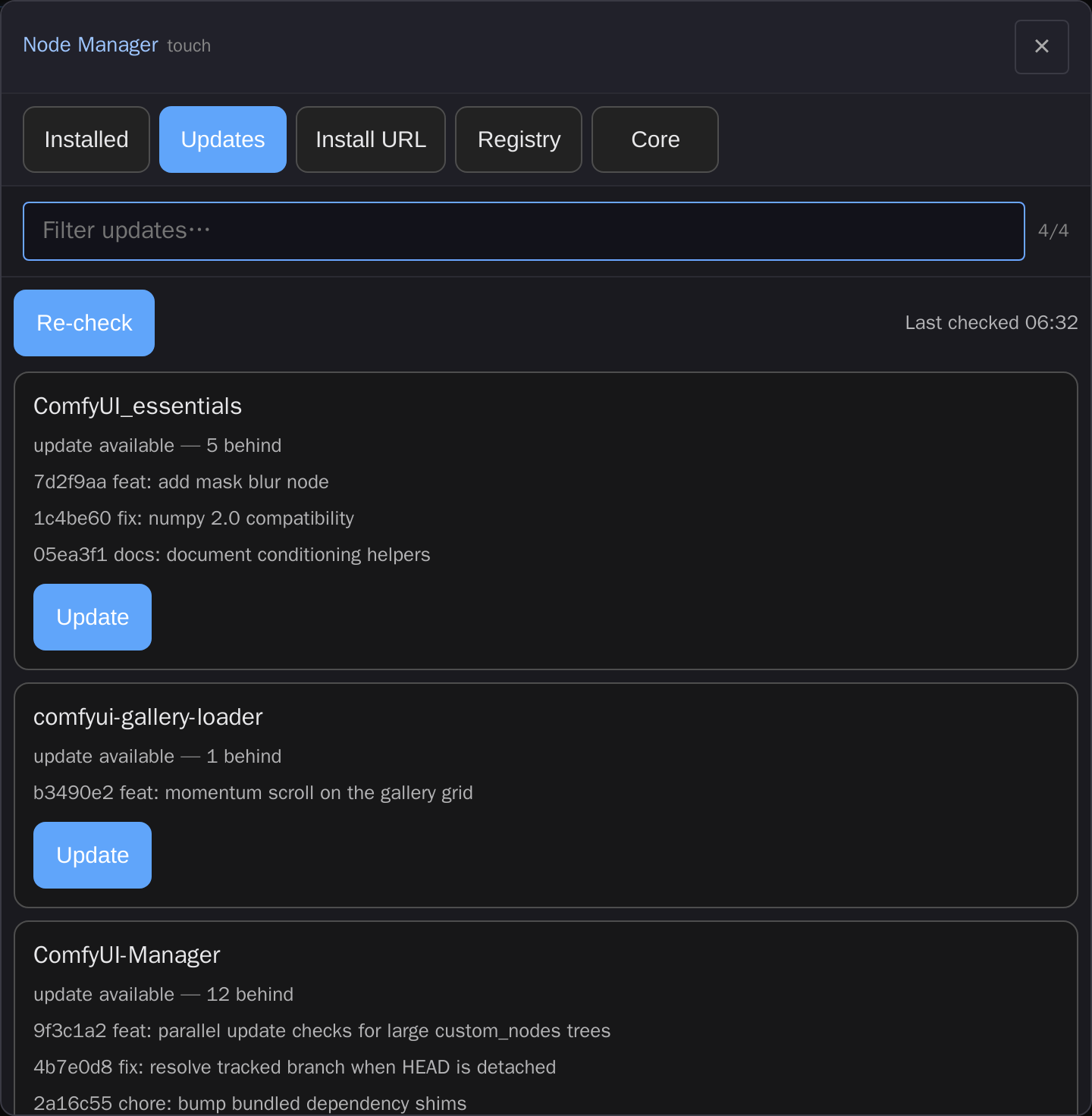
The Installed tab: every pack with its git ref, and each git-backed pack's available update lazy-loaded inline — the incoming commits previewed and a one-tap Update. (Screenshot uses representative data.)
Install
cd <ComfyUI>/custom_nodes
git clone https://github.com/laurigates/comfyui-touch-manager
cd comfyui-touch-manager
bun install
bun run build      # emit web/dist/ (served by ComfyUI)
Restart ComfyUI; hard-refresh the browser tab (Ctrl+Shift+R / Cmd+Shift+R).
What it does
A full-screen, touch-first modal for managing custom-node packs from the ComfyUI canvas — opened from a top action-bar button, the command palette ("Touch Node Manager"), the Extensions menu, or the sidebar's vertical-nav icon (which opens the modal directly). It's built for phones and tablets: big tap targets, 16px inputs (no iOS zoom), momentum scroll, and a fuzzy filter on every list. Four tabs:
- Installed — every pack across all
custom_nodesroots, with a one-line description of what it is for, its current git ref (or registry version), its author, whether it has local changes, its remote, and how many nodes it registered in the running install (with their top categories, e.g.197 nodes · ImpactPack). Descriptions are read from the pack's own files with a fixed precedence —pyproject.toml[project.description], thenpackage.json, then the README's first prose paragraph — and never fabricated: a pack that describes itself nowhere shows no description line. Across a real 96-pack install this resolves 84 frompyprojectand 12 from READMEs. Per-pack Update, Versions, Forks, Disable, and Delete actions (a disabled pack instead offers Enable, restoring it) — Update works for both git-backed packs (fetch + fast-forward) and packs installed from the Comfy Registry (re-downloads the latest published version). Updating a pack with local changes prompts before touching it: cancel, or Force update to discard the changes and proceed. Fuzzy search by name, author, remote URL, or description — so "upscale" finds the packs that do upscaling even when none of them says so in its directory name. The list paints instantly; a background sweep then checks each updatable pack (a few at a time) — a git fetch, or a registry version comparison — and fills its available update inline on the row. Packs with an available update float to the top once the sweep finishes. Results are cached, so updating one pack doesn't re-check everything; a Re-check updates button reruns the sweep on demand. - Forks (from an Installed row) — switch a pack to a different fork of
the same project without reinstalling it. The picker lists the repo it was
forked from (upstream first) and the fork network's siblings by star count,
straight from the GitHub API, marks the one you are already on, and always
offers a paste-a-URL fallback for a fork it cannot enumerate (or a GitLab
one). Switching repoints the pack's
originand checks out the new remote's default branch (or a ref you name) in place: the directory name and git history are kept, so the pack keeps working and later Updates track the fork. New Python dependencies are installed automatically. A dirty working tree prompts before anything is discarded. - Delete (from an Installed row) — permanently remove a pack directory, the
irreversible counterpart to Disable. It asks for an explicit confirmation
that names the directory and points at Disable as the reversible alternative.
It is live only when the server's delete gate permits it — loopback by
default; a non-loopback bind (e.g.
--listen 0.0.0.0) requiresTOUCH_MANAGER_ALLOW_REMOTE_DELETE=1in the server environment. When the gate refuses, the button is shown disabled with the reason and the env var named above the list, rather than hidden: an action you cannot see is one you cannot know exists, let alone enable. - Install URL — paste a GitHub/GitLab URL to clone a pack into
custom_nodes. Gated by the server's bind policy (loopback by default; a non-loopback bind requires theTOUCH_MANAGER_ALLOW_REMOTE_INSTALLserver env), the same gate the backend enforces. - Registry — search registry.comfy.org and install a pack by its registry or git version.
- Core — the ComfyUI core repo's ref and how far it is behind
origin/upstream, with a fast-forward Update core action.
After any mutating action the modal shows a prominent "Restart ComfyUI to
apply" notice, with an optional one-tap restart when the server's reboot gate
permits it. All actions drive the pack's /touch_manager/* backend routes,
which use ComfyUI-bundled libraries only.
Security
Install, fork switch and core update put code into the interpreter ComfyUI runs in, so the backend does not trust a request just because the server is bound to loopback:
- Every
POST /touch_manager/*requires the headerX-Touch-Manager: 1and is refused when the browser marks itSec-Fetch-Site: cross-site. A custom header forces a CORS preflight, which no ComfyUI middleware approves for that header, so another website open in your browser cannot drive these routes. This holds with--enable-cors-headertoo. The pack's own UI sends the header; a script calling the API must add it. - Loopback trust needs a loopback
Host. On a loopback bind, a request is treated as local only when it arrives aslocalhost,127.x.x.xor[::1]. A request under any other name (a DNS-rebinding page, or a reverse proxy that forwards its own hostname) is treated like a non-loopback bind and needs the matchingTOUCH_MANAGER_ALLOW_REMOTE_*opt-in.
Compatibility
- ComfyUI: modern Vue frontend (
comfyui-frontend-package >= 1.40) for thewidget.onPointerDowninterception hook. - Frontend changes take effect after
bun run build+ a browser hard-refresh — no ComfyUI restart.
Bundled code
The served frontend (web/dist/index.js) is generated by bun build from the
TypeScript in src/. The build inlines one first-party dependency,
@laurigates/comfy-modal-kit
(pkg:npm/@laurigates/comfy-modal-kit, MIT) — the shared modal/fuzzy-search
primitives used across this pack family. It is a declared npm dependency (see
package.json), not copied-in vendored source, and it is
published to npm with build provenance
(SLSA, signed via GitHub Actions) attesting it was built from that repo.
The npm scope @laurigates, the GitHub org laurigates, and this pack's Comfy
Registry PublisherId = laurigates are the same author. So the inlined bundle's
upstream origin is identifiable and first-party — not unattributed third-party
code. Verify: npm view @laurigates/comfy-modal-kit dist.attestations.
License
MIT — see LICENSE.