
ComfyUI-DSD
An Unofficial ComfyUI custom node package that integrates a/Diffusion Self-Distillation (DSD) for zero-shot customized image generation. DSD is a model for subject-preserving image generation that allows you to create images of a specific subject in novel contexts without per-instance tuning.
Nodes (6)
Gemini reads your subject photo, then rewrites your prompt to actually describe it
Subject-preserving FLUX without training a LoRA
Downloads the multi-gigabyte DSD model and loads it in one shot
The lean twin of the Downloader for when the model is already on disk
It hands you the two standard paths, it doesn't pick files
Controls how your subject photo gets squeezed into DSD's reference slot
ComfyUI-DSD
An Unofficial ComfyUI custom node package that integrates Diffusion Self-Distillation (DSD) for zero-shot customized image generation.
DSD is a model for subject-preserving image generation that allows you to create images of a specific subject in novel contexts without per-instance tuning.
Features
- Subject-preserving image generation using DSD model
- Gemini API prompt enhancement
- Direct model download from Hugging Face
- Fine-grained control over generation parameters
- Multiple image resizing options
Installation
- Clone this repository into your ComfyUI custom_nodes folder:
cd ComfyUI/custom_nodes
git clone https://github.com/irreveloper/ComfyUI-DSD.git
- Install the required dependencies:
pip install -r requirements.txt
-
Get the model files (two options):
- Option 1: Use the
DSD Model Downloadernode in ComfyUI to automatically download the model - Option 2: Download manually from Hugging Face or Google Drive
The model files will be stored in:
ComfyUI/models/dsd_model/transformer/(for transformer files)ComfyUI/models/dsd_model/pytorch_lora_weights.safetensors(for LoRA file)
- Option 1: Use the
-
Restart ComfyUI
Available Nodes
-
DSD Model Downloader: Automatically downloads the model from Hugging Face
- Supports downloading from custom repositories with the
repo_idparameter - Includes options for model precision (bfloat16, float16, float32)
- Provides memory optimization options (low_cpu_mem_usage, model_cpu_offload, sequential_cpu_offload)
- Optional Hugging Face token support via parameter or HF_TOKEN environment variable
- Supports downloading from custom repositories with the
-
DSD Model Loader: Loads a pre-downloaded model
- Supports custom model and LoRA paths
- Multiple precision options (bfloat16, float16, float32)
- Memory optimization options for different hardware configurations
-
DSD Model Selector: Helps select models from local directories
- Automatically finds models in the default ComfyUI model paths
- Verifies model existence and provides appropriate warnings
-
DSD Gemini Prompt Enhancer: Uses Google's Gemini API to enhance prompts for better image generation results
- The API key can be provided in two ways:
- As an input parameter to the node (not recommended for sharing workflows)
- Through the
GEMINI_API_KEYenvironment variable (strongly recommended)
- Analyzes both the input image and text prompt to generate improved prompts
Note: To use the enhanced prompts, connect this node's output to the DSD Image Generator's prompt input and enable the
use_gemini_promptoption. If no API key is provided, the original prompt will be used. - The API key can be provided in two ways:
-
DSD Image Generator: Generates images with the DSD model
- Supports detailed parameter control:
- Guidance scale (overall, image-specific, and text-specific)
- Inference steps
- Resolution control
- Seed control (0 for random seed)
- Returns both the generated image and the reference image
- Displays progress during generation
- Supports detailed parameter control:
-
DSD Resize Selector: Provides flexible image resizing options for the DSD Image Generator:
- resize_and_center_crop: Resizes and center crops the image (default behavior)
- center_crop: Simple center crop and resize
- pad: Preserves aspect ratio and adds padding to reach target size
- fit: Resizes to target dimensions without preserving aspect ratio
- Additional customization:
- Interpolation method (LANCZOS, BICUBIC, BILINEAR, NEAREST)
- Padding color (RGB values for pad mode)
Basic Workflow
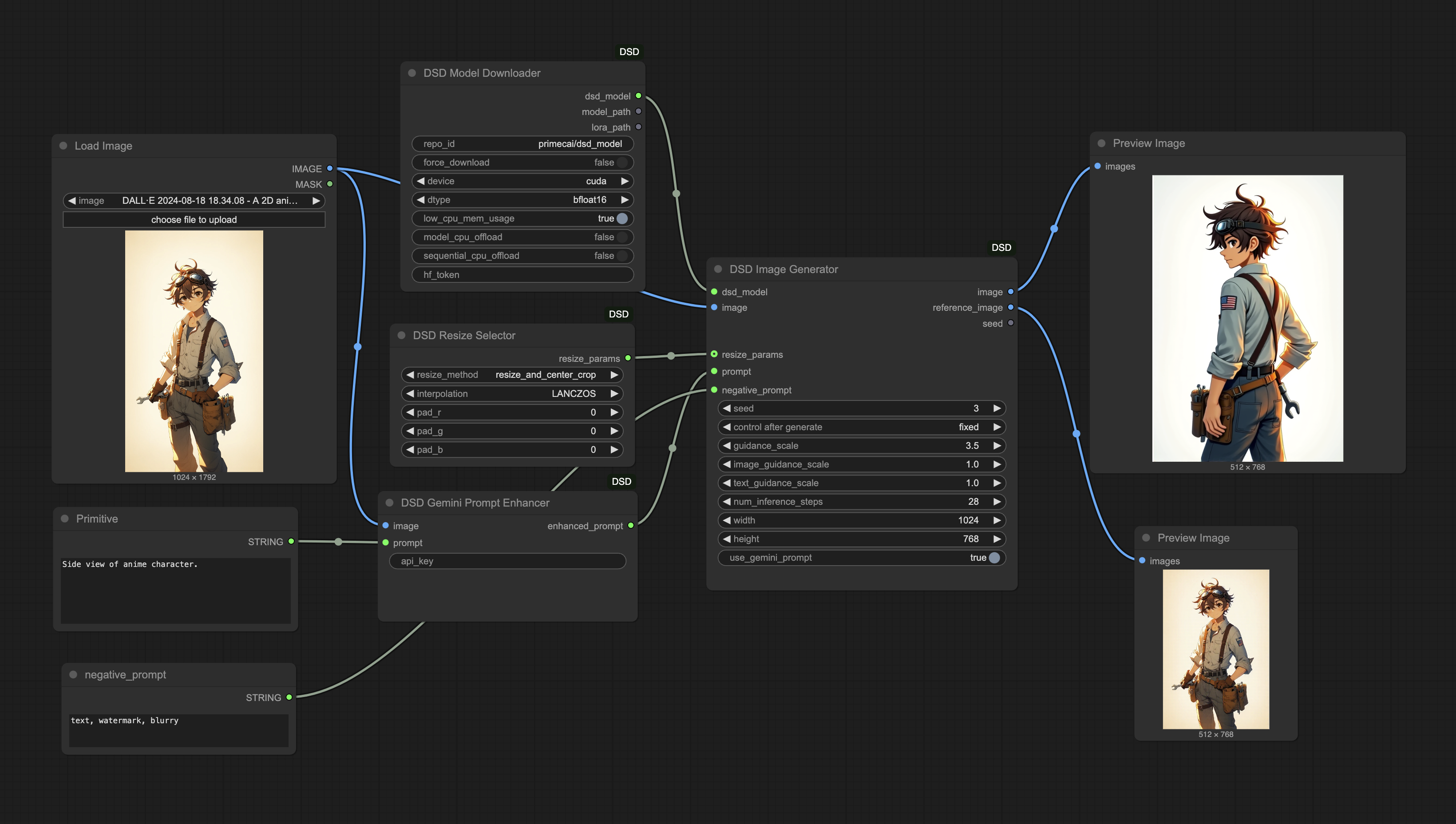
Advanced Usage
Memory Optimization
The DSD model can be memory-intensive. Several options are available to optimize memory usage:
- Precision: Use
bfloat16(default) for the best balance of speed and memory usage - CPU Offloading: Enable
model_cpu_offloadorsequential_cpu_offloadfor systems with limited VRAM - Resolution: Lower resolution and fewer inference steps can significantly reduce memory requirements
Gemini API Integration
For optimal results with the Gemini API:
- Obtain a Gemini API key from Google AI Studio
- Set it as an environment variable:
GEMINI_API_KEY=your_key_here - Connect the DSD Gemini Prompt Enhancer to your workflow
- Enable
use_gemini_prompton the DSD Image Generator
Custom Model Loading
If you have custom DSD models or want to use a different repository:
- Use the DSD Model Downloader with a custom
repo_id - Or manually download the model files and use DSD Model Loader with custom paths
Troubleshooting
- Memory Issues: Try reducing precision (use bfloat16), lower resolution, or fewer steps
- Gemini API: Ensure you have a valid API key (can be set via GEMINI_API_KEY environment variable)
- Model Loading: If you see errors, try using the Model Downloader node to re-download files
- Import Errors: Make sure all dependencies are installed correctly
- CUDA Errors: If you encounter CUDA out-of-memory errors, try enabling CPU offloading options
Examples
Check the examples directory for sample workflows.