
Krea2 Training Free Improvements
Composable Krea2 guidance and acceleration nodes, including GAG, NAG, Prompt Reinjection, TaylorSeer, and adaptive progressive sampling.
Nodes (5)
Denoise at half size, land at full size
The research-y node, and how to tame it
Making the negative box work again at CFG 1
A 0.025 nudge that stops your prompt fading out
Skip all 28 blocks and cache one tensor
Krea2 Training Free Improvements
Composable training-free guidance and acceleration nodes for Krea2 in ComfyUI.
Nodes
Krea2 Geometry-Aware Attention Guidance
An adaptation of Geometry-Aware Attention Guidance for Krea2's single-stream transformer. It applies alpha=1.5 Entmax and the parallel-only GAG correction to image-query -> positive-text retrieval while leaving image self-attention dense.
The paper proves GAG for explicit cross-attention. Krea2 uses joint attention, so this implementation preserves the native text-attention mass and replaces only the conditional distribution within the positive-text partition. It is a Krea2 adaptation, not official code from the paper authors.
Krea2 NAG Negative Prompt
Krea2 negative prompting based on Normalized Attention Guidance.
Krea2 Prompt Reinjection
An adaptation of Prompt Reinjection
that saves Krea2's shallow text features and adds them back before deeper
single-stream blocks. The defaults (origin=1, targets=2..27, weight=0.025,
no anchoring) follow the official recommendation for a new MMDiT architecture.
Krea2 TaylorSeer Lite
An adaptation of the official TaylorSeer Lite HunyuanImage implementation. It periodically computes the full Krea2 output and keeps Taylor factors for that one final feature only. Forecast steps skip all 28 transformer blocks. Unlike the earlier per-block implementation, cache memory is independent of the number and hidden width of transformer blocks.
This follows the released Lite code: the cached feature is the denoiser output after Krea2's final layer, not the hidden state before it. Finite differences and forecasts use integer denoising-step distance as in equations 7-9 of the TaylorSeer paper and the official code.
Krea2 Adaptive Progressive Sampler
A Krea2-aware progressive-resolution Euler sampler. It was informed by the fixed-noise hierarchy in Fresco, but it is an independent implementation rather than a reproduction: Fresco's exact promotion schedule and mixed-resolution attention code have not been released.
The sampler makes the transition verifiable instead of generating fresh random
padding. It decomposes ComfyUI's incoming seeded noise with an orthonormal 2D
Haar transform, denoises the low-frequency parent at a smaller spatial size,
then restores the untouched child detail coefficients at the current flow
sigma. For Krea2's rectified-flow marginal this is
x_sigma = sigma * noise + (1 - sigma) * clean. Each resolution uses Krea2's
native dense position grid; spreading coarse tokens across the final canvas
creates an out-of-distribution sparse RoPE grid and can duplicate anatomy.
Why a smaller start can still produce duplicated anatomy
A smaller latent does not automatically make a large final canvas safe. The first denoising calls establish global topology: subject count, pose, head and limb placement. Full-resolution calls performed later usually refine that topology rather than replace it.
An earlier prototype scaled the coarse token coordinates across the final canvas. For example, a half-resolution 32x32 token grid was positioned sparsely over the range of a 64x64 grid. Although only 32x32 tokens were evaluated, the transformer therefore saw an unfamiliar wide coordinate field. This can look to the model like unsupported oversized generation and produce extra heads, legs, or repeated subjects.
The current sampler does not scale or spread Krea2's position coordinates. Every resolution uses its native contiguous coordinate grid. On promotion, the sampler reconstructs the next resolution from the same seeded Haar noise hierarchy and the current clean prediction; it does not add newly sampled padding noise. A promotion also invalidates TaylorSeer Lite's cached output.
Recommended 10-step setup
Use the sampler with SamplerCustomAdvanced, BasicGuider, and a
BasicScheduler set to simple:
| Setting | Recommended value | Effect |
| --- | --- | --- |
| initial_scale | 0.5 | Starts at half latent width and height, then promotes once. |
| mode | adaptive | May promote after stable predictions, while preserving the required full-resolution tail. |
| stability_threshold | 0.08 | A larger value makes early promotion easier; a smaller value delays it. |
| minimum_steps_per_level | 2 | Prevents promotion before two model calls at the current resolution. |
| full_resolution_steps | 7 | Reserves at least the final seven of ten calls at full resolution. |
With these defaults, a 10-step run performs at most the first three calls at half resolution and at least the last seven at full resolution. Adaptive stability can promote earlier. This is the quality-first preset and the recommended starting point for 1024x1024 Krea2 Turbo generation.
full_resolution_steps=4 is an aggressive speed preset. It leaves much more of
the global structure to the coarse stage, so composition drift and duplicated
anatomy are more likely. initial_scale=0.25 adds a second promotion and is
also experimental; compare it against the same seed before relying on it.
In manual mode, transition_sigmas controls promotion directly and requires
one descending value for each promotion (0.5 needs one value; 0.25 needs
two). stability_threshold is ignored in manual mode. For ordinary 10-step
Turbo workflows, adaptive mode with the reserved tail is easier to reason
about than a schedule-specific sigma value.
The sampler intentionally supports only Krea2 CONST/rectified-flow models and
Euler sampling with a simple/Flux sigma schedule. It accepts Krea2's 4D image
latents and 5D single-frame image latents. Inpainting masks are rejected, and
the latent dimensions must be divisible by 2 for 0.5 or by 4 for 0.25.
Progressive output is not expected to be pixel-identical to a full-resolution
baseline because the early model evaluations operate on a different token
grid.
Composition
The four MODEL nodes are independent and can be connected in any order:
MODEL -> Krea2 GAG -> Krea2 NAG -> Prompt Reinjection -> TaylorSeer Lite -> KSampler
GAG is computed only from the positive prompt's shared sparse/dense pair. NAG adds a separate positive-vs-negative correction afterward; GAG projection is never applied to the NAG residual. TaylorSeer Lite forces a fresh computation when GAG or NAG crosses a configured sigma boundary, so it does not reuse a cache from a different guidance regime.
The progressive sampler is a SAMPLER, not a MODEL patch. It can therefore be
used with the MODEL chain above through SamplerCustomAdvanced. A resolution
promotion invalidates TaylorSeer's cached output before the next model call.
An importable example is available at
workflows/Krea2 GAG and NAG - Raw FP8 Turbo.json.
The custom-sampler graph is available at
workflows/Krea2 Adaptive Progressive Sampler - Raw FP8 Turbo.json.
Use CFG = 1.0. TaylorSeer Lite is intended for Euler/simple, where each scheduled
sigma has one model evaluation. Unsupported intermediate sampler evaluations
fall back to a full computation. These nodes currently target native Krea2
text-to-image only; Krea2Edit/reference latents are rejected explicitly.
Installation
Clone this repository into ComfyUI/custom_nodes and restart ComfyUI.
Default settings
- GAG:
guidance_scale=5,eta=15,strength=0.6,sigma_start=0.881,sigma_end=0.678 - NAG:
phi=4,tau=2.5,alpha=0.25 - Prompt Reinjection:
origin_layer=1,target_start=2,target_end=27,weight=0.025,anchoring=false - TaylorSeer Lite:
warmup_steps=3,fresh_interval=2,tail_full_steps=2,max_order=0 - Adaptive Progressive Sampler:
initial_scale=0.5,mode=adaptive,stability_threshold=0.08,minimum_steps_per_level=2,full_resolution_steps=7
TaylorSeer Lite trades quality for speed. Krea2 Turbo has only 10 large
denoising intervals; direct testing found first-order extrapolation produces
visible colored squares. The released implementations support order 0, and it
is the stable Krea2 Turbo default: cached steps reuse the latest full output
instead of extrapolating it. Orders 1 and 2 remain available for longer
schedules through an integer input (0 = latest output, 1 = linear trend,
2 = linear trend plus curvature). The final two steps always use the full model. At 1024x1024, batch
1, the one BF16 order-0 feature requires about 0.5 MiB, instead of more than 5
GiB for the former per-block cache.
On an RTX 3060 Ti 8 GB, the included four-node workflow completed at 1024x1024 without OOM or block noise. GAG + NAG + Prompt Reinjection took 105.7 seconds in testing; order-0 TaylorSeer Lite with the final two steps kept full took 67.5 seconds. Absolute times vary by offloading configuration.
The GAG defaults follow the paper, but Krea2 is a different architecture.
Compare against the same seed and reduce strength first if the result is too
strong.
Progressive sampler performance
The speed-up comes from evaluating fewer image tokens during the early calls; it is not an upscaler or a high-resolution fix pass. The default seven-step full-resolution tail deliberately favors structure over the maximum possible speed-up. Shortening the tail or starting at quarter resolution is faster but changes a larger portion of the denoising trajectory.
Measure performance with the same seed after one warm-up run. Model loading, DynamicVRAM, asynchronous weight offloading, VAE decode, and other MODEL patches can otherwise dominate the timing and make a cold baseline comparison misleading.
Verified example
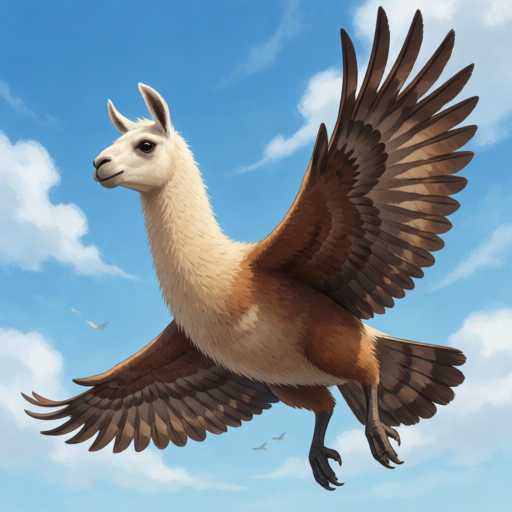
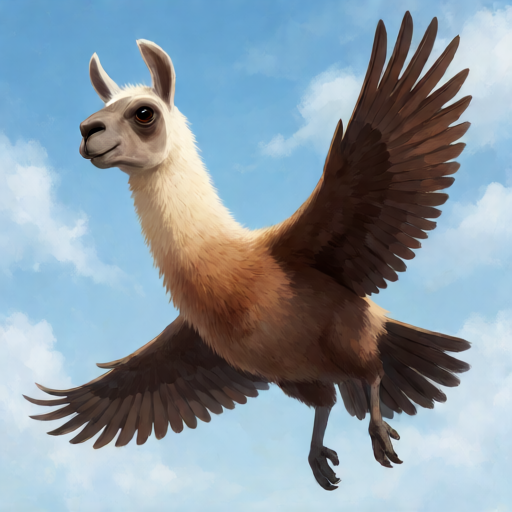
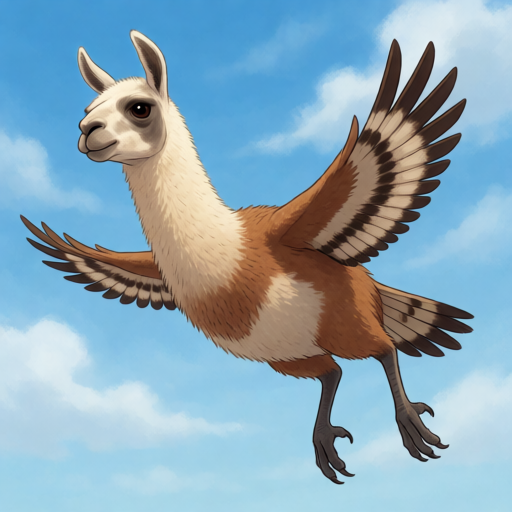
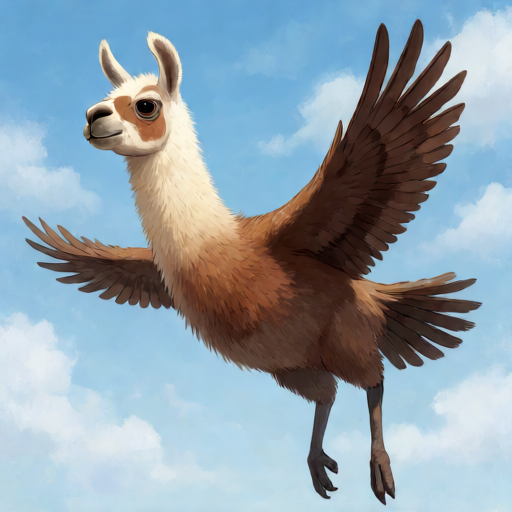
Prompt: A llama-bird hybrid creature flying in the sky. Llama head, bird body.
NAG negative: big wings
All four images below were generated successfully with the same seed, Krea2 Raw FP8, the Raw-to-Turbo LoRA, 10 Euler/simple steps, and CFG 1.0.
| Baseline | GAG |
| --- | --- |
|  |
|  |
|
| NAG | GAG + NAG |
| --- | --- |
|  |
|  |
|