
ComfyUI-MMS-Aligner
ComfyUI custom node that force-aligns audio with text into an SRT file using Meta's MMS models.
ComfyUI-MMS-Aligner
A ComfyUI custom node that force-aligns an audio clip with its text transcript and writes a timestamped SRT subtitle file.
Uses Meta's facebook/mms-1b-fl102 model (102 languages, FLEURS-trained) via transformers + torchaudio.functional.forced_align. Pure Python — no C++ compilation, no MSVC, no extra build tools.
Why FL102?
facebook/mms-1b-fl102 is the only MMS model used by this node. It covers 102 languages, trained on the cleaner FLEURS dataset, with per-language adapters (each language uses its own native tokenizer — no romanization required for the common cases).
If your language isn't in FL102, this node won't work for you — but for the languages most people actually need (English, Vietnamese, Chinese Mandarin, Spanish, French, German, Japanese, Korean, Arabic, Hindi, Russian, etc.), it does.
Screenshots
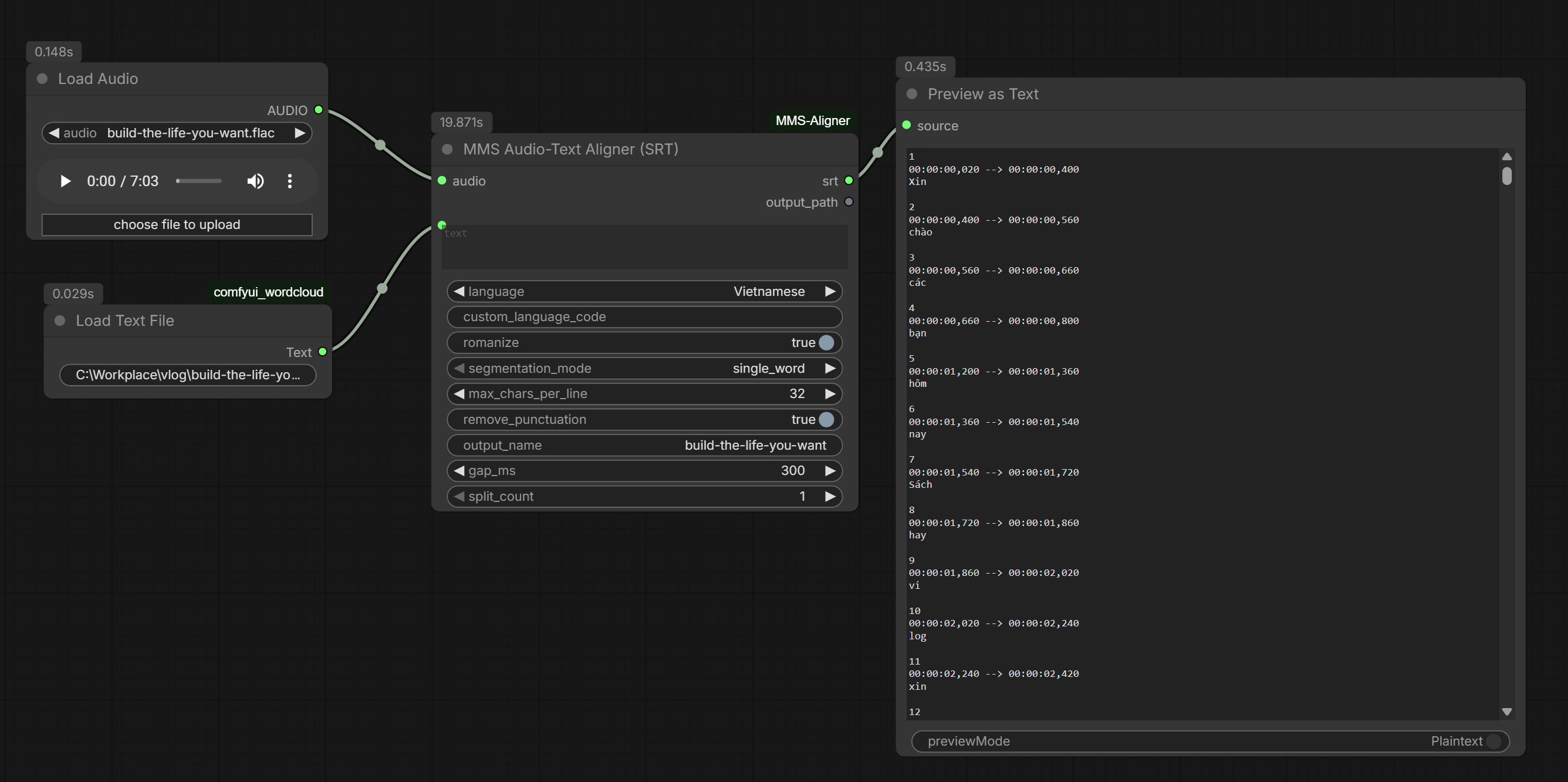
Features
- One node: audio + text in → SRT out (string and/or file).
- Single model, auto-downloaded to
ComfyUI/models/mms/facebook__mms-1b-fl102/on first use (~3.2 GB). - Pure-Python install: no compiler, no headaches on Windows.
- Language: ~30 common languages in a dropdown, any ISO 639-3 code via
custom, or auto-detect from the text. - Optional
romanizefallback (uroman) for edge cases. - Six segmentation modes: single-word (karaoke-style), max chars, punctuation, newlines, or combinations.
- Optional cue-gap bridging (
gap_ms) to eliminate sub-300 ms flicker between consecutive cues. - Optional output splitting (
split_count, up to 5) to emitname_1.srt,name_2.srt, … for chunked workflows. - Tooltips on every input.
- All processing in-memory — no temp WAV files written.
Installation
Manual
cd ComfyUI/custom_nodes
git clone https://github.com/idealweek/ComfyUI-MMS-Aligner
cd ComfyUI-MMS-Aligner
pip install -r requirements.txt
Restart ComfyUI. The node appears under audio/alignment as "MMS Audio-Text Aligner (SRT)".
Requirements:
torchandtorchaudioare already provided by ComfyUI. The extras (transformers,huggingface_hub,uroman,lingua-language-detector) are pure Python.
Usage
- Add a LoadAudio node and connect its output to the aligner's
audioinput. - Type or wire the transcript into the
textinput. - Pick
languageandsegmentation_mode(usesingle_wordfor karaoke-style one-word-per-cue output). - Set
output_name(no extension —.srtis added automatically). Files are written into ComfyUI's output directory. Thesrtstring output is always populated. - (Optional) raise
split_count(max 5) to split the result intooutput_name_1.srt,output_name_2.srt, … - (Optional) tune
gap_msto bridge tiny silences between consecutive cues — handy forsingle_wordmode to prevent flicker.
Example — Vietnamese
| Input | Value |
|---|---|
| audio | (from LoadAudio) |
| text | Xin chào, đây là một ví dụ.\nMột dòng nữa. |
| language | Vietnamese |
| romanize | False |
| segmentation_mode | max_chars+punctuation+newlines |
| max_chars_per_line | 42 |
| gap_ms | 300 |
| output_name | subs |
| split_count | 1 |
Output (srt):
1
00:00:00,120 --> 00:00:02,340
Xin chào, đây là một ví dụ.

2
00:00:02,500 --> 00:00:03,820
Một dòng nữa.
Inputs
| Field | Type | Default | Description |
|---|---|---|---|
| audio | AUDIO | — | ComfyUI audio. Resampled to 16 kHz mono internally. |
| text | STRING (multiline) | "" | Transcript. |
| language | enum | auto | auto, ~30 common languages, or custom. |
| custom_language_code | STRING | "" | ISO 639-3 (used only when language=custom). |
| romanize | BOOL | False | Optional fallback. Usually leave off — the per-language tokenizer handles native scripts. |
| segmentation_mode | enum | max_chars+punctuation+newlines | See below. |
| max_chars_per_line | INT | 42 | 0 disables the cap. |
| remove_punctuation | BOOL | False | Strip .,!?;:"()[]{}—–…«»“”‘’ from SRT lines (keeps apostrophes/hyphens). Doesn't affect segmentation. |
| gap_ms | INT | 300 | Bridge consecutive cues whose gap is under this many ms by snapping prev.end to next.start. Real pauses (≥ gap_ms) are preserved. 0 disables. |
| output_name | STRING | "subtitles" | Base file name (no extension) written to ComfyUI's output dir. .srt is appended automatically; path separators are stripped. |
| split_count | INT | 1 | 1 = single file. 2–5 splits cues into near-equal chunks named <output_name>_1.srt, <output_name>_2.srt, … |
Segmentation modes
single_word— one word per cue (karaoke-style). Pair withgap_msto avoid flicker.max_chars— pack words greedily up tomax_chars_per_line.punctuation— break at.!?,;:.newlines— break wherever the input text has a line break.max_chars+punctuation— both.max_chars+punctuation+newlines— all three.
Outputs
srt(STRING) — full SRT content (un-split, even whensplit_count> 1).output_path(STRING) — newline-separated list of paths written to disk (one entry whensplit_count=1, N entries otherwise).
How it works
- Resample the input audio to 16 kHz mono in memory.
- Detect the language from the transcript (lingua) when
language=auto. - Download
facebook/mms-1b-fl102toComfyUI/models/mms/on first run (cached after). - Load the model with the per-language adapter (
model.load_adapter(lang)andprocessor.tokenizer.set_target_lang(lang)). - Tokenize each transcript word with the language's native tokenizer (optionally romanize first).
- Get emissions via a single forward pass; convert to log-probs.
- Force-align with
torchaudio.functional.forced_align; merge token spans into word boundaries. - Segment word timings into SRT cues per the chosen mode.
- Emit the SRT as a string and (optionally) write to disk.
Troubleshooting
- "Could not auto-detect language" — text too short or mixed; set
languageexplicitly. - "Transcript produced no alignable tokens" — text contains characters not in the language's tokenizer vocab. Try
romanize=True, or check the language code. - Slow first run — model is downloading (~3.2 GB); subsequent runs use the cache.
- Wrong language adapter — make sure the ISO 639-3 code matches one of the FL102 languages.
License
Credits
- Meta MMS —
facebook/mms-1b-fl102 transformers— model loading & adapterstorchaudio.functional.forced_align— alignment mathuroman— pure-Python universal romanizer (ISI)lingua-language-detector— text language detection