
Causal Forcing for ComfyUI
Unofficial community integration, not affiliated with the Causal Forcing authors: runs the official Causal Forcing++ frame-wise 2-step and Causal Forcing frame-wise 4-step checkpoints (Wan2.1-T2V-1.3B based) in a separate WSL2/Linux runtime, with real VIDEO outputs and step/timing reports.
Nodes (3)
ComfyUI-CausalForcing
Unofficial ComfyUI integration of Causal Forcing and Causal Forcing++ (code, models, project page). Not affiliated with or endorsed by the Causal Forcing authors, Tsinghua University, Shengshu, Alibaba (Wan) or Comfy Org.
日本語の概要: README.ja.md
Causal Forcing distils Wan2.1-T2V-1.3B into an autoregressive video model that generates one latent frame (frame-wise) or one chunk of frames (chunk-wise) at a time with a few denoising steps; Causal Forcing++ released the first frame-wise 2-step and 1-step models. This package runs the official checkpoints with the official inference pipeline from ComfyUI:
- Causal Forcing Runtime: pick a runtime the administrator registered (a WSL2 or Linux venv with the pinned upstream checkout and the weights). Workflows cannot name executables or commands.
- Causal Forcing Generate (T2V / I2V): 832x480, 81 frames at 16 fps, 1-4
videos per job. Models:
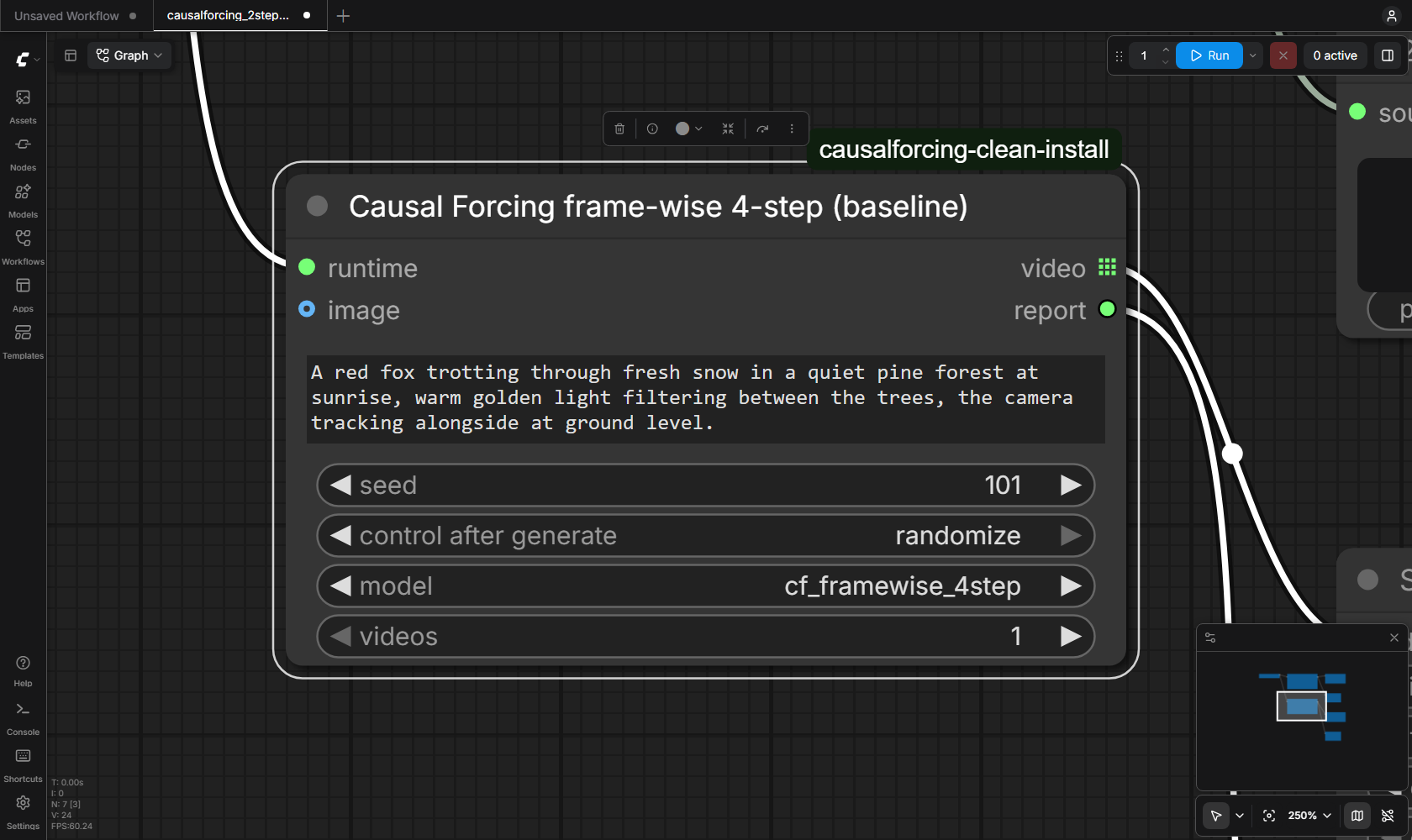
cfpp_framewise_2step(Causal Forcing++ frame-wise 2-step, default) andcf_framewise_4step(Causal Forcing frame-wise 4-step, the baseline). Optionalimageinput for frame-wise image-to-video. Returns real ComfyUIVIDEOoutputs and a JSON report with the generator forwards actually run, per-phase timings, memory and the checkpoint load evidence. - Causal Forcing Doctor: checks the runtime (upstream files against the pinned commit, model and checkpoint files, CUDA and flash-attn).
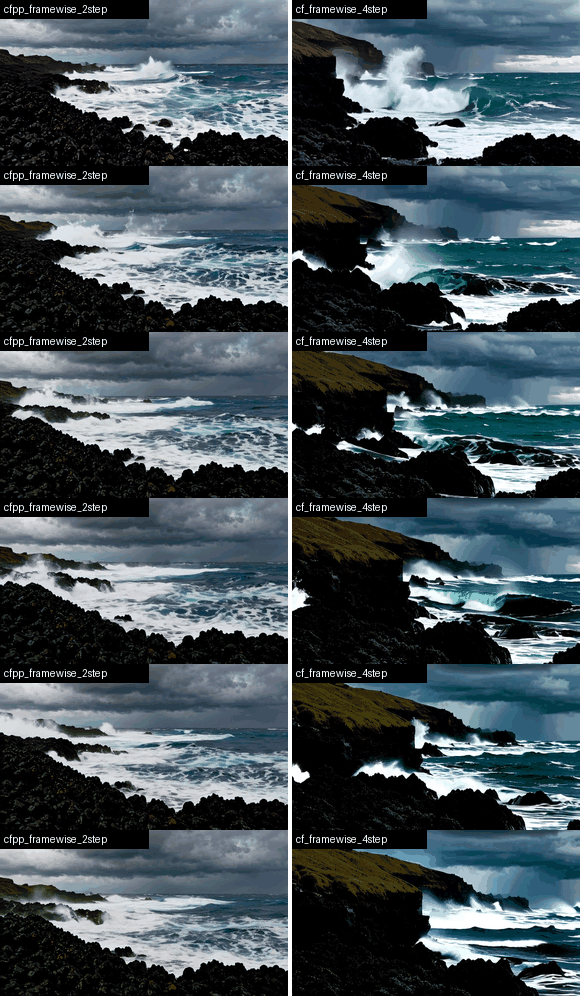
Left: Causal Forcing++ frame-wise 2-step; right: Causal Forcing frame-wise 4-step; same prompt, seed and initial noise (different trained checkpoints, so the videos differ). Reduced preview; full-resolution MP4s are in the v0.1.0 release.
Results (RTX 5090, WSL2, 832x480, 81 frames)
Warm runs, mean of 6 videos (3 prompts x 2 seeds) per model; details, cold start and raw records in docs/BENCHMARKS.md.
| Model | Generator forwards per video | Generator | Inference total (text encode + generator + VAE) | Whole GPU peak |
| --- | --- | --- | --- | --- |
| cfpp_framewise_2step | 65 (2 steps per frame, 4 for the first frame, + 21 context updates) | 7.05 s | 12.31 s | 20.3 GB |
| cf_framewise_4step | 105 (4 steps per frame + 21 context updates) | 10.97 s | 16.29 s | 20.3 GB |
- Same output as the official script: for the same prompt and seed, the
official
inference.pyand this package produce identical initial noise, identical latents and identical 8-bit frames for both models (check). - The 2-step model's generator was 1.56x faster than the 4-step model's here; end to end 1.32x. MP4 playback is 16 fps; these are not real-time or paper latency figures (other GPU, other measurement).
- Quality: by eye, both models gave coherent videos for all 6 prompt/seed pairs; the 4-step model moves the camera and subjects much more, the 2-step model keeps steadier shots. Six pairs are not a quality benchmark.
Status
| | Scope |
| --- | --- |
| Tested (real weights) | ComfyUI v0.38.0 on Windows 11 with a WSL2 Ubuntu 24.04 runtime (torch 2.8.0+cu128, flash-attn 2.8.3), RTX 5090 32 GB. Text-to-video with both models (frame-wise 2-step and 4-step), 832x480x81, batch 1, bit-identical to the official script. Through ComfyUI's HTTP API: generation with Save Video, image-to-video with the 2-step model, Doctor, cancel, timeout and runtime errors (no process left behind, GPU memory back to idle). Clean install from git archive. |
| Tested (CPU CI) | Ubuntu and Windows: config and job validation, argv/environment construction, the enforced forward counts, real subprocess control with a fake runtime (cancel/timeout stop the whole process tree on Linux), node registration and validate_prompt in a real ComfyUI checkout, VIDEO outputs, the image input. |
| Not verified yet | cfpp_framewise_1step and cf_chunkwise_4step are accepted by the runner (official configs and checkpoints) but were not run for this release; the Doctor and the runner check their schedules, but there is no real-weight result. Image-to-video with the 4-step model. |
| Untested | Linux ComfyUI hosts with real weights, other GPUs, GPUs below 32 GB, other resolutions or lengths. |
| Not supported | Long video / Rolling Forcing, the HY1.5 8B models, training, native Windows runtimes. A persistent worker (as in ComfyUI-MonarchRT 0.2.0) is not part of this release: every job starts a runtime process (model load about 35-42 s plus the first prompt encoding on this machine). |
Install
- Install the node: clone this repository into
ComfyUI/custom_nodes/(no Python dependencies are added to ComfyUI). - Set up a runtime and download the weights: docs/SETUP.md.
- Register the runtime in
ComfyUI/user/causalforcing.runtimes.json(template: examples/causalforcing.runtimes.example.json), restart ComfyUI and run Causal Forcing Doctor. - Load workflows/causalforcing_2step_vs_4step.json
(or
causalforcing_i2v_2step.json), select your runtime and queue it.
How it works
ComfyUI writes a schema-checked job file into a fresh job folder and starts
runtime/cf_job.py with the runtime's Python (wsl.exe -d <distro> --exec ... on Windows). The runner imports the pinned upstream code unmodified and
follows the official inference.py for each video:
- the official config of the model; the checkpoint key the official command
uses (
generator_emawith--use_ema); FSDP prefixes mapped explicitly and every generator tensor loaded withstrict=True(upstream falls back tostrict=False; this package refuses a partial load); set_seed(seed)right before the noise, as the official script;- the official step lists including the 4-step first frame of the 1/2-step models, timestep warping, re-noising, the clean-context KV update per frame and the KV-cache reset per video, all inside the unmodified upstream pipeline; the runner counts the generator calls and fails on a mismatch;
- for image-to-video, the official transform (resize to 832x480, normalise) and VAE encoding of the first frame;
- every
torch.loadwithweights_only=True.
Details: docs/SECURITY.md, docs/TESTING.md, docs/BENCHMARKS.md, docs/LICENSING.md.
This package is separate from ComfyUI-MonarchRT (same author): Causal Forcing and MonarchRT are different methods, and each package runs its own upstream in its own runtime.
Registry
Comfy Registry node id causalforcing (publisher hiroki-abe-58); see the
release notes for the current state.
License
Apache License 2.0 for this repository. Upstream code and weights are installed separately under their own licenses; see docs/LICENSING.md.
Citation
If you use Causal Forcing, cite the papers:
@article{zhu2026causal,
  title={Causal Forcing: Autoregressive Diffusion Distillation Done Right for High-Quality Real-Time Interactive Video Generation},
  author={Zhu, Hongzhou and Zhao, Min and He, Guande and Su, Hang and Li, Chongxuan and Zhu, Jun},
  journal={arXiv preprint arXiv:2602.02214},
  year={2026}
}

@article{zhao2026causal,
  title={Causal Forcing++: Scalable Few-Step Autoregressive Diffusion Distillation for Real-Time Interactive Video Generation},
  author={Zhao, Min and Zhu, Hongzhou and Zheng, Kaiwen and Zhou, Zihan and Yan, Bokai and Li, Xinyuan and Yang, Xiao and Li, Chongxuan and Zhu, Jun},
  journal={arXiv preprint arXiv:2605.15141},
  year={2026}
}