
ComfyUI-ThinkingLLM
A multimodal ComfyUI AI node with Qwen3.5, Qwen3-VL, Qwen2.5-VL, Qwen3, and Gemma 4 integrations. Features live thinking in the terminal to see what the LLM is doing in real time.
Nodes (12)
Split one long story into four video prompts, then stitch it back together
A local LLM that actually listens
Cloud LLMs from ComfyUI — without ever putting a key in a workflow
Your node isn't frozen — it's thinking
The same Qwen node, minus the training wheels
Vision LLMs on the VRAM you actually have
Every llama.cpp dial, exposed and explained
Cheap, fast prompt enhancement on a text-only GGUF
A local LLM that writes your prompts better than you do
Steal ThinkingLLM's system prompts for any node that takes a string
Turn any audio into text your LLM can read
VRAM-Cleanup
ComfyUI-ThinkingLLM
ThinkingLLM is a multimodal local-LLM node pack for ComfyUI. It provides clean workflows for Qwen, Gemma 4, GGUF, Whisper ASR, prompt enhancement, image/video understanding, audio analysis, and secure OpenAI-compatible providers.
GPL-3.0 fork of Deaquay/ComfyUI-Qwen3.5-Uncensored, itself derived from huchukato/ComfyUI-QwenVL-Mod and 1038lab/ComfyUI-QwenVL. See LICENSE.
.gif)
Highlights
- Local Transformers/Hugging Face and GGUF inference
- Image and video understanding with optional mask-focused analysis
- Gemma 4 audio understanding and Whisper speech-to-text
- Prompt enhancers for image and video generation workflows
- Thinking-mode control, live terminal streaming, and a separate
RAW_TRACEoutput - Curated model recommendations and preset-specific generation guidance
- Secure OpenAI-compatible API node for approved remote providers
- Existing compatible models are discovered instead of downloaded twice
Quick install
ComfyUI Manager (recommended)
- Open ComfyUI Manager → Install via Registry.
- Search for
ThinkingLLM. - Click Install and restart ComfyUI.
Manual install
cd ComfyUI/custom_nodes
git clone https://github.com/goodguy1963/ComfyUI-ThinkingLLM.git
cd ComfyUI-ThinkingLLM
pip install -r requirements.txt
For GGUF vision or Gemma 4 audio, also follow the llama.cpp backend installation guide.
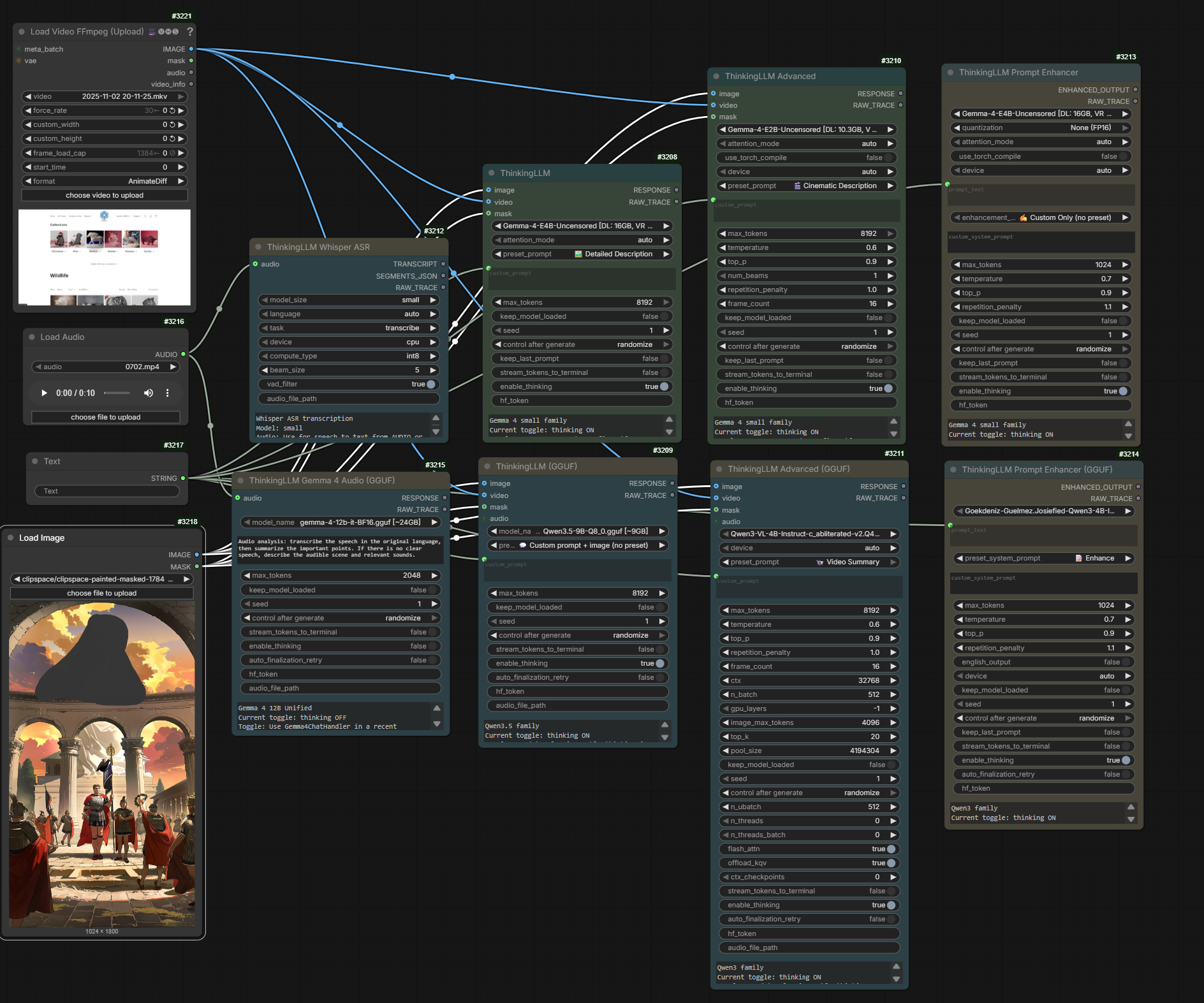
Nodes at a glance
| Node | Backend | Purpose |
| --- | --- | --- |
| ThinkingLLM | Transformers / HF | Image and video understanding |
| ThinkingLLM (Advanced) | Transformers / HF | Full controls and MASK_PREVIEW |
| ThinkingLLM Prompt Enhancer | Transformers / HF | Text prompt enhancement |
| ThinkingLLM (GGUF) | llama.cpp | GGUF image and video understanding |
| ThinkingLLM (GGUF Advanced) | llama.cpp | GGUF advanced controls and MASK_PREVIEW |
| ThinkingLLM Gemma 4 Audio (GGUF) | llama.cpp | Gemma 4 audio understanding |
| ThinkingLLM Whisper ASR | faster-whisper | Speech-to-text transcription |
| ThinkingLLM Prompt Enhancer (GGUF) | llama.cpp | GGUF prompt enhancement |
| ThinkingLLM System Prompt Preset | Utility | Reusable system prompts as STRING |
| ThinkingLLM API (OpenAI Compatible) | Remote API | Approved OpenAI-compatible providers |
The Transformers/HF nodes are the recommended default when you want the simplest installation. Choose GGUF when you specifically need quantized llama.cpp models or Gemma 4 audio.
Start a workflow
- Add the ThinkingLLM node that matches your backend and task.
- Select a model or an already installed local model.
- Connect image, video, audio, mask, or text inputs as needed.
- Connect
RESPONSEorENHANCED_OUTPUTto a text display or downstream prompt input. - Connect
RAW_TRACEwhen you want generation diagnostics.
Useful defaults:
- Start with
enable_thinking=falsefor transcription and short direct answers. - Enable
stream_tokens_to_terminalwhen diagnosing a slow or unhelpful generation. - Resize very large images before inference to reduce context and memory pressure.
- Use the dedicated Gemma 4 Audio or Whisper node instead of assuming every multimodal model supports audio.
For explanations of thinking mode, model guidance, raw traces, audio, masks, and object-removal prompting, see Features and workflows.
Model families
ThinkingLLM includes curated entries for:
- Qwen3.8, Qwen3.5, Qwen3-VL, Qwen2.5-VL, and Qwen3
- Gemma 4 vision, text, and audio-capable GGUF variants
- Whisper
tinythroughlarge-v3anddistil-large-v3 - Local compatible Transformers checkpoints and GGUF/mmproj pairs
See Models and backends for exact families, model locations, local discovery, platform notes, and backend requirements.
Remote API node
ThinkingLLM API (OpenAI Compatible) supports approved OpenAI-compatible providers while keeping credentials on the ComfyUI server. Provider keys are not stored in workflows.
Documentation
| Topic | Guide | | --- | --- | | Thinking, streaming, traces, audio, masks, and workflow behavior | Features and workflows | | Supported models, discovery, locations, and backend selection | Models and backends | | GGUF / llama.cpp installation on Windows and Linux | llama.cpp backend installation | | Duration-aware LTX and MiniMax H3 prompting | Duration-aware video prompts | | Video preset recommendations and rationale | Video preset settings | | OpenAI-compatible API node | API setup and security | | OpenAI-compatible image inputs | API image inputs | | Maintainer and fork notes | Maintainer notes |
Production deployment
This repository provides ComfyUI nodes, not a complete production runtime. For exposed or serverless workflows, review dependency locking, validation, secrets, cost controls, monitoring, and rollback before deployment. The ComfyUI on RunPod production-readiness checklist is a useful starting point.
Credits
- Deaquay/ComfyUI-Qwen3.5-Uncensored
- huchukato/ComfyUI-QwenVL-Mod
- 1038lab/ComfyUI-QwenVL
- Qwen Team (Alibaba Cloud)
- JamePeng/llama-cpp-python
- comfyanonymous/ComfyUI
Maintainer: goodguy1963
License
GPL-3.0. See LICENSE.