
😸 YFG Comical Nodes
Utility custom nodes for special effects, image manipulation and quality of life tools.
Nodes (26)
A whole seed row on one dropdown
15 images, one dropdown, and a diagram that shows the active path
The top end of the YFG switcher family
Turn an image into a contrast mask for inpainting or compositing
Upload a render to imgBB and get a shareable URL, straight from the graph
A 3-way image switch with a routing diagram, so you can see what you picked
A 5-way image switch that tells you which slot is live
Turn a photo into a halftone, CMYK screen angles included
See the tonal range before you judge the render
One histogram, two outputs, zero clutter — the compact analyzer
A before/after node that labels itself, so you actually know which side is which
Load any image from a URL — or a base64 string, or a local path
Six threshold modes, three channels — the swiss-army monochrome clipper
The two-line resize that turns renders into pixel art
The folder-aware random image picker with a built-in file browser
True randomness from atmospheric noise — the version that keeps your key in the graph
True random numbers without ever typing your key into the graph
The checkpoint loader that flattens your folder chaos
The workflow-persistence trick
Stamp text onto a mask — the node for watermarks and annotations
See your render without wiring a second node
The save node that speaks A1111 so CivitAI can read it
Your CivitAI uploads keep showing 'no resources used'? This node fixes that.
A monitor node that lives in the title bar
Random prompts from a .txt, with your negative strings intact
Stop rewiring StringConcatenate every time — flip your prompt order with one click.
YFG Comical ComfyUI Custom Nodes
</div>A collection of ComfyUI utility custom nodes. These provide functionality not offered in the core app or other custom nodes. Several nodes enhance existing ideas with improved UX and quality-of-life features.
- YFG Comical ComfyUI Custom Nodes
- Nodes
- Image Histograms Generator
- Image Histograms Generator (compact)
- Image Halftone Generator
- Image Side by Side
- Image to imgBB
- Smart Checkpoint Loader
- Mono Clip
- VAE Decode with Preview
- Image to Contrast Mask
- PixelArt
- Text Mask Overlay
- Image Switchers
- Random.org True Random Number
- Random.org True Random Number (V2)
- Random Image From Directory
- Random Prompt From File
- Display Value
- CivitAI MetaSave
- CivitAI MetaSave V2
- Live Preview Panel
- Power Lora Loader Extras
- Text Concat Swap
- Examples
- All nodes as of 06-13-2024
- Acknowledgements
- Nodes
<small><i><a href="http://ecotrust-canada.github.io/markdown-toc/">Table of contents generated with markdown-toc</a></i></small>
Nodes
Image Histograms Generator
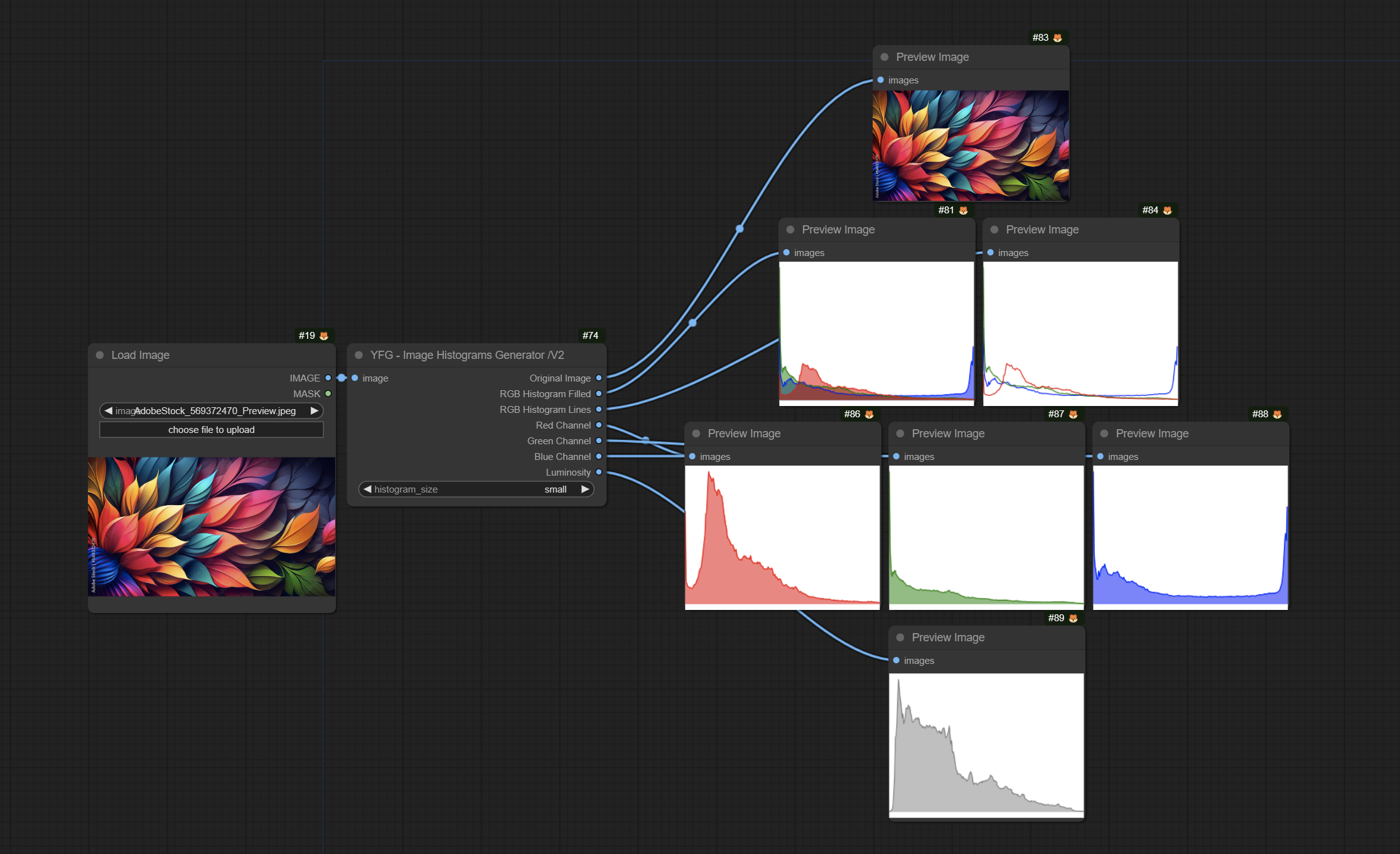
Calculate image histograms for RGB channels and L (luminance); displays a graphical representation.
Image Histograms Generator (compact)
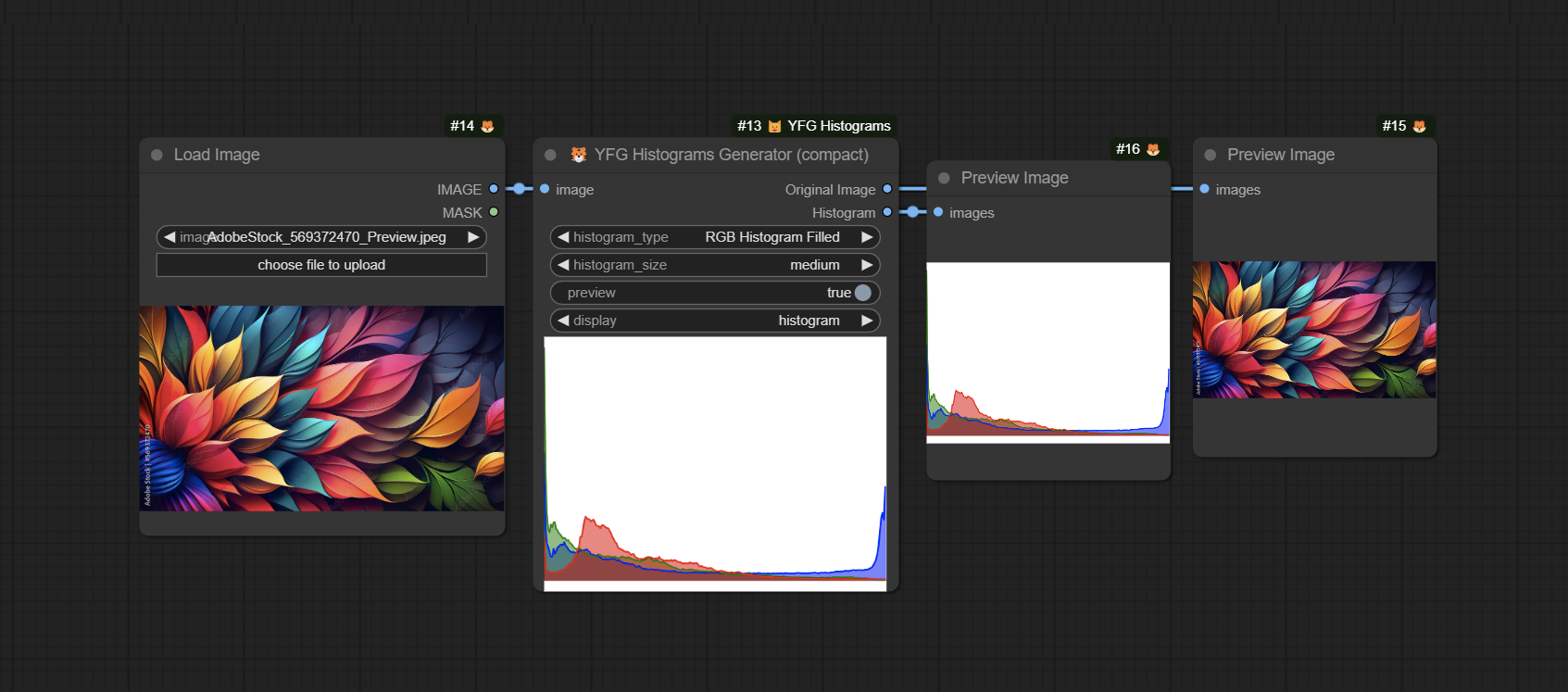
Reduces outputs to just two: Original and Histogram. Can self-preview (original or histogram) and forward the selected histogram downstream.
Image Halftone Generator
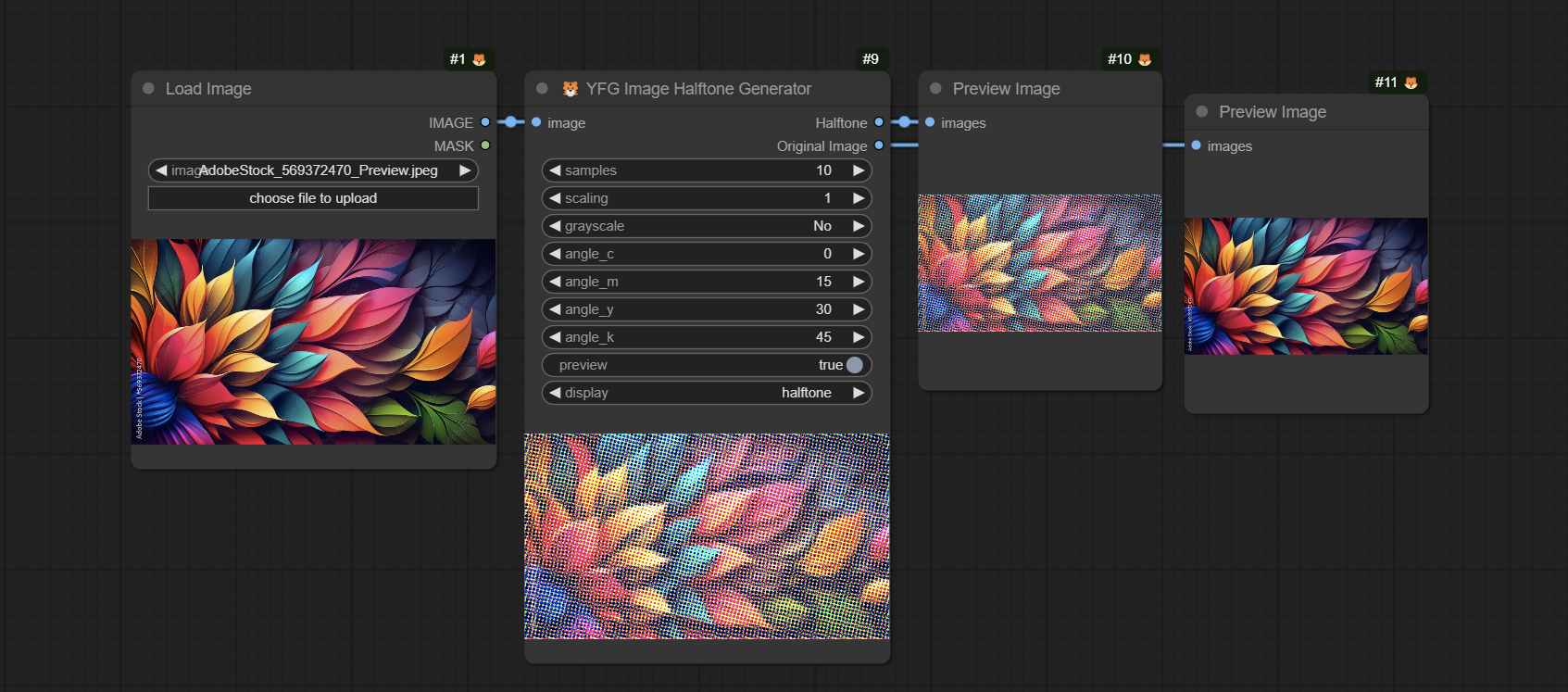
Based on original code by Phil Gyford and ComfyUI node by aimingfail.
Generates halftone from an input image; can self-display or send output to other nodes.
Image Side by Side
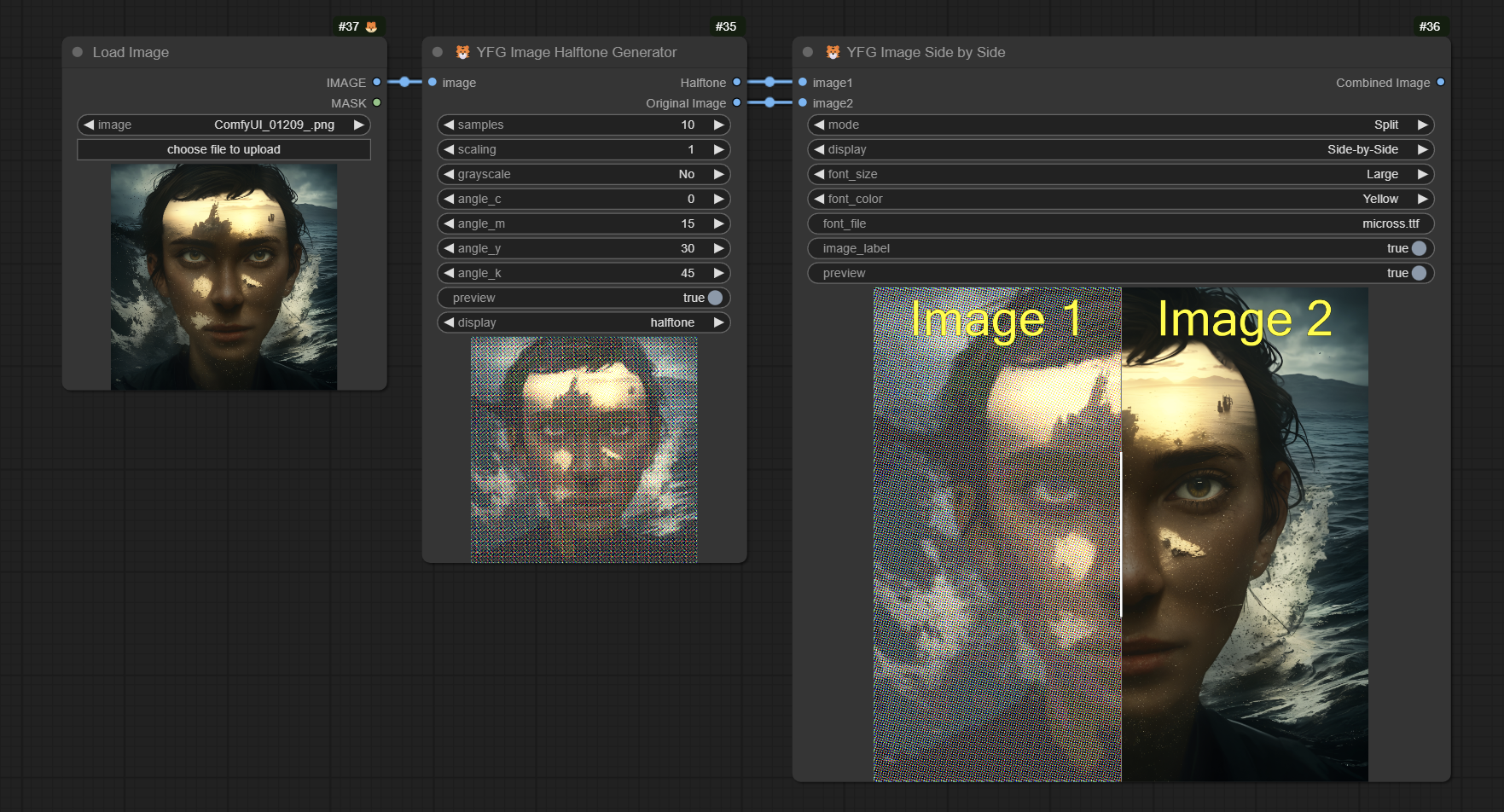
Creates a side-by-side or split image from two inputs. Optional self-preview, headers (font/size/color), and label toggles.
Example (side-by-side instead of split):
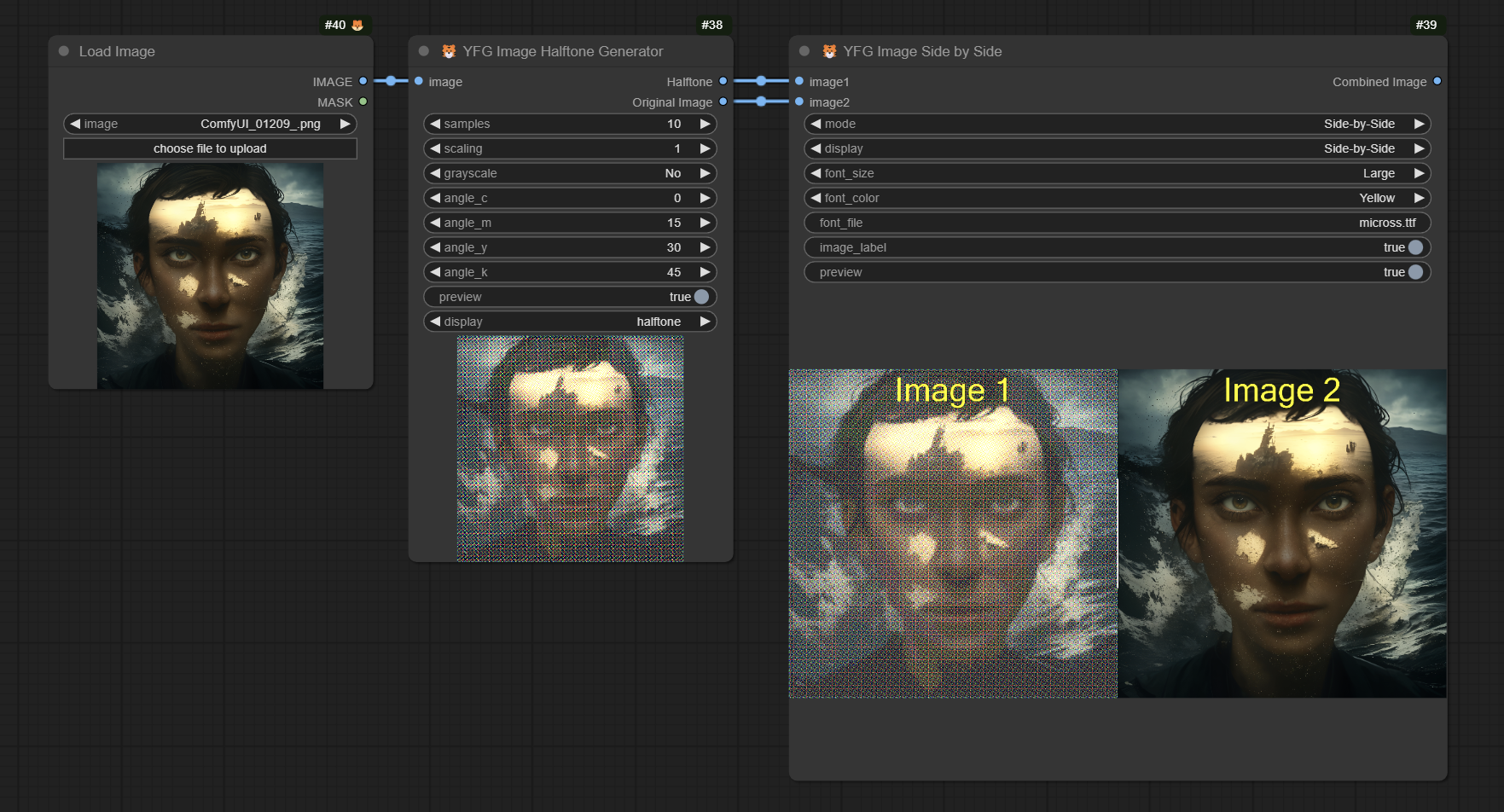
Image to imgBB
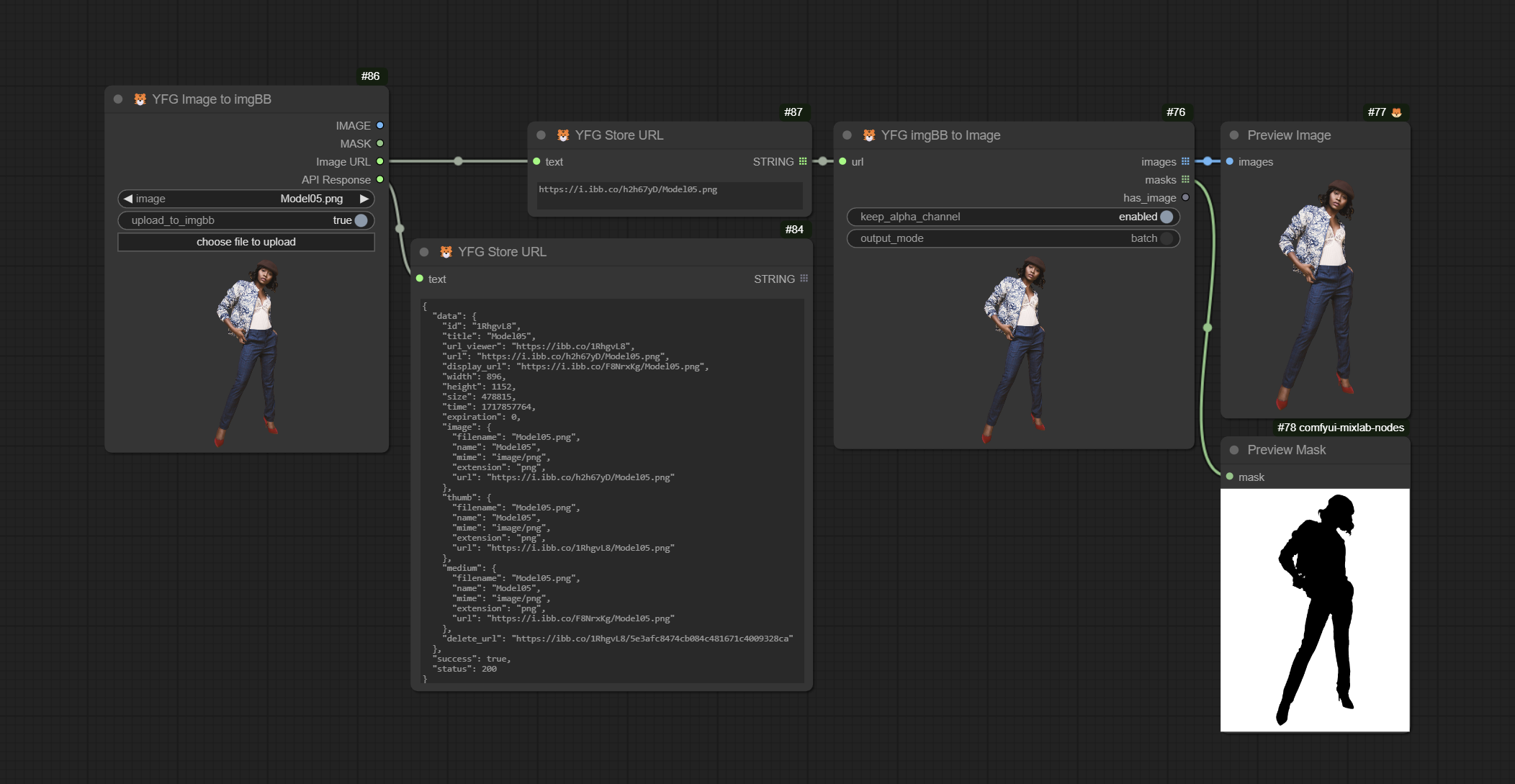
Upload and download images to/from imgBB. Includes nodes for downloading images and a URL "storage" node that keeps the original link alongside the workflow.
Setup
Create imgbb_api_key.json under ./loaders/:
{
  "api_key": "YOUR_API_KEY_HERE"
}
Obtain a key at https://api.imgbb.com/.
Smart Checkpoint Loader
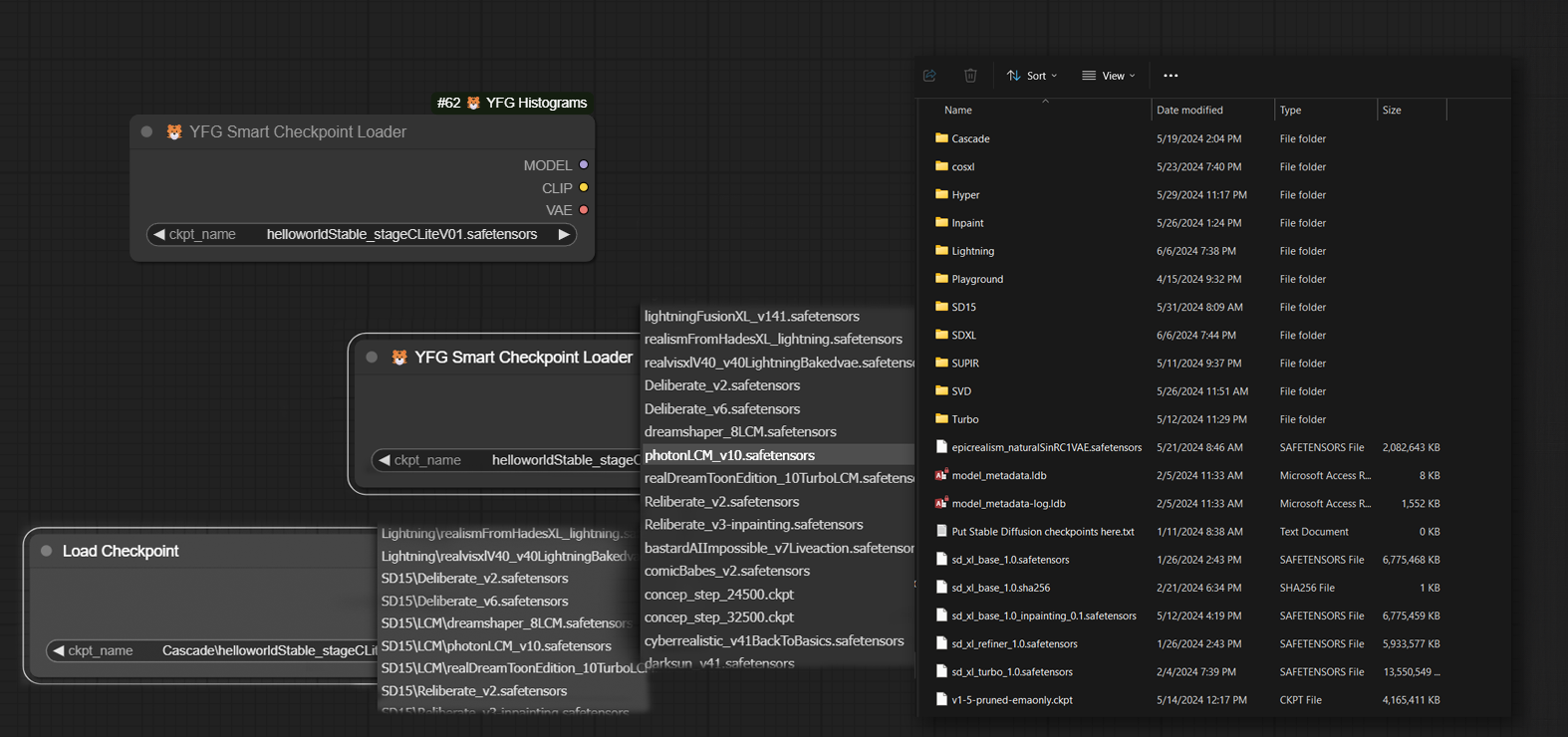
Drop-in replacement for the core "Load Checkpoint," but flattens complex directory trees so checkpoints appear as if in a single folder — ideal for sharing workflows.
Mono Clip
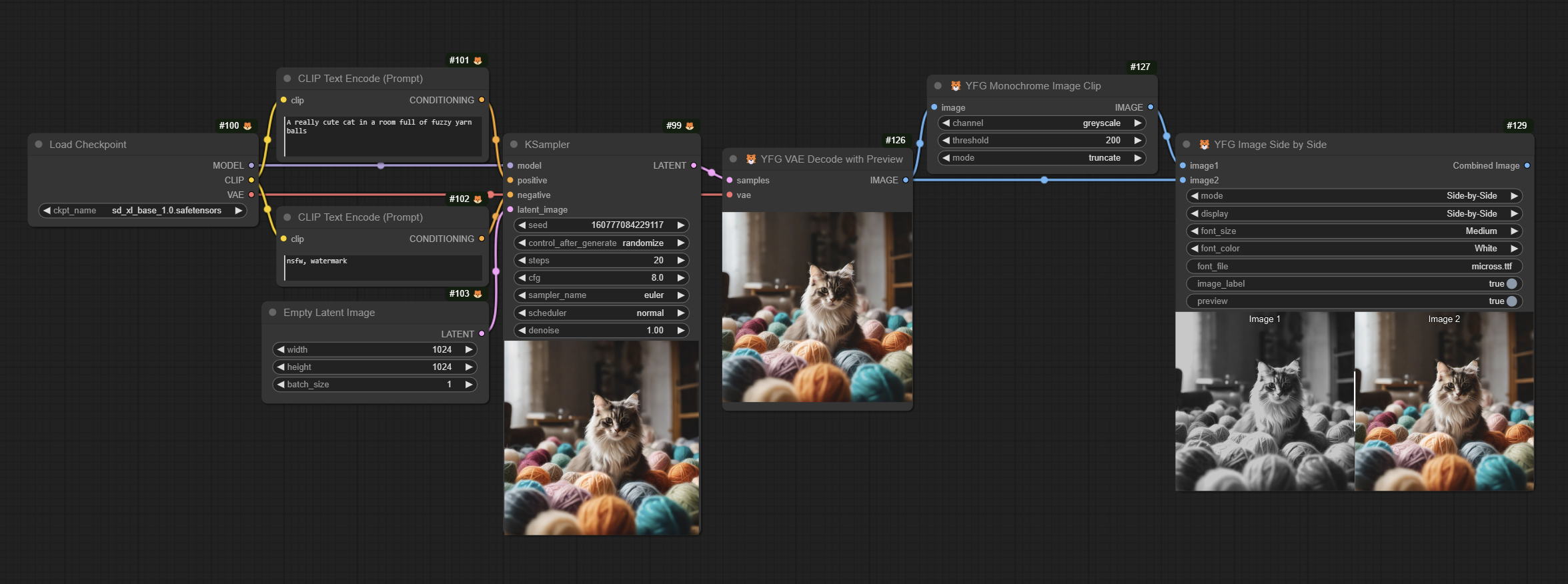
Produces B/W or grayscale clipped images with three modes (each reversible). Useful for masks and stylization.
Based on original code by XSS.
VAE Decode with Preview
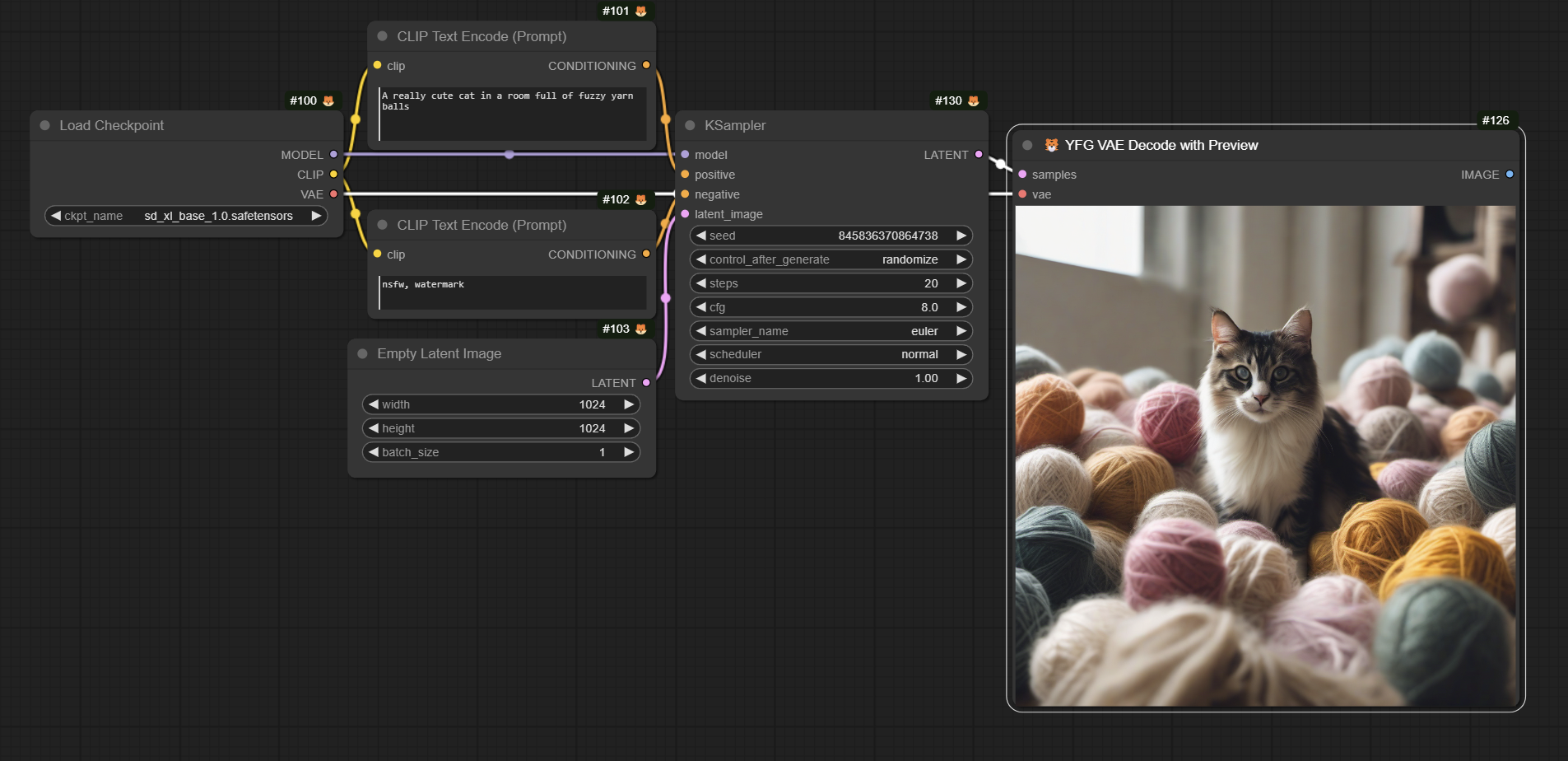
VAE decode with inline preview and QoL options.
Based on original code by XSS.
Image to Contrast Mask
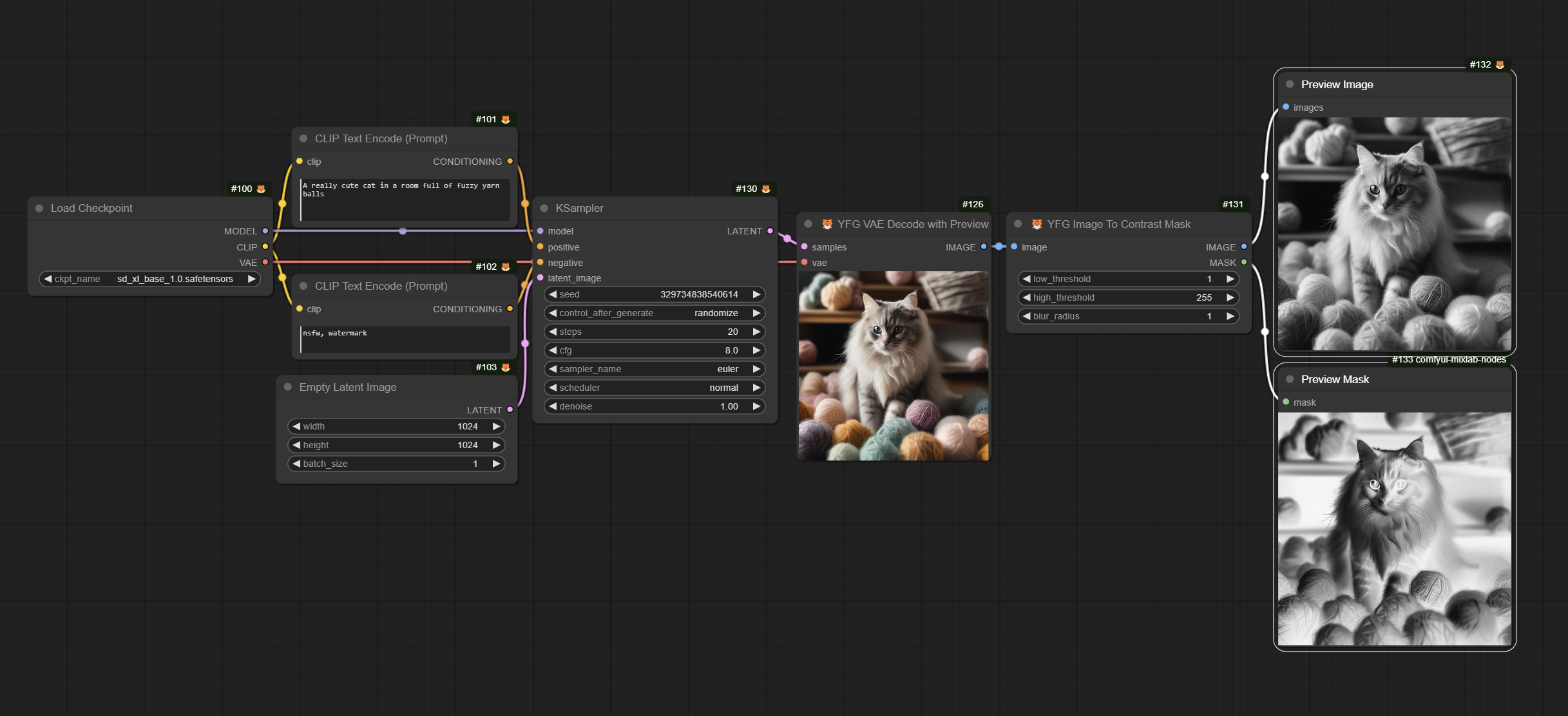
Creates a grayscale contrast mask. Select low/high thresholds (1–255), optional blur.
Based on original code by XSS.
PixelArt
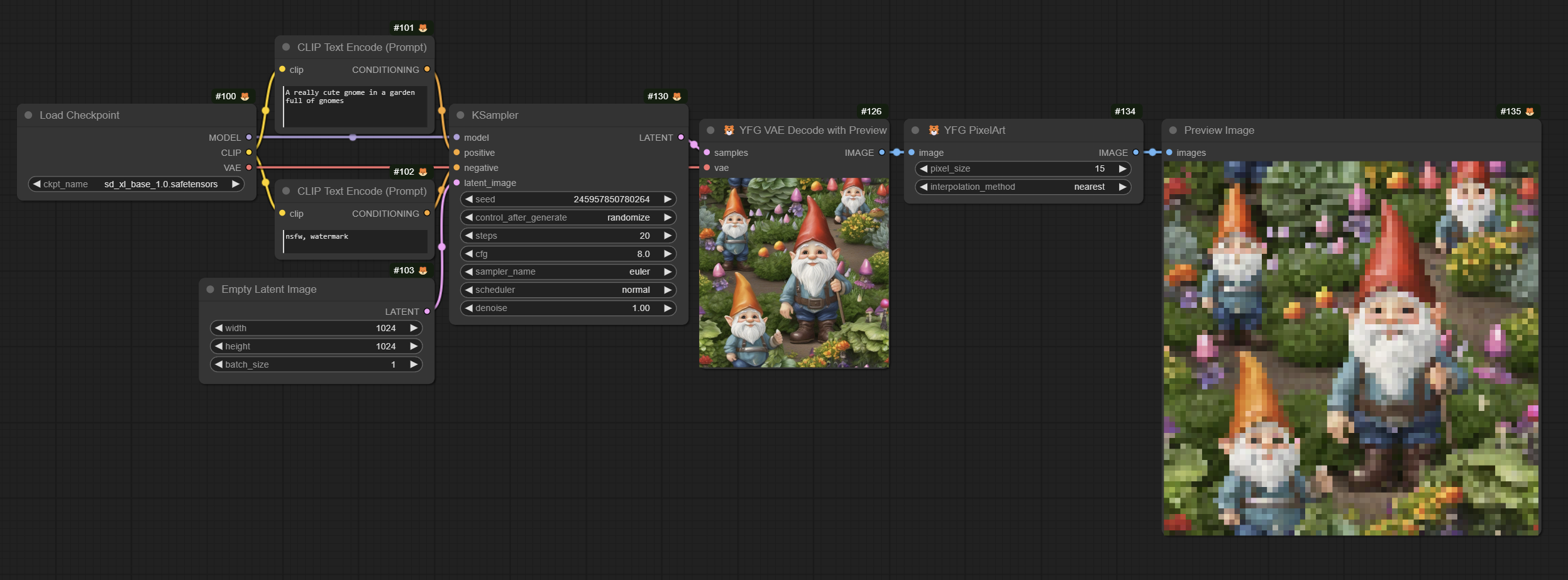
Generates pixel-art style images. Choose interpolation and pixel size.
Based on original Mosaic code by XSS.
Text Mask Overlay
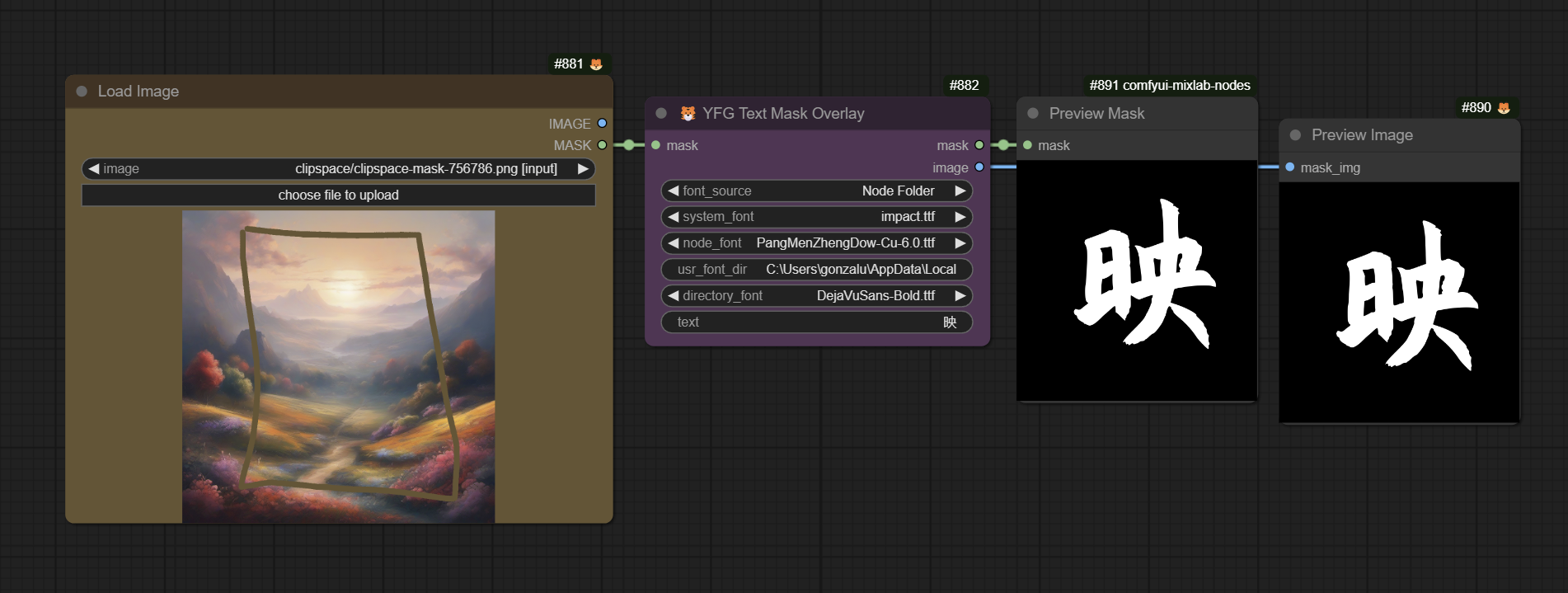
Enhances the idea by Yuigahama Yui:
- Choose fonts from System, User, or local
./fonts/directory. - Built-in Mask-to-Image conversion (no extra converter needed).
Example
| <a href="img/textMaskOverlay01original.png"><img src="img/textMaskOverlay01original.png" alt="Text Mask Overlay Example" width="400"/></a> | <a href="img/textMaskOverlay01.png"><img src="img/textMaskOverlay01.png" alt="Text Mask Overlay Example" width="400"/></a> | | :-: | :-: | | Original | Output |
Example workflow JSON (also embedded in the image below):

Based on the ComfyUI-Text node by Yuigahama Yui.
Image Switchers
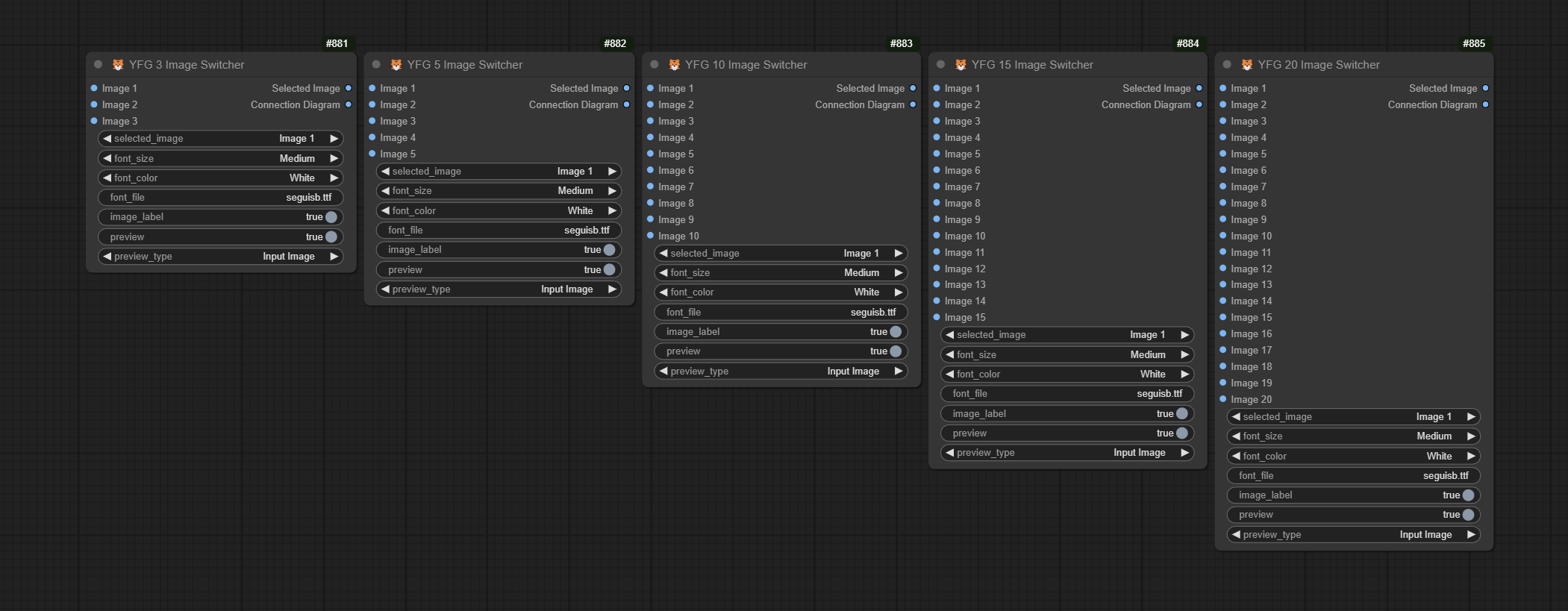
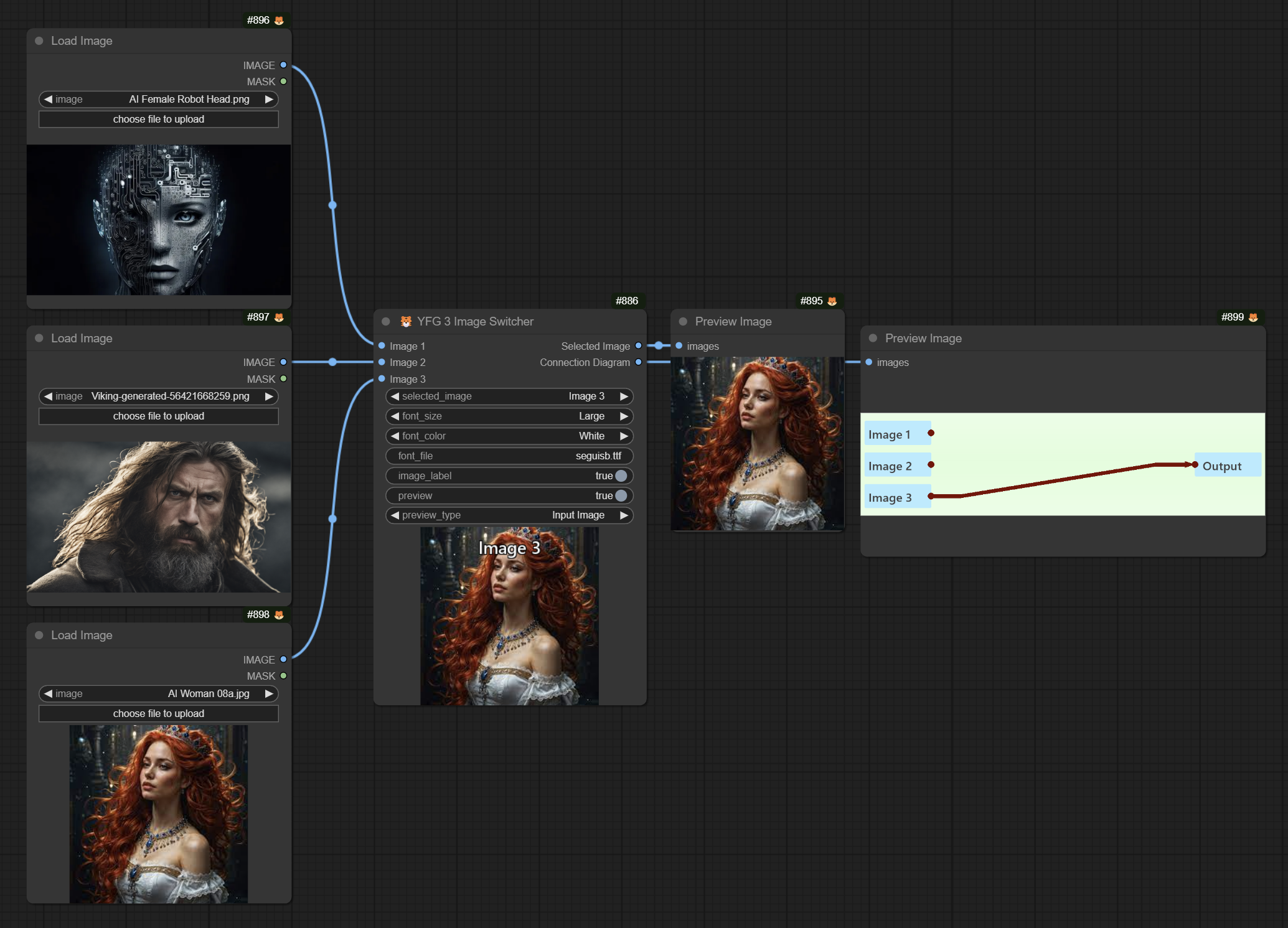
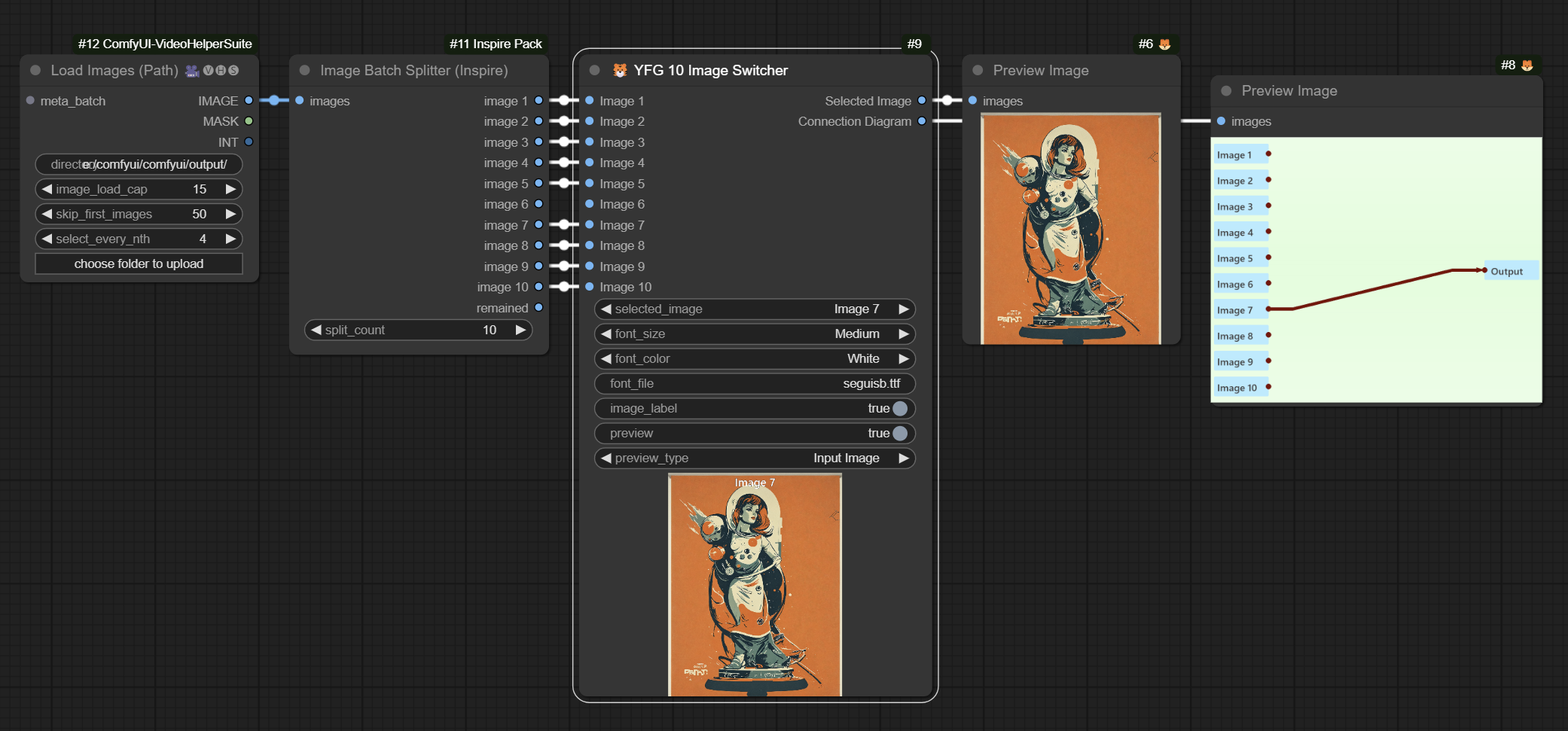
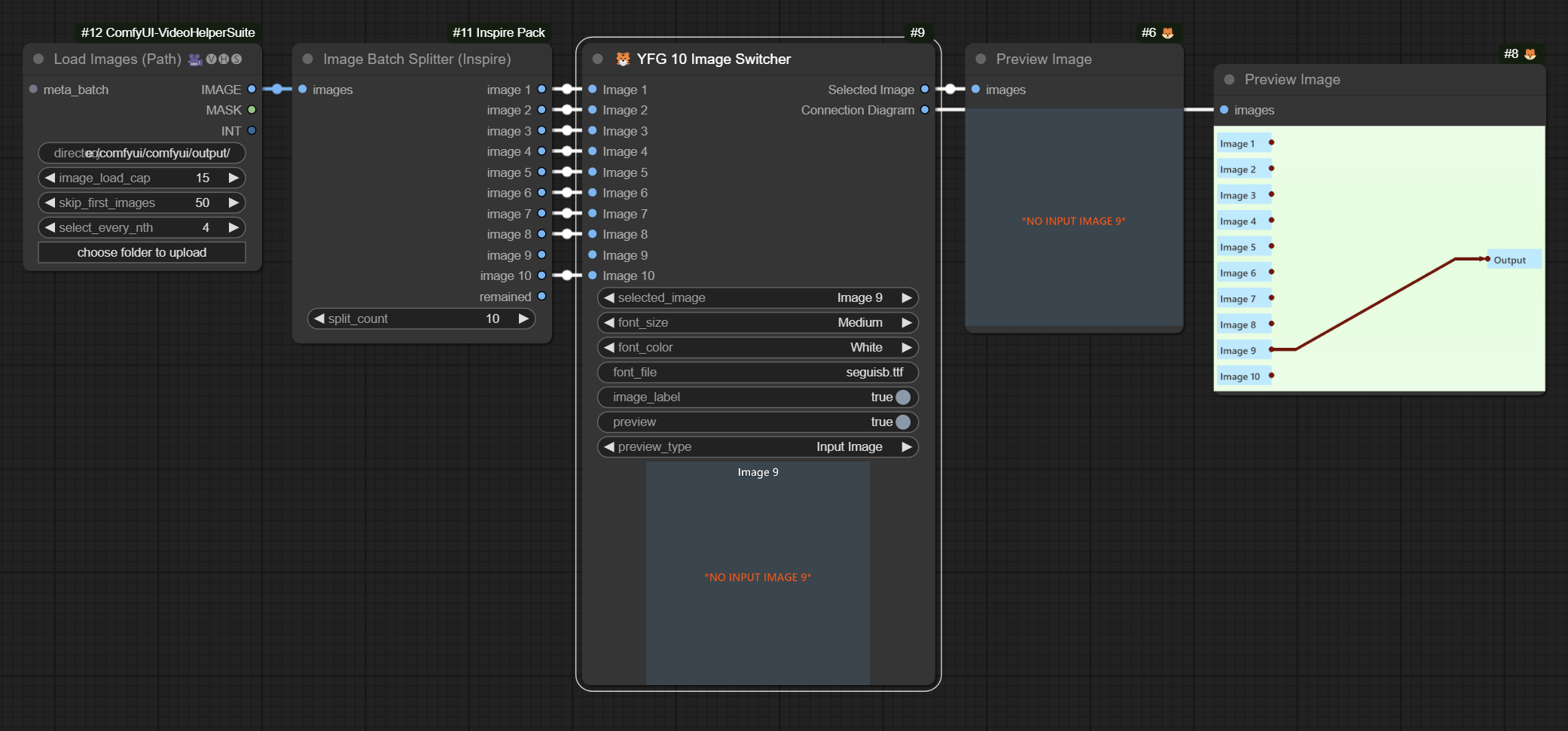
Multi-input image switchers (3, 5, 10, 15, 20 inputs). Provide a routing matrix, inline preview, and graceful handling of missing inputs (with user warnings). Designed to avoid "ganged" switcher confusion in complex workflows.
Random.org True Random Number
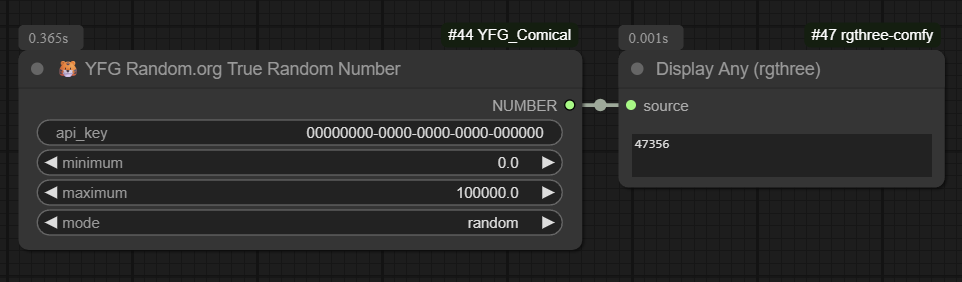
Modified version of the WAS node (original wasn't functioning). Requires a Random.org account and API key.
Based on original code by WASasquatch.
Random.org True Random Number (V2)
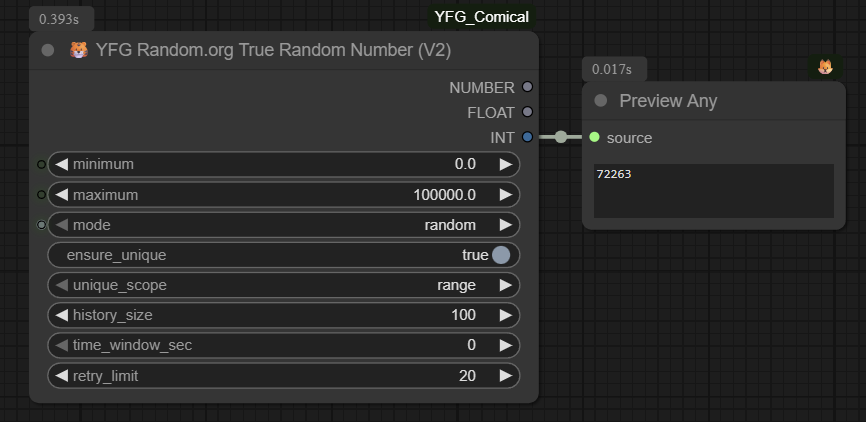
Integrates with the random.org JSON-RPC API to generate true random numbers from atmospheric noise.
✨ Features
-
Secure API key handling
Key is not exposed in UI, workflow JSON, or image metadata. Loaded at runtime from:- Environment variable
RANDOM_ORG_API_KEY, or - Local JSON file
random_org_api_key.jsonnext toRandomOrgV2.py.
- Environment variable
-
Flexible outputs
Emits three types for broad node compatibility:NUMBERFLOATINT
-
Optional uniqueness filtering (in-memory)
Avoid repeats within a Python session:ensure_unique— toggle de-duplicationunique_scope—"range"(per[min, max]) or"global"(across all ranges)history_size— how many values to remembertime_window_sec— ignore duplicates older than this windowretry_limit— extra draws to try before giving up
-
Backwards compatible
Old node remains available asRandomOrgTrueRandomNumber_node.
New node isRandomOrgV2TrueRandomNumber_node.
🔑 API Key Setup
-
Create
random_org_api_key.jsonnext toRandomOrgV2.py:{ "api_key": "YOUR_API_KEY_HERE" } -
Or set an environment variable before launching ComfyUI:
export RANDOM_ORG_API_KEY=YOUR_API_KEY_HEREOn Windows (PowerShell):
setx RANDOM_ORG_API_KEY "YOUR_API_KEY_HERE"
⚙️ Example Usage
-
Generate a random integer between 1 and 100
minimum = 1maximum = 100mode = random
-
Ensure no repeats in the current range
- Enable
ensure_unique - Set
unique_scope = range - Adjust
history_sizeandtime_window_sec
- Enable
📌 Notes
- Session-lifetime uniqueness resets when Python restarts.
- Persistence (disk-based history) may be added in a future version.
- API limits: Random.org quotas apply — check your dashboard.
Random Image From Directory
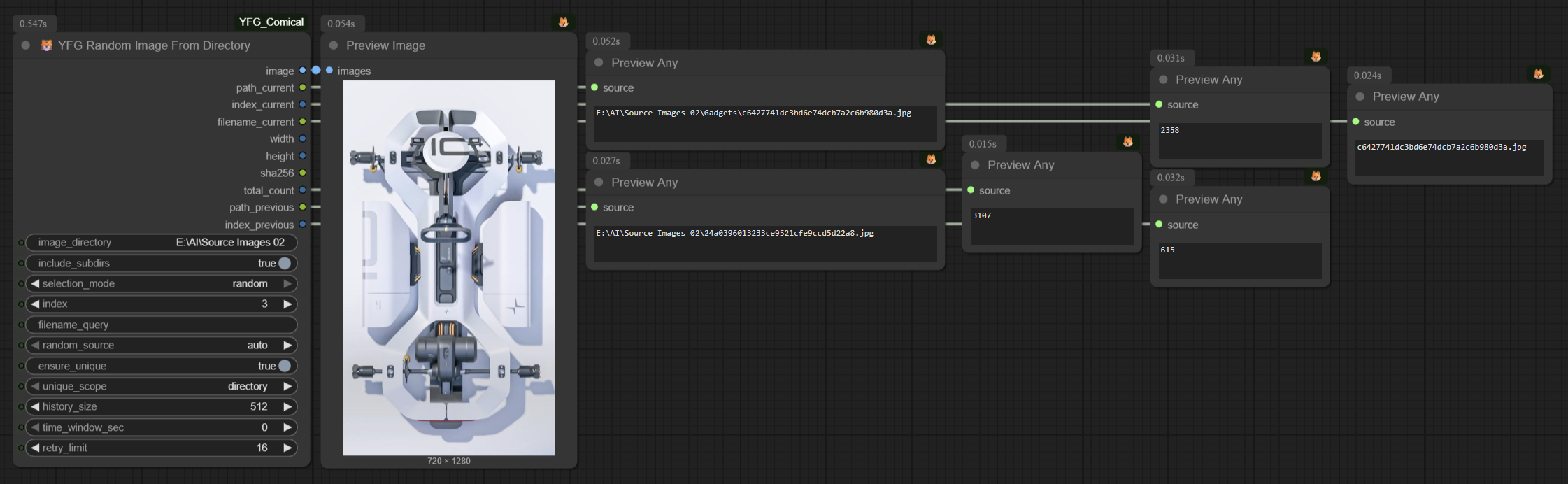
This node selects a single image from a given directory (with optional recursion into subdirectories).
It supports true randomness (via Random.org integration if configured) or deterministic selection by index/filename.
It also tracks previously selected images so you can compare "current" vs "previous" outputs.
✨ Features
- Built-in directory browser
- 📁 Browse for Directory button opens a navigable server-side folder picker — no need to type paths manually.
- 🕐 Recent Directories button shows an MRU list of previously used directories for quick re-selection.
- Used directories are saved automatically to
yfg_dir_history.jsonon each run.
- Inline output value display
- Key output values (
index_current,width,height,total_count,index_previous) are shown directly on the output slots after each run — no external display nodes needed. 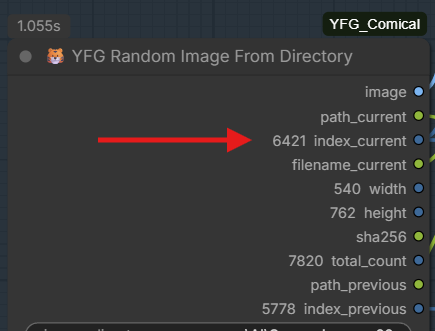
- Key output values (
- Directory traversal
- Select only from the top folder, or include all subdirectories.
- Multiple selection modes
random: choose a random image (true random if Random.org is enabled, otherwise local PRNG).by_index: pick image by numeric index (clamped to valid range — no wrap-around).by_filename: select a file by exact name or substring.by_query: glob-style matching (*.png,cat*, etc.), random among matches.
- Uniqueness filtering
- Avoids repeating the same file within the same session.
- Scope can be per-directory or global.
- Adjustable
history_sizeandtime_window_secfor fine control.
- Metadata outputs
- Current/previous file info, image size, and SHA256 hash of the file.
- Also reports
total_count= number of eligible images found.
🔧 Input Parameters
image_directory(string) – Path to the folder containing images.include_subdirs(bool, default: True) – Whether to scan subdirectories.selection_mode(choice, default: random) – Image selection method.index(int) – Used whenselection_mode=by_index.filename_query(string) – Used whenselection_mode=by_filenameorby_query.random_source(choice, default: auto) –auto: use Random.org if API key is configured, else local PRNG.local: always use local PRNG.random_org: force Random.org usage (requires API key).
ensure_unique(bool) – Prevent repeats during a session.unique_scope(choice) –"directory"or"global".history_size(int, default: 512) – Max remembered items.time_window_sec(int, default: 0) – Forget items older than this many seconds.show_preview(bool, default: False) – Show a preview thumbnail on the node after each run.retry_limit(int, default: 16) – Max retries when avoiding duplicates.
🖥️ Outputs
image– The loaded image tensor.path_current– Full path of the selected image (current).index_current– Index of the selected image (current).filename_current– Filename of the selected image.width– Width of the image in pixels.height– Height of the image in pixels.sha256– SHA256 checksum of the file (useful for deduplication).total_count– Total number of eligible images discovered in the directory (after filters).path_previous– Full path of the image from the previous run.index_previous– Index of the image from the previous run.
🔑 Random.org Setup (optional)
- To enable true randomness, place your API key in
random_org_api_key.jsonnext to the node:
-
Create
random_org_api_key.jsonnext toRandomOrgV2.py:{ "api_key": "YOUR_API_KEY_HERE" } -
Or set an environment variable before launching ComfyUI:
export RANDOM_ORG_API_KEY=YOUR_API_KEY_HEREOn Windows (PowerShell):
setx RANDOM_ORG_API_KEY "YOUR_API_KEY_HERE"
📌 Notes
- Current vs previous outputs make it easy to compare selections.
- Session-lifetime uniqueness resets when Python restarts.
- Directory history is persisted to
yfg_dir_history.jsonand survives restarts (max 50 entries). - API limits: Random.org quotas apply — check your dashboard.
Random Prompt From File
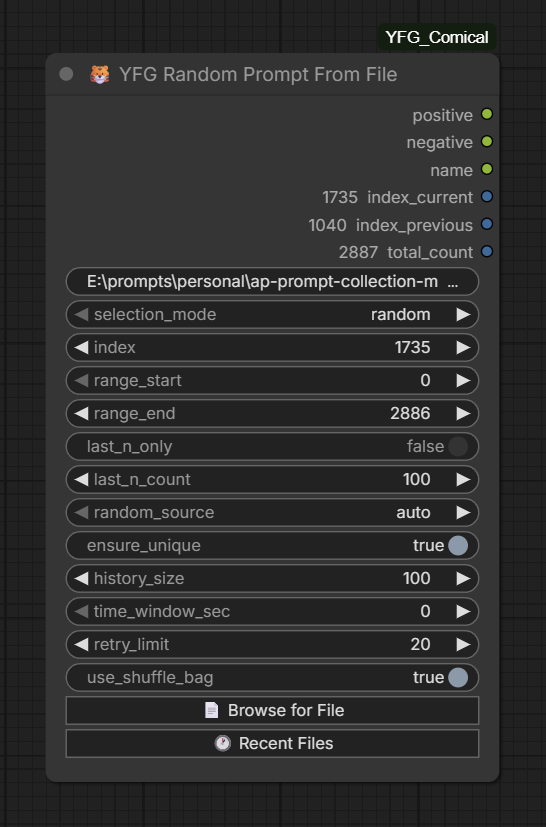
Selects a single prompt entry from a .txt prompt file using true random.org numbers (or local PRNG). Outputs positive, negative, and name text directly — no additional nodes or wiring required.
✨ Features
- Built-in file browser
- 📄 Browse for File button opens a navigable server-side file picker showing directories and
.txtfiles, with a live prompt count badge per file. - 🕐 Recent Files button shows an MRU list of previously used files for quick re-selection.
- Used files are saved automatically to
yfg_file_history.jsonon each run.
- 📄 Browse for File button opens a navigable server-side file picker showing directories and
- Auto range population
range_startandrange_endfill automatically (0 and total−1) whenever a file is selected — no manual entry needed.
- Last-N toggle
last_n_onlyrestricts the random pool to the last N entries in the file — ideal when new prompts are appended to the bottom and you want to pick only from the newest additions.
- Incremental modes
incrementalwalks the file in order, advancing one prompt per run and wrapping back to the start after the last entry — ideal for continuous batch runs.incremental_no_wrapdoes the same sequential walk but stops at the end and holds there — ideal for a single clean pass through a range with no repeats.
- Inline output value display
index_current,index_previous,total_count, andfile_nameare shown directly on the output slots after each run.
- INDEX auto-sync
- The INDEX widget updates automatically after every run so switching to
by_indexmode requires no manual typing.
- The INDEX widget updates automatically after every run so switching to
- True random.org integration
- Uses the same Random.org API key as the Random Number nodes — no separate setup needed.
- Uniqueness filtering
- Avoids repeating prompts within a session with configurable history size and time window.
- Shuffle bag
- Cycles through all prompts in the pool before repeating, then reshuffles — guarantees uniform coverage.
📄 Prompt File Format
positive: your positive prompt here

negative: ugly, deformed, watermark

----
positive: second prompt

negative:

name: Optional Label
----
- Entries separated by any number of hyphens (
-,--,----) on their own line negative:content may be emptyname:is optional — defaults to the filename stem- Leading/trailing separator lines are silently ignored
- UTF-8 encoding required
🔧 Input Parameters
prompt_file(string) – Path to the.txtprompt file. Use 📄 Browse or 🕐 Recent buttons.selection_mode(choice, default: random) – How the prompt is chosen:random– picks randomly fromrange_start..range_end.by_index– uses the INDEX widget value directly.incremental– advances one prompt per run fromrange_starttorange_end, then wraps back torange_start. See Incremental Modes below.incremental_no_wrap– same sequential walk, but stops atrange_endand holds there.
index(int) – Used whenselection_mode=by_index. Auto-syncs after every run.range_start(int, default: 0) – First prompt index in the pool. Auto-fills to 0 when a file is selected. Also the wrap-back point inincrementalmode.range_end(int, default: 0) – Last prompt index in the pool. Auto-fills to total−1 when a file is selected. 0 = last prompt. Also the wrap trigger inincrementalmode.
Out-of-range bounds are clamped, not rejected, so a bad range degrades to a usable pool instead of failing mid-queue. Every adjustment is reported in the console:
range_startbeyond the last prompt is pulled back to the last index.range_endbeyond the last prompt is pulled back to the last index.range_endbelowrange_startis an inverted range and collapses to a single entry atrange_start. Inincremental_no_wrapthat is indistinguishable from a finished walk, which is why it is called out explicitly.
last_n_only(bool, default: False) – When ON, restricts the pool to the last N entries only. Applies torandommode only.last_n_count(int, default: 100) – How many entries from the end to include whenlast_n_onlyis ON.random_source(choice, default: auto) –auto,local, orrandom_org.ensure_unique(bool, default: True) – Avoid repeating prompts within a session.history_size(int, default: 100) – How many recent indices to track for uniqueness.time_window_sec(int, default: 0) – Forget entries older than this many seconds.retry_limit(int, default: 20) – Max attempts before falling back to last candidate.use_shuffle_bag(bool, default: True) – Cycle through all prompts before repeating, then reshuffle.
🖥️ Outputs
positive– Positive prompt text.negative– Negative prompt text (empty string if not specified in file).name– Prompt name from thename:field, or filename stem if omitted.index_current– 0-based index of the selected prompt. Auto-syncs to INDEX widget.index_previous– Index of the prompt selected in the previous run this session.total_count– Total number of valid prompts found in the file.file_path– Full path to the selected prompt file. Wire into a metadata field or display node as needed.file_name– Filename only (no path). Displayed inline on the output slot after each run; full path shown on hover.range_start– First index of the pool actually used this run. Resolved, not the raw widget value — reflects clamping andlast_n_onlynarrowing.range_end– Last index of the pool actually used this run. Resolved, so a widget value of0reports astotal−1.
Outputs are appended, never reordered. Slots 1–8 keep the same positions they had in earlier versions, so workflows saved before
range_start/range_endexisted load with all their links intact.
🔁 Incremental Modes
Two modes walk the prompt file in order rather than picking randomly. Both advance the index by exactly 1 per run; they differ only in what happens at the end of the range.
| Mode | At range_end | Use when |
| --- | --- | --- |
| incremental | Wraps back to range_start and repeats indefinitely | Running continuously and you want the file to loop |
| incremental_no_wrap | Holds at range_end, returning it on every subsequent run | Making a single clean pass with no repeats |
How it works
- The first run returns the prompt at
range_start. - Each subsequent run advances the index by exactly 1.
- On reaching
range_end, behavior depends on the mode (see table above). - The INDEX widget ticks up visibly on every run, so the current position is always on screen.
With range_start=0 and range_end=4, a queue of 12 runs produces:
incremental          → 0 1 2 3 4 0 1 2 3 4 0 1
incremental_no_wrap  → 0 1 2 3 4 4 4 4 4 4 4 4
When incremental_no_wrap reaches the end, a notice is printed to the ComfyUI console on each further run so the exhausted range isn't silent.
Bounds
range_start and range_end define the walk. Since both auto-fill to 0 and total−1 when a file is selected, the default behavior covers the entire file. Narrow them to walk a subset — for example range_start=500, range_end=549 covers just those 50 prompts.
Automatic reset
Position is tracked per mode, per file, and per range. Changing the prompt file, range_start, range_end, or switching between the two incremental modes resets the counter to range_start on the next run — no manual reset needed. To reset without changing anything, switch to by_index, set INDEX to your desired starting point, then switch back.
Interaction with other settings
ensure_unique, use_shuffle_bag, random_source, and last_n_only are all ignored in both incremental modes — sequential traversal already controls exactly which prompt comes next.
🔑 Random.org Setup (optional)
Uses the same random_org_api_key.json file as the Random Number nodes — see Random.org True Random Number (V2) for setup instructions.
📌 Notes
- Session-lifetime uniqueness resets when Python restarts.
- Incremental position is held in memory for the session. Restarting ComfyUI restarts the walk at
range_startin both incremental modes. - File history is persisted to
yfg_file_history.jsonand survives restarts (max 20 entries). - File cache — parsed prompt files are cached in memory keyed by modification time. Re-parsing only occurs when the file changes on disk — zero overhead on repeat runs.
- API limits: Random.org quotas apply — check your dashboard.
Display Value
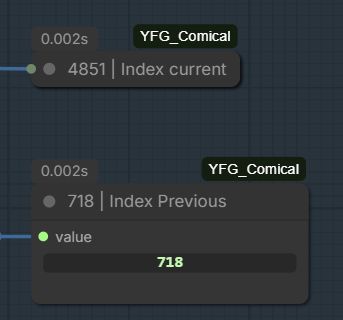
A minimal utility node that displays any value — INT, FLOAT, or STRING — inline in both the node body and the title bar. Designed to replace large display nodes (like ShowText or Display Int) wherever a compact read-only indicator is all that's needed.
✨ Features
- Title bar display — value shown as
value | labelso it's always visible even when the node is collapsed to its smallest size. - In-body display — green value rendered in the node body when expanded, no extra height added.
- Rename to label — double-click the node title in ComfyUI to set a custom label (e.g.
Index,Width,Seed). The value is appended automatically after each run. - Any type — accepts
INT,FLOAT, orSTRINGon the single input slot via wildcard. - Persistent — last value is saved into the workflow JSON and pre-filled on reload.
🔧 Inputs
value(any) – The value to display.
📌 Notes
- No outputs — this is a pure display/monitoring node.
- The node title format is
value | label. Rename the node to change the label; the value portion updates automatically on each run.
CivitAI MetaSave
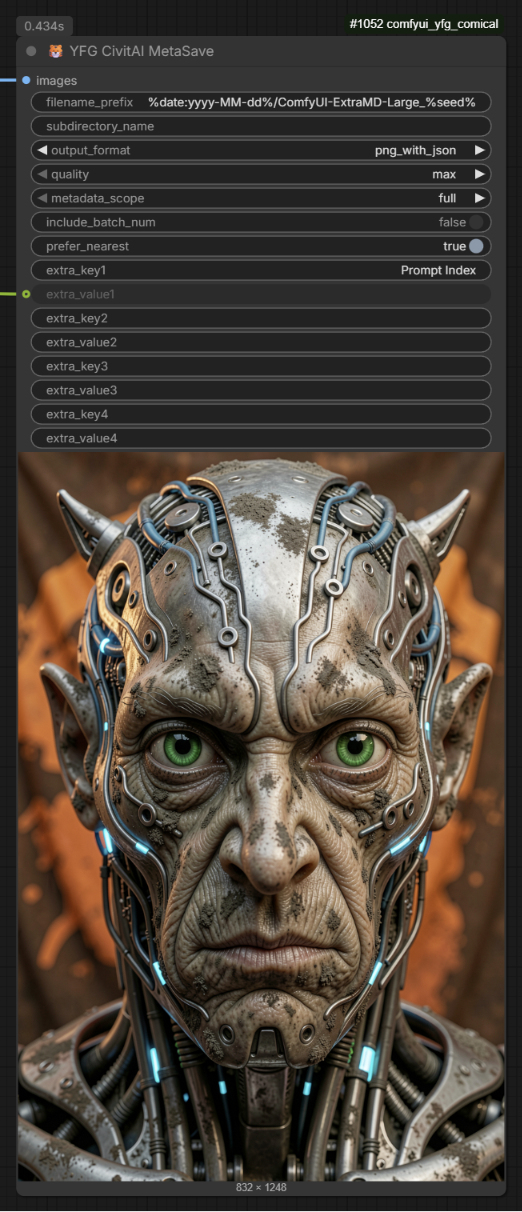
Looking for the newest version? See CivitAI MetaSave V2 below. V1 is frozen and will not change, so existing workflows keep working exactly as they are.
Saves images with full A1111-compatible metadata embedded so that CivitAI automatically recognizes and displays generation info — model, LoRA weights, embeddings, sampler settings, seed, and prompts — exactly as it does for Automatic1111 outputs.
A single node replaces the two-node workflow required by other metadata extensions. Four optional custom key/value extra-metadata pairs are built directly into the node — no helper nodes required.
Compatible with classic SD (KSampler, KSamplerAdvanced), Flux, SD3, Ideogram, SamplerCustomAdvanced, LoRA, and upscale workflows.
✨ Features
- CivitAI auto-recognition — embeds the
parameterstext chunk that CivitAI parses for resources, prompts, and settings, identical to A1111 output. - Multi-format output — PNG, JPEG, or WebP, each with an optional sidecar workflow JSON.
- EXIF embedding — JPEG and WebP outputs also receive EXIF UserComment metadata so CivitAI can read them regardless of format.
- Model & resource hashing — SHA-256 hashes (first 10 hex chars) for checkpoint, VAE, LoRA, and embedding files are computed and cached on disk to avoid redundant re-hashing.
- LoRA detection — finds LoRA weights from both LoraLoader nodes and inline
<lora:name:weight>syntax in the prompt text. - Filename tokens — supports
%date:yyyy-MM-dd%,%seed%,%model%,%pprompt:32%,%nprompt:32%,%width%,%height%in the filename prefix. - Subdirectory support — optional sub-folder creation inside the output directory, also supporting date tokens.
- Metadata scope control — choose what gets embedded: full, default, parameters only, workflow only, or none.
- Four inline extra metadata slots — attach custom key/value pairs (e.g. workflow name, prompt index, project tag) without any additional nodes.
🔧 Input Parameters
images(IMAGE) – Images to save.filename_prefix(string, default:ComfyUI) – Output filename prefix. Supports tokens:%date:yyyy-MM-dd%,%seed%,%model%,%pprompt:32%,%nprompt:32%,%width%,%height%.subdirectory_name(string) – Optional sub-folder inside the output directory. Supports%date%tokens. Leave blank to use the default output folder.output_format(choice, default:png_with_json) – Image format. The*_with_jsonvariants also write a sidecar.jsonworkflow file.png/png_with_jsonjpg/jpg_with_jsonwebp/webp_with_json
quality(choice, default:max) – Output quality level. Ignored for PNG.max— 100 (lossless WebP)high— 80medium— 60low— 30
metadata_scope(choice, default:full) – Controls what metadata is embedded.full— A1111 parameters string + full ComfyUI workflow JSONdefault— same as the built-in SaveImage nodeparameters_only— A1111-style parameters string onlyworkflow_only— ComfyUI workflow JSON onlynone— no metadata
include_batch_num(bool, default:false) – Append a 5-digit batch index to the filename when saving multiple images.prefer_nearest(bool, default:true) – When multiple upstream nodes provide the same field, prefer the one closest (fewest graph hops) to this node.extra_key1/extra_value1(string, optional) – Custom metadata key/value pair 1.extra_key2/extra_value2(string, optional) – Custom metadata key/value pair 2.extra_key3/extra_value3(string, optional) – Custom metadata key/value pair 3.extra_key4/extra_value4(string, optional) – Custom metadata key/value pair 4.
📌 Notes
piexifmust be installed (pip install piexif). It is listed as a dependency inpyproject.tomland should install automatically via ComfyUI Manager.- Hash cache is stored in
civitai_metasave/.cache/model_hash_cache.json. Hashes are computed once per file and reused on subsequent runs — no performance penalty after the first generation. - Steps are required for full metadata. If no Steps value is found upstream, the parameters string is skipped and a warning is printed to the console. This is a CivitAI requirement, not a bug.
- Workflow attribution — derived from comfyui_image_metadata_extension by edelvarden which itself was a fork of ComfyUI-SaveImageWithMetaData. Maintained and extended independently as part of YFG Comical.
CivitAI MetaSave V2
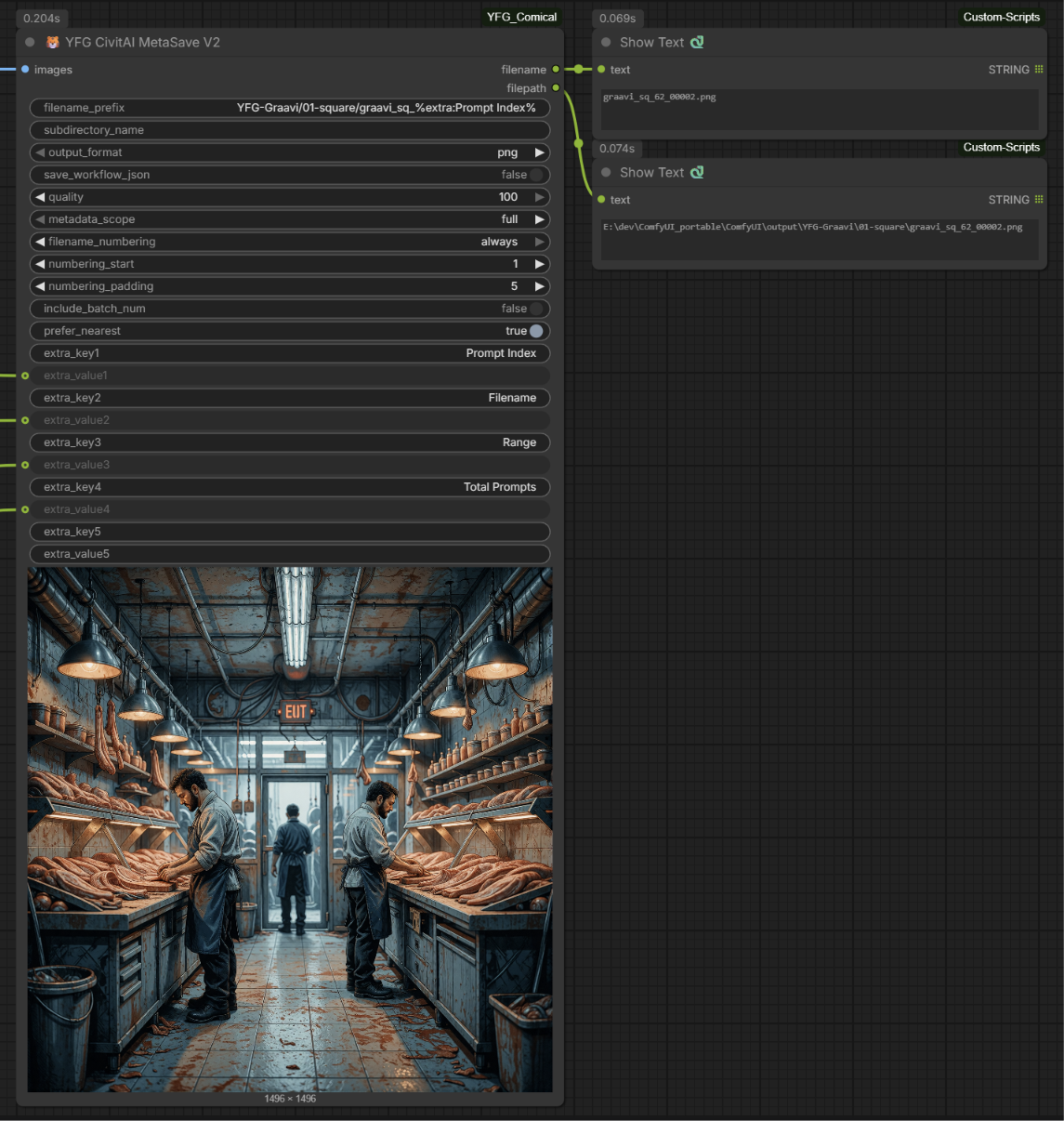
Second-generation metadata save node. Shares the entire capture, trace, and hashing pipeline with V1, but with a cleaner layout and several capabilities V1 could not gain without breaking saved workflows.
Both versions can be installed and used side by side. V1 is frozen; new work happens here.
🆕 What's new versus V1
| | V1 | V2 |
| --- | --- | --- |
| Extra metadata fields | 4 fixed pairs | Grows as you use them, up to 32 pairs |
| Filename tokens | Fixed set only | Plus any extra field or captured metadata field |
| File numbering | First file unnumbered | Configurable mode, start value, and padding |
| output_format | 6 entries (png, png_with_json, …) | 3 entries plus a save_workflow_json toggle |
| quality | 4 preset buckets | Integer 1–100 |
| Outputs | None | filename and filepath |
✨ Features
- Everything V1 does — CivitAI auto-recognition, model/LoRA/embedding hashing with an on-disk cache, inline
<lora:name:weight>detection, EXIF embedding for JPEG and WebP, and metadata scope control. - Dynamic extra metadata fields — one empty key/value pair sits at the bottom of the node. Fill it and another appears; clear the trailing ones and the surplus is pruned. Values can be typed or wired from another node.
- Metadata-aware filename tokens — build filenames from your own extra fields or from any captured metadata value.
- Configurable numbering — number every file including the first, choose the starting number, and set the digit padding.
- Filename and filepath outputs — chain the saved path into a logger, display node, or downstream tooling.
🔧 Input Parameters
images(IMAGE) – Images to save.filename_prefix(string, default:ComfyUI) – Output filename prefix. See Filename tokens below.subdirectory_name(string) – Optional sub-folder inside the output directory. Supports the same tokens. Leave blank for the default output folder.output_format(choice, default:png) –png,jpg, orwebp.save_workflow_json(bool, default:false) – Also write a sidecar.jsonfile containing the raw workflow.quality(int, default: 100) – Compression quality 1–100 for jpg and webp. 100 is lossless for webp. Ignored for png.metadata_scope(choice, default:full) –full,default,parameters_only,workflow_only, ornone.filename_numbering(choice, default:always) –alwaysnumbers every file including the first;on_conflictonly adds a number when the name already exists.numbering_start(int, default: 1) – First number to use.0starts at0000,1starts at0001.numbering_padding(int, default: 5) – Digits to pad to.5gives00001,4gives0001.include_batch_num(bool, default:false) – Append a 5-digit batch index when saving multiple images from one run.prefer_nearest(bool, default:true) – When several upstream nodes supply the same metadata field, prefer the one fewest graph hops away.extra_key1/extra_value1(string, optional) – First custom metadata pair. Additional pairs appear automatically as you use them. See Dynamic extra metadata fields below.
🖥️ Outputs
filename– Filename of the last image saved this run, including extension.filepath– Full absolute path of the last image saved this run.
🏷️ Filename tokens
| Token | Resolves to |
| --- | --- |
| %date:yyyy-MM-dd% | Current date/time. Supports yyyy MM dd hh mm ss |
| %seed% %model% %width% %height% | Values captured from the workflow |
| %pprompt:32% %nprompt:32% | Positive/negative prompt, truncated to N characters |
| %extra:KEY% | Value of your extra metadata field named KEY |
| %extra:KEY:12% | Same, truncated to 12 characters |
| %KEY% | Your extra field KEY, or any captured metadata field such as %Sampler%, %Steps%, %CFG scale% |
Key matching is case-insensitive. Unresolved tokens are replaced with nothing and logged to the console, so a typo is visible rather than silently baked into a filename.
A literal / typed into filename_prefix still creates a subfolder; slashes and other illegal characters inside substituted values are replaced with _ so prompt text can be used safely.
Example: %date:yyyy-MM-dd%/YFG-%extra:Prompt Index%-%seed%
➕ Dynamic extra metadata fields
The node starts with one extra_key1 / extra_value1 pair. Type a key or wire a value into it, and extra_key2 / extra_value2 appear beneath. Clear the trailing pairs and the extras are removed again, always leaving exactly one empty pair ready. Up to 32 pairs.
The usual pattern is to type the key and wire the value:
Random Prompt From File  ──▶  extra_value1     extra_key1 = Prompt Index
                         ──▶  extra_value2     extra_key2 = Filename
Values can be typed instead, and both strings and numbers are accepted — a wired integer 0 is recorded as 0, not dropped.
Pairs are written to the image in numeric order. A pair with an empty key is skipped; a pair with a value but no key raises an error rather than silently discarding data.
This is driven by
web/js/civitai_metasave_v2.js, which ships with the pack. ComfyUI's nativeCOMFY_AUTOGROW_V3inputs would remove the need for it, but they are resolved during the socket pass of the frontend'saddInputs(), which runs before the widget pass — so the initial groups render above the node's ordinary widgets rather than below them. The extension keeps the layout correct and also grows on typing, not only on connecting.
📌 Notes
piexifmust be installed (pip install piexif). It is listed inpyproject.tomland installs automatically via ComfyUI Manager.- Hash cache lives in
civitai_metasave/.cache/model_hash_cache.json, shared with V1. Each model file is hashed once and reused afterwards. - Steps are required for full metadata. If no Steps value is found upstream, the parameters string is skipped and a warning is printed. This is a CivitAI requirement, not a bug.
- Both versions share one set of execution hooks. They live in the same package deliberately — a separate folder per version would re-apply ComfyUI's execution monkey-patches once per copy.
- Attribution — derived from comfyui_image_metadata_extension by edelvarden, itself a fork of ComfyUI-SaveImageWithMetaData by nkchocoai. The dynamic-input technique is adapted from rgthree-comfy. Maintained and extended independently as part of YFG Comical.
Live Preview Panel
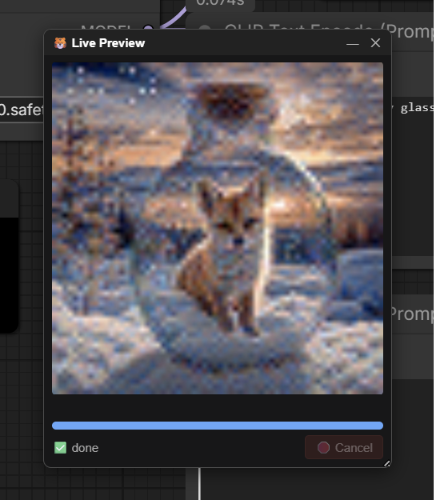
A floating, draggable live preview window that mirrors the KSampler preview so you can watch generation progress from anywhere in your workflow — no more panning back and forth to the sampler node to check on a render or catch a bad generation early.
This is a pure frontend extension — it has no node, no inputs, and no outputs. It simply appears as a floating panel over the canvas, similar to ComfyUI's built-in minimap. Under the hood it listens to the same websocket events (progress and b_preview) that drive the KSampler's own inline preview, so it adds zero backend overhead.
✨ Features
- Live preview image — updates in real time as the sampler works, exactly like the in-node preview.
- Progress bar & step counter — shows
step N / M (%)for the currently executing node. - Executing node indicator — displays the title and ID of whichever node is currently running (e.g.
▶ KSampler (#53)). - 🛑 Cancel button — interrupts the current generation from anywhere, without touching the sampler node.
- Drag & resize — move it by the header, resize from the bottom-right grip. Position and size are remembered between sessions.
- Collapse & hide —
—collapses to just the title bar;✕hides the panel (it reappears automatically on the next run). - Keyboard toggle —
Alt+Shift+Lshows/hides the panel at any time. - Settings switch — a master on/off toggle in ComfyUI Settings (search for "YFG"): 🐯 Enable Live Preview panel. When off, the panel never appears, even during generations.
📌 Notes
- Previews require ComfyUI's preview generation to be enabled (the default). If you launch ComfyUI with
--preview-method none, the panel will still show progress and the executing node, but no image. - The panel auto-appears whenever a generation starts (unless disabled in Settings). If you close it with
✕, it comes back on the next run — or pressAlt+Shift+Lto bring it back immediately. - The hotkey deliberately avoids
Alt+Shift+P, which is reserved by Microsoft Edge for tab grouping.
Power Lora Loader Extras
(companion enhancement, no new node)
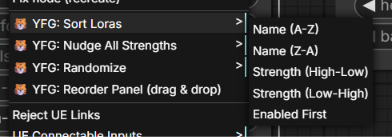
A pure frontend enhancement for rgthree's Power Lora Loader (rgthree) node — adds sort, bulk strength control, randomization, and drag-and-drop reordering directly to its own right-click menu. No new node type, nothing to wire up: just right-click any Power Lora Loader on your canvas.
✨ Features
- 🐯 YFG: Sort Loras — reorder the lora list by Name (A-Z/Z-A), Strength (High-Low/Low-High), or Enabled First.
- 🐯 YFG: Nudge All Strengths — bump every lora's strength up or down in sync (
+0.05/-0.05/+0.10/-0.10), or reset all back to1.0in one click. - 🐯 YFG: Randomize
- Randomize Strengths… — prompts for a
min,maxrange and assigns each lora a random strength within it. - Randomize On/Off (by % chance)… — prompts for a percent chance (0–100), rolled independently for each lora. This is a per-lora coin-flip, not a target count — e.g. asking for
20%on a list of 30 loras means each one has a 1-in-5 chance of landing on, so the total enabled will vary run to run (often somewhere around 6, but not always). - Enable Exactly N Loras… — prompts for a whole number and turns on exactly that many, chosen at random, with the rest off. Use this instead of the percent option if you want a specific count every time.
- 🔁 Auto-Randomize Each Queue Run — toggle to re-roll strengths/on-off automatically before each individual run in a queued batch. (Experimental — not yet confirmed reliable on all ComfyUI frontend versions.)
- Randomize Strengths… — prompts for a
- 🐯 YFG: Get Trigger Words — pulls trigger/trained words for the selected loras straight from rgthree's own cached CivitAI info (the same data behind its "Show Info" dialog) and shows them in a copyable dialog.
- Enabled Loras Only / All Loras — choose the scope before fetching.
- Handles both short curated CivitAI word lists and raw tag-frequency data (the kind extracted directly from a lora's training captions), deduplicating across all selected loras into one combined list.
- No extra backend needed — this calls rgthree's own already-running
/rgthree/api/loras/infoendpoint directly, so it works out of the box wherever rgthree-comfy is installed. - Loras with no cached CivitAI info (never run through "Show Info," or genuinely untagged) are listed separately at the end so you know what's missing rather than being silently skipped.
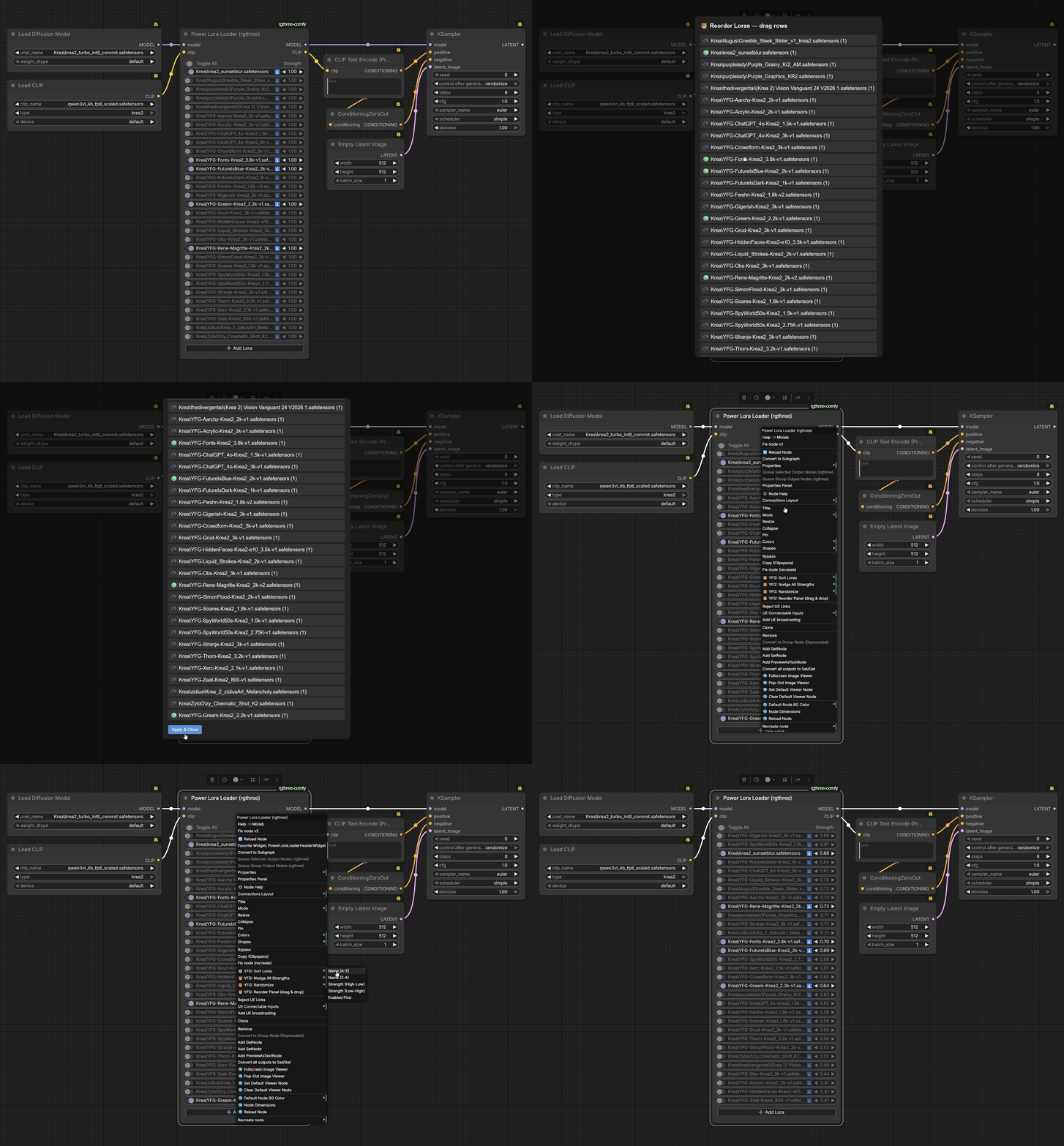
- 🐯 YFG: Reorder Panel (drag & drop) — opens a floating panel listing all loras; drag rows into the order you want and click "Apply & Close."
Reorder panel:
📌 Notes
- All changes (order, strengths, on/off state) are saved directly in the Power Lora Loader's own widget values — the workflow JSON remains 100% standard rgthree-comfy format, so files stay fully portable to installs that don't have this extension.
- Requirement: rgthree-comfy must be installed. This ships as part of
ComfyUI_YFG_Comicaland loads automatically — no extra install step. - Get Trigger Words only returns data rgthree already has cached for a lora. If a lora has never had its info fetched (via rgthree's own "Show Info" on that row, or a CivitAI match), it'll show up in the "no trigger words found" list rather than triggering a fresh lookup. Copies only the trigger words to the clipboard.
- Right-click directly on a lora row to get rgthree's own built-in menu (Show Info / Toggle / Move Up-Down / Remove) — the 🐯 additions live on the node's general right-click menu instead, so both work side by side.
Text Concat Swap
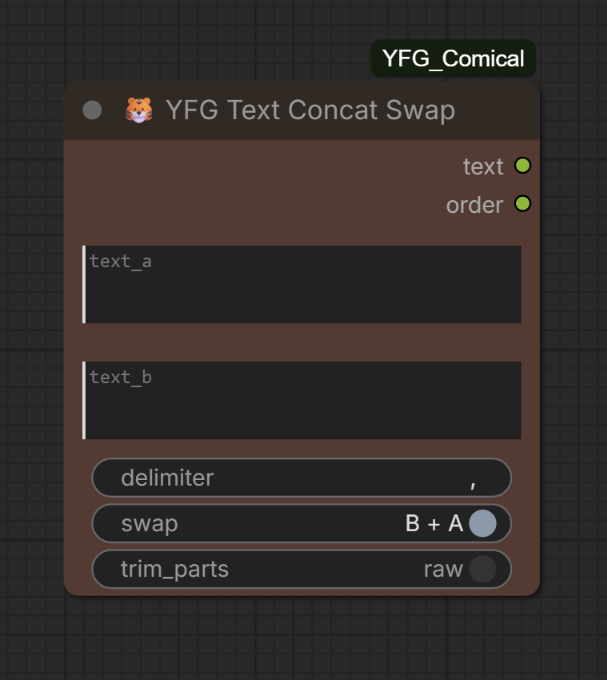
Joins two strings with a delimiter, plus a single clickable toggle that flips which string comes first. It replaces the usual manual dance of rewriting (or rewiring) the inputs of the core StringConcatenate node every time you want the style tail in front of the subject instead of behind it.
✨ Features
- One-click order flip — the
swapwidget is a boolean button that readsA + BorB + A, so the current order is visible on the node face at a glance and changes with a single click. - No dangling delimiters — empty inputs are dropped before joining, so a muted or unconnected branch never leaves a stray
,in the prompt. None-safe — aNonearriving from a muted upstream node (a bypassed VL captioner, for example) is coerced to an empty string instead of raising.- Escape-aware delimiter —
\n,\tand\scan be typed into the single-line delimiter widget to get a newline, tab, or plain space. - Optional trim —
trim_partsstrips leading/trailing whitespace from each side before joining, so sloppy text boxes still produce clean output. - Order readout — a second
orderoutput emitsA + BorB + Aas a string, handy for piping into 🐯 YFG Display Value or into saved metadata.
🔧 Input Parameters
text_a(STRING, multiline) – First string whenswapis off.text_b(STRING, multiline) – First string whenswapis on.delimiter(STRING) – Joiner placed between the two parts. Default,. Supports\n,\t,\s.swap(BOOLEAN) –A + B(off) orB + A(on).trim_parts(BOOLEAN) –trim(default) strips surrounding whitespace from each part;rawleaves both untouched.
🖥️ Outputs
text(STRING) – The concatenated result.order(STRING) –A + BorB + A, reflecting the current toggle state.
📌 Notes
- Both text widgets honour ComfyUI dynamic prompts, and either can be converted to an input socket and driven from upstream nodes.
- The delimiter is only inserted when both parts are non-empty — with one side blank the output is just the other side, unchanged.
- Pure stdlib; no additional dependencies.
Examples
Sample Workflow
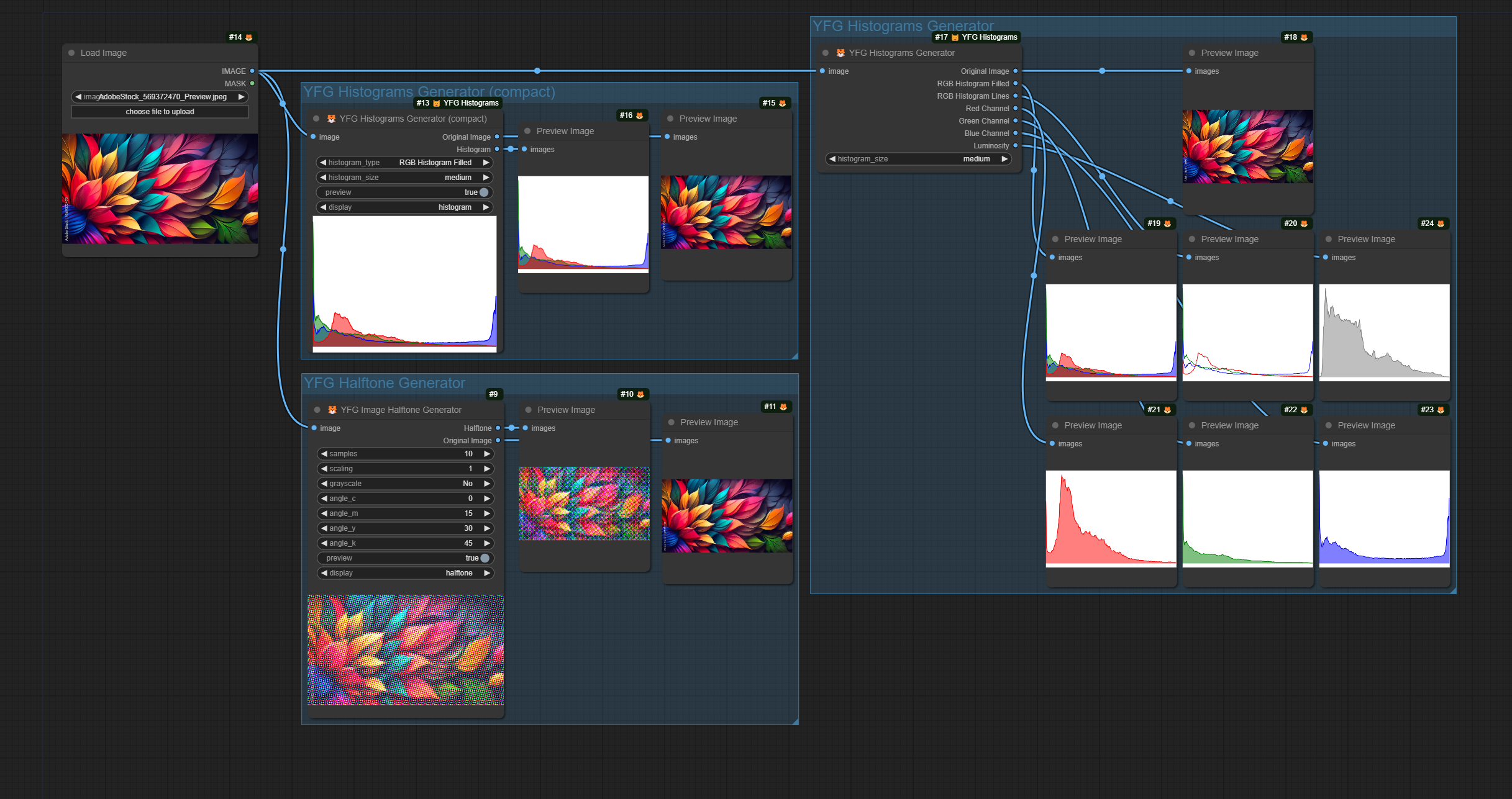
If the embedded workflow doesn't load, use the JSON:
workflows/ComfyUI_YFG_Comical-Example-Workflow.json
All nodes as of 06-13-2024
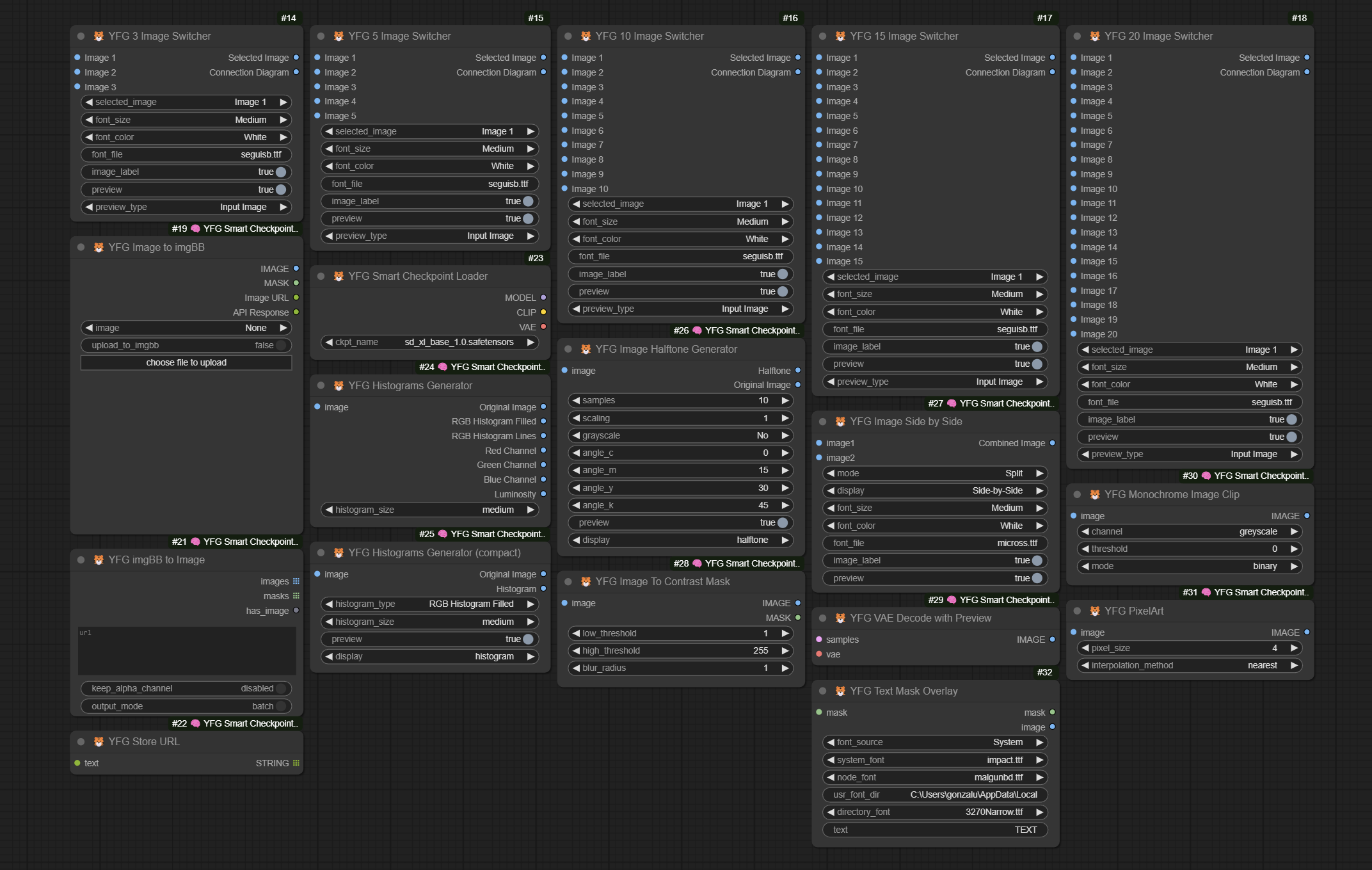
Acknowledgements
Huge thanks to creators whose work inspires or integrates with these nodes:
…and many others. Thank you for your talent and generosity.