
ComfyUI-H3VAE-PyOpt
Optimized PyTorch/Triton MiniMax H3 video VAE runtime for ComfyUI.
ComfyUI-H3VAE-PyOpt


<a id="english"></a>
Faster MiniMax H3 video VAE, ready for ComfyUI.
In the archived RTX PRO 5000 72GB comparisons below, PyOpt has the fastest recorded encode and decode times: 8.458 s / 6.440 s. Powered by PyTorch and Triton, it replaces one Loader while keeping your existing VAE Encode / VAE Decode nodes. No TensorRT engine required.
FP16 by default; optional INT8 acceleration.
Performance · Modes and settings · Installation · Quality · Optimization history · Reproduce
Why use this repository?
- Faster H3 VAE inference. At the recorded GPU, 768×1344×124 input and tile256 settings, the fastest PyOpt INT8 encode/decode paths have lower latency than the measured ComfyUI
--fastand TensorRT configurations. The fastest measured decoder that retains FP16 runs in 10.923 s. - Fits existing workflows.
H3VAEPyOptLoaderoutputs a standard ComfyUI VAE for the native encode/decode nodes, with support for ComfyUI CPU offload and CUDA reload. - No engines to build or maintain. Load the original model code and safetensors weights directly. Optimizations use
torch.compileand Triton, without ONNX export, TensorRT engine builds or checkpoint conversion.
“Fastest” means the lowest recorded latency among the versions, workloads and tested configurations listed here. Reference results and current PyOpt results come from separate experiments, and INT8 involves a quality trade-off. Conditions and sources are provided below. The latest optimizations are not included in a tagged release; each benchmark records its source revision or file hashes.
Performance
Workload: RTX PRO 5000 72GB · 768×1344×124 frames · encoder/decoder tile256. All times below measure the full VAE stage after warmup, excluding loading, initial compilation and media I/O. They do not measure the entire video generation workflow.
Comparison with ComfyUI and TensorRT
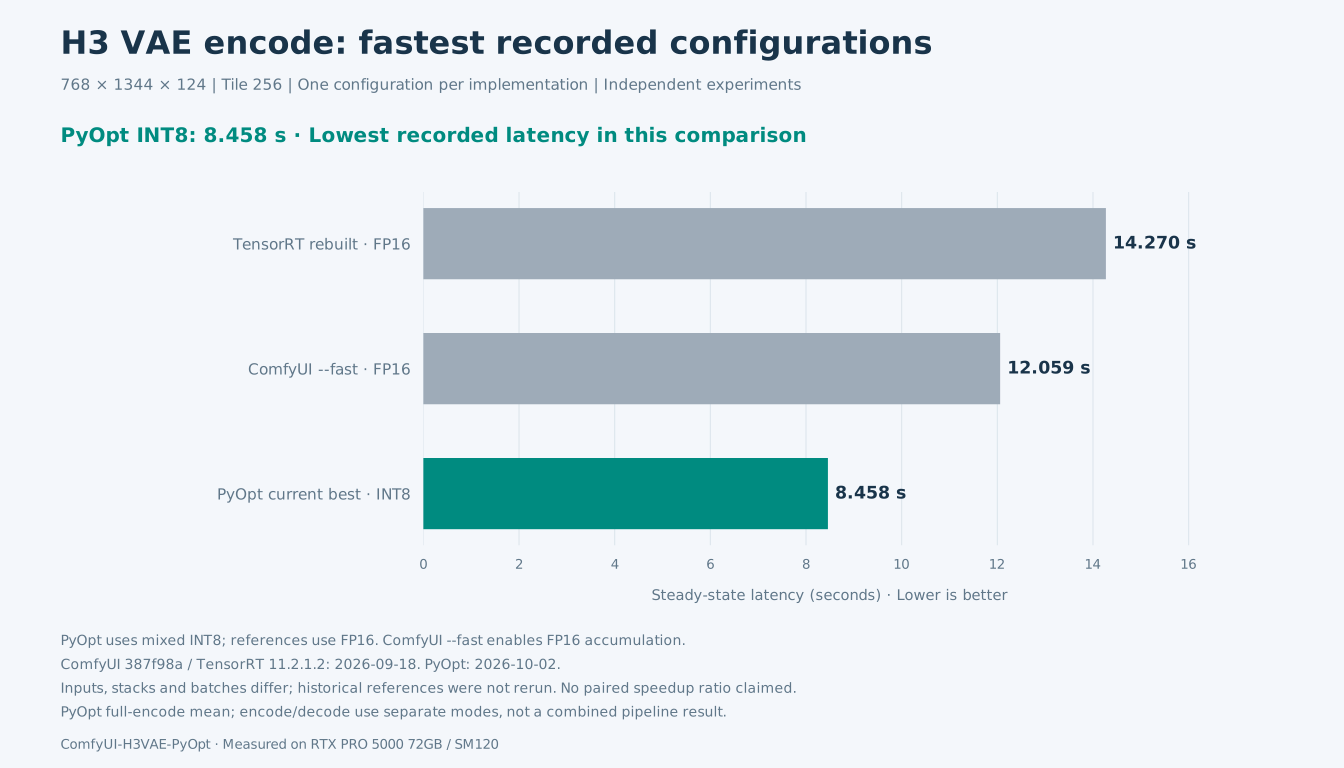
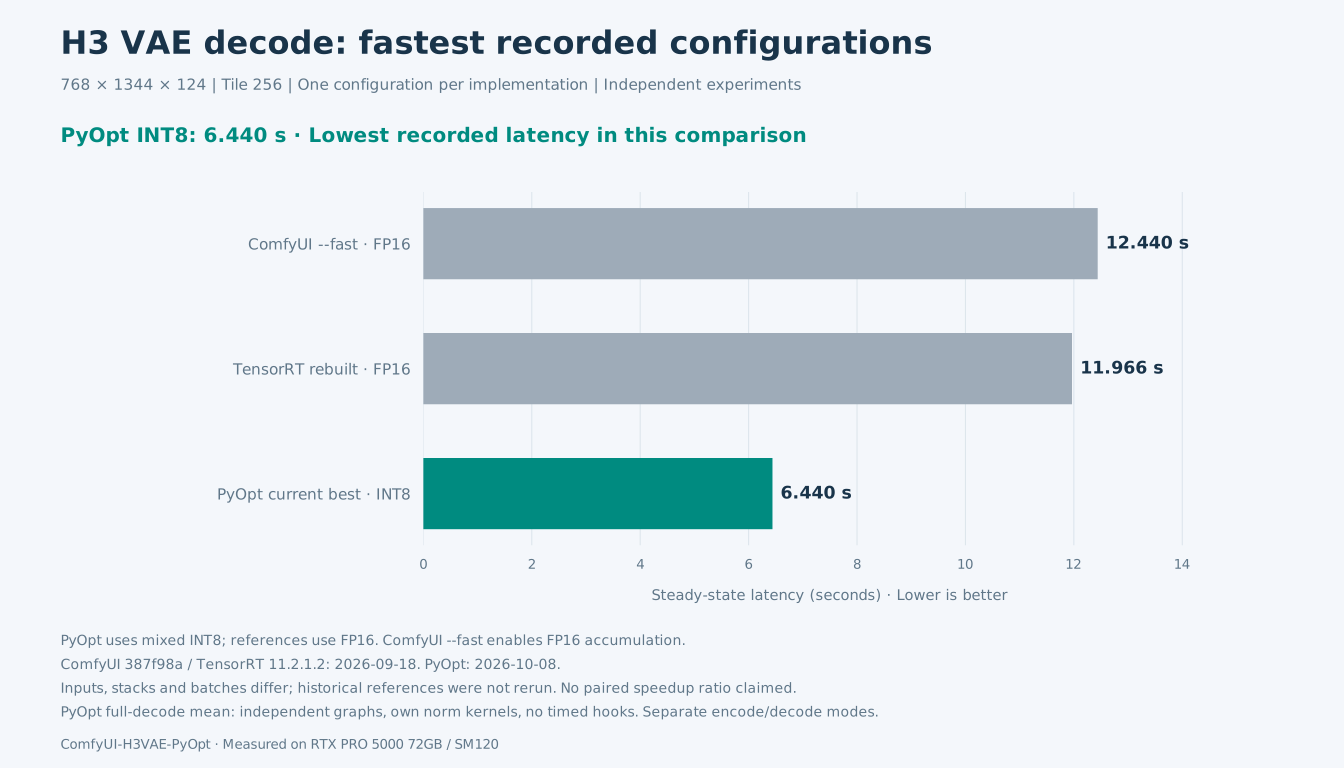
Each chart shows one fastest archived configuration per implementation at this workload: ComfyUI with --fast fp16_accumulation, TensorRT with a locally rebuilt tile256 engine from the same weights, and PyOpt with its current fastest INT8 path. Earlier PyOpt versions, slower configurations and engines with different tile sizes are kept out of these charts.
| Implementation / fastest tested configuration | Encode | Decode | Measurement source |
| --- | ---: | ---: | --- |
| ComfyUI 387f98a + --fast fp16_accumulation | 12.059 s | 12.440 s | 2026-09-18 |
| TensorRT 11.2.1.2, FP16 engine rebuilt from the same weights | 14.270 s | 11.966 s | 2026-09-18 |
| PyOpt INT8: fastest encode / decode modes selected separately | 8.458 s | 6.440 s | Encode · 2026-10-02 / Decode · 2026-10-08 |
This table summarizes the fastest tested configurations from separate experiments. The reference implementations use historical versions and builds; inputs, software stacks, batch sizes, precision and background GPU load also differ. We therefore do not infer a percentage speedup over competitors from these records. PyOpt's two best times use different modes and must not be added together as a measured encode+decode total.
Chart data and configurations · Chart generator · Plan for a unified comparison
Current fastest tested PyOpt modes
| Goal | Mode | Current latency | Key settings |
| --- | --- | ---: | --- |
| Faster encode | INT8 encoder with normalization recomputation and causal-zero skipping | 8.458 s | int8_encode=true, decode_fusions=false, staged batch4 |
| Faster decode | Fused INT8 decoder with SM120 FFN-up/SwiGLU and residual/norm1/QKV quantization, 144 INT8 Linear layers | 6.440 s | int8_decode=true, decode_fusions=true, tile batch4 |
| Fast decode with FP16 | Fused FP16 decoder | 10.923 s | int8_decode=false, decode_fusions=true, tile batch8 |
These are steady-state means for the fastest tested configurations, not individual minimum samples. The latest paired encode comparison measured 8.683 → 8.458 s (2.59% lower latency) with unchanged peak allocated memory. It skips convolution products from the two known-zero causal padding planes without changing quantization or rounding. FP16 remains the default; settings for all three accelerated modes are below.
The latest paired decode comparison measured 6.519 → 6.440 s (1.20% lower latency) across six blocks, with unchanged peak allocated memory. It fuses residual/norm1/QKV quantization and implements the original block0/final normalization arithmetic independently. Natural RGB stayed bitwise equal across 8 videos / 992 frames; method and evidence.
Quick start
You need an NVIDIA CUDA GPU, compatible PyTorch/Triton versions, and the MiniMax H3 FL2VA/video_vae model code and safetensors weights. Install using ComfyUI's own Python environment:
cd /path/to/ComfyUI/custom_nodes
git clone https://github.com/fishelegs/ComfyUI-H3VAE-PyOpt.git
cd /path/to/ComfyUI
python -m pip install -r custom_nodes/ComfyUI-H3VAE-PyOpt/requirements.txt
Prefer the PyTorch installation already used by ComfyUI and matched to your CUDA environment. Set the model locations, then restart ComfyUI:
export H3_VAE_MODEL_CODE_DIR=/path/to/MiniMax-H3/FL2VA/video_vae
export H3_VAE_WEIGHTS_PATH=/path/to/minimax_h3_video_vae_fp16.safetensors
Alternatively, put the weights in ComfyUI/models/vae and select them in the Loader. The model code directory still needs to be configured.
For the INT8 decoder, also install its pinned dependency:
python -m pip install 'comfy-kitchen==0.2.34'
This repository does not distribute model code, weights or engines. Model use is subject to the MiniMax H3 Community License.
ComfyUI usage
Search for MiniMax H3 VAE Load (PyTorch Optimized) (H3VAEPyOptLoader) and connect its VAE output to your existing VAE Encode / VAE Decode nodes.
Start with the Loader defaults to confirm your workflow works. To reproduce the fastest configurations above, use dtype=fp16, compile_encoder=true, compile_decoder=true and fast_linear=false, then select a column below:
| Parameter | Fastest INT8 encode | Fastest INT8 decode | Fastest FP16 decode |
| --- | --- | --- | --- |
| int8_encode | true | false | false |
| int8_decode | false | true | false |
| decode_fusions | false | true | true |
| encoder_tile_size / decoder_tile_size | 256 / 256 | 256 / 256 | 256 / 256 |
| encoder_staged_batch | 4 | 4 | 4 |
| tile_batch | 2 | 4 | 8 |
INT8 encoding cannot currently be combined with a fused decoder. Both decoder modes above use an FP16 encoder. Combining INT8 encoding with int8_decode=true uses the unfused decoder and does not reproduce the 6.440 s result.
The latest encoder scheduling and INT8 FFN-up/SwiGLU optimizations are enabled automatically only on SM120. The new norm1 bundle additionally requires the validated PyTorch 2.11.0 / CUDA 13.0 / Triton 3.6.0 stack and target batch4 states; other supported configurations retain the previous real INT8 path. INT8 and decoder fusion require NVIDIA CUDA SM80+ as a baseline; fused decoding also requires FP32 normalization, which is enabled by default. Windows, performance on other GPUs and their memory requirements have not received equivalent validation; BF16 is not integrated. Initial compilation can take time. Set the Loader's warmup to decode or both to warm up during loading. Recheck quality and memory use after changing tile or batch sizes.
Configuration and compatibility · Decoder fusion details · INT8 behavior and limitations
Minimal workflows
- Fused INT8 decode / Fused FP16 decode.
- INT8 image encode→decode: upload a 256×256 image, then replace the example filename and model paths.
- Default FP16 decode.
These examples use the ComfyUI API format. After updating paths, submit one to your local server:
curl -sS -X POST http://127.0.0.1:8188/prompt \
  -H 'Content-Type: application/json' \
  --data-binary @examples/minimal_h3vae_pyopt_int8_fused_prompt.json
The decode examples use zero latents to demonstrate node connections; they do not demonstrate generated image quality.
Quality and validation
INT8 uses lossy mixed precision: its speed comes with quantization error. FP16 fusion can also change rounding order, and FP16 VAE reconstruction is not lossless.
The 2026-09-24 decoder reconstruction test covered 8 real videos totaling 992 frames, using the same FP16 encoder for both modes. The PSNR values below compare reconstructed RGB before video compression against the source video:
| Decoder mode | Mean per-frame PSNR | Worst-frame PSNR | Frames below 30 dB | | --- | ---: | ---: | ---: | | Fused FP16 | 35.110 dB | 32.709 dB | 0 / 992 | | Fused INT8 | 34.940 dB | 32.587 dB | 0 / 992 |
In a separate paired test, the INT8 encoder reduced mean source-reconstruction PSNR by approximately 0.623 dB relative to the FP16 encoder. The latest causal-zero optimization preserved bitwise-identical INT8 latents on 8 videos, with RGB equality additionally checked on one full 124-frame video. It introduced no additional INT8 error in these checks.
The latest norm1 bundle retained bitwise-equal natural RGB across 8 videos / 992 frames at both 1344 and 1376 widths, using independently compiled A/P graphs and no original-kernel producer binding in P. ComfyUI target/fallback inputs and actual CPU offload/CUDA reload also passed. This evidence applies to the measured recipe and inputs; original INT8 loss remains. Latest decoder validation.
The ComfyUI wrapper and CPU offload/CUDA reload have been validated; quality and timing results are recorded separately. These results apply to the tested media. Passing 30 dB does not guarantee identical detail, seams or temporal behavior on arbitrary videos. Decoder quality evidence · Latest encoder validation · INT8 quality trade-offs
Optimization history
Earlier iterations are collected here; competitor charts show only the current fastest configurations. Each row below is an independent experiment. Percentages refer only to that row's baseline and must not be compounded across experiments.
INT8 encoder history
| Date / stage | Paired encode comparison | Latency reduction | Report | | --- | ---: | ---: | --- | | 2026-10-02 · Convolution tiling + dynamic quantization | 12.545 → 10.121 s | 19.32% | Implementation and FP16 comparison | | 2026-10-02 · Four-stage convolution pipeline | 10.120 → 9.505 s | 6.07% | Nsight hotspots and A/B | | 2026-10-02 · norm/absmax fusion | 9.506 → 9.138 s | 3.87% | Numerical and memory validation | | 2026-10-02 · Recompute and write INT8 directly | 9.140 → 8.684 s | 4.99% | Recomputation evidence | | 2026-10-02 · Skip causal-zero convolution taps | 8.683 → 8.458 s | 2.59% | Latest implementation and evidence |
Decoder history
| Date / stage | Measured decode | Notes | | --- | ---: | --- | | 2026-09-22 · v0.2.0 INT8 | 8.278 s | 72 INT8 Linear layers, batch2; paired FP16 result: 11.477 s, 27.9% lower latency | | 2026-09-24 · FP16 / INT8 fusion | 10.923 / 6.667 s | FP16 batch8 / INT8 with 144 Linear layers, batch4; initial fusion profiles | | 2026-10-02 · GEMM scheduling replay | No new change adopted | Candidates did not consistently outperform existing CUTLASS; unsuccessful experiments retained | | 2026-10-02 · GEMM+SwiGLU fusion / FP16 finalizer replay | No new change adopted | Local gains were not established as full-decode improvements; numerical gates and findings | | 2026-10-03 · INT8 FFN-up/SwiGLU fusion | 6.640 → 6.509 s | 1.98% lower latency with matched norm schedules; full-video, Nsight and integration evidence | | 2026-10-03 · FFN and attention follow-up | No new change adopted | Initial screening and GEMM scheduling / exact QKV fusion did not establish sufficient gains for production adoption | | 2026-10-03 · INT8 batch divergence diagnosis | No new change adopted | Exact local counterfactual traces the first propagated difference to residual/norm1 before QKV; batch 4 retained | | 2026-10-03 · INT8 residual/norm1/QKV quantization fusion | No new change adopted | Prototype saves 1.28% under its recorded norm schedule; final 16-warp baseline fails exact quantization | | 2026-10-03 · INT8 norm1 contract follow-up | No new change adopted | Exact W16 local chain is 4.43% faster; complete validation stops at an unvalidated R1024 / two-warp schedule | | 2026-10-08 · INT8 norm1 R1024 / two-warp fusion | No new change adopted | Fixed W2 local chain is 7.07% faster, with 35 exact layer checks; independently compiled full-video RGB fails the acceptance screen, so no full-decode timing | | 2026-10-08 · INT8 norm1 graph controls | No new change adopted | Same-graph A/B isolates W2 arithmetic: full RGB PSNR is 52.07 dB, below the 55 dB screen | | 2026-10-08 · INT8 W16 fusion integration | No new change adopted | Controlled full RGB is bitwise exact; natural compilation reaches 56.66 dB but fails the strict screen; no full-decode timing | | 2026-10-08 · Block0 RMS / final LayerNorm control | No new change adopted | Block0 norm/QKV are bitwise exact; same-candidate control isolates final LayerNorm: replacing only its dispatch restores exact tile RGB; no full-decode timing | | 2026-10-08 · Exact norm1 / block0 / final LayerNorm bundle | 6.519 → 6.440 s | 1.20% lower latency, 6/6 blocks; natural multi-video, holdout and Comfy acceptance |
Further encoder addressing/BK32 and FP16 CTA-group candidates were not adopted; measurements and remaining directions. An encoder producer/consumer fusion first needs activation-patch reuse to avoid repeated normalization; static feasibility audit.
Earlier comparisons and other workloads: ComfyUI runtime · ComfyUI fast · TensorRT with matching tiles · Historical 368/672 tile benchmarks
Benchmarking
Benchmark the current fused INT8 decoder without TensorRT:
python bench_pyopt_vs_trt.py --pyopt-only --decode-fusions --int8-decode \
  --model-code-dir "$H3_VAE_MODEL_CODE_DIR" --weights "$H3_VAE_WEIGHTS_PATH" \
  --height 768 --width 1344 --frames 124 \
  --decoder-tile 256 --encoder-tile 256 --tile-batch 4 --staged-batch 4 \
  --warmup 2 --runs 5 --seed 20260924 \
  --output results/int8_fused_768.json
For the fused FP16 decoder, remove --int8-decode, use --tile-batch 8 and change the output filename. Timing includes dynamic quantization and output processing.
Latest decoder A/B commands · Latest encoder A/B commands · Real-video quality and four-way comparison · Unified comparison plan (not yet executed)
Regenerate the charts from the repository's recorded numerical evidence without running the model:
python scripts/render_benchmark_charts.py --current-only
Contributing and compatibility
Contributing guide · CPU CI and GPU validation boundaries · Tested compatibility
Use the Benchmark report issue template to contribute performance and quality results for other GPUs. Include the environment, configuration and raw timings.
License
Repository-authored code is MIT-licensed. ComfyUI, PyTorch, Triton, safetensors, optional comfy-kitchen, and MiniMax H3 model code/weights retain their respective licenses. This repository does not include or relicense MiniMax H3 model code or weights. See THIRD_PARTY_NOTICES.md.
<a id="chinese"></a>
简体中文
更快的 MiniMax H3 视频 VAE,直接接入 ComfyUI。
在下方已归档的 RTX PRO 5000 72GB 对比中,最快的 encode 和 decode 记录均来自 PyOpt:8.458 秒 / 6.440 秒。使用 PyTorch/Triton 加速,替换一个 Loader 即可沿用原有 VAE Encode / VAE Decode 节点,无需 TensorRT engine。
默认使用 FP16,可选 INT8 加速。
性能对比 · 最新模式与配置 · 安装 · 画质 · 优化迭代 · 复现
为什么使用这个仓库
- 让 H3 VAE 更快。 在已记录的同 GPU、768×1344×124、tile256 配置中,最快 PyOpt INT8 路径的 encode/decode 耗时均低于已测 ComfyUI
--fast和 TensorRT 记录;保留 FP16 精度的最快已测 decoder 为 10.923 秒。 - 直接接入现有工作流。 一个
H3VAEPyOptLoader输出标准 ComfyUI VAE,继续使用原生编码、解码节点;支持 ComfyUI CPU offload/CUDA reload。 - 无需构建和维护 engine。 直接加载原始模型代码与 safetensors 权重,通过
torch.compile和 Triton 完成优化,不需要 ONNX 导出、TensorRT 构建或 checkpoint 转换。
“最快”指本页列出的版本、规格和已测配置中的最低记录。竞品数据与最新 PyOpt 来自不同轮次,INT8 也有精度取舍;测试条件和来源见下文。最新优化尚未包含在带标签的 release 中,各测试记录了对应的源码版本或文件哈希。
性能
测试规格:RTX PRO 5000 72GB · 768×1344×124 帧 · encoder/decoder tile256。 以下均为预热后的完整 VAE 阶段耗时,排除加载、首次编译和媒体 I/O,不代表整条视频生成流程的耗时。
与 ComfyUI、TensorRT 对比
图中每个实现只保留该规格下已归档的最快配置:ComfyUI 使用 --fast fp16_accumulation,TensorRT 使用本机同权重重建的 tile256 engine,PyOpt 使用当前最快的 INT8 路径。旧版 PyOpt、较慢配置和不同 tile 的 engine 不放进竞品图。
| 实现 / 最快已测配置 | Encode | Decode | 测量来源 |
| --- | ---: | ---: | --- |
| ComfyUI 387f98a + --fast fp16_accumulation | 12.059 s | 12.440 s | 2026-09-18 |
| TensorRT 11.2.1.2,同权重重建 FP16 engine | 14.270 s | 11.966 s | 2026-09-18 |
| PyOpt INT8:分别选择最快 encode / decode 模式 | 8.458 s | 6.440 s | Encode · 2026-10-02 / Decode · 2026-10-08 |
这是已测最快配置的汇总,不是全表同轮 A/B。竞品是历史版本与构建记录;输入、软件栈、batch、精度和后台负载也存在差异,因此不据此计算“比竞品快 X%”。PyOpt 的两个最优时间来自不同模式,不能相加成一个已测的 encode+decode 总时间。
本仓库当前最快的已测模式
| 目标 | 模式 | 当前耗时 | 关键配置 |
| --- | --- | ---: | --- |
| 更快 encode | INT8 encoder,重算 norm 并跳过因果零卷积 | 8.458 s | int8_encode=true,decode_fusions=false,staged batch4 |
| 更快 decode | INT8 decoder 融合,SM120 FFN-up/SwiGLU 和 residual/norm1/QKV 量化、144 个 INT8 Linear | 6.440 s | int8_decode=true,decode_fusions=true,tile batch4 |
| 保留 FP16 的快速 decode | FP16 decoder 融合 | 10.923 s | int8_decode=false,decode_fusions=true,tile batch8 |
这些数字是最快已测配置的稳态均值,不是挑选单次最小值。最新 encode 的同轮对照为 8.683 → 8.458 s(耗时降低 2.59%),峰值 allocated 不变;通过跳过前两帧因果 padding 中已知为零的卷积乘积提速,量化和舍入规则保持不变。默认仍为 FP16,三个加速模式的具体开关见下方。
最新 decode 同轮对照为 6.519 → 6.440 s(耗时降低 1.20%),六组配对均胜出,峰值 allocated 不变。通过融合 residual/norm1/QKV 量化,并独立实现原有 block0 / 最终归一化算术提速;8 段视频 / 992 帧的自然 RGB 逐位一致,方法与证据。
快速开始
需要 NVIDIA CUDA GPU、兼容的 PyTorch/Triton,以及 MiniMax H3 的 FL2VA/video_vae 模型代码和 safetensors 权重。使用 ComfyUI 自己的 Python 环境安装:
cd /path/to/ComfyUI/custom_nodes
git clone https://github.com/fishelegs/ComfyUI-H3VAE-PyOpt.git
cd /path/to/ComfyUI
python -m pip install -r custom_nodes/ComfyUI-H3VAE-PyOpt/requirements.txt
优先沿用 ComfyUI 已安装、与本机 CUDA 匹配的 PyTorch。设置模型位置后重启 ComfyUI:
export H3_VAE_MODEL_CODE_DIR=/path/to/MiniMax-H3/FL2VA/video_vae
export H3_VAE_WEIGHTS_PATH=/path/to/minimax_h3_video_vae_fp16.safetensors
权重也可以放在 ComfyUI/models/vae,然后在 Loader 中选择;模型代码目录仍需设置。
使用 INT8 decoder 时,额外安装其固定版本依赖:
python -m pip install 'comfy-kitchen==0.2.34'
本仓库不分发模型代码、权重或 engine。模型使用须遵守 MiniMax H3 Community License。
ComfyUI 用法
搜索 MiniMax H3 VAE Load (PyTorch Optimized)(H3VAEPyOptLoader),把它的 VAE 输出连接到现有 VAE Encode / VAE Decode 节点。
首次使用可保持 Loader 默认配置,先确认工作流正常。要复现上方最快配置,公共设置为 dtype=fp16、compile_encoder=true、compile_decoder=true、fast_linear=false,并按表选择:
| 参数 | 最快 INT8 encode | 最快 INT8 decode | 最快 FP16 decode |
| --- | --- | --- | --- |
| int8_encode | true | false | false |
| int8_decode | false | true | false |
| decode_fusions | false | true | true |
| encoder_tile_size / decoder_tile_size | 256 / 256 | 256 / 256 | 256 / 256 |
| encoder_staged_batch | 4 | 4 | 4 |
| tile_batch | 2 | 4 | 8 |
INT8 encoder 暂不能与融合 decoder 同时开启。 上表两个 decoder 模式均使用 FP16 encoder;INT8 encoder 若搭配 int8_decode=true,使用的是非融合 decoder,不对应 6.440 秒的记录。
Encoder 的最新调度与 INT8 FFN-up/SwiGLU 优化只在 SM120 自动启用;新 norm1 方案还限定于已测 PyTorch 2.11.0 / CUDA 13.0 / Triton 3.6.0 软件栈和目标 batch4 状态,其他受支持配置沿用原有真实 INT8 实现。INT8 和 decoder 融合的基础要求为 NVIDIA CUDA SM80+。融合 decoder 还要求 FP32 normalization(默认开启)。Windows、其他 GPU 的性能及显存需求尚未完成同等验证;BF16 未接入。首次编译可能较慢,可用 Loader 的 warmup=decode 或 both 在加载时预热。改变 tile 或 batch 后应复查画质和显存。
配置与兼容性 · Decoder 融合说明 · INT8 合同与限制
最小工作流
- INT8 融合 decode / FP16 融合 decode。
- INT8 图片 encode→decode:先上传 256×256 图片,再替换示例文件名和模型路径。
- 默认 FP16 decode。
这些是 ComfyUI API 格式示例。修改路径后可提交到本地服务:
curl -sS -X POST http://127.0.0.1:8188/prompt \
  -H 'Content-Type: application/json' \
  --data-binary @examples/minimal_h3vae_pyopt_int8_fused_prompt.json
Decode 示例使用全零 latent,只演示节点连接,不代表生成画质。
画质与验证
INT8 是有损混合精度,速度优势伴随量化误差。FP16 融合也可能改变舍入顺序,不能把“FP16”理解为 VAE 重建无损。
2026-09-24 的 decoder 重建测试覆盖 8 段真实视频、共 992 帧,两条路径均使用相同 FP16 encoder;以下 PSNR 对比视频压缩前的 RGB 与原视频:
| Decoder 模式 | 平均逐帧 PSNR | 最差帧 PSNR | 低于 30 dB | | --- | ---: | ---: | ---: | | FP16 融合 | 35.110 dB | 32.709 dB | 0 / 992 | | INT8 融合 | 34.940 dB | 32.587 dB | 0 / 992 |
INT8 encoder 在单独的同轮测试中,相比 FP16 encoder 的源重建平均 PSNR 低约 0.623 dB。最新因果零卷积优化保持 8 段视频的 INT8 latent 逐位一致,并另对一段完整 124 帧视频复查了 RGB 一致,未增加这些检查中的原有 INT8 误差。
最新 norm1 方案在 1344 和 1376 两种宽度、8 段视频 / 992 帧上保持自然 RGB 逐位一致:A/P 独立编译,P 不绑定原 kernel 来产生输出。ComfyUI 的目标 / 非目标形状及实际 CPU offload/CUDA reload 也已通过。这一结论限于已测方案和输入,原有 INT8 误差仍存在。最新 decoder 验证。
ComfyUI wrapper 和 CPU offload/CUDA reload 已验证;精度与性能测试分开记录。上述结果限于已测素材,30 dB 通过不代表任意视频的细节、接缝或时序完全一致。Decoder 画质证据 · Encoder 最新验证 · 原有 INT8 画质取舍
优化迭代
这里保留版本演进;竞品图只展示当前最快配置。下表每行是独立实验,百分比只针对该行基线,不能跨轮串联。
INT8 encoder
| 日期 / 阶段 | 同轮 encode 对照 | 耗时降低 | 记录 | | --- | ---: | ---: | --- | | 2026-10-02 · 卷积 tile+动态量化 | 12.545 → 10.121 s | 19.32% | 实现与 FP16 对照 | | 2026-10-02 · 四级卷积流水线 | 10.120 → 9.505 s | 6.07% | Nsight 热点与 A/B | | 2026-10-02 · norm/absmax 融合 | 9.506 → 9.138 s | 3.87% | 数值与显存验证 | | 2026-10-02 · 重算并直接写 INT8 | 9.140 → 8.684 s | 4.99% | 重算优化证据 | | 2026-10-02 · 跳过因果零卷积 | 8.683 → 8.458 s | 2.59% | 最新实现与证据 |
Decoder
| 日期 / 阶段 | 已测 decode | 说明 | | --- | ---: | --- | | 2026-09-22 · v0.2.0 INT8 | 8.278 s | 72 个 INT8 Linear、batch2;同轮 FP16 为 11.477 s,耗时降低 27.9% | | 2026-09-24 · FP16 / INT8 融合 | 10.923 / 6.667 s | FP16 batch8 / INT8 144 个 Linear、batch4;初始融合配置 | | 2026-10-02 · GEMM 调度回放 | 未采用新改动 | 候选没有稳定胜过现有 CUTLASS,保留失败实验 | | 2026-10-02 · GEMM+SwiGLU 融合 / FP16 finalizer 回放 | 未采用新改动 | 局部收益尚未验证为完整 decode 提升,数值门禁与实验结论 | | 2026-10-03 · INT8 FFN-up/SwiGLU 融合 | 6.640 → 6.509 s | 固定相同 norm 调度,耗时降低 1.98%;完整视频、Nsight 与集成证据 | | 2026-10-03 · FFN 与 attention 后续筛选 | 未采用新改动 | 初轮筛选及 GEMM 调度 / 精确 QKV 融合均未建立足够的生产采用收益 | | 2026-10-03 · INT8 batch 差异定位 | 未采用新改动 | 精确局部对照定位首个传播差异到 QKV 前的 residual/norm1;保留 batch 4 | | 2026-10-03 · INT8 residual/norm1/QKV 量化融合 | 未采用新改动 | 原型在已测 norm 调度下节省 1.28%;最终 16-warps 基线未通过精确量化检查 | | 2026-10-03 · INT8 norm1 数值合同跟进 | 未采用新改动 | W16 精确局部链耗时降低 4.43%;完整验证在尚未验证的 R1024 / 2-warps 调度处停止 | | 2026-10-08 · INT8 norm1 R1024 / 2-warps 融合 | 未采用新改动 | 固定 W2 局部链耗时降低 7.07%,35 层精确检查通过;独立自然编译的完整视频 RGB 未过验收门,未进行完整 decode 计时 | | 2026-10-08 · INT8 norm1 完整图对照 | 未采用新改动 | 同图 A/B 定位到 W2 算术差异:完整 RGB PSNR 为 52.07 dB,未过 55 dB 门槛 | | 2026-10-08 · INT8 W16 融合接入 | 未采用新改动 | 受控完整 RGB 逐位一致;自然编译为 56.66 dB,通过普通检查但未过严格门槛;未进行完整 decode 计时 | | 2026-10-08 · Block0 RMS / 最终 LayerNorm 对照 | 未采用新改动 | Block0 norm/QKV 逐位一致;同一候选图对照定位最终 LayerNorm:只替换该处调度即可恢复首组 RGB 逐位一致;未进行完整 decode 计时 | | 2026-10-08 · 精确 norm1 / block0 / 最终 LayerNorm 方案 | 6.519 → 6.440 s | 耗时降低 1.20%,6/6 配对胜出;自然多视频、独立输入及 Comfy 验收 |
本轮 encoder 地址计算 / BK32 和 FP16 CTA 分组候选均未采用;原始测量与后续方向。 Encoder 的 producer/consumer 融合需先复用激活输入块,避免重复归一化;静态可行性分析。
早期对比与其他规格:ComfyUI runtime · ComfyUI fast · 同 tile TensorRT · 368/672 tile 历史基准
直接测试
测当前 INT8 融合 decoder,不需要 TensorRT:
python bench_pyopt_vs_trt.py --pyopt-only --decode-fusions --int8-decode \
  --model-code-dir "$H3_VAE_MODEL_CODE_DIR" --weights "$H3_VAE_WEIGHTS_PATH" \
  --height 768 --width 1344 --frames 124 \
  --decoder-tile 256 --encoder-tile 256 --tile-batch 4 --staged-batch 4 \
  --warmup 2 --runs 5 --seed 20260924 \
  --output results/int8_fused_768.json
测 FP16 融合 decoder:去掉 --int8-decode,改为 --tile-batch 8 并更换输出文件名。动态量化和输出处理包含在计时中。
最新 decoder A/B 命令 · 最新 encoder A/B 命令 · 真实视频质量与四路比较 · 统一竞品复测方案(待执行)
图表使用仓库内的数值证据生成,无需运行模型:
python scripts/render_benchmark_charts.py --current-only
贡献与兼容性
贡献指南 · CPU CI 与 GPU 验证边界 · 已测兼容性
欢迎通过 Issue 的 Benchmark report 模板补充其他 GPU 的性能与画质数据,请同时提供环境、配置和原始计时。
许可证
本仓库自行编写的代码采用 MIT 许可证。ComfyUI、PyTorch、Triton、safetensors、可选的 comfy-kitchen,以及 MiniMax H3 模型代码和权重均保留各自的许可证。本仓库不包含 MiniMax H3 模型代码或权重,也不为它们重新授权。详见 第三方声明。