
Text Encode (Krea2)
Vision-aware text conditioning for the Krea2 / K2 model. Feeds reference images through the Qwen3-VL-4B vision path with the Krea2 descriptor template; optional per-image mask crops to the masked region. No VAE (Krea2 has no reference-latent pathway). Auto-growing image+mask slots.
Nodes (2)
ComfyUI-Krea2TexTEncoder
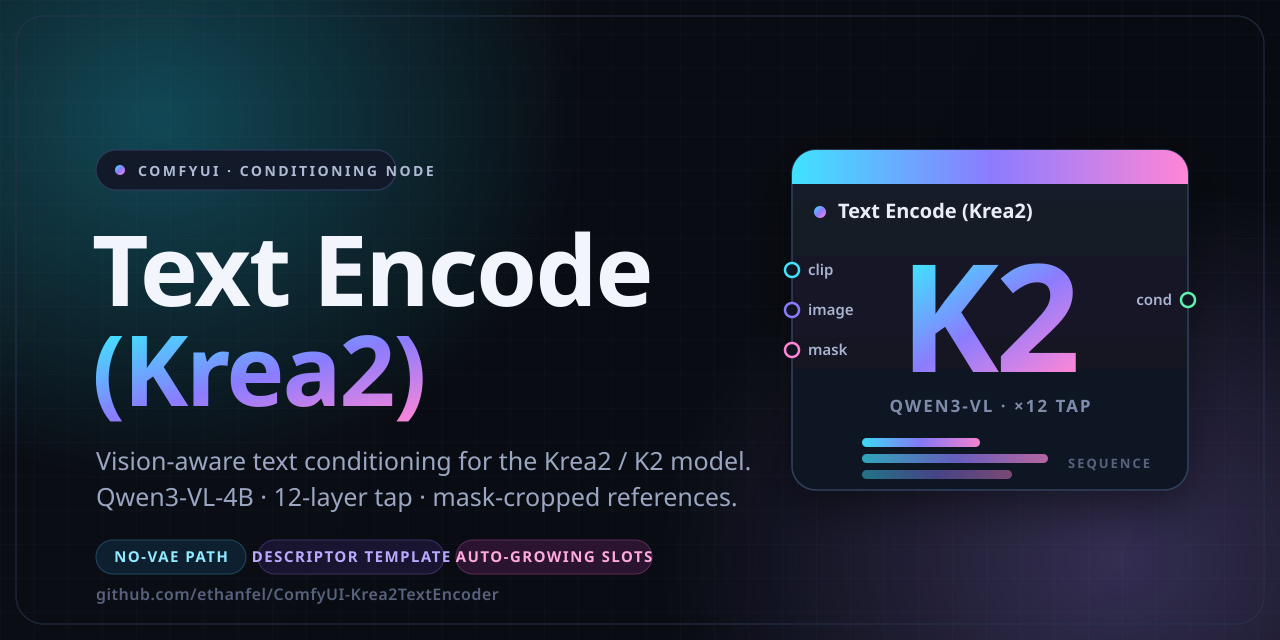
Text Encode (Krea2) — vision-aware text conditioning for the Krea2 / K2 model
(kreaturbo.safetensors), whose text encoder is Qwen3-VL-4B (12-layer tap).
Why this node exists
Krea2's text encoder is a vision-language model, so a reference image can be pushed
through its vision path to make the conditioning visually aware of that image — a
"prompt from a picture" effect. People were reaching for the core
TextEncodeQwenImageEdit node to do this, which has two problems for Krea2:
- The VAE input does nothing. Krea2's DiT (
comfy/ldm/krea2/model.py,SingleStreamDiT) builds its token sequence as[text_tokens, noisy_image_patches]— there is no slot for a reference latent, andKrea2.extra_conds(comfy/model_base.py) never readsreference_latents. So a connected VAE produces areference_latentsentry the model silently discards. (Real pixel-faithful editing would require training a reference-latent pathway into the DiT — it can't be done from a node alone.) - Wrong template with images. With an image attached, the core node falls back to Qwen3-VL's plain image template instead of the Krea2 descriptor template the model was conditioned with.
This node fixes both: it forces the Krea2 descriptor template even with images, and
it omits the VAE input entirely. It also accepts an unbounded, auto-growing set of
image+mask pairs (connect image1, a fresh image2/mask2 pair appears, and so on).
Masks
Each reference image has an optional companion mask. When connected, the image is
cropped to the mask's bounding box before the vision encoder, so the VLM only sees the
masked region. Use mask_padding to keep surrounding context: it grows the crop box by
that fraction of the image size on each side (0 = tight crop, 0.1 ≈ 10% margin, high
values ≈ the whole image). The mask is used only to compute the crop — it is not itself
sent to the VLM. This is reference-image masking — not inpainting: Krea2 has no
concat/inpaint pathway to regenerate a masked region of the output. (To spatially restrict
where the prompt applies in the output, use ComfyUI's standard ConditioningSetMask
downstream of this node — that works generically at the sampler level.)
Inputs
| Input | Type | Notes |
|-------|------|-------|
| clip | CLIP | Load with CLIPLoader → type krea2. |
| prompt | STRING | Your text prompt. |
| image1…N | IMAGE | Optional reference images; slots grow as you connect them. |
| mask1…N | MASK | Optional per-image mask; crops imageN to the masked bounding box. |
| mask_padding | FLOAT | Context kept around the mask, as a fraction of image size per side (0 = tight, default). |
| system_prompt | STRING input | Optional. Wire a text node to override the system instruction; unconnected = Krea2's default descriptor. See below. |
| vision_position | CHOICE | Image tokens before prompt (default) or after prompt in the user turn. |
| print_prompt | BOOLEAN | Print the assembled Qwen3-VL prompt to the ComfyUI console (debug). |
| vision_megapixels | FLOAT | Max size before the vision encoder; references are downscaled to this cap, never upscaled (default 1.0). |
Output: conditioning for the Krea2 sampler. (print_prompt dumps the assembled Qwen3-VL
prompt to the console for debugging.)
System prompt (making the prompt interact with the image)
system_prompt is a connectable text input, not a widget — leave it unconnected to use
Krea2's trained descriptor (the in-distribution default), or wire a text node to override it.
Provide just the instruction text; the node wraps it in the chat-template scaffolding.
By default the VLM is only told to describe the image, so your prompt and the reference sit
side by side. To make them interact (à la Qwen-Image-Edit), feed an instruct-style
instruction. The package ships a Krea2 System Prompt node preloaded with that instruction —
just drop it and wire its output into system_prompt (edit the text if you like). Its default
text is:
Describe the key features of the reference image (color, shape, size, texture, objects, background), then explain how the user's instruction should combine with or alter it, and generate a new image meeting the instruction while staying consistent with the reference where appropriate:
This is experimental / out-of-distribution — Krea2 was trained on the fixed descriptor, so results may drift. A/B it against the default.
Output is a standard CONDITIONING for the Krea2 sampler. With no images connected it
works as a plain Krea2 text encoder.
Install
Symlink (or copy) this repo into ComfyUI's custom_nodes/, matching the existing setup:
ln -s /media/p5/ComfyUI-Krea2TexTEncoder /media/p5/Comfyui/custom_nodes/ComfyUI-Krea2TexTEncoder
Then restart ComfyUI.