
Subworkflow (reusable workflows)
Use ComfyUI workflows as reusable subworkflows via Subworkflow Input, Subworkflow Output, and Subworkflow nodes
Nodes (7)
Stop copy-pasting your sampler chain — turn it into a node
The same reusable workflow, but fetched from a URL
The doorman for your reusable workflow
How to tweak a value mid-workflow without a circular reference
The outer half of the model-tweaking pair
Same trick, workflow fetched remotely
Where your reusable workflow hands results back
ComfyUI-Subworkflow 
ComfyUI-Subworkflow adds reusable workflow boundaries to ComfyUI. It lets one workflow expose named inputs and outputs, then lets another workflow execute it through a single Subworkflow node.
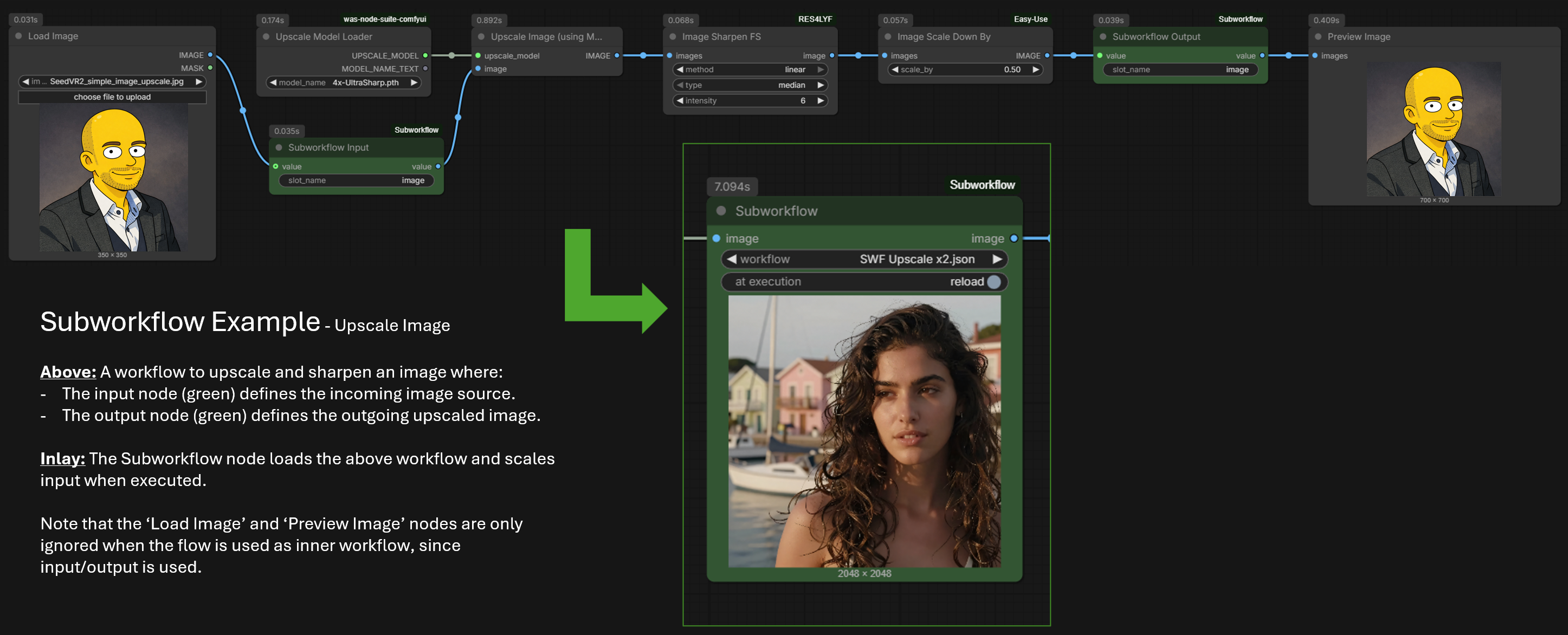
Subworkflow custom nodes
To control the workflow boundaries, this extension adds several custom nodes: Subworkflow, Subworkflow Input, and Subworkflow Output.
These nodes work together to load and execute inner workflows while exposing their inputs and outputs on the outer workflow.
To resolve circular reference problems when an inner workflow output needs to be modified and passed back into the inner workflow input, Subworkflow Modifier and Subworkflow Modifier Source nodes are added as well.
Node: Subworkflow
Loads a workflow from ComfyUI/user/default/workflows and expands it into the current prompt at execution time. The selected inner workflow determines the visible input and output slots on the node.
Inputs:
workflow: workflow file to execute (the inner workflow).at execution: controls whether the inner workflow file is reloaded on every execution or a loaded workflow instance is kept.
Outputs are dynamic and are inferred from the inner workflow's Subworkflow Output nodes.
In the example below you can see several workflows are used, and the image to video workflow is used several times:
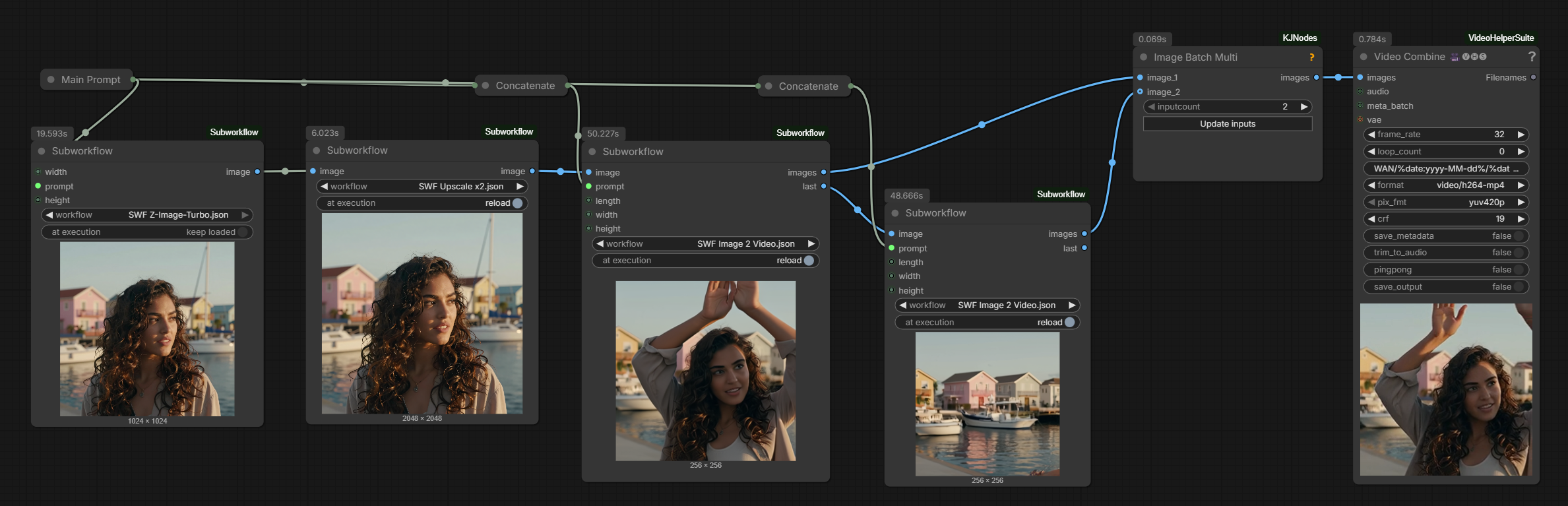 Example workflow with several Subworkflow nodes with loaded inner workflows
Node: Subworkflow (from URL)
Loads a workflow from a URL and expands it into the current prompt at execution time. The selected inner workflow determines the visible input and output slots on the node.
Inputs:
url: absolutehttp://orhttps://URL that returns a workflow JSON file.at execution: controls whether the inner workflow URL is reloaded on every execution or a loaded workflow instance is kept.verify ssl: controls whether HTTPS certificate validation is enforced while loading from URL (in case of Python SSL certificate issues with certain endpoints, such as GitHub raw URLs). Use with caution and only for trusted sources.
Outputs: dynamic and are inferred from the inner workflow's Subworkflow Output nodes.
Node: Subworkflow Input
Marks an input boundary inside a reusable workflow. The slot_name widget controls the label shown on the outer Subworkflow node. The value type is inferred from the connected node.
When used directly in a normal workflow, Subworkflow Input must have its value input linked for correct execution.
That linked node is ignored when used as inner workflow inside Subworkflow, and the value is instead provided by the outer Subworkflow node input.
If no linked node is attached to the Subworkflow input, the linked node of the Subworkflow Input is used as fallback. This allows for optional inputs on the inner workflow.
This structure allows for default values to be set on the input, and to use the same workflow as standalone or as inner workflow without changes.
Node: Subworkflow Output
Marks an output boundary inside a reusable workflow. The slot_name widget controls the label shown on the outer Subworkflow node. The output type is inferred from the connected value.
Subworkflow Output also behaves as a passthrough when other nodes inside the same inner workflow consume its output.
Node: Subworkflow Modifier
The Subworkflow Modifier node allows for modifying a value from the inner workflow and passing it back into the inner workflow without creating circular reference problems.
Used inside the inner workflow and accessed from outer workflow by the Subworkflow Modifier Source node.
Node: Subworkflow Modifier Source
The Subworkflow Modifier Source node is used in combination with the Subworkflow Modifier node.
Use the native dropdown at the top of the node to select the loaded Subworkflow or Subworkflow (from URL) whose modifier values should be exposed. The selector is a widget only and has no input socket. The source shares that target node's parsed workflow data and execution settings instead of loading a second independent copy.
This remains a separate outer node to avoid the graph cycle that would arise if the modified value were passed directly from the target Subworkflow output back into its input.
The older Subworkflow Modifier Source (from URL) node remains available only for compatibility with saved workflows; new workflows should select a URL-backed target from the regular modifier source.
See Features section below for an example of how to use these nodes together.
Installation
How get the Subworkflow custom nodes in ComfyUI.
From ComfyUI Custom Nodes UI
- Open the ComfyUI Manager
- Open the Custom Nodes Manager
- Make sure to remove filters
- Search for "Subworkflow (re-useable workflows)" and click install.
- Restart ComfyUI after installation. Browser also require a hard refresh.
From GitHub Repository
Clone this repository into your ComfyUI custom nodes directory:
cd ComfyUI/custom_nodes
git clone https://github.com/eniewold/ComfyUI-Subworkflow.git
Restart ComfyUI after installation or after Python changes. Browser-side updates also require a hard refresh. Note that there are no library dependencies outside of the standard Python environment bundled with ComfyUI.
FEEDBACK WELCOME: This is an early release and work in progress. Expect bugs and breaking changes as I continue development. Please report any issues you encounter, especially those unrelated to the known issues below, and share your use cases and feedback. Check below on how to get debug messages in the log files.
Simple Step-by-Step Usage Example
- Adjust an (inner) workflow and add one or more
Subworkflow Inputnodes where external values should enter. - Add one or more
Subworkflow Outputnodes where values should leave the inner workflow. - Set meaningful
slot_namevalues on each input and output boundary. - Save the inner workflow (keep default folder
ComfyUI/user/default/workflows). - In another workflow, add a
Subworkflownode and select the saved workflow file (now called the inner workflow). - Connect or set value for the input and output slots.
Features
Highlights of the current features of this extension. See the example workflows and notes below for more details and use cases.
Modifier Nodes 
If you want to expose an output from the inner workflow, modify it (for example, add loras to a model), and then pass it back into the inner workflow, you can use the Subworkflow Modifier node in combination with Subworkflow Modifier Source nodes.
The modifier node takes an input value, passes it through to its output, and also makes it available as a source for modifier sources. On the outer modifier source, select the corresponding loaded Subworkflow node. The reference does not add a graph connection, so the source can expose the pre-modifier value without creating a dependency cycle.
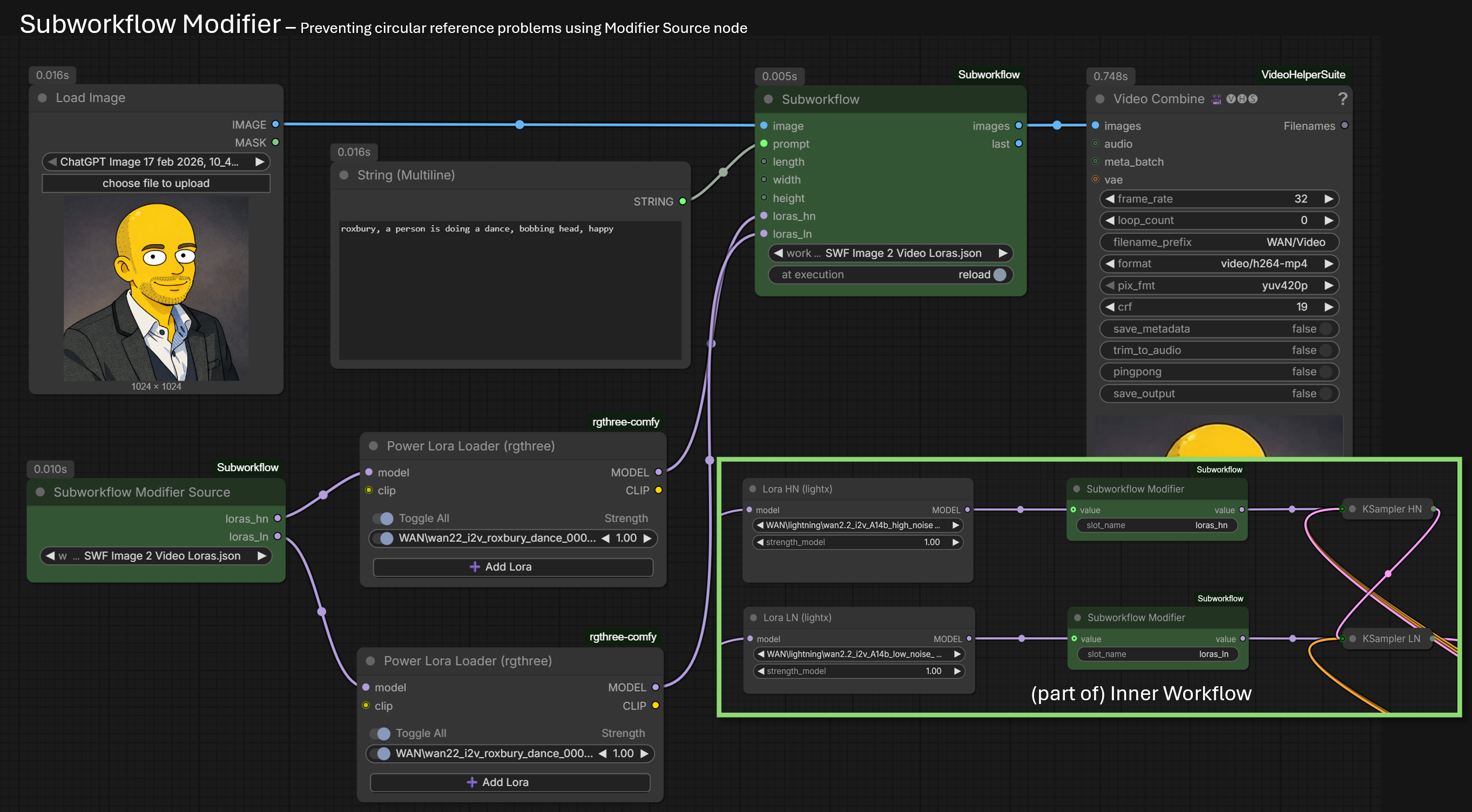
User Value Entry
For Subworkflow Input nodes with primitive number types, users can now set the value directly in the Subworkflow node without a link to separate node.
This allows for more compact workflows when you simply want to set a number for the inner workflow.
When an node is linked to the input of such a node, the linked node value will take precedence over the set value.
The value input can also be disabled; the linked input of the inner input will use as fallback value.
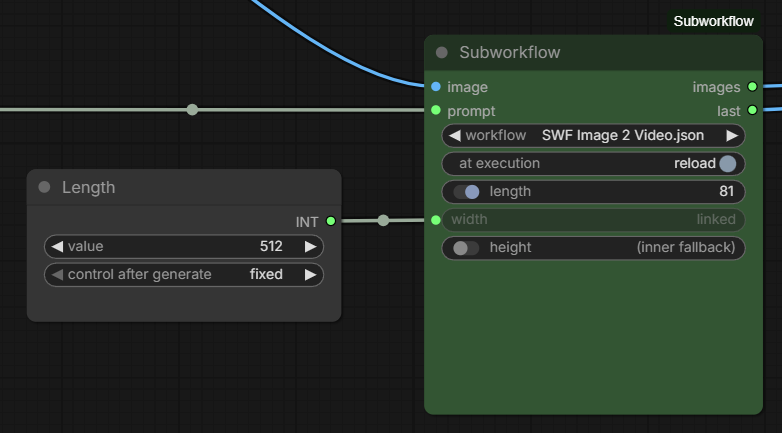
Notes
Some notes and observations about the behavior and development of this extension.
- Developed and tested with ComfyUI version 0.18.2.
- The
Subworkflownode sets the input and output parameters when loading the inner workflow. This load is executed when the outer workflow is loaded. When linked nodes do not match the expected input types provided bySubworkflow OutputandSubworkflow Inputfrom inner workflow, the links are severed silently. - The
Subworkflow Outputnode will not pass through values to it's output when it's used as inner workflow. When the workflow is executed standalone, it will pass through values transparently as expected. - The
Subworkflow Inputwill ignore any linked nodes to the input values when used as inner workflow. When the workflow is executed standalone, it will use the linked values transparently as expected. - If the input of a corresponding
Subworkflow Inputon theSubworkflownode is not linked, the inner workflow will use the linked node of theSubworkflow Inputnode. This allows for optional inputs on the inner workflow. - The
Subworkflownode loads the values from the selected inner workflow as is; including seed numbers. Whenat executionis set tokeep loaded, the seed value will be updated by the inner workflow if it has a randomize-after-processing node linked to theSubworkflow Input. This allows for workflows that need to update their own input values, such as a seed that should randomize on every execution but also be exposed for linking to other nodes. - The
Subworkflownode will keep the loaded file untouched, it will never save any changes to the inner workflow back to the file. - A large portion of the source code has been created using AI assistance. Without this, the project would not have been possible for me at this time. I have done my best to review and test the generated code, but there may be edge cases or bugs that I have missed. Please report any issues you encounter.
Subworkflow vs Subgraph
Note: Subworkflows are fundametally different from subgraphs. Subworkflow offers a way to reuse entire workflows as nodes in other workflows, while subgraphs are a way to reuse a group of nodes within the same workflow.
Use Cases
- Reuse a prompt, sampler, or decode chain across multiple workflows.
- Wrap model-specific pipelines behind a small set of named inputs and outputs.
- Build compact higher-level workflows from tested lower-level workflows.
- Keep experimental graph sections isolated while exposing only the inputs and outputs that matter.
- Share common workflow pieces without copying all nodes into every workflow.
Supported Shapes
ComfyUI workflow JSON appears in a few different shapes depending on how it was saved and which nodes are used. This extension currently supports:
- UI-format workflows with top-level
nodesandlinksarrays. - API-format workflows where each node is keyed by node id and has
class_typeandinputs. - UI-format native ComfyUI subgraphs stored under
definitions.subgraphs. - UI node class names stored directly in
node.type. - UI node class names stored in
node.properties["Node name for S&R"]whennode.typecontains a UUID. - UI links in classic array form:
[id, source_node, source_slot, target_node, target_slot, type]. - UI links in object form with
id,origin_id,origin_slot,target_id, andtarget_slot. - UI
widgets_valuesstored as ordered lists. - UI
widgets_valuesstored as dictionaries keyed by widget/input name. - Widget-backed
COMBO,INT,FLOAT,STRING, andBOOLEANinputs, including legacy list-based combo definitions and control-after-generate companion widgets. - Boundary nodes used as passthroughs when other nodes connect to
Subworkflow InputorSubworkflow Outputoutputs.
Subworkflow Input and Subworkflow Output boundary names are read from their slot_name widget. For UI workflows this can come from either list-style or dictionary-style widgets_values; for API workflows it is read from the node's inputs.slot_name.
Known Issues
- [ ] The
Subworkflownode progress can exceed 100%, sometimes reaching about 200%. Check with the upscale workflow example. - [ ] Used paths with macro elements are not formatted currectly when used in inner workflow? (use Video Combine node with %date:yyyy-MM-dd%/WAN/Video)
- [ ] Green progress borders appear on more than one node when executing a inner workflow as part of a larger workflow. These borders should be limited to the currently executing node(s) outer workflow.
- [ ] The order if inputs/outputs on the
Subworkflownode is undetermined (probably based on the order of nodes in the inner workflow JSON). Consider adding an option to control this order. - [ ] When a node
Subworkflow Inputis used inside a subgraph, it will not be detected as a boundary node and will not be exposed on theSubworkflownode.
Version History
- v1.3.0 -
Subworkflow Modifier Sourcenow selects a loaded file- or URL-backedSubworkflowthrough a native dropdown, shares its parsed workflow data per execution, and prunes unrelated sampler/output branches to prevent duplicate renders. The URL-specific source remains as deprecated compatibility support. - v1.2.3 - (re)loading an inner workflow with links updates no longer disconnects all input links; they are now preserved when possible.
- v1.2.2 - Fixed a bug where inner node validation exception were raised due to removal of initial static output slots.
- v1.2.1 - Removed the maximum number of inputs and outputs on the
Subworkflownode (was previously set to 8). - v1.2.0 - Added value entry for primitive
Subworkflow Inputinput nodes directly on theSubworkflownode. Check README features section for details. - v1.1.0 - Added
Subworkflow Modifier,Subworkflow Modifier Source(+ from URL) nodes. Combining these nodes in inner and outer workflows allows for circular links between an inner workflow input and output, without circular reference problems. - v1.0.1 - UI only nodes are now supported in inner workflows, no longer raising and error when loading.
- v1.0.0 - Initial release of the four custom nodes and workflow loading and execution behavior.
Debug Logging
Backend debug logging is controlled by the COMFYUI_SUBWORKFLOW_DEBUG environment variable.
- When set to
true, trace-style Python logs are enabled. - When unset or set to
false, only normal release logs are shown.
When using ComfyUI portable, adjust the launch script and add the following after 'setlocal' line:
...
setlocal
set COMFYUI_SUBWORKFLOW_DEBUG=1
...
Frontend debug logging is separate and can be enabled in the browser console:
- Enable it by setting the
swf_debugitem inlocalStorageto"1":
localStorage.setItem("swf_debug", "1")