
ComfyUI-StyleGan
StyleGAN2 and StyleGAN3 support for ComfyUI, @dfl's fork with added features
Nodes (16)
The slider for a face you can't prompt
The average-face node
Morphing faces with lerp and slerp
Find the knobs nobody labelled
The free edit axes, no sampling required
From seed to latent
The StyleGAN model loader (and the model hunt that follows)
Pinning a good edit so you can find it next month
Get the exact face back from a PNG
The face file that remembers itself
Paste a face back into existence
Render the filmstrip before you commit
Pushing a real photo back into StyleGAN's latent space
Pull one latent out of a batch
Flatten a face into copy-pasteable text
The node that turns a StyleGAN latent into pixels
ComfyUI-StyleGan
Basic support for StyleGAN2 and StyleGAN3 models.
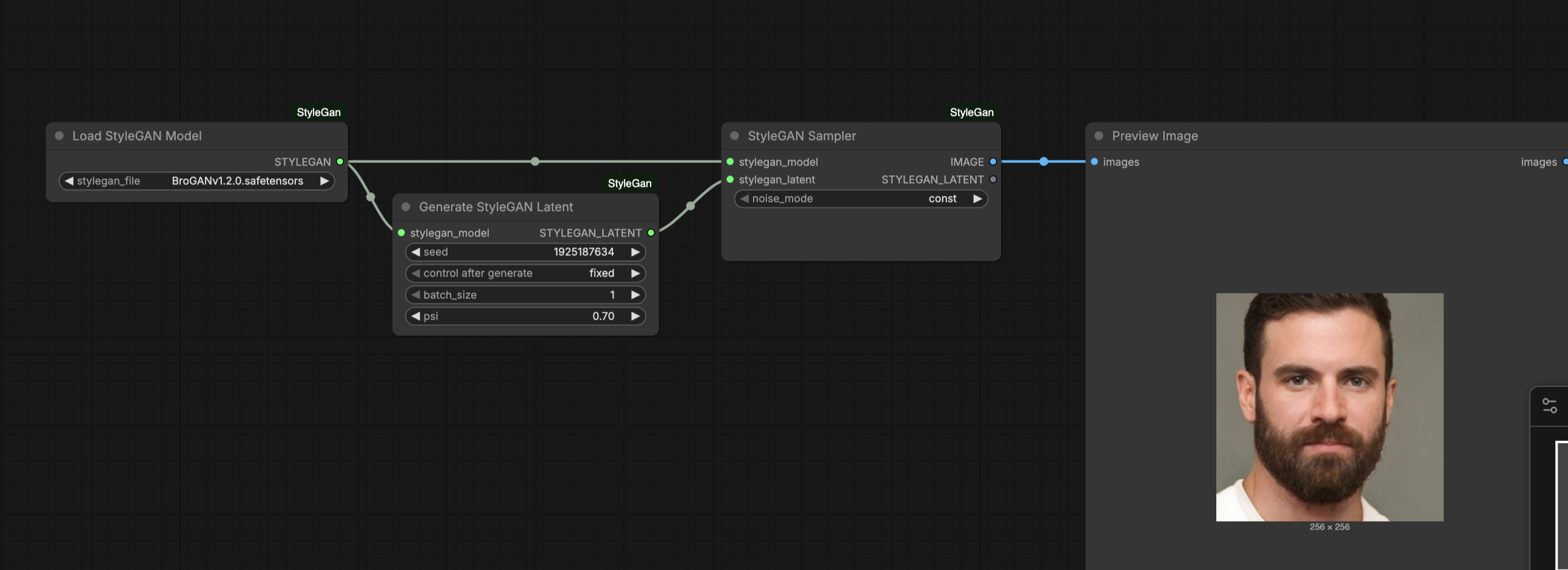
This is @dfl's actively maintained fork of spacepxl/ComfyUI-StyleGan, with several additions on top of the original: automatic .safetensors caching/conversion for .pkl checkpoints, latent embedding in saved PNGs (with model-compatibility tracking), seed/image mixing, unsupervised latent direction discovery (GANSpace/SeFa) with strength-sweep previews, and StyleGAN+FaceID support.
Original:
https://github.com/NVlabs/stylegan3
Models:
- https://catalog.ngc.nvidia.com/orgs/nvidia/teams/research/models/stylegan2/files
- https://catalog.ngc.nvidia.com/orgs/nvidia/teams/research/models/stylegan3/files
- https://github.com/justinpinkney/awesome-pretrained-stylegan2
- https://github.com/justinpinkney/awesome-pretrained-stylegan3
- https://huggingface.co/EFHQ/efhq_weights/tree/main/stylegan
- https://huggingface.co/quartzermz/BroGANv1.0.0
- https://huggingface.co/quartzermz/BroGANv2.0.0
Place any models you want to use in ComfyUI/models/stylegan/*.pkl (create the folder if it doesn't exist).
Safetensors
LoadStyleGAN prefers .safetensors checkpoints. .pkl files aren't just weights though, they're a pickled Python object (architecture + weights), so the first time you load a .pkl, LoadStyleGAN unpickles it once and automatically writes a .safetensors cache next to it (same folder, same name). Every load after that uses the cache and never touches pickle again.
The cache records the model's exact original constructor arguments (init_kwargs, captured automatically by torch_utils.persistence for every StyleGAN2/3 model) as metadata alongside the weights, so reloading reconstructs the exact same architecture rather than guessing hyperparameters from tensor shapes. Verified bit-exact against the original .pkl output.
To convert without loading into ComfyUI first (e.g. to batch-convert a models folder), run the same logic standalone:
python convert_to_safetensors.py model.pkl
Seed mixing
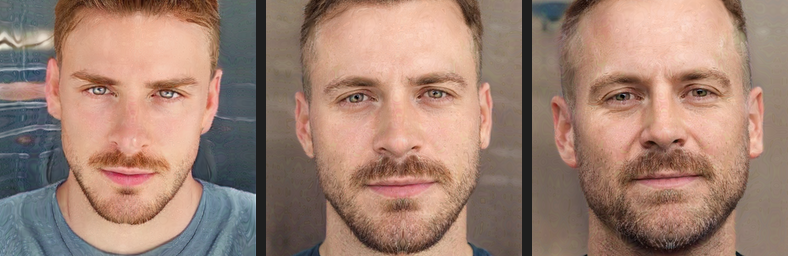
BlendStyleGANLatents lerp/slerp-blends two latents using a coarse/mid/fine mask, for style-mixing between two generated faces. Drag the image above into ComfyUI to load the example workflow.
Mixing from saved images instead of seeds

Any image saved with SaveStyleGANLatentImg has its exact latent embedded in the PNG. LoadStyleGANLatentImg reads that back out directly (instant, exact, no seed or generation history needed) so you can blend two files instead of two seeds: drag/copy the images into ComfyUI's input/ folder, then LoadStyleGANLatentImg x2 → BlendStyleGANLatents → StyleGANSampler, same as the seed-mixer above. A PNG with no embedded latent (e.g. a plain photo) raises a clear error instead of silently failing — for that case, use StyleGANInversion instead, which approximates a latent for any image via optimization.
You don't actually need SaveStyleGANLatentImg specifically: this extension patches core SaveImage/PreviewImage so any save of a StyleGANSampler output automatically carries the same embedded latent, no extra node required. (Look for a StyleGAN: prefix in the server log if you're ever debugging unrelated SaveImage behavior and want to rule this out.)
LoadStyleGANLatentImg's third output, model_file, is the filename of the model that generated the latent (e.g. BroGANv1.2.0.safetensors) — useful for checking two images actually came from the same model before blending them; latents from different checkpoints aren't guaranteed compatible.
To try the example workflow above as-is (not just as a template), copy examples/face_A.png and examples/face_B.png into your ComfyUI/input/ folder first — the workflow's two LoadStyleGANLatentImg nodes reference those exact filenames, which (unlike the seed-mixer example) aren't portable on their own since they're specific saved images, not a seed number.
Latent direction discovery (GANSpace / SeFa)
DiscoverGANSpaceDirections and DiscoverSeFaDirections both find unsupervised edit directions in W-space, with no labeled attribute data required. Neither tells you what a direction does; use StyleGANDirectionSweep first to render a strength-sweep filmstrip for a given component_index and eyeball what it changes before committing to a strength.
DiscoverGANSpaceDirectionssamples random latents and runs PCA over them. Directions are scaled to roughly "1 sigma" units, sostrengtharound +/-1-3 is a good starting range withApplyStyleGANDirection.DiscoverSeFaDirectionseigen-decomposes the generator's style-modulation weights directly (no sampling, effectively instant). Directions are unit-normalized, so useful strengths are larger, e.g. +/-5-20.- Component sign and ordering can vary between GANSpace runs/seeds (PCA sign ambiguity) - a negative
strengthjust flips the edit direction, same as blend direction inBlendStyleGANLatents. ApplyStyleGANDirectionmoves a single latent along one component, optionally restricted to a coarse/mid/fine layer subset via the samemaskconvention asBlendStyleGANLatents. Chain multipleApplyStyleGANDirectionnodes to compose edits from several components.
You can also discover directions offline, without ComfyUI running, with discover_directions.py:
python discover_directions.py model.safetensors --method sefa
python discover_directions.py model.safetensors --method ganspace --num-samples 5000
python discover_directions.py model.safetensors --method sefa --sweep 0,1,2 --sweep-out sweep.png
This saves a .safetensors file (same folder as the model by default) with each component as its own named tensor (component_00, component_01, ...), and can optionally render a sweep-preview PNG grid for a few components in one shot (the --sweep option needs the compiled StyleGAN CUDA/MPS ops, same as running the model in ComfyUI; discovery itself does not). LoadStyleGANDirections loads this file: leave direction_name blank to get the whole batch back (for StyleGANDirectionSweep-style exploration by component_index), or fill it in once you know which component you want (e.g. component_03) to load just that one direction.
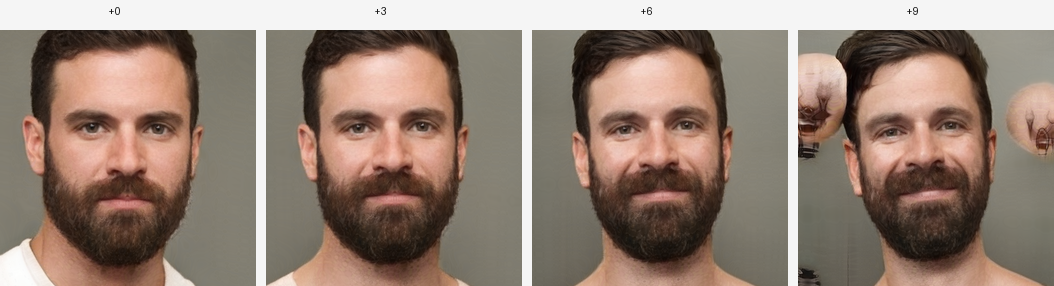
Example above: BroGANv1.2.0, GANSpace component_02, coarse mask, StyleGANDirectionSweep from 0 to 9 in 4 steps — a clean, disentangled smile direction that starts breaking down past ~strength 7-8 (visible ghosting at +9). Drag the image into ComfyUI to load the workflow.
A note on MPS + PyTorch versions: we found StyleGAN3 synthesis results can differ meaningfully between PyTorch versions on the same MPS device for the same seed/direction (verified: torch 2.7.0 and 2.10.0 reproduce cleanly, torch 2.14.0 gave visibly different, worse results for this same example). If a direction that should show a clear effect looks wrong or flat, try a different PyTorch version before assuming the direction itself is bad.
StyleGAN + FaceID
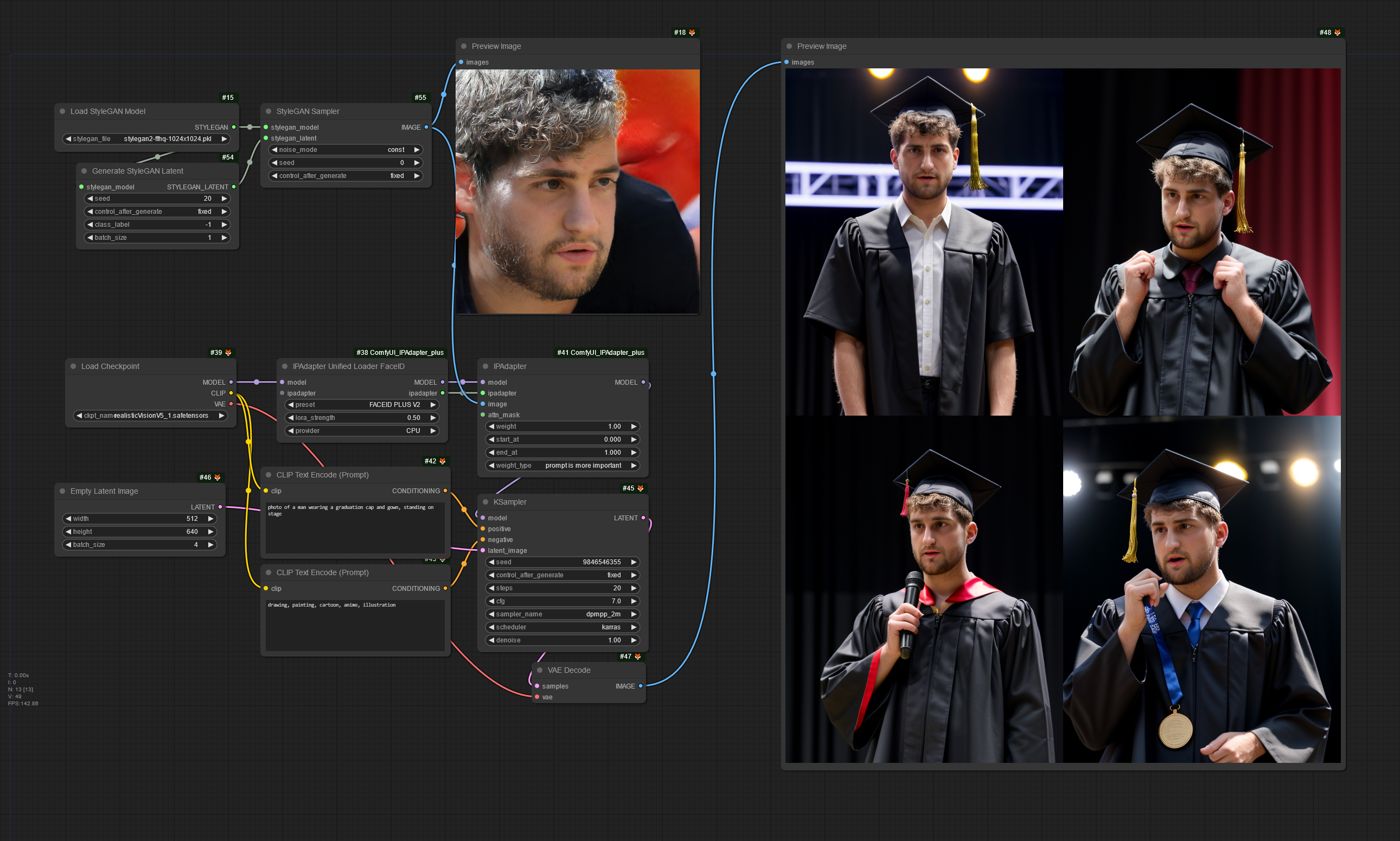
StyleGAN's mapping network generates a face latent (and rendered face) far faster than a diffusion model, making it a good identity source for IPAdapter FaceID/InstantID: generate a candidate face with GenerateStyleGANLatent + StyleGANSampler, then feed that image into IPAdapterUnifiedLoaderFaceID to condition an SD1.5/SDXL checkpoint's generation on that identity. Drag the image above into ComfyUI to load the example workflow.
StyleGAN + Krea 2 identity editing
A StyleGAN-generated face also works as the source image for ComfyUI-Krea2Edit's Krea 2 Identity Edit LoRA, which does instruction-based, identity-preserving edits ("recolor the car to matte black", pose/outfit/scene changes, etc.) instead of resampling a new face: generate a candidate face with GenerateStyleGANLatent + StyleGANSampler, then wire that image into VAEEncode (→ Krea2EditModelPatch.source_latent) and Krea2EditGroundedEncode.image in place of a LoadImage node, same as any other Krea2Edit source. See that repo's README for full node wiring and usage notes.
StyleGAN + SUPIR upscaling

StyleGAN outputs are low resolution (typically 512-1024px) and can look soft or slightly artifacted. Feeding a generated face from StyleGANSampler into a SUPIR restore/upscale pass adds realistic skin and hair detail while keeping the identity. Drag the image above into ComfyUI to load the example workflow.
Installation
StyleGAN uses custom CUDA extensions which are compiled at runtime, so unfortunately the setup process can be a bit of a pain.
You need CUDA Toolkit, ninja, and either GCC (Linux) or Visual Studio (Windows). Tested on Windows with CUDA Toolkit 11.7 and VS2019 Community. You may also need to add paths to the system PATH, CUDA_HOME, and LD_LIBRARY_PATH.
PATH:
C:\Program Files (x86)\Microsoft Visual Studio\2019\Community\VC\Tools\MSVC\14.29.30133\bin\Hostx64\x64
C:\Program Files (x86)\Microsoft Visual Studio\2019\Community\VC\Auxiliary\Build

CUDA_HOME:
C:\Program Files\NVIDIA GPU Computing Toolkit\CUDA\v11.7

LD_LIBRARY_PATH:
C:\Program Files\NVIDIA GPU Computing Toolkit\CUDA\v11.7\lib\x64
If you're using ComfyUI portable, the embedded python installation is probably also missing some necessary files. The only solution I found to this was to just copy them from a full system installation of python 3.10.x to the embedded installation.
From C:/Users/username/AppData/Local/Programs/Python/Python310/include/*
to ComfyUI_windows_portable/python_embeded/Include/*
(make sure you don't overwrite any file/folders that are already there)
And from C:/Users/username/AppData/Local/Programs/Python/Python310/libs/*
to ComfyUI_windows_portable/python_embeded/libs/*
If all of that is set up correctly, when you run a StyleGAN workflow, it will first build the necessary PyTorch plugins (should take 30-60s), then generate an image. There will be a message in the console, and then subsequent images will be much faster to generate (measured at 64 images/sec on a 3090 with a large batch, although ComfyUI's tensor to PIL for previews will bottleneck realtime generation to more like 8 fps)
StyleGAN2:
Setting up PyTorch plugin "bias_act_plugin"... Done.
Setting up PyTorch plugin "upfirdn2d_plugin"... Done.
StyleGAN3:
Setting up PyTorch plugin "bias_act_plugin"... Done.
Setting up PyTorch plugin "filtered_lrelu_plugin"... Done.