
Smart Aspect Ratio
ComfyUI node that lets you set the aspect ratio with the prompt. Converts megapixels + aspect ratio into width/height, with prompt-based ratio detection and randomization.
ComfyUI Smart Aspect Ratio
A ComfyUI custom node that converts a megapixel target and aspect ratio into pixel dimensions (width × height). The ratio can be fixed, randomized, or detected automatically from a connected prompt.
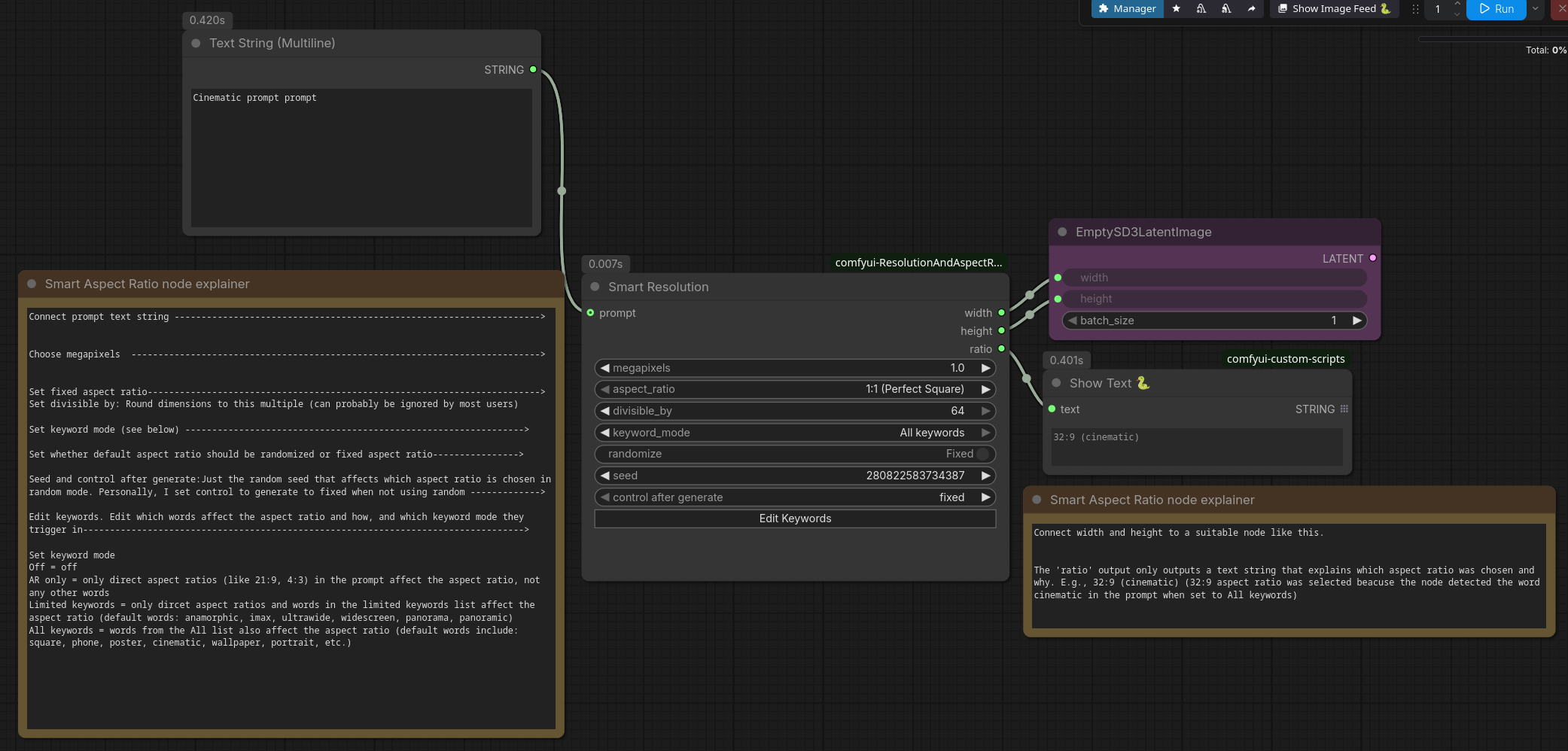
Type cinematic ultrawide city at night and the node hands your latent a 21:9 resolution. Write 16:9 anywhere in the prompt and it obeys exactly. Or skip detection entirely and use it as a clean megapixels-plus-ratio resolution picker and/or randomize the aspect ratio for each run.
Features
- 23 aspect ratios from 9:32 portrait to 32:9 landscape
- Prompt-based detection — connect your prompt text and the node picks a fitting ratio automatically
- Explicit override — writing
16:9(or any accepted ratio) in the prompt forces it exactly - Keyword matching — terms like
cinematic,widescreen,portrait, oranamorphicmap to weighted ratio pools - Seed-controlled randomization — choose between a fixed or random ratio when nothing matches, reproducible via seed
- Editable keyword rules — click Edit Keywords on the node to change the mapping, no restart needed
Installation
ComfyUI Manager: search for Smart Aspect Ratio. <!-- keep this in sync with the registry DisplayName -->
Manual:
cd ComfyUI/custom_nodes
git clone https://github.com/dawncreatescode/comfyui-ResolutionAndAspectRatio
Restart ComfyUI. The node appears under the Resolution category.
Quick start
- Add the node: Add Node → Resolution → Smart Aspect Ratio.
- On your Empty Latent Image, connect
widthandheightto this node. - (Optional, for prompt detection) Feed the same prompt string into both your CLIP Text Encode and this node's
promptinput — e.g. from a String/Primitive node:
[String: prompt] ──┬──→ [CLIP Text Encode] ──→ ...
                   └──→ [Smart Aspect Ratio] ──width───→ [Empty Latent Image]
                                              ──height──→
- Pick a
megapixelstarget (1.0 ≈ SDXL native) and you're done. Without apromptconnection, the node is a simple ratio/resolution picker using theaspect_ratiodropdown.
How the ratio is chosen
Detection runs in strict priority order — first match wins:
- Explicit ratio in the prompt.
16:9 photo of a harbor→16:9 (from prompt). Always wins. - Keyword match.
anamorphic close-up→21:9 (anamorphic). When a keyword maps to several ratios (e.g.widescreen→ 16:9 / 19:9 / 21:9), one is picked by weighted random using the seed. - Fallback. Nothing matched → the fixed
aspect_ratiodropdown, or a random ratio ifrandomizeis on.
The ratio output always tells you what fired — 21:9 (from prompt), 16:9 (cinematic), 4:5 (fallback). Connect it to a Show Text node while you're tuning.
Keyword modes — and why Limited is the default
| Mode | What triggers detection |
|---|---|
| Off | Nothing — fixed or random ratio only |
| AR only | Only explicit ratios written in the prompt (16:9, 3:2, …) |
| Limited keywords (default) | Explicit ratios + unambiguous format terms (widescreen, anamorphic, ultrawide, …) |
| All keywords | Everything above + content words (cinematic, portrait, poster, phone, …) |
Content words are powerful but can be unintended: in portrait of a king, "portrait" describes the subject, not the orientation — yet All mode will dutifully make the image tall. Limited only reacts to words that unambiguously describe a format, which is why it's the default. Switch to All when you want maximum hands-off behavior and your prompts don't use those words for content.
Default keyword rules
| Words | Ratio pool | Active in |
|---|---|---|
| anamorphic | 21:9 | Limited + All |
| imax | 4:3 | Limited + All |
| ultrawide | 21:9 32:9 | Limited + All |
| widescreen | 16:9 19:9 21:9 | Limited + All |
| panorama, panoramic | 16:9 19:9 21:9 32:9 | Limited + All |
| square, avatar, thumbnail | 1:1 | All only |
| mobile, phone, smartphone | 9:16 9:19 9:21 | All only |
| poster | 2:3 3:4 4:5 | All only |
| cinematic | 16:9 21:9 32:9 | All only |
| banner, wallpaper | 16:9 21:9 32:9 | All only |
| landscape, horizontal, wide angle, wide shot | all landscape ratios | All only |
| portrait, vertical, tall | all portrait ratios | All only |
Supported aspect ratios
Portrait: 2:3 3:4 3:5 4:5 5:7 5:8 7:9 9:16 9:19 9:21 9:32 · Square: 1:1 · Landscape: 3:2 4:3 5:3 5:4 7:5 8:5 9:7 16:9 19:9 21:9 32:9
Editing the rules
Click Edit Keywords on the node. Each rule has:
- Words — comma-separated triggers (case-insensitive, phrase-aware)
- Ratios — comma-separated pool, or
$LANDSCAPE/$PORTRAITfor the full sets - Weights — optional per-ratio probabilities (blank = equal chance)
- Category —
limited(active in Limited + All) orall(All mode only)
Changes save to keywords.json in the node folder and apply immediately.
Node reference
Inputs
| Input | Type | Description |
|---|---|---|
| megapixels | dropdown | Pixel budget, 0.1–2.5 MP (1.0 ≈ SDXL native, ~0.25 ≈ SD 1.5 native) |
| aspect_ratio | dropdown | Fallback ratio when detection is off or finds nothing |
| divisible_by | dropdown | Round dimensions to a multiple of 8 / 16 / 32 / 64 — see below |
| keyword_mode | dropdown | Which prompt keywords trigger detection (see modes) |
| randomize | boolean | Pick a random ratio when nothing matches |
| seed | INT | Fixed seed → reproducible picks; set control_after_generate to randomize for variety per run |
| prompt | STRING (optional) | The text to scan — same string you feed your CLIP Text Encode |
Outputs
| Output | Description |
|---|---|
| width | Image width in pixels |
| height | Image height in pixels |
| ratio | Selected ratio + what triggered it, e.g. 16:9 (cinematic) |
Choosing divisible_by
Stable Diffusion latents require dimensions divisible by 8, so 8 is the hard minimum. Larger multiples (32, 64) are safer across models and avoid edge artifacts some checkpoints show at odd sizes — at the cost of landing slightly further from your exact ratio and megapixel target. Rule of thumb: leave it at 64; drop to 16 or 8 only if you need shapes as exact as possible and know your model handles them.
Troubleshooting
My keyword isn't detected. Check keyword_mode — content words like cinematic need All keywords. Also confirm the prompt input is actually connected; the node can't see text it isn't given.
Dimensions aren't exactly my ratio. That's divisible_by rounding. Lower it for a closer fit.
randomize gives the same ratio every run. The seed is fixed. Set the seed widget's control_after_generate to randomize.
Which ratio fired, and why? Connect the ratio output to a Show Text node — it names the trigger.