
ComfyUI-ASASR
ASASR 4x diffusion super-resolution (FLUX.1-dev dual-LoRA) for ComfyUI, with native fp8/GGUF support. Non-commercial (CC-BY-NC-4.0 weights).
ComfyUI-ASASR
ComfyUI node for ASASR, a diffusion-based 4x image super-resolution model built on a FLUX.1-dev backbone with a dual-LoRA design (SR + DPO adapters) and OminiControl-style image conditioning.
- Upstream project: wafer-bob/ASASR
- Model weights: wafer-bob/ASASR on Hugging Face
All credit for the ASASR model, training, and inference code goes to its original authors (wafer-bob / Kuaishou Technology). This repository is a ComfyUI integration of their published model and weights.
Non-commercial use only. The ASASR model weights and the code derived from the upstream repository (
asasr/vendor/,asasr/color_fix.py) are licensed under CC-BY-NC-4.0. They may not be used commercially. See License below.
What it does
One node, ASASR Upscale (4x), takes a FLUX.1-dev MODEL, CLIP and
VAE from ComfyUI's standard loaders plus an IMAGE, and returns a 4x
upscaled IMAGE (batch-aware). Because it runs on ComfyUI's own model
types, it:
- works with bf16, fp8 and GGUF-quantized FLUX.1-dev checkpoints, so you can pick the precision your GPU can hold;
- reuses the FLUX.1-dev files you already have instead of downloading a separate copy;
- is loaded and offloaded by ComfyUI's own model management, like any other model in your workflow.
The input image is split into overlapping low-resolution tiles, each tile is bicubic-upscaled to a 512px condition image, denoised with FLUX + the ASASR LoRAs, and the resulting high-resolution tiles are feather-blended back together. A global color-fix pass (AdaIN or wavelet) corrects for drift against a bicubic reference of the whole image.
This is a research-grade port of an academic model. Expect it to be slow — each 128px tile takes a full 16-step diffusion pass. For more than twice the speed at comparable quality, add the FLUX.1-Turbo-Alpha LoRA and run 6 steps; see Fast mode.
Results
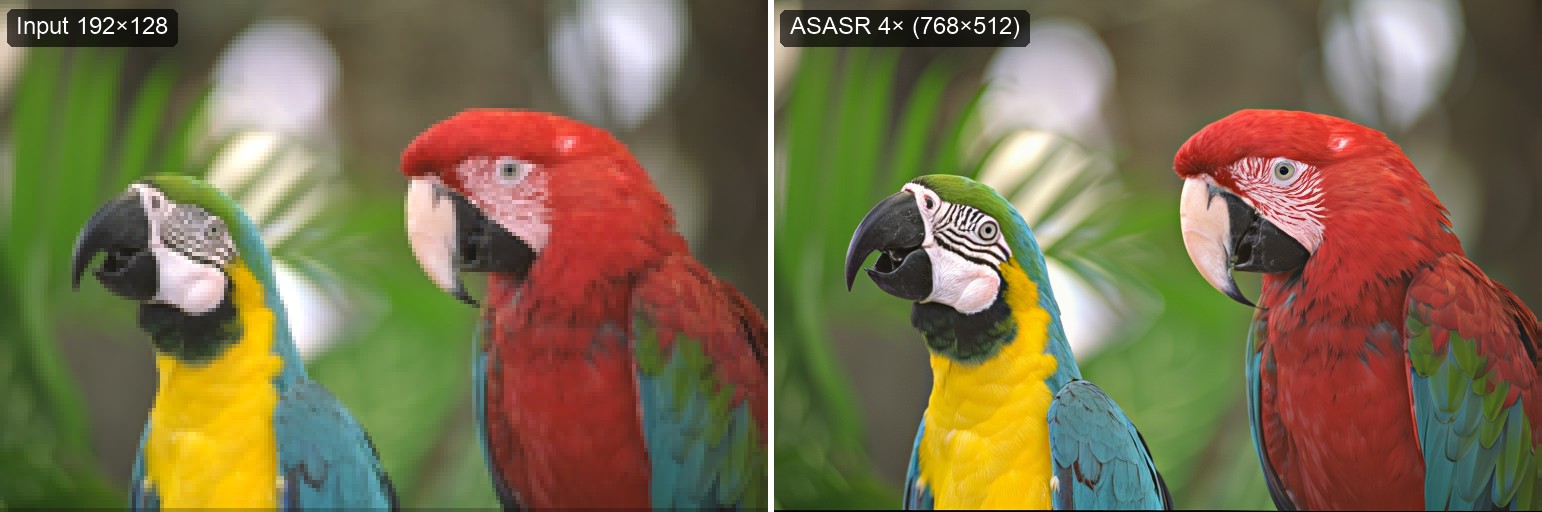
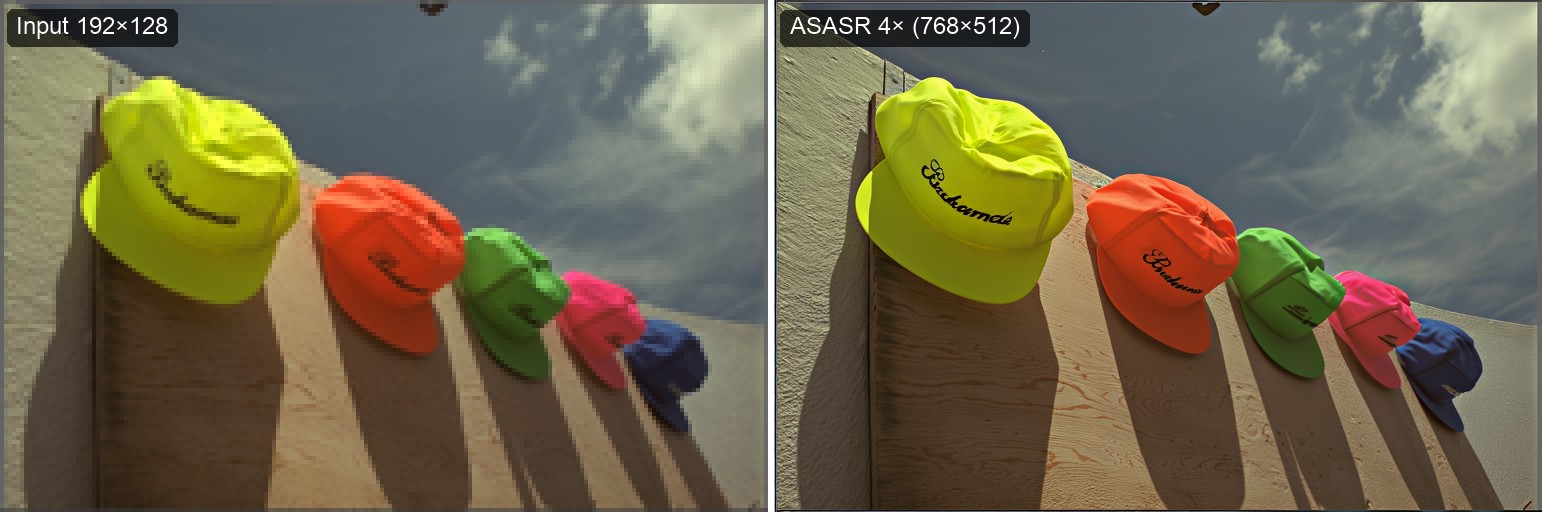
All examples below were produced end to end through the ComfyUI API with
the 1.0 default settings (28 steps, guidance 3.5, tile_size 128,
tile_overlap 16, color_fix adain). Inputs are images from the Kodak
Lossless True Color Image Suite, downscaled 4× with bicubic filtering, so
the original image serves as ground truth.
Before / after (left: 192×128 input, shown with nearest-neighbor scaling; right: ASASR 4× output):
Compared with bicubic upscaling and the original image, with zoomed crops in the bottom row:
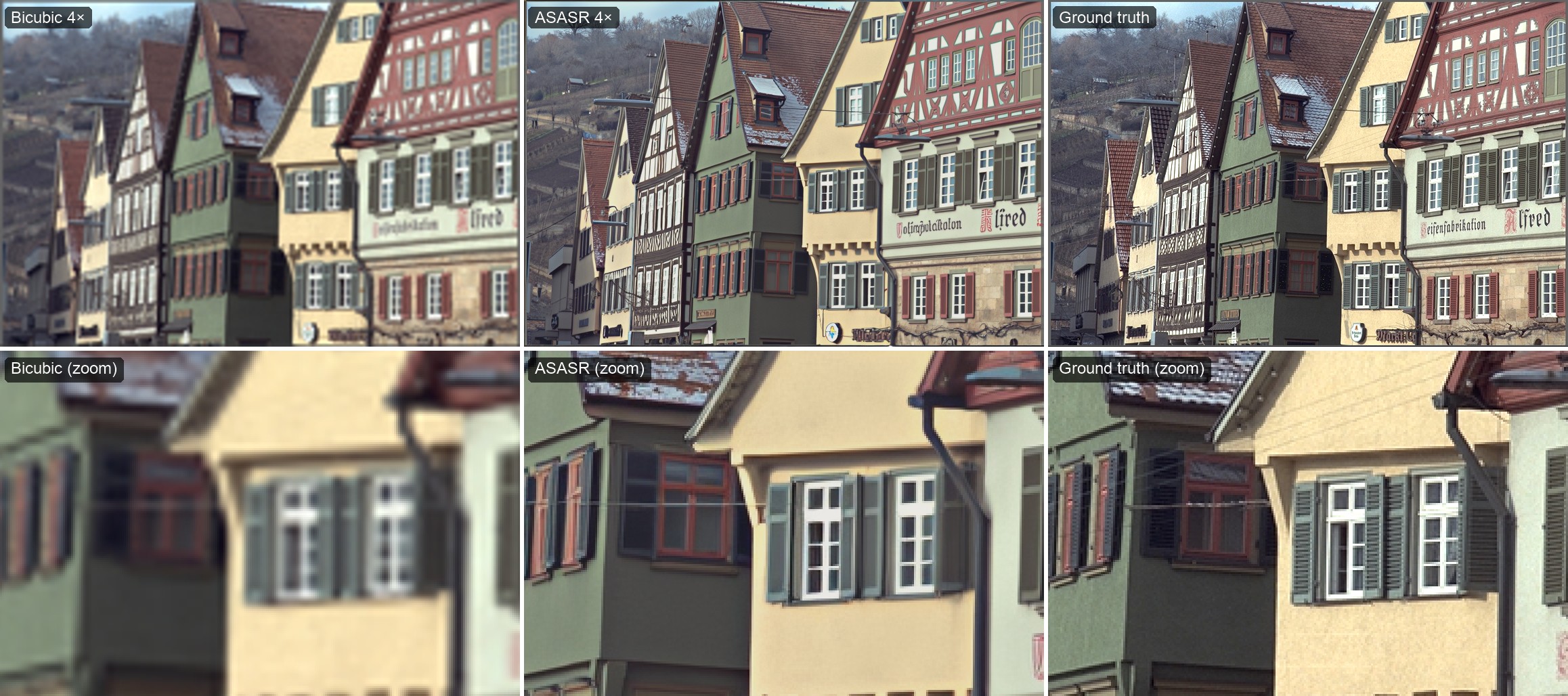
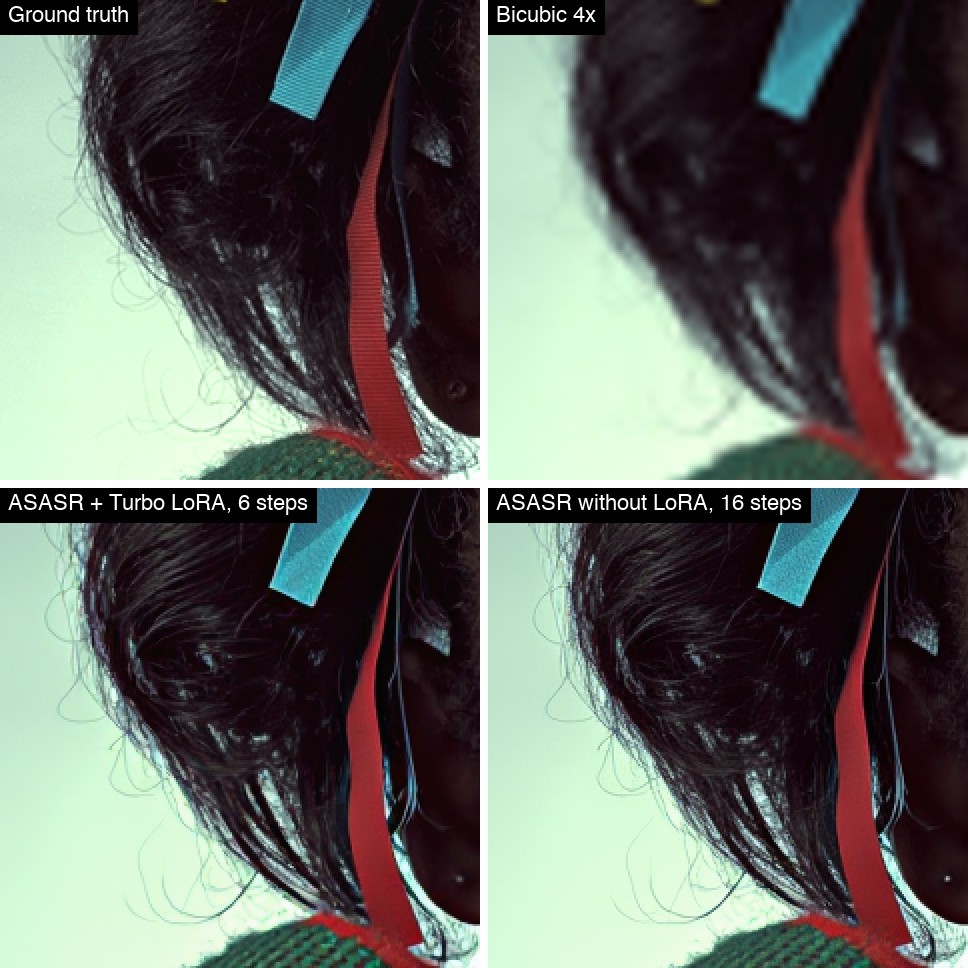
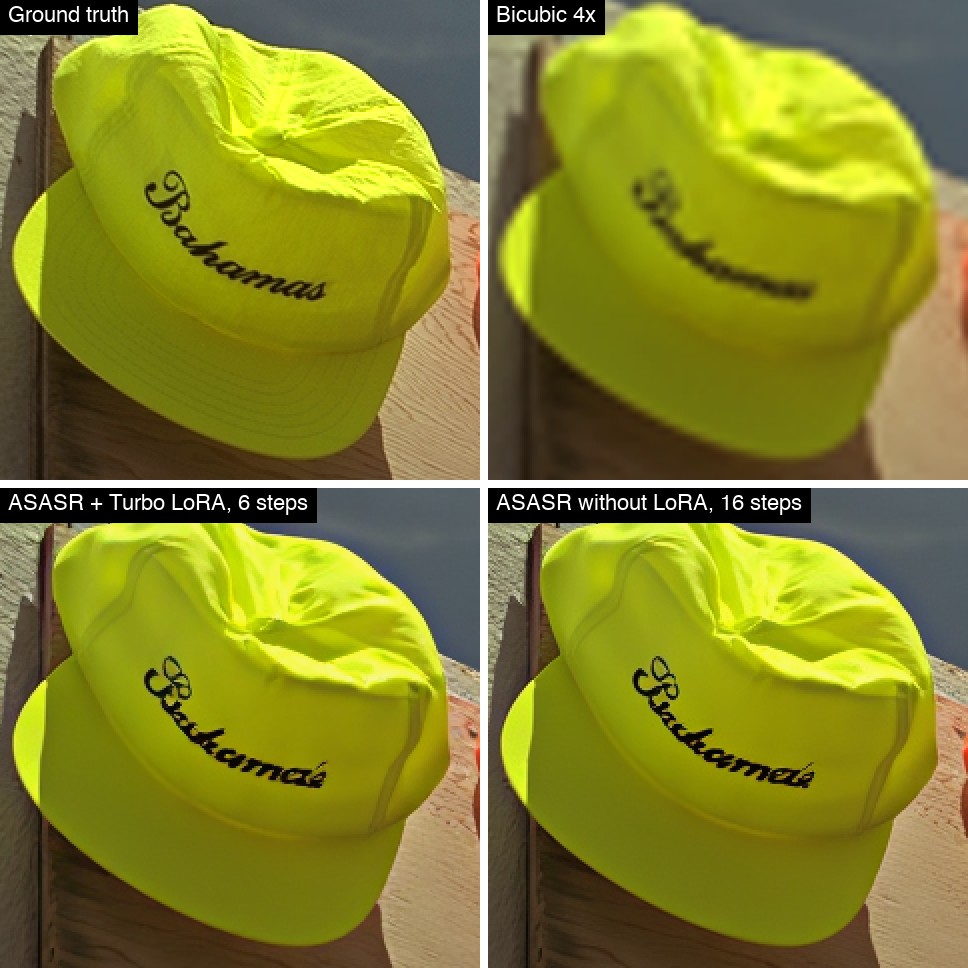
ASASR is a generative model: it reconstructs plausible fine detail such as window frames, lettering and textures instead of interpolating blur. Small details that are lost entirely in the input, like thin wires or exact letter shapes, are reinvented rather than recovered, so the output is not a faithful reconstruction of the original.
The bf16, fp8 and GGUF Q8 variants produce visually equivalent results; see Performance.
Fast mode (FLUX.1-Turbo-Alpha)
FLUX.1-Turbo-Alpha
is a step-distillation LoRA for FLUX.1-dev. Loaded with a normal
LoraLoaderModelOnly in front of the ASASR node, it lets ASASR run with
6 steps instead of 16, 2.3–2.4x faster with bf16 or fp8 checkpoints
(see Performance):
- Download
diffusion_pytorch_model.safetensorsfrom alimama-creative/FLUX.1-Turbo-Alpha and save it asmodels/loras/FLUX.1-Turbo-Alpha.safetensors. - Open
example_workflows/asasr_upscale_turbo.json(UNETLoader → LoraLoaderModelOnly at strength 1.0 → ASASR Upscale withsteps6).
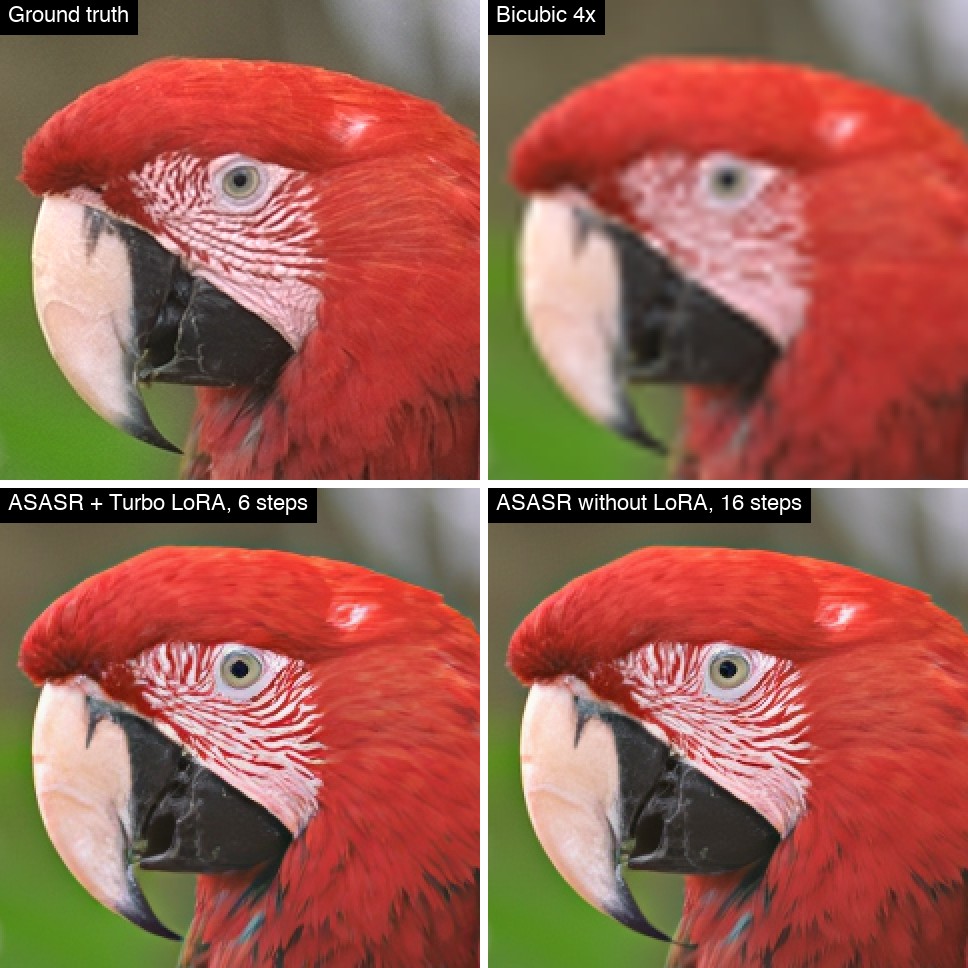
Crops from 4× upscales of Kodak images (192×128 inputs); top row: original and bicubic, bottom row: ASASR with the Turbo LoRA at 6 steps and without it at the default 16 steps:
Notes:
- On heavily degraded inputs (blur, noise, JPEG) 6 steps held up in our tests; 4 steps is faster still but occasionally shows small artifacts, and 3 or fewer degrades visibly.
- Other speed-up LoRAs did not work as well: Hyper-FLUX.1-dev 8-step adds noticeably more invented detail, and the TDD LoRA produced broken output.
- Switching to a different sampler (res_multistep, DPM++ 2M, DEIS, UniPC) gave no benefit over the built-in Euler sampler at equal step counts.
- FLUX.1-Turbo-Alpha is itself released under the FLUX.1-dev non-commercial license.
Requirements
- ComfyUI, running on Python >= 3.10.
- An NVIDIA GPU with CUDA. Peak VRAM is about 35 GB with a bf16 checkpoint and about 25 GB with fp8 or GGUF Q8 (see Performance). Other ComfyUI backends (Apple Silicon/MPS, CPU) have not been tested.
- FLUX.1-dev model files (see Models).
- The two ASASR LoRA adapters (~885 MB SR LoRA + ~111 MB DPO LoRA), which auto-download on first run (see LoRA weights).
Installation
Option A: ComfyUI Manager / Comfy Registry
Search for "ASASR" in ComfyUI Manager, or install it with comfy-cli:
comfy node install comfyui-asasr
Option B: Manual
cd ComfyUI/custom_nodes
git clone https://github.com/claussteinmassl/ComfyUI-ASASR.git
cd ComfyUI-ASASR
pip install -r requirements.txt
Run pip install using the same Python environment ComfyUI itself uses
(e.g. activate ComfyUI's venv first, or use its embedded Python).
Restart ComfyUI afterward.
Models
ASASR runs on FLUX.1-dev, loaded through ComfyUI's standard loader nodes.
FLUX.1-dev is a gated model on Hugging Face. Accept the license at huggingface.co/black-forest-labs/FLUX.1-dev (requires a free Hugging Face account), then download from that repository with your own Hugging Face access token:
| File | Put it in | Load it with |
| --- | --- | --- |
| flux1-dev.safetensors | models/diffusion_models/ (or models/unet/) | UNETLoader (Load Diffusion Model) |
| ae.safetensors | models/vae/ | VAELoader |
Text encoders: clip_l.safetensors and a T5-XXL file (e.g.
t5xxl_fp16.safetensors or t5xxl_fp8_e4m3fn.safetensors) from
comfyanonymous/flux_text_encoders,
placed in models/text_encoders/ and loaded with DualCLIPLoader
(type flux).
Lower VRAM: set UNETLoader's weight_dtype to fp8_e4m3fn to load
the bf16 checkpoint in fp8, or use a GGUF-quantized FLUX.1-dev checkpoint
with ComfyUI-GGUF's
UnetLoaderGGUF (install that node pack separately). Any loader that
produces a FLUX.1-dev MODEL works. Quantized conversions of FLUX.1-dev
remain subject to the FLUX.1-dev license.
LoRA weights
The SR and DPO LoRA adapters are downloaded automatically on first use
(via huggingface_hub), into:
<ComfyUI>/models/loras/ASASR/
  sr_lora/pytorch_lora_weights_v2.safetensors
  dpo_lora/adapter_model.safetensors
To place them manually instead (e.g. on an offline machine), download the
same two files from
huggingface.co/wafer-bob/ASASR and
put them at those exact relative paths under
<ComfyUI>/models/loras/ASASR/. Set auto_download to false on the
node once the files are in place if you want to skip the network check
entirely.
ASASR Upscale (4x)
Takes an image batch and returns a 4x upscaled batch (IMAGE → IMAGE).
| Input | Type | Default | Notes |
| --- | --- | --- | --- |
| model | MODEL | — | FLUX.1-dev UNet from UNETLoader, ComfyUI-GGUF's UnetLoaderGGUF, or any other loader producing a FLUX ModelPatcher. |
| clip | CLIP | — | From DualCLIPLoader (clip_l + t5xxl, type flux). Used only to encode the empty text prompt — ASASR conditions on the LR image, not on text. |
| vae | VAE | — | From VAELoader, the FLUX ae.safetensors. |
| image | IMAGE | — | Batch of images to upscale. |
| steps | INT | 16 (range 1–100) | Diffusion steps per tile. 16 matches the upstream 28 steps closely at about half the time; use 6 with Fast mode. |
| guidance | FLOAT | 3.5 (range 0.0–20.0, step 0.1) | Classifier-free guidance scale. |
| seed | INT | 0 | Base seed; each tile uses a deterministic offset seed, so results are reproducible per batch and per tile layout. |
| sr_lora_scale | FLOAT | 1.0 (range 0.0–2.0, step 0.05) | Scale of the internally-applied SR LoRA delta. See ASASR LoRAs are applied internally below. |
| dpo_lora_scale | FLOAT | 1.0 (range 0.0–2.0, step 0.05) | Scale of the internally-applied DPO LoRA delta. Same note applies. |
| condition_scale | FLOAT | 1.0 (range 0.0–4.0, step 0.05) | OminiControl condition attention scale. Values other than 1.0 allocate a dense attention bias, which is memory-expensive at production resolution; 1.0 is the fast path. |
| tile_size | INT | 128 (range 64–512, step 16) | LR-side tile edge length, in pixels. See Tiling. |
| tile_overlap | INT | 16 (range 0–63) | LR-side overlap between adjacent tiles. Internally clamped to at most half of tile_size. |
| color_fix | combo | adain | adain, wavelet, or none. Applied globally after tiles are merged. |
| auto_download | BOOLEAN | true | Auto-download the ASASR LoRA weights (see LoRA weights) if missing. |
ASASR LoRAs are applied internally, not via a LoRA loader
The SR and DPO LoRA adapters are downloaded automatically and applied internally, inside the node, as branch-gated deltas restricted to the OminiControl condition branch.
Do not load the ASASR LoRA files with a normal LoRA loader (e.g.
LoraLoaderModelOnly) and feed the patched model into this node. A regular LoRA loader has no notion of which branch a delta belongs to and would apply it to the main FLUX branch as well, which deviates from the regime ASASR was trained under and will produce incorrect results. Letsr_lora_scale/dpo_lora_scaleon this node control the adapter strength instead.
Other FLUX.1-dev LoRAs that are meant to change the base model, such as the FLUX.1-Turbo-Alpha step-distillation LoRA used in Fast mode, do go through a normal LoRA loader in front of this node.
Memory management
Model loading and offloading is entirely ComfyUI's own
(load_models_gpu) — the model behaves like any other model in a ComfyUI
workflow and is subject to ComfyUI's normal VRAM management and "Free
model and node cache" behavior. In addition to the loaded FLUX model, the
node keeps one LoRA delta store resident on the compute device: about
1 GB in bf16 (bf16, fp8 and GGUF checkpoints), or about 2.1 GB in fp32
when the model computes in fp16 or fp32.
Known deviations from upstream
- T5 empty-prompt padding: ASASR conditions on an empty text prompt. Comfy's T5 tokenizer convention pads/truncates to 256 tokens, while the upstream reference implementation uses 512. The expected impact is negligible, since the prompt is empty either way and image conditioning dominates.
condition_scale != 1.0allocates a dense attention bias tensor, which is memory-expensive at production (non-tile) resolutions. Leave it at1.0unless you specifically need to tune this and can afford the memory cost.- No ComfyUI attention patches / ControlNet: the forward pass
calls comfy's Flux block modules directly rather than going through
comfy's
transformer_optionshook, so attention patches,transformer_options, and ControlNet do not apply to this node.
Numerical parity
The node's forward pass is verified against the upstream diffusers
reference implementation (vendored in asasr/vendor/, used only by the
test suite) with tiny twin models (matching architecture, randomly
initialized to keep the test fast) covering the base FLUX forward, the
LoRA-patched forward, the OminiControl condition branch, and the
condition_scale attention bias. Maximum observed deviation is
approximately 4e-7, well under the 1e-4 parity gate used by the test
suite.
Performance
Measured on an NVIDIA RTX PRO 6000 Blackwell (96 GB) with ComfyUI
a716932, PyTorch 2.14 / CUDA 13.0, tile_size 128, by running the two
shipped example workflows through the ComfyUI API. Every variant ran in a
fresh ComfyUI process; VRAM is the device-wide peak reported by
nvidia-smi, including the text encoders and VAE.
| Checkpoint | Mode | Time per tile | 768×512 output (2 tiles) | 1536×1024 output (12 tiles) | Peak VRAM | | --- | --- | --- | --- | --- | --- | | FLUX.1-dev bf16 | default, 16 steps | 2.7 s | 5.4 s | 30.4 s | 34.4 GB | | FLUX.1-dev bf16 | Turbo LoRA, 6 steps | 1.1 s | 2.3 s | 13.1 s | 34.5 GB | | FLUX.1-dev fp8 (e4m3fn) | default, 16 steps | 3.6 s | 7.2 s | 40.9 s | 23.5 GB | | FLUX.1-dev fp8 (e4m3fn) | Turbo LoRA, 6 steps | 1.5 s | 3.0 s | 17.1 s | 23.5 GB | | FLUX.1-dev GGUF Q8_0 | default, 16 steps | 4.4 s | 8.9 s | 51.0 s | 24.1 GB | | FLUX.1-dev GGUF Q8_0 | Turbo LoRA, 6 steps | 3.9 s | 7.9 s | 45.8 s | 25.1 GB |
Times are for a warm model; the first run after starting ComfyUI adds
model loading (and, on the very first run, the ASASR LoRA download).
Runtime scales linearly with the number of tiles and with steps.
- Compared with 1.0: the 1.0 default of 28 steps took 5.5 s per tile (bf16). 1.1 halves that with 16 steps and computes the ASASR LoRA deltas in bf16 instead of fp32 (about 20% faster per step, identical output).
- Quality: 16 steps are visually indistinguishable from 28 on our test
images, and the bf16, fp8 and GGUF variants produce visually equivalent
output. The bf16 variant matches the upstream
diffusersreference implementation up to bf16 rounding. - fp8 saves memory, not time: on this GPU the fp8 weights are cast per layer during the forward pass, so fp8 is slower than bf16.
- Turbo LoRA with GGUF: ComfyUI-GGUF applies LoRAs on the fly in every forward pass, which eats most of the saving from fewer steps. Use bf16 or fp8 for Fast mode.
- Smaller GPUs: in the 1.0 measurements, with ComfyUI limited to a
24 GB budget (
--reserve-vram 72on the 96 GB card), the fp8 and GGUF variants ran at unchanged speed, and fp8 also stayed within a 16 GB budget. These were simulated limits on a large card, not tests on real 16/24 GB GPUs.
Tiling
ASASR was trained on 128px → 512px tiles, so tile_size = 128 (the
default) is the model's native, most faithful operating point.
The input image is padded and split into a grid of overlapping tiles of
tile_size x tile_size pixels (LR side). Each tile is bicubic-upscaled to
512x512 to form the FLUX conditioning image, denoised for steps steps, and
the resulting 4x tile is blended into the output using a feathered mask over
the overlap region (tile_overlap) so seams don't show. After all tiles are
merged, a global color-fix pass (AdaIN or wavelet, from the StableSR
color-fix method) aligns the result's color statistics with a bicubic
upscale of the original input.
When to change the defaults:
- Larger
tile_sizeprocesses fewer tiles per image (faster overall), but moves away from the model's trained regime and can lose fine detail fidelity. Generation always runs at the model's native 512px condition resolution: fortile_sizeabove 128, the per-tile result is bicubic-resized from that 512px render, so tile sizes above 128 do not add model-generated detail beyond a 512px-per-tile render.tile_size = 128is the faithful, native setting. - Larger
tile_overlapreduces visible seams at the cost of more redundant diffusion work (more overlapping pixels are computed twice). It cannot exceed half oftile_size. color_fix: noneskips the global color correction if you plan to do your own color grading downstream, or if you notice color-fix artifacts on unusual inputs.
A 512x512 input at the default tile_size=128 already produces 16+ tiles
(before overlap padding), each requiring a full diffusion pass — this is
the main cost driver, not image resolution alone.
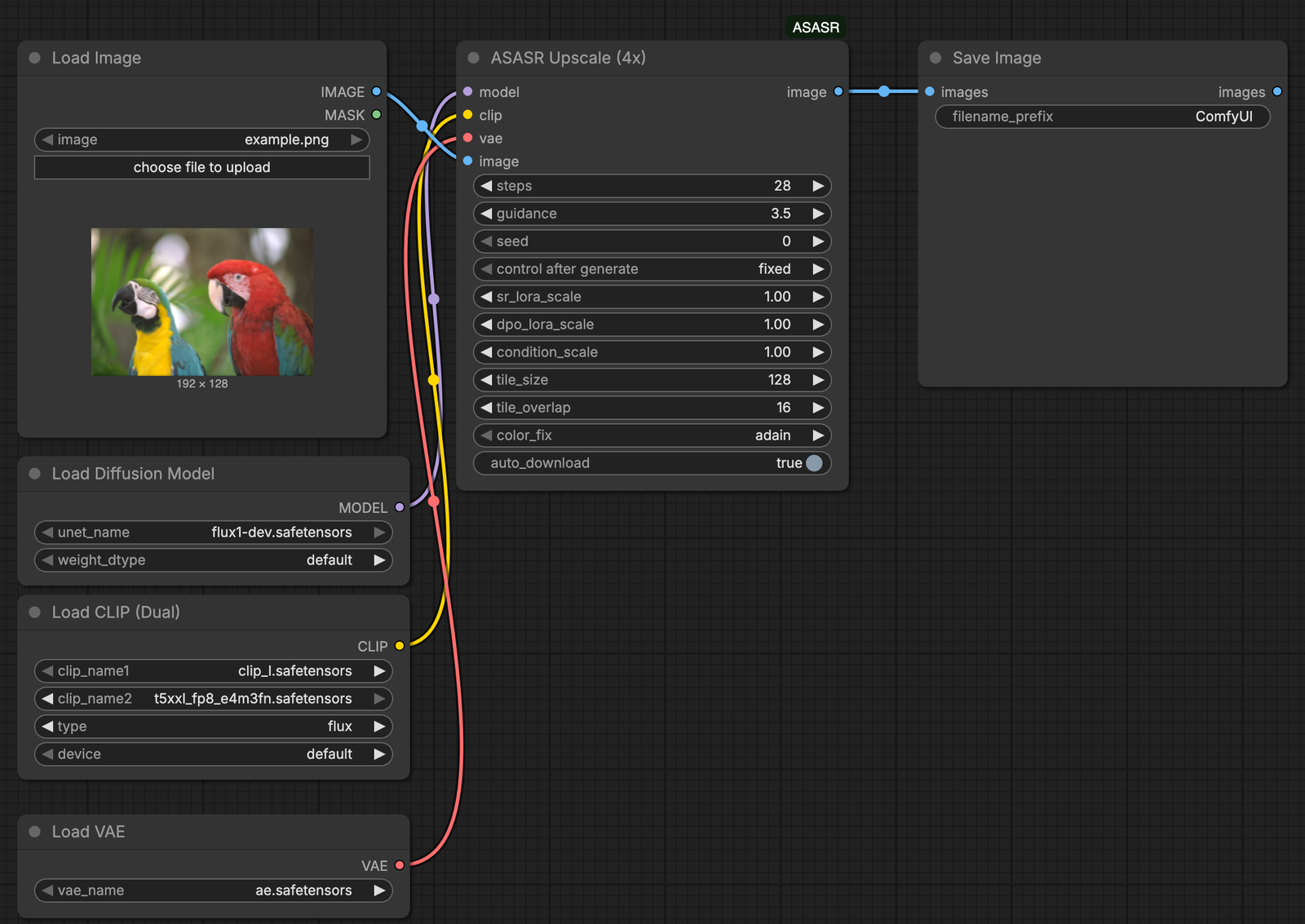
Example workflow
A minimal graph (LoadImage + UNETLoader + DualCLIPLoader + VAELoader →
ASASR Upscale (4x) → SaveImage) is included at
example_workflows/asasr_upscale_example.json:
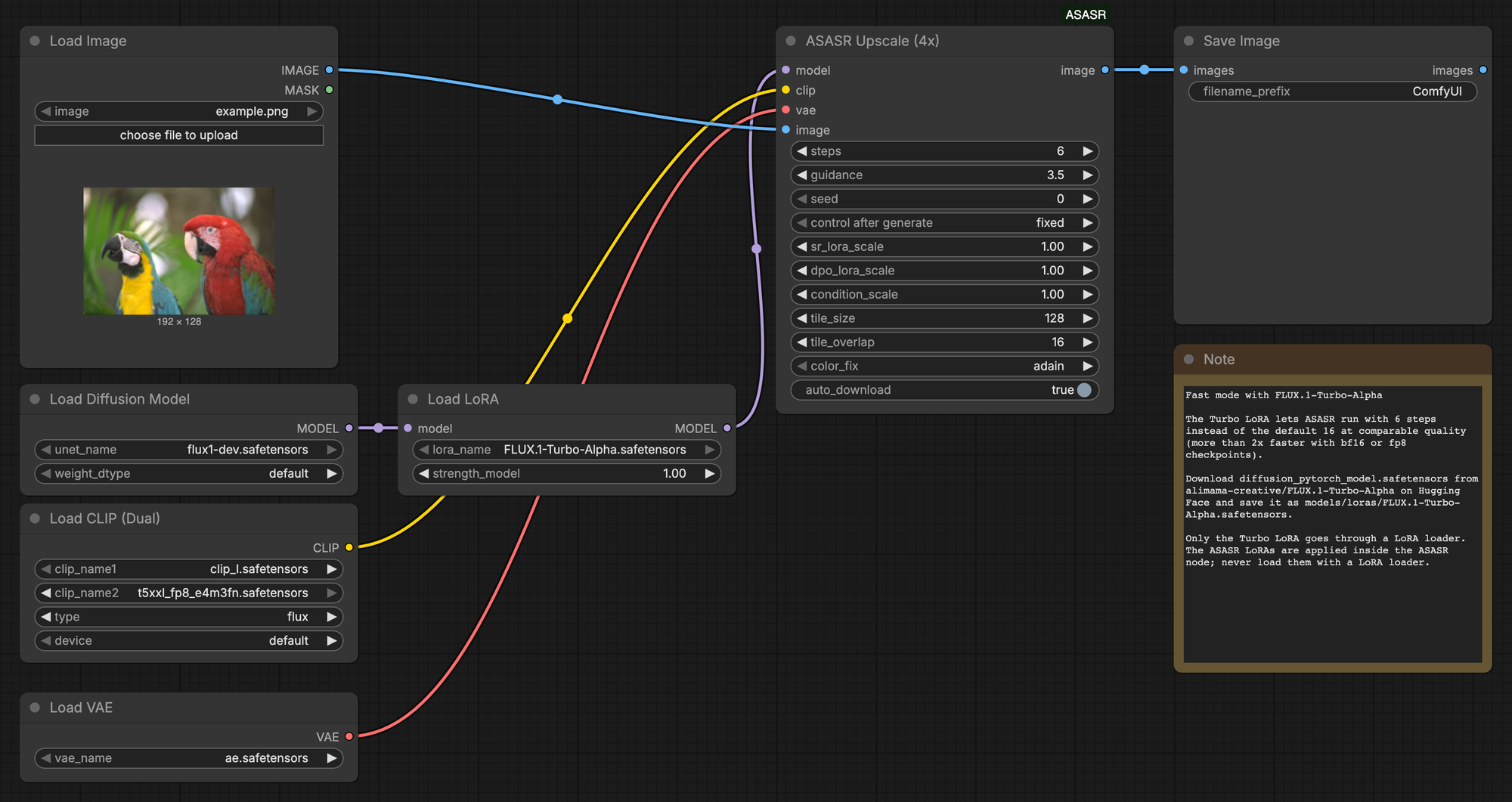
A second graph,
example_workflows/asasr_upscale_turbo.json,
adds a LoraLoaderModelOnly with FLUX.1-Turbo-Alpha between the UNETLoader
and the ASASR node and runs 6 steps (see
Fast mode).
Load them in ComfyUI via Workflow → Open (or drag the file onto the
canvas). Once the node pack is installed, both also appear, with preview
thumbnails, in ComfyUI's template browser under ComfyUI-ASASR. Swap the
UNETLoader node for ComfyUI-GGUF's UnetLoaderGGUF to use a
GGUF-quantized checkpoint.
License
- ComfyUI integration code in this repository (everything outside
asasr/vendor/andasasr/color_fix.py): MIT. See LICENSE. asasr/vendor/andasasr/color_fix.py, derived from the upstream ASASR repository, and the ASASR model weights (downloaded separately from Hugging Face): CC-BY-NC-4.0 — non-commercial use only. Seeasasr/vendor/LICENSE. The model weights additionally inherit the non-commercial terms of the underlying FLUX.1-dev model.
Because the model weights and part of the code are non-commercial, the combined package (this repository plus the downloaded weights) is for non-commercial use only, regardless of the MIT license on the node code itself.
Credits
- ASASR model, LoRA weights, and inference code: the ASASR authors (wafer-bob) and Kuaishou Technology — github.com/wafer-bob/ASASR, huggingface.co/wafer-bob/ASASR.
- Color-fix routines (AdaIN / wavelet reconstruction): adapted from StableSR's color-fix implementation by Li Yi — pkuliyi2015/sd-webui-stablesr.
- Example images: Kodak Lossless True Color Image Suite
(
kodim03,kodim08,kodim15,kodim23), released by Eastman Kodak for unrestricted use. - FLUX.1-Turbo-Alpha (optional Fast mode LoRA): Alimama Creative — huggingface.co/alimama-creative/FLUX.1-Turbo-Alpha.
- FLUX.1-dev: Black Forest Labs — huggingface.co/black-forest-labs/FLUX.1-dev.