
comfyui-google-genmedia-custom-nodes
ComfyUI custom nodes for Google GenMedia models (Veo, Imagen, Nano Banana, Gemini, Virtual-try-on, Lyria) with Gemini API key and Vertex AI dual auth support
Nodes (20)
The original Nano Banana, wired into ComfyUI
The speed-quality sweet spot, in graph form
Nano Banana Pro, without leaving your ComfyUI graph
Gemini 2.5 as a ComfyUI text node, for prompt work that needs eyes and ears
Google's Imagen 3 in your graph — a text-to-image API node with a real negative prompt
Imagen 4 in ComfyUI — pick your tier (fast, standard, ultra) and mind the one-image rule
Text-to-music in ComfyUI, because the video deserves a soundtrack too
A fake Nano Banana that costs nothing — test your workflow before you spend
Prototype Nano Banana 2 for free — including its 4K output and thinking mode
Test Nano Banana Pro's 4K canvas and six image slots without paying for them
Veo 2 image-to-video, when your image already lives in the cloud
Animate a ComfyUI image with Veo 2, without the cloud gymnastics
The plainest on-ramp to Google video
Veo 3.1 image-to-video from a GCS bucket, the cloud-native way
Animate any image with Veo 3.1, straight from the tensor
Character consistency in Veo 3.1 without training a thing
Veo 3.1 text-to-video with native audio, in your graph
Ran a Veo node and saw nothing? This is the node that shows the video
The node that turns Veo output into frames you can actually use
Clothes on a person, without the Photoshop
Based on GoogleCloudPlatform/comfyui-google-genmedia-custom-nodes (Apache 2.0). Added: Gemini API key authentication, Nano Banana 2 (Gemini 3.1 Flash Image), Veo 3.1 Lite, and Placeholder nodes for workflow prototyping.
This is not an officially supported Google product. This project is not eligible for the Google Open Source Software Vulnerability Rewards Program.
comfyui-genmedia-gemini-api
ComfyUI custom nodes for Google GenMedia models, with Gemini API (API key) and Vertex AI (ADC) dual authentication support.
Supported models:
- Gemini
- Gemini 2.5 Flash Image (Nano Banana 🍌)
- Gemini 3.1 Flash Image (Nano Banana 2 🍌🍌) — NEW
- Gemini 3 Pro Image (Nano Banana Pro 🍌)
- Imagen3
- Imagen4
- Lyria2
- Veo2
- Veo3.1 / Veo3.1 Fast / Veo3.1 Lite — NEW
- Virtual-try-on
- Placeholder nodes (🧪) — NEW: API-free dummy image generation for workflow testing
Authentication
Option A: Gemini API key (recommended for containers)
Set one of the following environment variables. No GCP project or region required.
export GOOGLE_API_KEY=AIza...
# or
export GEMINI_API_KEY=AIza...
Option B: Vertex AI (ADC)
All nodes accept gcp_project_id and gcp_region as optional inputs and use the Vertex AI APIs. If you are running ComfyUI on GKE as described in ComfyUI on GKE guide, the Vertex AI APIs will be authenticated with GKE workload identity and no additional action is required.
If you are running your own (local) ComfyUI installation, you will need to install the custom nodes and authenticate to Google Cloud as a user or a Service Account. See installation section for details.
Pricing
All the custom nodes provided with this repo use Vertex AI APIs to generate content and hence, Vertex AI pricing is applied to each API call. See Vertex AI Pricing for the model that you want to use.
Note : If you store the content in Google Cloud Storage using these custom nodes, refer to Google Cloud Storage pricing.
Installing the Google Generative Media custom nodes
ComfyUI on GKE
If you want to run ComfyUI on GKE and use these custom nodes, follow the ComfyUI on GKE guide that will spin up ComfyUI on GKE with these custom nodes installed and ready to use.
ComfyUI running locally
If you are running ComfyUI locally or at a place other than GCP and want to use these custom nodes, you need to perform the following steps to install them:
-
Download these custom nodes in one of the following ways:
-
Using the ComfyUI Manager
- Go to ComfyUI Manager --> Custom Node Manager --> search for
comfyui-google-genmedia-custom-nodes. Click Install.
- Go to ComfyUI Manager --> Custom Node Manager --> search for
-
Manual installation using git
-
Open the terminal on the machine that is running ComfyUI and change to the directory where ComfyUI is running from.
cd <PATH_TO_COMFYUI_INSTALLATION> E.g if your ComfyUI is running from "/home/user/username/ComfyUI", replace <PATH_TO_COMFYUI_INSTALLATION> with "/home/user/username/" -
Change to the custom_nodes folder.
cd ComfyUI/custom_nodes -
Clone this repository in the custom_nodes folder:
git clone https://github.com/GoogleCloudPlatform/comfyui-google-genmedia-custom-nodes -
Install python packages:
- If you are running ComfyUI in a python virtual environment, activate it before installing the dependencies.
source <PATH_TO_PYTHON_VIRTUAL_ENVIRONMENT>/bin/activate - Install python packages
pip install -r comfyui-google-genmedia-custom-nodes/requirements.txt
- If you are running ComfyUI in a python virtual environment, activate it before installing the dependencies.
-
-
-
Now that the custom nodes are installed, set up authentication with Google Cloud. This is needed because the custom nodes will use Vertex AI APIs in the given Google Cloud project and region. Choose one of the following authentication methods:
-
Re-start ComfyUI via ComfyUI manager or manually. Verify there are no failures in the logs and the log says that google-genmedia custom node has been loaded successfully, similar to the following message:
Import times for custom nodes: ..... ..... ..... 2.8 seconds: /XXX/XXXX/ComfyUI/custom_nodes/comfyui-google-genmedia-custom-nodes -
You are all set! Start using the custom nodes. Right click on ComfyUI, Click the 'Add node' menu and you should see a category named
Google AIwith custom nodes for Google’s genmedia models as shown in the image below. You will need to pass a GCP project id and GCP region as input parameter to every node if you are using the custom nodes from your local ComfyUI installation.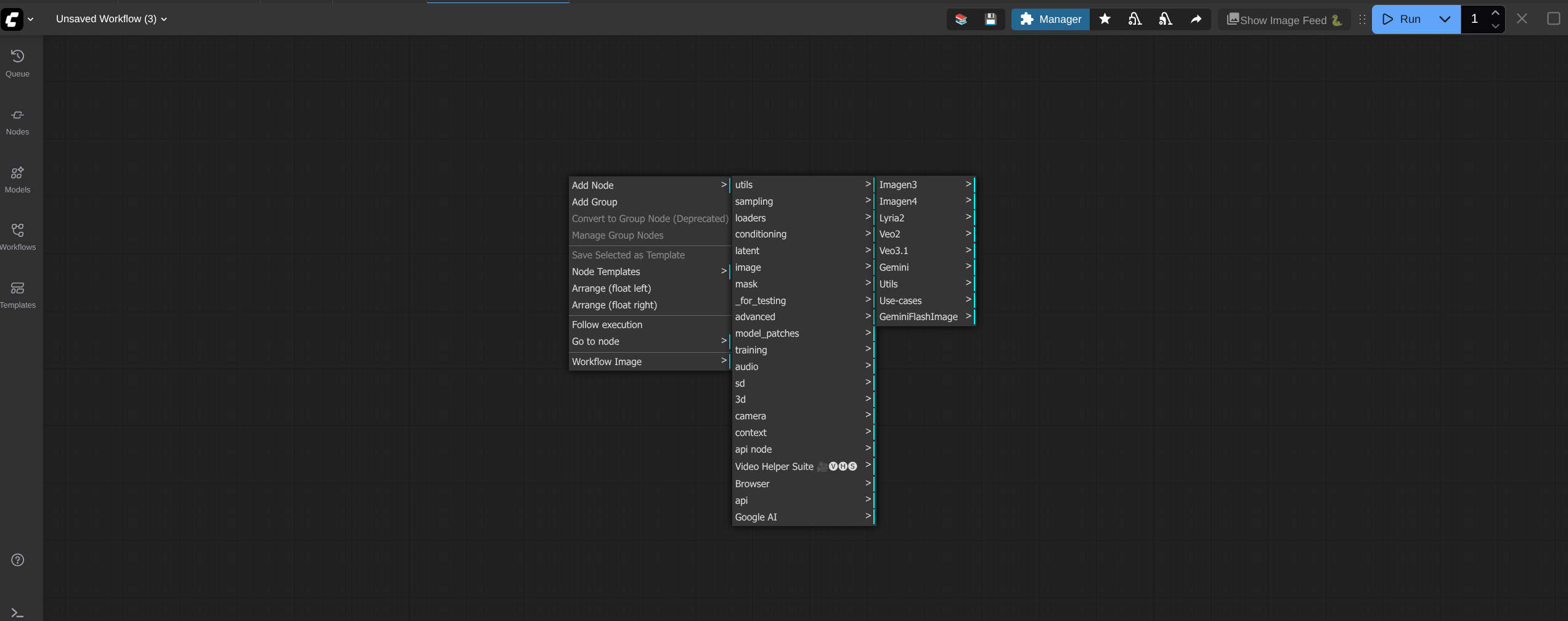
-
Optional step : If you are not familiar with Google's GenMedia custom nodes, we provide some sample workflows with this repo that shows how to use the nodes. You can download and use the sample workflows by following the steps in Sample Workflows section. For full set of features and input parameters to each node, see Node features section for more details.
Authenticate local ComfyUI with Google Cloud user
- On the machine where you are running ComfyUI, install gcloud cli using the documentation https://docs.cloud.google.com/sdk/docs/install
- Authenticate with the following command. Enter your Google Cloud credentials when prompted:
gcloud auth application-default login
Authenticate local ComfyUI with Google Cloud Service Account
- On the machine where you are running ComfyUI, install gcloud cli using the documentation https://docs.cloud.google.com/sdk/docs/install
- Authenticate with the following command. Enter your Google Cloud credentials when prompted:
gcloud auth login - Set shell variables
export PROJECT_ID="<YOUR_PROJECT_ID>" export SERVICE_ACCOUNT_ID="<YOUR_SERVICE_ACCOUNT_ID>" export USER_EMAIL=`gcloud auth list --filter=status:ACTIVE --format="value(account)"` Replace <YOUR_PROJECT_ID> with the GCP project id you plan to use Replace <YOUR_SERVICE_ACCOUNT_ID> with the name of the service account you will use to access Google Cloud with ComfyUI. It will be created in the next step. - Set Google Cloud project.
gcloud config set project $PROJECT_ID - Create a new service account:
gcloud iam service-accounts create $SERVICE_ACCOUNT_ID \ --display-name="ComfyUI Service Account" \ --description="Service Account to use ComfyUI" - Grant permissions to the service account:
gcloud projects add-iam-policy-binding $PROJECT_ID \ --member="serviceAccount:${SERVICE_ACCOUNT_ID}@${PROJECT_ID}.iam.gserviceaccount.com" \ --role="roles/storage.objectUser" --condition=None gcloud projects add-iam-policy-binding $PROJECT_ID \ --member="serviceAccount:${SERVICE_ACCOUNT_ID}@${PROJECT_ID}.iam.gserviceaccount.com" \ --role="roles/aiplatform.user" --condition=None - Grant the Service Account Token Creator role to your user on the service account. This role lets your user account to impersonate the Service Account created in previous steps:
gcloud iam service-accounts add-iam-policy-binding \ ${SERVICE_ACCOUNT_ID}@${PROJECT_ID}.iam.gserviceaccount.com \ --member="user:${USER_EMAIL}" \ --role="roles/iam.serviceAccountTokenCreator" - Now, set yourself to impersonate the service account
gcloud auth application-default login --impersonate-service-account=${SERVICE_ACCOUNT_ID}@${PROJECT_ID}.iam.gserviceaccount.com
Node features
Gemini 2.5 Custom Node
Category: Google AI/Gemini
This node integrates the Gemini 2.5 into ComfyUI, supporting text generation only with multimodal inputs (image, video, audio).
Required Inputs
| Parameter | Type | Default | Description |
| :--- | :--- | :--- | :--- |
| prompt | STRING | "Describe the content in detail." | Multiline string. The main text prompt for the model. |
| model | Dropdown | GEMINI_PRO | Selects the specific Gemini model to use. |
| temperature | FLOAT | 0.7 | Controls randomness (0.0 to 1.0). Higher values are more creative; lower are more deterministic. |
| max_output_tokens | INT | 8192 | The maximum number of tokens to generate in the response (Max: 8192). |
| top_p | FLOAT | 1.0 | The maximum cumulative probability of tokens to consider (0.0 to 1.0). |
| top_k | INT | 32 | The maximum number of tokens to consider when generating the next token (1 to 64). |
| candidate_count | INT | 1 | Number of alternative responses to generate (1 to 8). |
| stop_sequences | STRING | "" | Comma-separated phrases that cause the model to stop generating text. |
| response_mime_type| String | text/plain | The desired format of the response. Options: text/plain, application/json. |
| harassment_thresholds | Dropdown | BLOCK_MEDIUM_AND_ABOVE | Individual settings for Harassment Content. |
| hate_speech_thresholds | Dropdown | BLOCK_MEDIUM_AND_ABOVE | Individual settings for Content. |
| sexually_explicit_thresholds | Dropdown | BLOCK_MEDIUM_AND_ABOVE | Individual settings for Sexually Explicit Content. |
| dangerous_content_thresholds | Dropdown | BLOCK_MEDIUM_AND_ABOVE | Individual settings Dangerous Content. |
| gcp_project_id | STRING | "" | Manually specify GCP Project ID. |
| gcp_region | STRING | "" | Manually specify GCP Region.|
Optional Inputs
| Parameter | Type | Default | Description |
| :--- | :--- | :--- | :--- |
| system_instruction | STRING | "" | Multiline string. System instructions to guide the model's behavior or persona. |
| image_file_path | STRING | "" | Absolute path to an image file (e.g., output/file.png). |
| image_mime_type | Dropdown | image/png | Helper to specify the MIME type for the image path provided. |
| video_file_path | STRING | "" | Absolute path to a video file (e.g., output/file.mp4). |
| video_mime_type | Dropdown | video/mp4 | Helper to specify the MIME type for the video path provided. |
| audio_file_path | STRING | "" | Absolute path to an audio file (e.g., output/file.mp3). |
| audio_mime_type | Dropdown | audio/mp3 | Helper to specify the MIME type for the audio path provided. |
Outputs
| Name | Type | Description |
| :--- | :--- | :--- |
| generated_output | STRING | The raw text content generated by the Gemini model. |
Sample
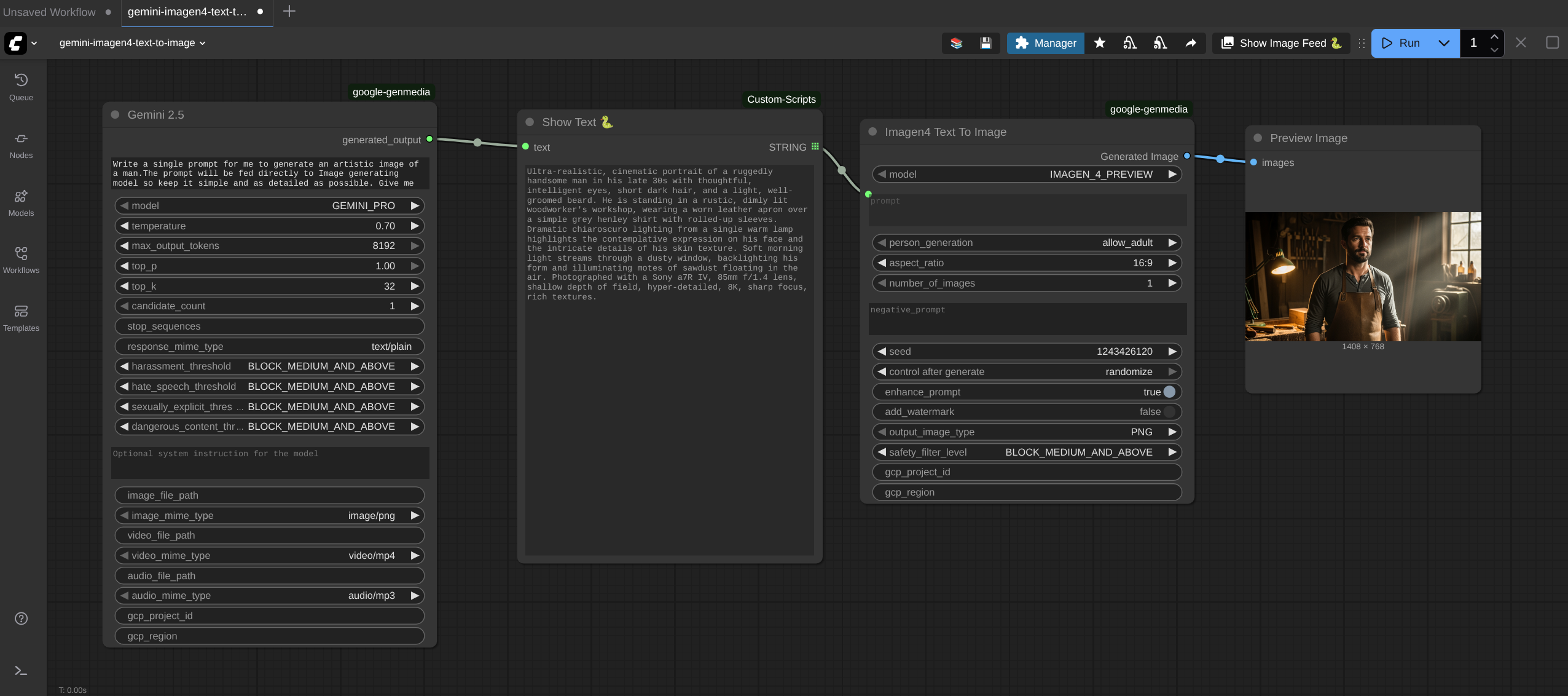
Imagen 3 Custom Node
Category: Google AI/Imagen3
This node provides an interface to the Imagen3 for text-to-image generation.
Required Inputs
| Parameter | Type | Default | Description |
| :--- | :--- | :--- | :--- |
| prompt | STRING | A vivid landscape painting of a futuristic city. | The text description of the image you want to generate. |
| person_generation | DROPDOWN | ALLOW_ADULT | Controls whether the model can generate people (e.g., "allow_adult", "dont_allow"). |
| aspect_ratio | DROPDOWN | 16:9 | The desired aspect ratio of the generated images. Options : 1:1, 3:4, 4:3, 9:16, 16:9. |
| number_of_images | INT | 1 | The number of images to generate. Min: 1, Max: 4. |
| seed | INT | 0 | Seed for reproducibility. If set to 0, the Imagen3 API handles randomness automatically. Note: Not supported if enhance_prompt is enabled. |
| enhance_prompt | BOOLEAN | True | If true, the model will automatically rewrite your prompt for better quality. Note: Disables seed. |
| add_watermark | BOOLEAN | False | If true, adds a watermark to the output. |
| output_image_type | Dropdown | PNG | The file format of the generated image. Options: PNG, JPEG. |
| safety_filter_level | STRING | BLOCK_MEDIUM_AND_ABOVE | Strictness of the safety filter (e.g., "BLOCK_NOCE", BLOCK_ONLY_HIGH"). |
| project_id | STRING | "" | Manually specify GCP Project ID. |
| region | STRING | "" | Manually specify GCP Region. |
Optional Inputs
| Parameter | Type | Default | Description |
| :--- | :--- | :--- | :--- |
| negative_prompt | STRING | "" | Text description of what to exclude from the image. |
Outputs
| Name | Type | Description |
| :--- | :--- | :--- |
| images | IMAGE | A list of PIL Image objects representing the generated content. |
Sample
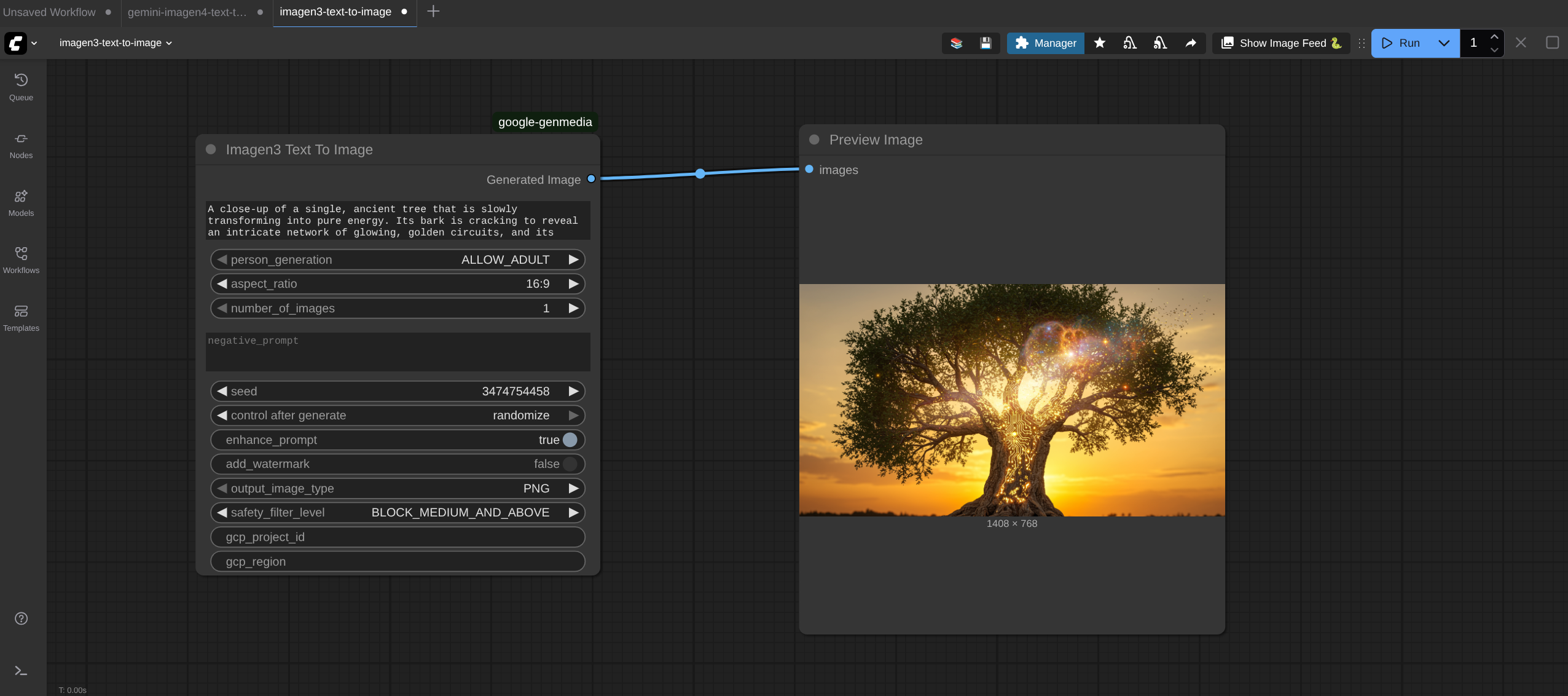
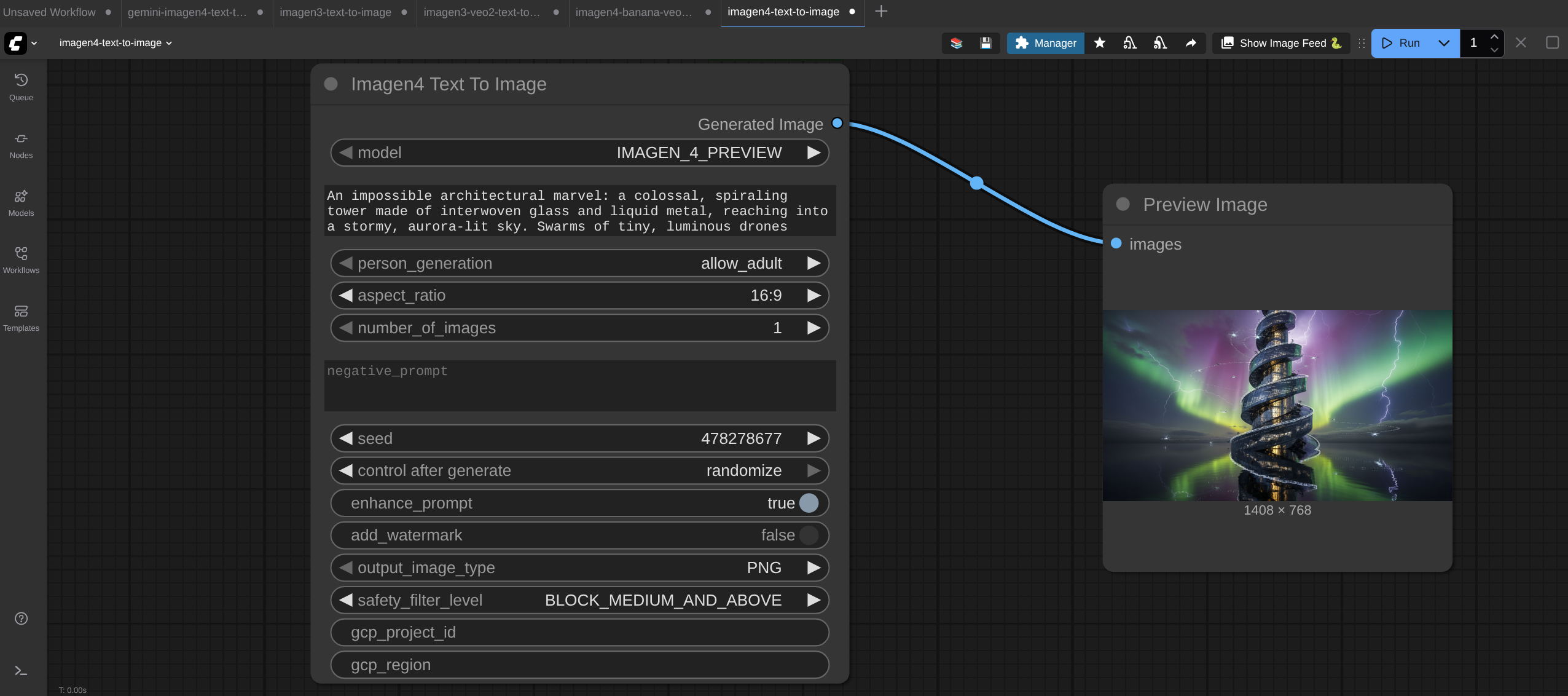
Imagen 4 Custom Node
Category: Google AI/Imagen4
This node provides an interface to the Imagen4 for high-quality text-to-image generation.
Required Inputs
| Parameter | Type | Default | Description |
| :--- | :--- | :--- | :--- |
| model | Dropdown | IMAGEN_4_PREVIEW | Selects the specific Imagen4 model version to use. |
| prompt | STRING | A vivid landscape painting of a futuristic city. | Multiline string. The main text description for the image generation. |
| person_generation | Dropdown | allow_adult | Controls if the model generates people. Options: allow_adult, dont_allow. |
| aspect_ratio | Dropdown | 16:9 | The aspect ratio of the generated images. Options: 1:1, 16:9, 4:3, 3:4, 9:16. |
| number_of_images | INT | 1 | The number of images to generate per request. Min: 1, Max: 4. |
| seed | INT | 0 | Seed for reproducibility. If set to 0, the Imagen4 API handles randomness automatically. Note: Not supported if enhance_prompt is enabled.|
| enhance_prompt | BOOLEAN | True | If true, the model automatically rewrites/improves your prompt for better quality. Note: Disables seed. |
| add_watermark | BOOLEAN | False | If true, adds an invisible digital watermark to the output. |
| output_image_type | Dropdown | PNG | Format requested from the API before conversion to tensor. Options: PNG, JPEG. |
| safety_filter_level | Dropdown | BLOCK_MEDIUM_AND_ABOVE | Strictness of safety filters (e.g., BLOCK_ONLY_HIGH, BLOCK_NONE). |
| gcp_project_id | STRING | "" | Manually specify GCP Project ID. |
| gcp_region | STRING | "" | Manually specify GCP Region. |
Optional Inputs
| Parameter | Type | Default | Description |
| :--- | :--- | :--- | :--- |
| negative_prompt | STRING | "" | Text description of elements to exclude from the image. |
Outputs
| Name | Type | Description |
| :--- | :--- | :--- |
| Generated Image | IMAGE | A batch of images (torch tensors) ready for use in ComfyUI. |
Sample
Veo2 Custom Nodes
1. Veo2 Text To Video
Category: Google AI/Veo2
Generates videos purely from text prompts using the Google Veo 2.0.
Required Inputs
| Parameter | Type | Default | Description |
| :--- | :--- | :--- | :--- |
| prompt | STRING | N/A | Multiline string. The main text description for the video generation. |
| aspect_ratio | Dropdown | 16:9 | The aspect ratio of the generated video. Options: 16:9, 9:16. |
| compression_quality | Dropdown | optimized | Video quality setting. Options: optimized (standard), lossless (requires output_gcs_uri input parameter). |
| person_generation | Dropdown | allow_adult | Controls if the model generates people. Options: allow_adult, dont_allow. |
| duration_seconds | INT | 8 | Length of video in seconds. Min: 5, Max: 8. |
| enhance_prompt | BOOLEAN | True | If true, the model automatically improves your prompt. Note: Disables seed |
| sample_count | INT | 1 | Number of video samples to generate. Min: 1, Max: 4. |
| seed | INT | 0 | Seed for reproducibility. If set to 0, the Veo API handles randomness automatically. Note: Not supported if enhance_prompt is enabled. |
| gcp_project_id | STRING | "" | Manually specify GCP Project ID. |
| gcp_region | STRING | "" | Manually specify GCP Region. |
Optional Inputs
| Parameter | Type | Default | Description |
| :--- | :--- | :--- | :--- |
| negative_prompt | STRING | "" | Text description of elements to avoid in the video. |
| output_gcs_uri | STRING | "" | GCS path to save the video. Required if compression_quality is lossless. |
Outputs
| Name | Type | Description |
| :--- | :--- | :--- |
| video_paths | VEO_VIDEO | A list of file paths to the generated videos. |
Sample
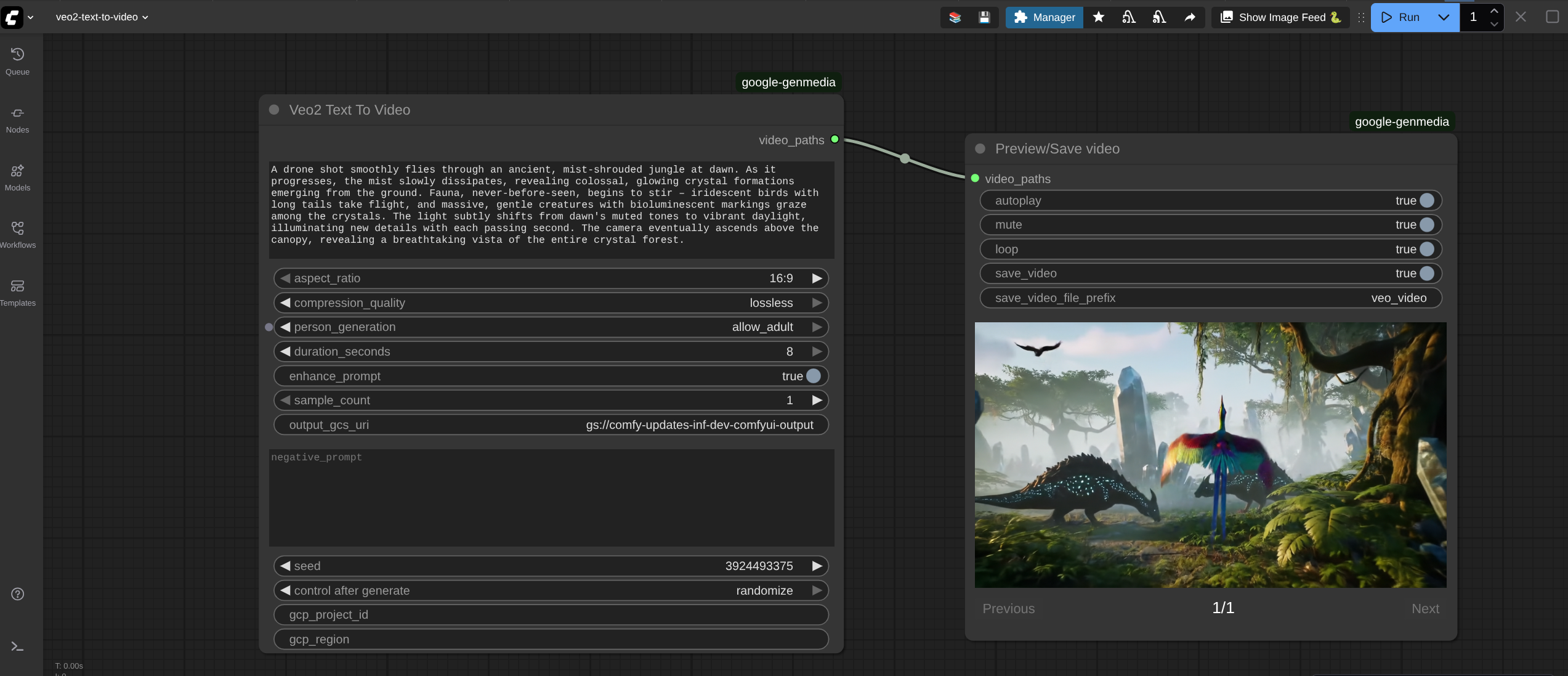
2. Veo2 Image To Video (GcsUriImage)
Category: Google AI/Veo2
Generates videos using an image stored on Google Cloud Storage (GCS) as the starting frame.
Required Inputs
| Parameter | Type | Default | Description |
| :--- | :--- | :--- | :--- |
| gcsuri | STRING | "" | Required. The gs:// URI path to the input image. |
| image_format | Dropdown | PNG | The MIME type/format of the input image. Options: PNG, JPEG, MP4. |
| prompt | STRING | N/A | Multiline string. Text description to guide the animation/video. |
| aspect_ratio | Dropdown | 16:9 | The aspect ratio of the generated video. Options: 16:9, 9:16. |
| compression_quality | Dropdown | optimized | Video quality setting. Options: optimized (standard), lossless (requires output_gcs_uri input parameter). |
| person_generation | Dropdown | allow_adult | Controls if the model generates people. Options: allow_adult, dont_allow. |
| duration_seconds | INT | 8 | Length of video in seconds. Min: 5, Max: 8. |
| enhance_prompt | BOOLEAN | True | If true, automatically improves the prompt. Note: Disables seed |
| sample_count | INT | 1 | Number of video samples to generate. Min: 1, Max: 4. |
| seed | INT | 0 | Seed for reproducibility. If set to 0, the Veo API handles randomness automatically. Note: Not supported if enhance_prompt is enabled. |
| gcp_project_id | STRING | "" | Manually specify GCP Project ID. |
| gcp_region | STRING | "" | Manually specify GCP Region. |
Optional Inputs
| Parameter | Type | Default | Description |
| :--- | :--- | :--- | :--- |
| last_frame_gcsuri | STRING | "" | The gs:// URI for a final frame image (for interpolation). |
| output_gcs_uri | STRING | "" | GCS path to save output. Required if compression_quality is lossless. |
| negative_prompt | STRING | "" | Text description of elements to avoid in the video. |
Outputs
| Name | Type | Description |
| :--- | :--- | :--- |
| video_paths | VEO_VIDEO | A list of file paths to the generated videos. |
3. Veo2 Image To Video (Tensor)
Category: Google AI/Veo2
Generates videos using a ComfyUI image tensor (passed from another node) as the starting frame.
Required Inputs
| Parameter | Type | Default | Description |
| :--- | :--- | :--- | :--- |
| image | IMAGE | N/A | The input image tensor from ComfyUI. |
| image_format | Dropdown | PNG | The format hint for the API processing. Options: PNG, JPEG, MP4. |
| prompt | STRING | N/A | Multiline string. Text description to guide the animation. |
| aspect_ratio | Dropdown | 16:9 | The aspect ratio of the generated video. Options: 16:9, 9:16. |
| compression_quality | Dropdown | optimized | Video quality setting. Options: optimized (standard), lossless (requires output_gcs_uri input parameter). |
| person_generation | Dropdown | allow_adult | Controls if the model generates people. Options: allow_adult, dont_allow. |
| duration_seconds | INT | 8 | Length of video in seconds. Min: 5, Max: 8. |
| enhance_prompt | BOOLEAN | True | If true, automatically improves the prompt. Note: Disables seed. |
| sample_count | INT | 1 | Number of video samples to generate. Min: 1, Max: 4. |
| seed | INT | 0 | Seed for reproducibility. If set to 0, the Veo API handles randomness automatically. Note: Not supported if enhance_prompt is enabled. |
| gcp_project_id | STRING | "" | Manually specify GCP Project ID. |
| gcp_region | STRING | "" | Manually specify GCP Region. |
Optional Inputs
| Parameter | Type | Default | Description |
| :--- | :--- | :--- | :--- |
| last_frame | STRING | "" | An image tensor to use as the final frame for interpolation. |
| output_gcs_uri | STRING | "" | GCS path to save output. Required if compression_quality is lossless. |
| negative_prompt | STRING | "" | Text description of elements to avoid in the video. |
Outputs
| Name | Type | Description |
| :--- | :--- | :--- |
| video_paths | VEO_VIDEO | A list of file paths to the generated videos. |
Sample
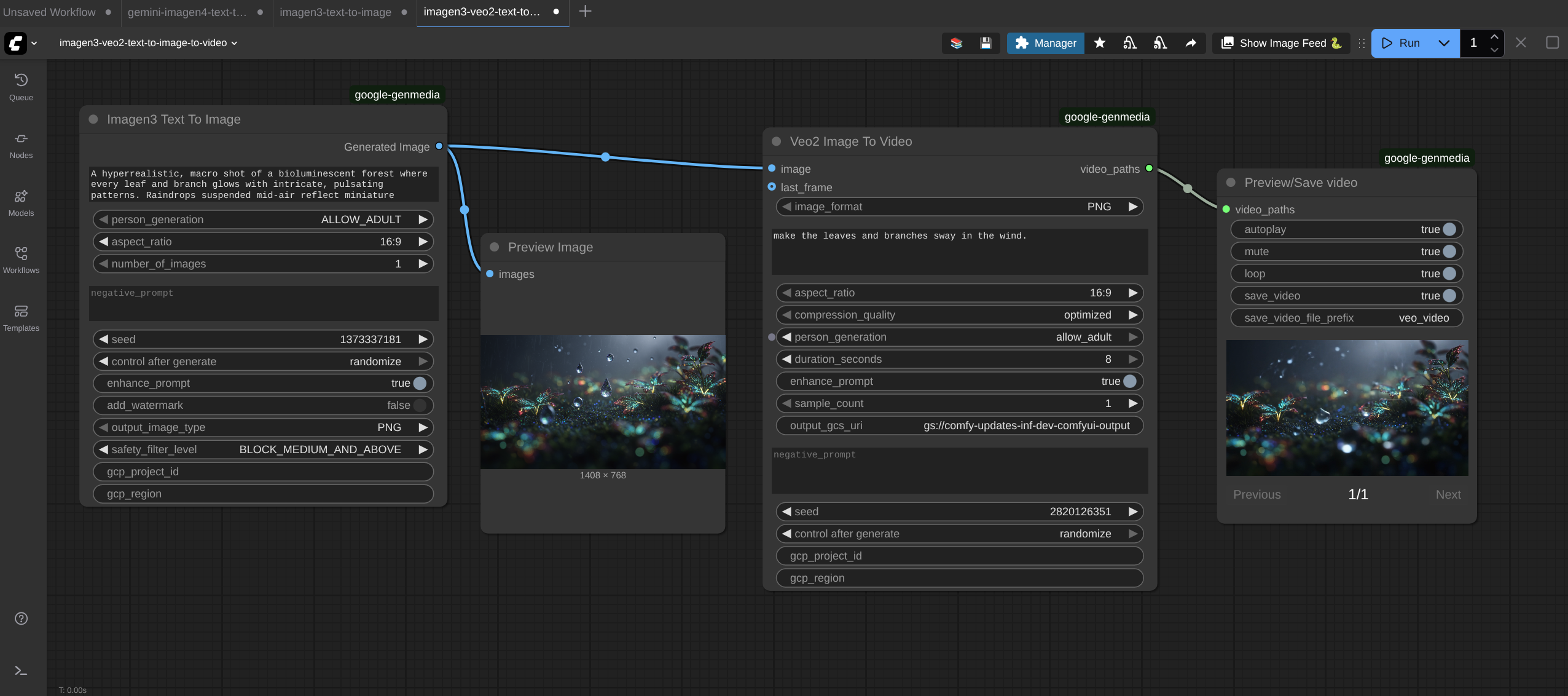
Veo 3.1 Custom Nodes
Veo3.1 Text to Video
Category: Google AI/Veo3.1
Generates videos purely from text prompts using the Google Veo 3.1.
Required Inputs
| Parameter | Type | Default | Description |
| :--- | :--- | :--- | :--- |
| model | Dropdown | VEO_3_1_PREVIEW | Select the specific Veo 3.1 model version. Options: VEO_3_1_PREVIEW, VEO_3_1_FAST_PREVIEW, VEO_3_1_LITE_PREVIEW. |
| prompt | STRING | N/A | Multiline string. The main text description for the video generation. |
| aspect_ratio | Dropdown | 16:9 | The aspect ratio of the generated video. Options: 16:9, 9:16. |
| output_resolution| Dropdown | 720p | Resolution of the output video. Options: 720p, 1080p. |
| compression_quality | Dropdown | optimized | Video quality setting. Options: optimized (standard), lossless (requires output_gcs_uri input parameter). |
| person_generation | Dropdown | allow_adult | Controls if the model generates people. Options: allow_adult, dont_allow. |
| duration_seconds | INT | 8 | Length of video in seconds. Min: 4, Max: 8, Step: 2. |
| generate_audio | BOOLEAN | True | If true, generates a soundtrack for the video. |
| sample_count | INT | 1 | Number of video samples to generate. Min: 1, Max: 4. |
| seed | INT | 0 | Seed for reproducibility. If set to 0, the Veo API handles randomness automatically. Note: Not supported if enhance_prompt is enabled. Disabling enhance_prompt is not allowed in Veo3.1. |
| gcp_project_id | STRING | "" | Manually specify GCP Project ID. |
| gcp_region | STRING | "" | Manually specify GCP Region. |
Optional Inputs
| Parameter | Type | Default | Description |
| :--- | :--- | :--- | :--- |
| output_gcs_uri | STRING | "" | GCS path to save the video. Required if compression_quality is lossless. |
| negative_prompt | STRING | "" | Text description of elements to avoid in the video. |
Outputs
| Name | Type | Description |
| :--- | :--- | :--- |
| video_paths | VEO_VIDEO | A list of file paths to the generated videos. |
Sample
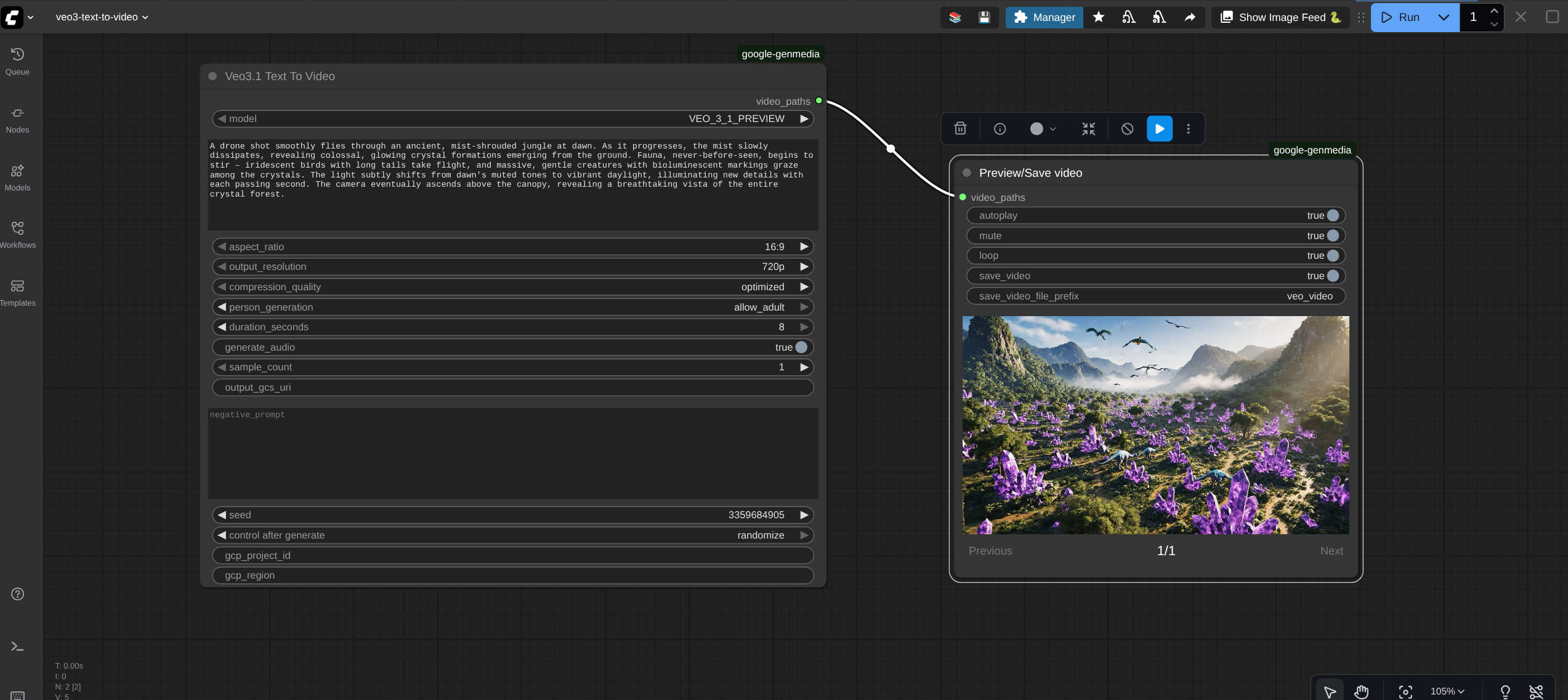
2. Veo3.1 Image To Video (GcsUriImage)
Category: Google AI/Veo3.1
Generates videos using an image stored on Google Cloud Storage (GCS) as the starting frame.
Required Inputs
| Parameter | Type | Default | Description |
| :--- | :--- | :--- | :--- |
| model | Dropdown | VEO_3_1_PREVIEW | Select the specific Veo 3.1 model version. Options: VEO_3_1_PREVIEW, VEO_3_1_FAST_PREVIEW, VEO_3_1_LITE_PREVIEW. |
| gcsuri | STRING | "" | The gs:// URI path to the input image. |
| image_format | Dropdown | PNG | The format of the input image. Options: PNG, JPEG, MP4. |
| prompt | STRING | N/A | Multiline string. Text description to guide the animation. |
| aspect_ratio | Dropdown | 16:9 | The aspect ratio of the generated video. Options: 16:9, 9:16. |
| output_resolution| Dropdown | 720p | Resolution of the output video. Options: 720p, 1080p. |
| compression_quality| Dropdown | optimized | Video quality. Options: optimized, lossless. |
| person_generation | Dropdown | allow_adult | Controls if the model generates people. Options: allow_adult, dont_allow. |
| duration_seconds | INT | 8 | Length of video in seconds. Min: 4, Max: 8, Step: 2. |
| generate_audio | BOOLEAN | True | If true, generates a soundtrack for the video. |
| sample_count | INT | 1 | Number of video samples to generate. Min: 1, Max: 4. |
| seed | INT | 0 | Seed for reproducibility. If set to 0, the Veo API handles randomness automatically. Note: Not supported if enhance_prompt is enabled. Disabling enhance_prompt is not supported in Veo3.1. |
| gcp_project_id | STRING | "" | Manually specify GCP Project ID. |
| gcp_region | STRING | "" | Manually specify GCP Region. |
Optional Inputs
| Parameter | Type | Default | Description |
| :--- | :--- | :--- | :--- |
| last_frame_gcsuri | STRING | "" | The gs:// URI for a final frame image (for interpolation). |
| output_gcs_uri | STRING | "" | GCS path to save output. Required if compression_quality is lossless. |
| negative_prompt | STRING | "" | Text description of elements to avoid in the video. |
Outputs
| Name | Type | Description |
| :--- | :--- | :--- |
| video_paths | VEO_VIDEO | A list of file paths to the generated videos. |
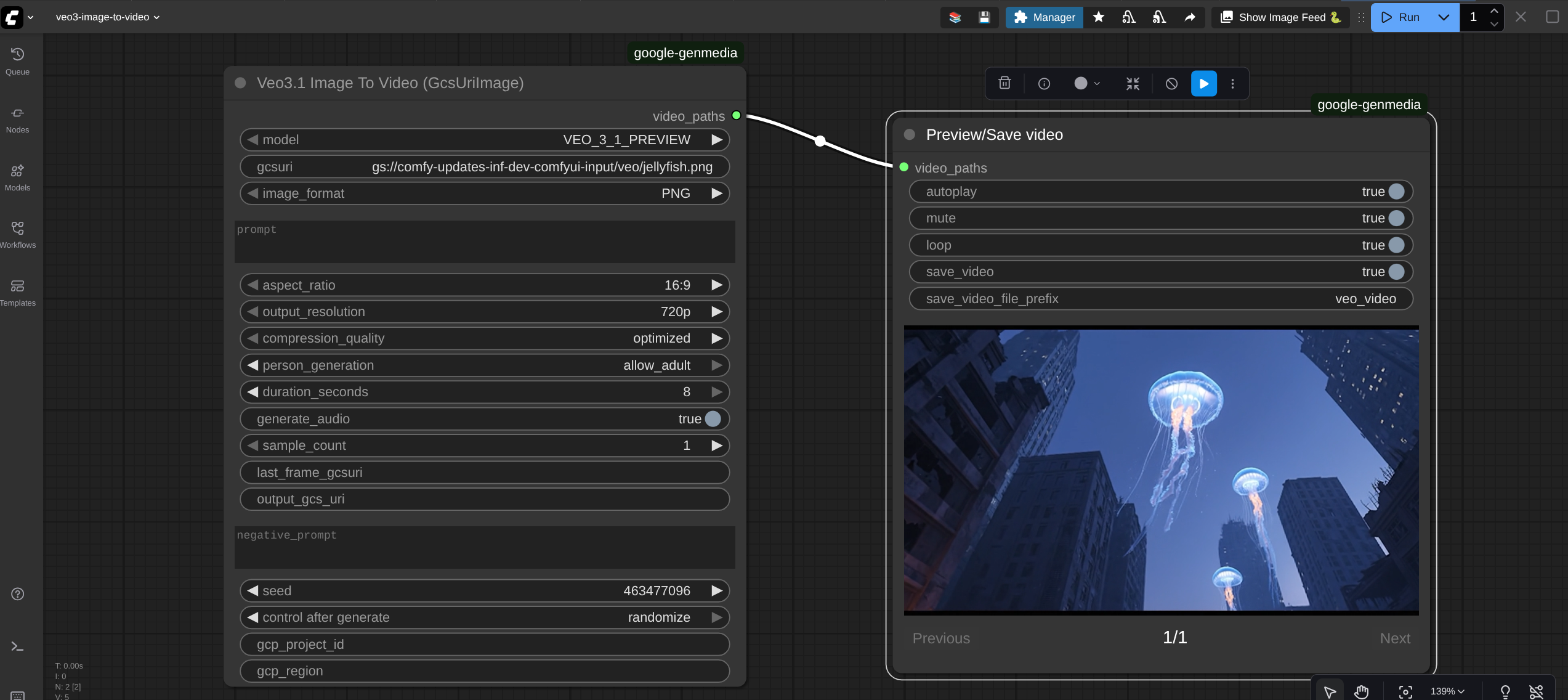
3. Veo3.1 Image To Video (Tensor)
Category: Google AI/Veo3.1
Generates videos using a ComfyUI image tensor (passed from another node) as the starting frame.
Required Inputs
| Parameter | Type | Default | Description |
| :--- | :--- | :--- | :--- |
| model | Dropdown | VEO_3_1_PREVIEW | Select the specific Veo 3.1 model version. Options: VEO_3_1_PREVIEW, VEO_3_1_FAST_PREVIEW, VEO_3_1_LITE_PREVIEW. |
| image | IMAGE | N/A | The input image tensor from ComfyUI. |
| image_format | Dropdown | PNG | Format hint for the API. Options: PNG, JPEG, MP4. |
| prompt | STRING | N/A | Multiline string. Text description to guide the animation. |
| aspect_ratio | Dropdown | 16:9 | The aspect ratio of the generated video. Options: 16:9, 9:16. |
| output_resolution| Dropdown | 720p | Resolution of the output video. Options: 720p, 1080p. |
| compression_quality| Dropdown | optimized | Video quality. Options: optimized, lossless. |
| person_generation | Dropdown | allow_adult | Controls if the model generates people. Options: allow_adult, dont_allow. |
| duration_seconds | INT | 8 | Length of video in seconds. Min: 4, Max: 8, Step: 2. |
| generate_audio | BOOLEAN | True | If true, generates a soundtrack for the video. |
| sample_count | INT | 1 | Number of video samples to generate. Min: 1, Max: 4. |
| seed | INT | 0 | Seed for reproducibility. If set to 0, the Veo API handles randomness automatically. Note: Not supported if enhance_prompt is enabled. Disabling enhance_prompt is not supported in Veo3.1. |
| gcp_project_id | STRING | "" | Manually specify GCP Project ID. |
| gcp_region | STRING | "" | Manually specify GCP Region. |
Optional Inputs
| Parameter | Type | Default | Description |
| :--- | :--- | :--- | :--- |
| last_frame | IMAGE | N/A | An image tensor to use as the final frame for interpolation. |
| output_gcs_uri | STRING | "" | GCS path to save output. Required if compression_quality is lossless. |
| negative_prompt | STRING | "" | Text description of elements to avoid in the video. |
Outputs
| Name | Type | Description |
| :--- | :--- | :--- |
| video_paths | VEO_VIDEO | A list of file paths to the generated videos. |
Sample
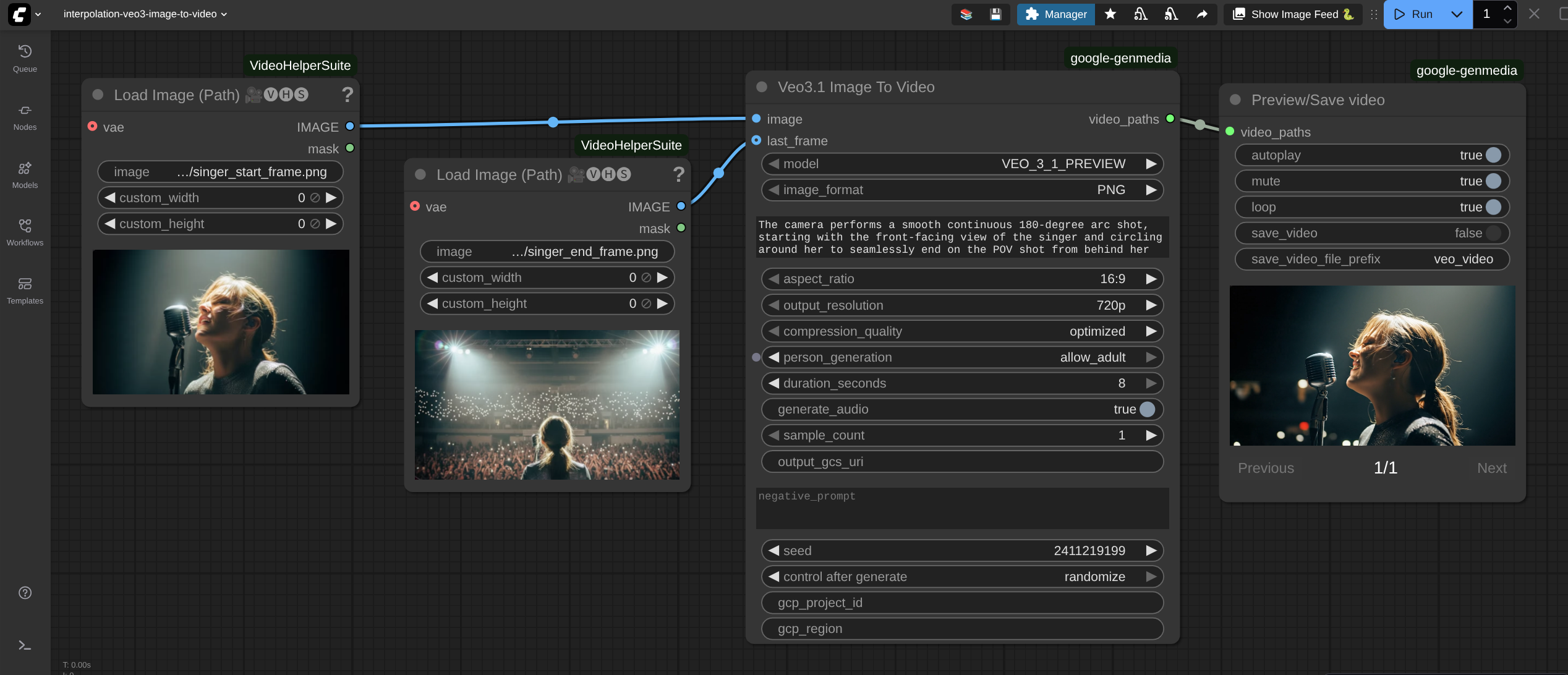
4. Veo3.1 Reference To Video
Category: Google AI/Veo3.1
Generates videos using multiple reference images to guide the style and content.
Required Inputs
| Parameter | Type | Default | Description |
| :--- | :--- | :--- | :--- |
| model | Dropdown | VEO_3_1_PREVIEW | Select the specific Veo 3.1 model version. Options: VEO_3_1_PREVIEW, VEO_3_1_FAST_PREVIEW, VEO_3_1_LITE_PREVIEW. |
| image1 | IMAGE | N/A | The primary reference image tensor. |
| image_format | Dropdown | PNG | Format hint for the API. Options: PNG, JPEG. |
| prompt | STRING | N/A | Multiline string. Text description to guide the animation. |
| aspect_ratio | Dropdown | 16:9 | The aspect ratio of the generated video. Options: 16:9, 9:16. |
| output_resolution| Dropdown | 720p | Resolution of the output video. Options: 720p, 1080p. |
| compression_quality| Dropdown | optimized | Video quality. Options: optimized, lossless. |
| person_generation | Dropdown | allow_adult | Controls if the model generates people. Options: allow_adult, dont_allow. |
| duration_seconds | INT | 8 | Length of video in seconds. Min: 4, Max: 8, Step: 2. |
| generate_audio | BOOLEAN | True | If true, generates a soundtrack for the video. |
| sample_count | INT | 1 | Number of video samples to generate. Min: 1, Max: 4. |
| seed | INT | 0 | Seed for reproducibility. If set to 0, the Veo API handles randomness automatically. Note: Not supported if enhance_prompt is enabled. Disabling enhance_prompt is not supported in Veo3.1. |
| gcp_project_id | STRING | "" | Manually specify GCP Project ID. |
| gcp_region | STRING | "" | Manually specify GCP Region. |
Optional Inputs
| Parameter | Type | Default | Description |
| :--- | :--- | :--- | :--- |
| image2 | IMAGE | N/A | Secondary reference image tensor. |
| image3 | IMAGE | N/A | Tertiary reference image tensor. |
| output_gcs_uri | STRING | "" | GCS path to save output. Required if compression_quality is lossless. |
| negative_prompt | STRING | "" | Text description of elements to avoid in the video. |
Outputs
| Name | Type | Description |
| :--- | :--- | :--- |
| video_paths | VEO_VIDEO | A list of file paths to the generated videos. |
Sample
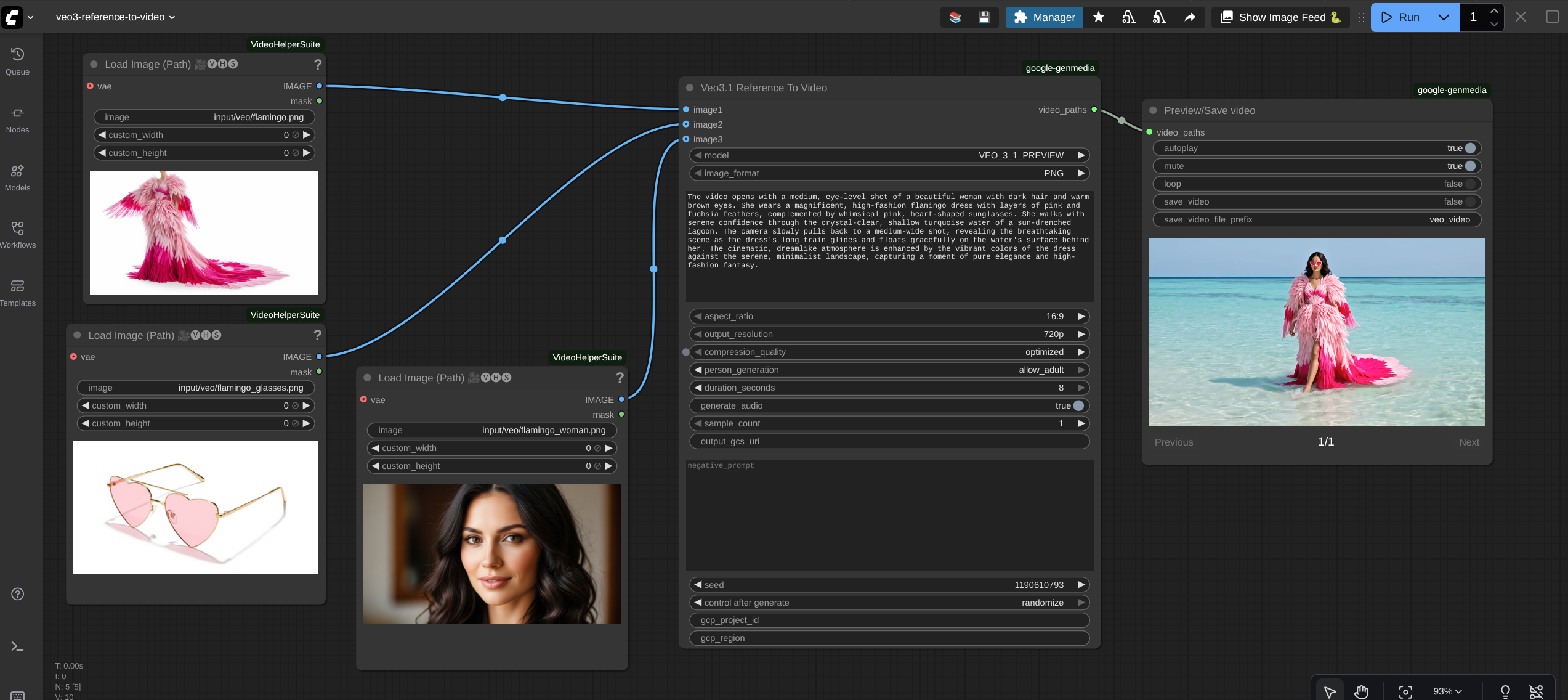
Gemini 2.5 Flash Image (Nano Banana 🍌)
Category: Google AI/GeminiFlashImage
This node integrates the Gemini 2.5 Flash Image model, designed for high-speed image generation and editing tasks.
Required Inputs
| Parameter | Type | Default | Description |
| :--- | :--- | :--- | :--- |
| model | Dropdown | GEMINI_25_FLASH_IMAGE | Selects the specific Gemini Flash Image model version. |
| prompt | STRING | "A vivid landscape painting of a futuristic city." | Multiline string. The main text description for the image generation. |
| aspect_ratio | Dropdown | 16:9 | The aspect ratio of the generated image. Options include 1:1, 2:3, 3:2, 3:4, 4:3, 4:5, 5:4, 9:6, 16:9, 21:9. |
| temperature | FLOAT | 0.7 | Controls randomness. Higher values are more creative; lower are more deterministic. Min: 0.0, Max: 1.0. |
| top_p | FLOAT | 1.0 | Cumulative probability cutoff for token selection. Min: 0.0, Max: 1.0. |
| top_k | INT | 32 | Limits token selection to the top K most probable tokens. Min: 1, Max: 64. |
| ~~harassment_threshold~~ | ~~Dropdown~~ | — | ~~Safety filter level for harassment content.~~ Removed: not supported by current API |
| ~~hate_speech_threshold~~ | ~~Dropdown~~ | — | ~~Safety filter level for hate speech content.~~ Removed: not supported by current API |
| ~~sexually_explicit_threshold~~ | ~~Dropdown~~ | — | ~~Safety filter level for sexually explicit content.~~ Removed: not supported by current API |
| ~~dangerous_content_threshold~~ | ~~Dropdown~~ | — | ~~Safety filter level for dangerous content.~~ Removed: not supported by current API |
| gcp_project_id | STRING | "" | Manually specify GCP Project ID. If empty, uses environment defaults. |
| gcp_region | STRING | global | Manually specify GCP Region. Default is global. |
Optional Inputs
| Parameter | Type | Default | Description |
| :--- | :--- | :--- | :--- |
| image1 | IMAGE | N/A | Primary input image tensor for image editing or reference tasks. |
| image2 | IMAGE | N/A | Secondary input image tensor. |
| image3 | IMAGE | N/A | Tertiary input image tensor. |
| system_instruction | STRING | "" | Multiline string. System-level instructions to guide the model's behavior. |
Outputs
| Name | Type | Description |
| :--- | :--- | :--- |
| Generated Image | IMAGE | The generated content as a batch of images (torch tensors). |
Sample
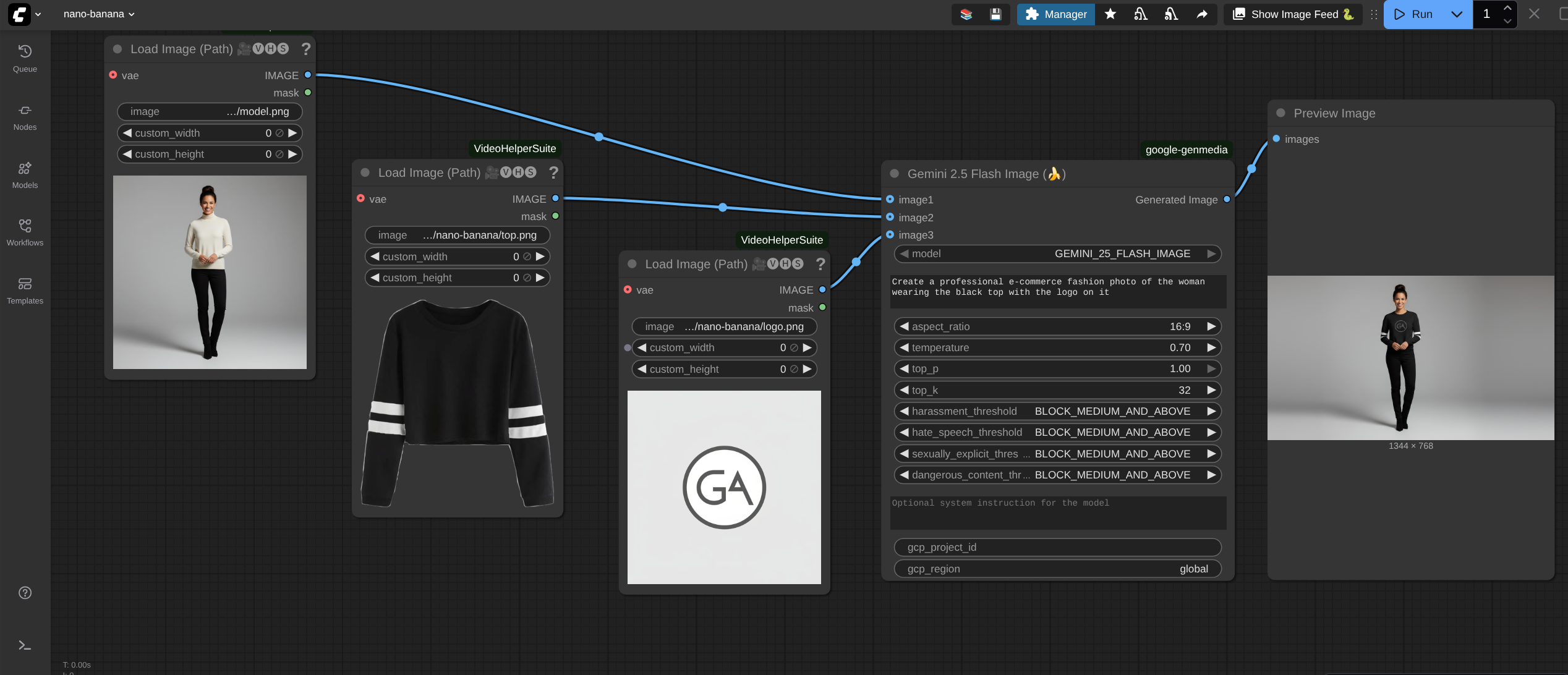
Gemini 3.1 Flash Image (Nano Banana 2 🍌🍌)
Category: Google AI/GeminiFlashImage
This node integrates the Gemini 3.1 Flash Image model (Nano Banana 2), featuring image size control and thinking process support.
Required Inputs
| Parameter | Type | Default | Description |
| :--- | :--- | :--- | :--- |
| model | Dropdown | GEMINI_31_FLASH_IMAGE | Selects the Gemini 3.1 Flash Image model. |
| prompt | STRING | "A vivid landscape painting of a futuristic city." | Multiline string. The main text description for the image generation. |
| aspect_ratio | Dropdown | 16:9 | The aspect ratio of the generated image. Options: 1:1, 2:3, 3:2, 3:4, 4:1, 4:3, 4:5, 5:4, 8:1, 9:16, 16:9, 21:9. |
| image_size | Dropdown | 1K | The output resolution. Options: 512, 1K, 2K, 4K. |
| temperature | FLOAT | 0.7 | Controls randomness. Higher values are more creative; lower are more deterministic. Min: 0.0, Max: 1.0. |
| top_p | FLOAT | 1.0 | Cumulative probability cutoff for token selection. Min: 0.0, Max: 1.0. |
| top_k | INT | 32 | Limits token selection to the top K most probable tokens. Min: 1, Max: 64. |
Optional Inputs
| Parameter | Type | Default | Description |
| :--- | :--- | :--- | :--- |
| image1 | IMAGE | N/A | Primary input image tensor for image editing or reference tasks. |
| image2 | IMAGE | N/A | Secondary input image tensor. |
| image3 | IMAGE | N/A | Tertiary input image tensor. |
| thinking_level | Dropdown | minimal | Controls thinking depth. Options: minimal (low latency), High (higher quality). |
| include_thoughts | BOOLEAN | False | If true, returns interim thought images in the response. |
| system_instruction | STRING | "" | Multiline string. System-level instructions to guide the model's behavior. |
| gcp_project_id | STRING | "" | Manually specify GCP Project ID. If empty, uses environment defaults. |
| gcp_region | STRING | global | Manually specify GCP Region. Default is global. |
Outputs
| Name | Type | Description |
| :--- | :--- | :--- |
| Generated Image | IMAGE | The generated content as a batch of images (torch tensors). |
Gemini 3 Pro Image (Nano Banana Pro 🍌)
Category: Google AI/GeminiProImage
This node integrates the Gemini 3 Pro Image model, designed for high-speed image generation and editing tasks.
Required Inputs
| Parameter | Type | Default | Description |
| :--- | :--- | :--- | :--- |
| model | Dropdown | GEMINI_3_PRO_IMAGE | Selects the specific Gemini Pro Image model version. |
| prompt | STRING | "A vivid landscape painting of a futuristic city." | Multiline string. The main text description for the image generation. |
| aspect_ratio | Dropdown | 16:9 | The aspect ratio of the generated image. Options include 1:1, 2:3, 3:2, 3:4, 4:3, 4:5, 5:4, 9:6, 16:9, 21:9. |
| image_size | Dropdown | 1K| The output size of the generated image. Options include 1K, 2K, 4K. |
| output_mime_type | Dropdown | image/png | The image type of the generated image. Options include PNG, JPEG. |
| temperature | FLOAT | 0.7 | Controls randomness. Higher values are more creative; lower are more deterministic. Min: 0.0, Max: 1.0. |
| top_p | FLOAT | 1.0 | Cumulative probability cutoff for token selection. Min: 0.0, Max: 1.0. |
| top_k | INT | 32 | Limits token selection to the top K most probable tokens. Min: 1, Max: 64. |
| ~~harassment_threshold~~ | ~~Dropdown~~ | — | ~~Safety filter level for harassment content.~~ Removed: not supported by current API |
| ~~hate_speech_threshold~~ | ~~Dropdown~~ | — | ~~Safety filter level for hate speech content.~~ Removed: not supported by current API |
| ~~sexually_explicit_threshold~~ | ~~Dropdown~~ | — | ~~Safety filter level for sexually explicit content.~~ Removed: not supported by current API |
| ~~dangerous_content_threshold~~ | ~~Dropdown~~ | — | ~~Safety filter level for dangerous content.~~ Removed: not supported by current API |
| gcp_project_id | STRING | "" | Manually specify GCP Project ID. If empty, uses environment defaults. |
| gcp_region | STRING | global | Manually specify GCP Region. Default is global. |
Optional Inputs
| Parameter | Type | Default | Description |
| :--- | :--- | :--- | :--- |
| image1 | IMAGE | N/A | Primary input image tensor for image editing or reference tasks. (optional) |
| image2 | IMAGE | N/A | Secondary input image tensor. (optional) |
| image3 | IMAGE | N/A | Tertiary input image tensor. (optional) |
| image4 | IMAGE | N/A | Quaternary input image tensor. (optional) |
| image5 | IMAGE | N/A | Quinary input image tensor. (optional) |
| image6 | IMAGE | N/A | Senary input image tensor. (optional) |
| system_instruction | STRING | "" | Multiline string. System-level instructions to guide the model's behavior. |
Outputs
| Name | Type | Description |
| :--- | :--- | :--- |
| Generated Image | IMAGE | The generated content as a batch of images (torch tensors). |
Sample
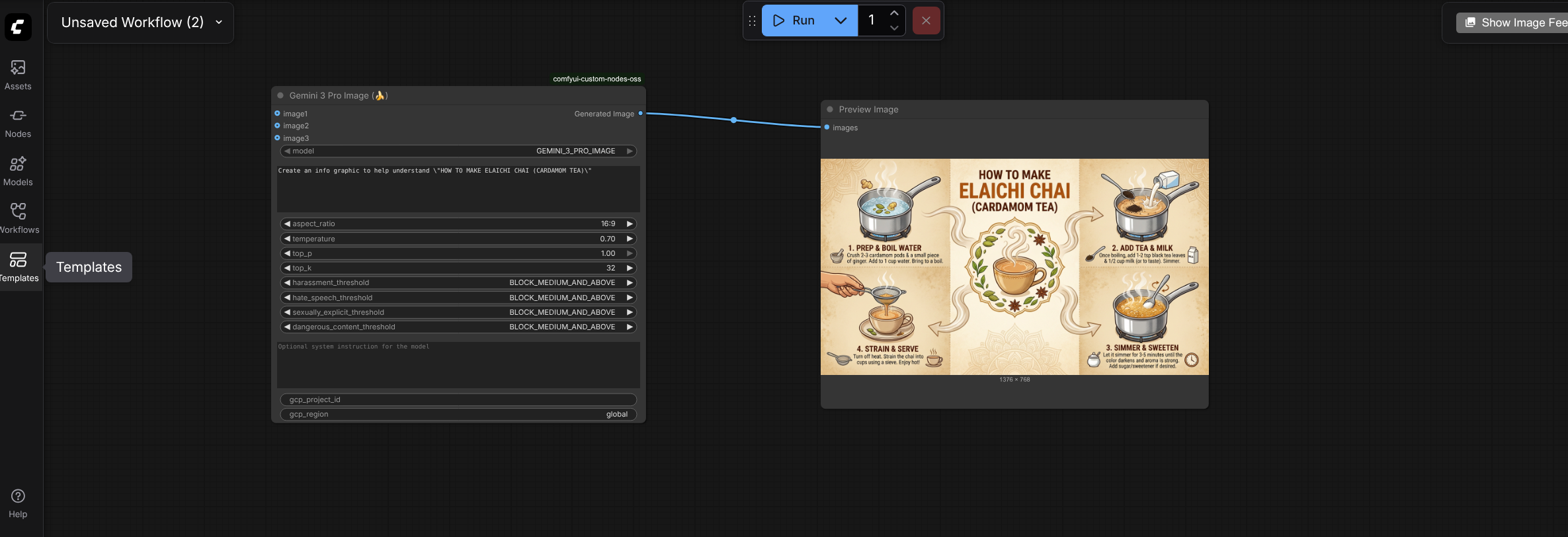
Placeholder Nodes (🧪)
Category: Google AI/Placeholder
Placeholder nodes generate dummy images locally using PIL (Pillow) without calling any API. Each node mirrors the exact same parameters as its corresponding Nano Banana node, so you can swap between real and placeholder nodes in a workflow without breaking connections.
Use cases:
- Rapidly test workflow structure — loops, branches, compositing, resizing — with zero API cost or rate limits
- Verify output image sizes for different aspect ratio / image size combinations
- Identify parameter settings at a glance: all parameters are rendered as text overlay on the image
Available nodes
| Node | Mirrors | Key difference |
| :--- | :--- | :--- |
| Placeholder: Gemini 2.5 Flash Image (🧪) | Gemini 2.5 Flash Image | aspect_ratio only (base 1024px) |
| Placeholder: Gemini 3.1 Flash Image (🧪) | Gemini 3.1 Flash Image | aspect_ratio + image_size + thinking_level |
| Placeholder: Gemini 3 Pro Image (🧪) | Gemini 3 Pro Image | aspect_ratio + image_size + output_mime_type, up to 6 input images |
Outputs
| Name | Type | Description |
| :--- | :--- | :--- |
| Placeholder Image | IMAGE | Dark gray image with gold border, crosshatch pattern, and parameter info overlay. Sized to match the real node's output. |
| param_summary | STRING | Human-readable parameter summary (key: value format). |
| thought_image | IMAGE | (3.1 Flash only) Dummy 1x1 tensor, matching the real node's output slot. |
Virtual Try-On
Category: Google AI/Virtual try-on
This node leverages Google's Virtual Try-On model. It takes an image of a person and an image of a garment (product) and generates a new image of the person wearing that garment.
Required Inputs
| Parameter | Type | Default | Description |
| :--- | :--- | :--- | :--- |
| person_image | IMAGE | N/A | The input image of a person. |
| product_image | IMAGE | N/A | The input image of a garment. |
| base_steps | INT | 32 | The number of inference steps. Higher values may improve quality but take longer. Min: 1, Max: 50. |
| person_generation | Dropdown | ALLOW_ADULT | Policy for generating people. Options: ALLOW_ADULT, DONT_ALLOW. |
| number_of_images | INT | 1 | The number of variations to generate per product. Min: 1, Max: 4. |
| seed | INT | 0 | Seed for reproducibility. If set to 0, the VTO API handles randomness automatically. Note: Not supported if enhance_prompt is enabled. |
| add_watermark | BOOLEAN | False | If true, adds a SynthID digital watermark to the output. Disables seed functionality. |
| safety_filter_level| Dropdown | BLOCK_MEDIUM_AND_ABOVE | The strictness of the safety filter. |
| gcp_project_id | STRING | "" | Manually specify GCP Project ID. |
| gcp_region | STRING | "" | Manually specify GCP Region. |
Outputs
| Name | Type | Description |
| :--- | :--- | :--- |
| Generated Image | IMAGE | The resulting image(s) of the person wearing the product in torch tensors format. |
Sample
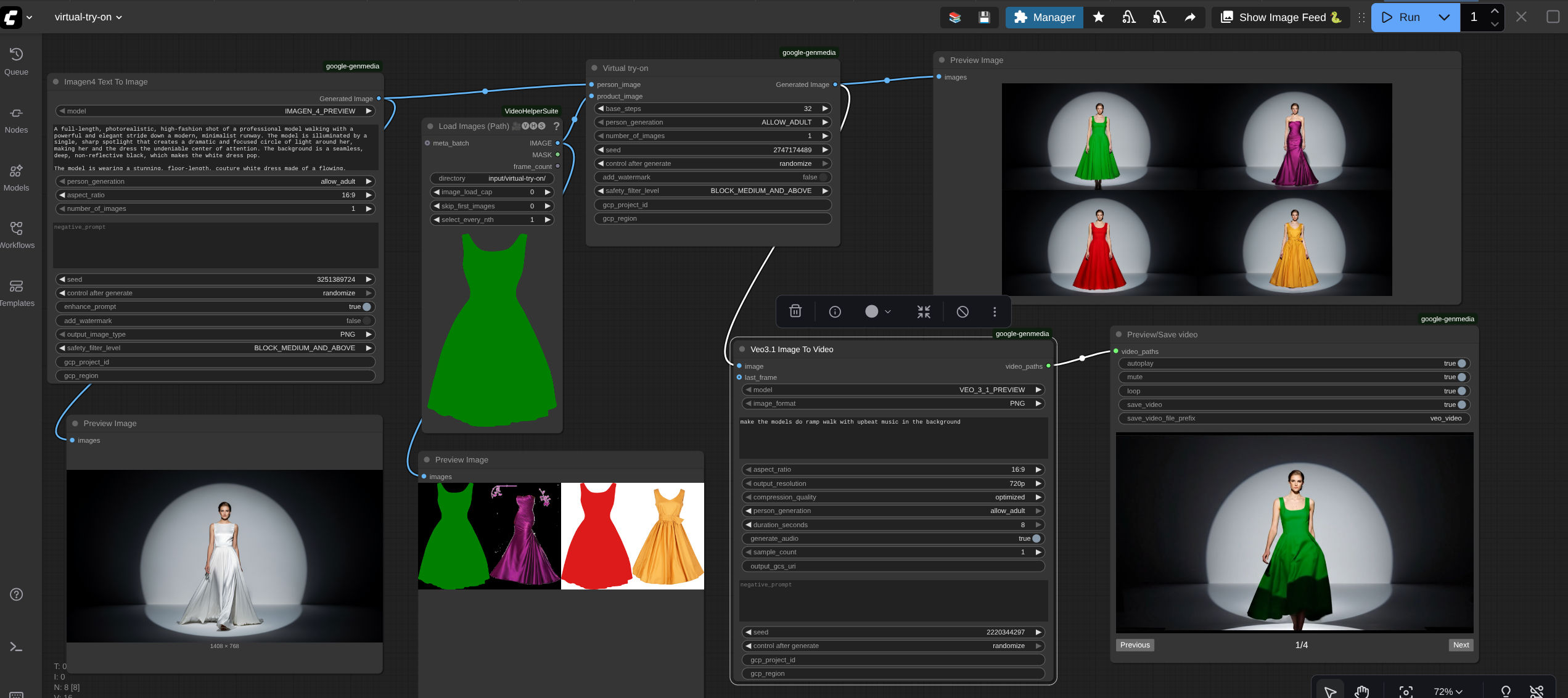
Lyria 2 Text To Music
Category: Google AI/Lyria2
This node integrates with Lyria2 to generate music tracks based on text prompts.
Required Inputs
| Parameter | Type | Default | Description |
| :--- | :--- | :--- | :--- |
| prompt | STRING | "Generate a light bass summer tune" | Multiline string. The main text description of the music you want to generate. |
| sample_count | INT | 1 | Number of music audio samples to generate. Min: 1, Max: 4. |
| seed | INT | 0 | Seed for reproducibility. Note: You cannot use a specific seed (>0) if sample_count is greater than 1. |
| gcp_project_id | STRING | "" | Manually specify GCP Project ID. |
| gcp_region | STRING | "" | Manually specify GCP Region. |
Optional Inputs
| Parameter | Type | Default | Description |
| :--- | :--- | :--- | :--- |
| negative_prompt | STRING | "" | Text description of musical elements to avoid (e.g., "drums", "vocals"). |
Outputs
| Name | Type | Description |
| :--- | :--- | :--- |
| audio | AUDIO | The generated music as a standard ComfyUI audio dictionary (waveform and sample rate). |
Video to VHS
Category: Google AI/Utils
This node takes the video output from a Veo generation node, extracts frames (up to 120), and converts them into a batch of images (Tensor). This is useful for processing video frames with other ComfyUI image-to-image or VAE nodes (often referred to as "VHS" workflows in ComfyUI).
Required Inputs
| Parameter | Type | Default | Description |
| :--- | :--- | :--- | :--- |
| video_paths | VEO_VIDEO | N/A | The internal list of video file paths passed from a Veo generation node. |
Outputs
| Name | Type | Description |
| :--- | :--- | :--- |
| frames | IMAGE | A batch of image frames extracted from the video (limit: 120 frames). |
Preview/Save video
Category: Google AI/Utils
This node handles the display and persistence of generated videos. It allows you to preview the videos generated by Google's models in the ComfyUI interface and optionally save the file permanently to the output directory.
Required Inputs
| Parameter | Type | Default | Description |
| :--- | :--- | :--- | :--- |
| video_paths | VEO_VIDEO | N/A | The input video connection from a Veo generation node. |
| autoplay | BOOLEAN | True | If true, the video starts playing automatically in the preview widget. |
| mute | BOOLEAN | True | If true, the video is muted by default. |
| loop | BOOLEAN | False | If true, the video plays on a loop. |
| save_video | BOOLEAN | False | If true, copies the video from the temp folder to the output/veo folder for permanent storage. |
| save_video_file_prefix| STRING | veo_video | The filename prefix for saved videos (e.g., veo_video_timestamp_hash.mp4). |
Outputs
This node does not produce data outputs to connect to other nodes. It outputs the video player UI widget.
Sample Workflows
Here is a GIF showing the various workflows in action,

Download and use sample workflows provided with this repo:
ComfyUI on GKE - If you are running ComfyUI via ComfyUI on GKE guide, the sample workflows will be provided with the installation. Click onWofkflows on ComfyUI screen and you will see the list of all the sample workflows. Click on any workflow and run it as shown in the GIF above.
ComfyUI running locally - If you are running ComfyUI locally or at a place other than GCP, you need to perform the following steps to download the sample workflows. These steps assume, you have already downloaded this repo by following the instructions in ComfyUI running locally
- Open the terminal on the machine that is running ComfyUI and change to the directory where ComfyUI is installed.
cd <PATH_TO_COMFYUI_INSTALLATION> E.g if your ComfyUI is running from "/home/user/username/ComfyUI", replace <PATH_TO_COMFYUI_INSTALLATION> with "/home/user/username/" - Change to the custom_nodes folder.
cd ComfyUI/custom_nodes - Copy the workflows by running the following command:
mv comfyui-google-genmedia-custom-nodes/sample-workflows/*json ../user/default/workflows/ - Install dependencies for the workflows to function:
mv comfyui-google-genmedia-custom-nodes/sample-workflows/input-images/* .../input/ - Open ComfyUI manager,click Custom Nodes Manager and search for
ComfyUI-VideoHelperSuiteand install the latest version. Then search forComfyUI-Custom-Scriptsand install the latets version. These are required as we use these custom nodes in the example workflows. - Restart ComfyUI via ComfyUI manager or manually. Check in the left side menu under workflows, the new .json workflow files should be present now. You can click on the files to load the workflows and then
RUNthem. - Make sure to pass the
gcp_project_idandgcp_regionto all the custom nodes in the workflows.Note that some of these workflows require an input parameter
output_gcs_uri. This is required in scenarios such as when you are generating a lossless video using veo3 and the APIs can not return a huge video file so it expects an output bucket to be provided as input where it saves the output video. The custom node will throw an interactive error sayingoutput_gcs_urimust be provided. If you encounter such situation, provide the bucket in the input parameteroutput_gcs_uriin the formatgs://YOUR_BUCKET_NAMEto the custom nodes. If you do not have a GCS bucket, create it in your Google Cloud project first.