
comfyui-optimal-resolution
A ComfyUI node that automatically computes optimal width/height for supported models, aspect ratios, and generation modes with instant feedback.
ComfyUI Optimal Resolution


<em>A custom node for <a href="https://github.com/comfyanonymous/ComfyUI">ComfyUI</a> that automatically computes the best width and height for any supported model, aspect ratio, and generation mode.</em>
🔍 Why This Node?
Different AI models (SDXL, FLUX, Qwen, Wan, …) have different “native” resolutions and constraints. Using the wrong size can degrade quality or even cause errors. ComfyUI‑Optimal Resolution takes the guesswork out of the equation:
- Model‑aware – each model has its own base resolution and divisor.
- Mode‑aware – supports Area‑based, Fixed exact, and model‑specific modes (e.g. 720p for Wan).
- Dynamic UI – dropdowns automatically filter valid aspect ratios and modes based on the selected model.
- Instant feedback – the calculated resolution is displayed directly on the node (for Nodes 1.0), so you always know what you’ll get.
🚀 Installation
1. Clone the repository
cd ComfyUI/custom_nodes
git clone https://github.com/caradat/comfyui-optimal-resolution.git
2. Restart ComfyUI
After restarting, you’ll find the “Optimal Resolution” node under the image category.
That’s it – no additional Python packages are required.
🧪 Usage
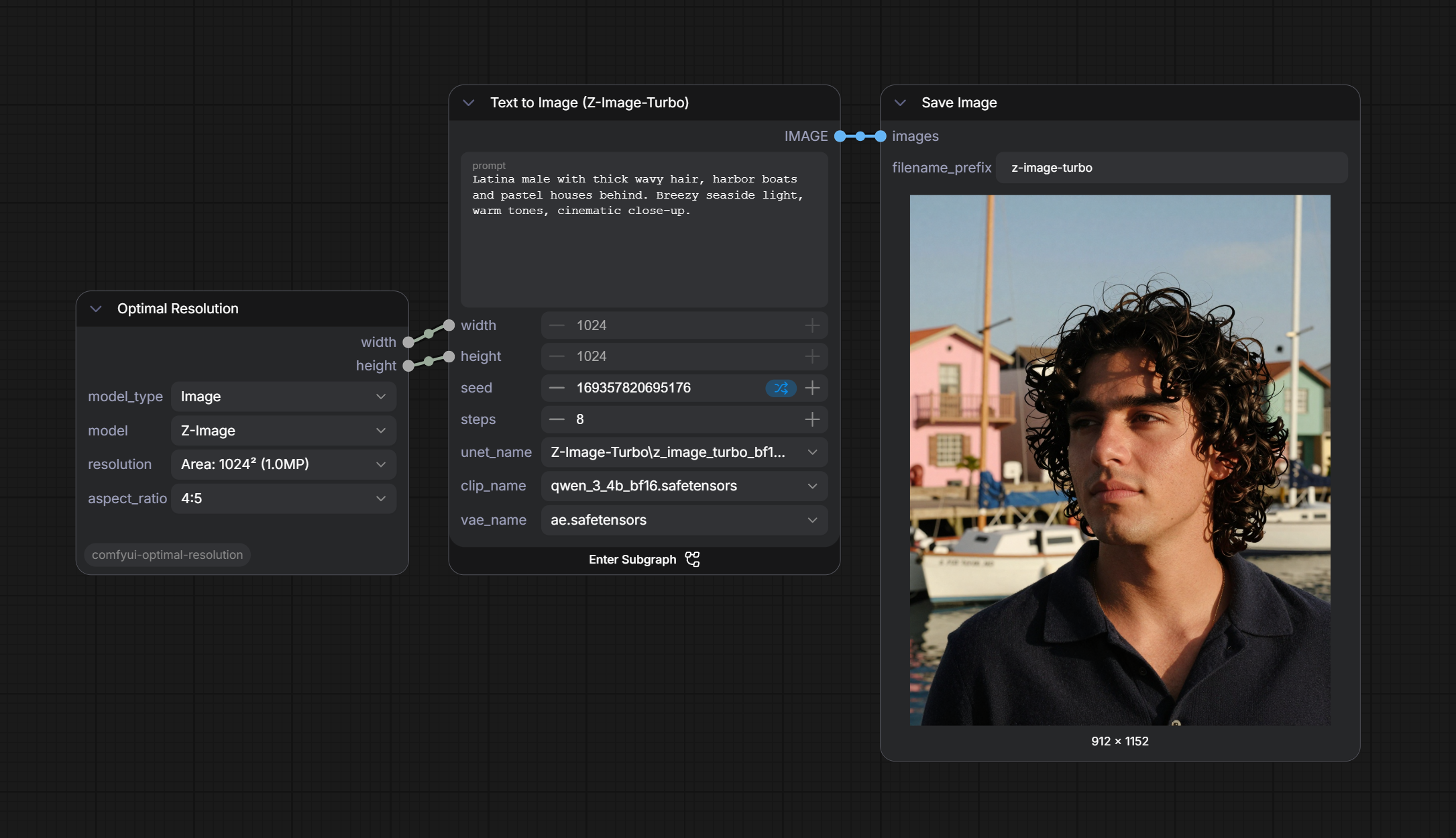
- Add the Optimal Resolution node to your workflow.
- Choose Image or Video model type.
- Pick your model (e.g., Z-Image Turbo).
- Select the desired resolution mode (e.g., Area 1024² (1.0MP)).
- Choose an aspect ratio – only valid options for the current mode are shown.
- The node outputs two integers:
widthandheight, which you can feed directly into an Empty Latent Image or any other resolution‑dependent node.
⚙️ Configuration
All model data is stored in models_data.json at the root of the extension. You can extend or modify it without touching the Python/JavaScript code.
Key sections of the JSON
| Key | Description |
|--------------------|-----------------------------------------------------------------------------------|
| model_types | Groups models into “Image” and “Video” types. |
| resolutions | Named area‑based resolutions (e.g. 1024² (1.0MP)). |
| exact_resolutions| Fixed width×height pairs for models that use exact sizing. |
| aspect_ratios | Default list of aspect ratios; can be overridden per model/mode. |
| models_data | Per‑model settings: base_resolution, multiple_of, resolution_options, etc. |
(Example: adding a new model is as simple as adding a new entry to models_data.)
📦 Supported Models
| Type | Model | Base Resolution | Divisor | Special Modes | |-------|-----------------------|-----------------|---------|---------------------| | Image | Stable Diffusion 1.5 | 512 | 8 | Area: 0.26 MP | | Image | SDXL Base | 1024 | 16 | Fixed (exact), Area | | Image | Flux 1 | 1024 | 16 | Standard | | Image | Flux 2 | 2048 | 16 | Area (0.26‑4.19 MP) | | Image | Qwen Image | 1328 | 16 | Fixed (exact), Area | | Image | Z‑Image | 1024 | 16 | Standard | | Image | Ernie Image | 1024 | 16 | Fixed (exact), Area | | Video | Wan 2.2 14B | 960 | 16 | 720p, 480p | | Video | Wan 2.2 5B | 960 | 16 | 720p | | Video | SVD XT | 768 | 16 | Standard | | Video | LTX 2.3 | 768 | 16 | Standard |
(All modes and exact resolutions are defined in the central models_data.json file.)
🧠 How It Works (Architecture Overview)
The extension is split into two parts that communicate via ComfyUI’s internal API:
- Python backend (
nodes.py,__init__.py)
- Loads
models_data.json. - Exposes two API endpoints:
GET /optimal_resolution/models– serves the configuration to the frontend.POST /optimal_resolution/calculate– receives parameters (model, mode, ratio) and returns the computed resolution.
- Core logic (
calculate_resolution_logic) handles exact resolutions, area‑based calculations, and divisor rounding.
- JavaScript frontend (
js/optimal_resolution.js)
- Registers a ComfyUI extension that overrides
onNodeCreated. - Fetches the model configuration and populates the dropdown widgets dynamically.
- Listens to widget changes, debounces, and calls the
/calculateAPI to update the display in real time.
This separation ensures the UI stays responsive while the heavy lifting (or future extensions) remains on the Python side.
📐 Resolution Calculation Logic
The node uses a multi‑step algorithm:
- Parse the aspect ratio (e.g.,
"16:9"→ ratio = 16/9). - If “Fixed (exact)” mode – look up the exact width/height for the chosen ratio in the model’s
exact_resolutions. - If an “Area” mode – extract the area value from
resolutions(e.g. 1.0 MP = 1 048 576 pixels), then derive height = √(area / ratio) and width = height × ratio. - Round both dimensions to the nearest multiple of the model’s divisor (usually 8 or 16).
- Enforce a minimum equal to the divisor to prevent zero or negative sizes.
The display text is updated on the node automatically, so you never have to run a workflow just to see the numbers.
📁 Repository Structure
comfyui-optimal-resolution/
├── __init__.py           # Extension registration & API routes
├── nodes.py              # Main node class & resolution calculation
├── models_data.json      # Central configuration file
├── js/
│   └── optimal_resolution.js  # Frontend widget logic
├── LICENSE
└── README.md
📜 License
This project is licensed under the MIT License. See LICENSE for details.
Created by <a href="https://github.com/caradat">caradat</a>