
ComfyUI_AdversarialAttack
A ComfyUI custom node set that generates adversarial examples using a pretrained ResNet18 classifier.
Nodes (3)
Make an ImageNet classifier see a cat as a bald eagle
See what a classifier actually thinks, before and after you attack it
The boring load node that quietly downloads 45 MB your first run
ComfyUI AdversarialAttack
A ComfyUI custom node set that generates adversarial examples using a pretrained ResNet18 classifier. Given an input image, the nodes produce a visually similar output image that is misclassified as a different ImageNet class.
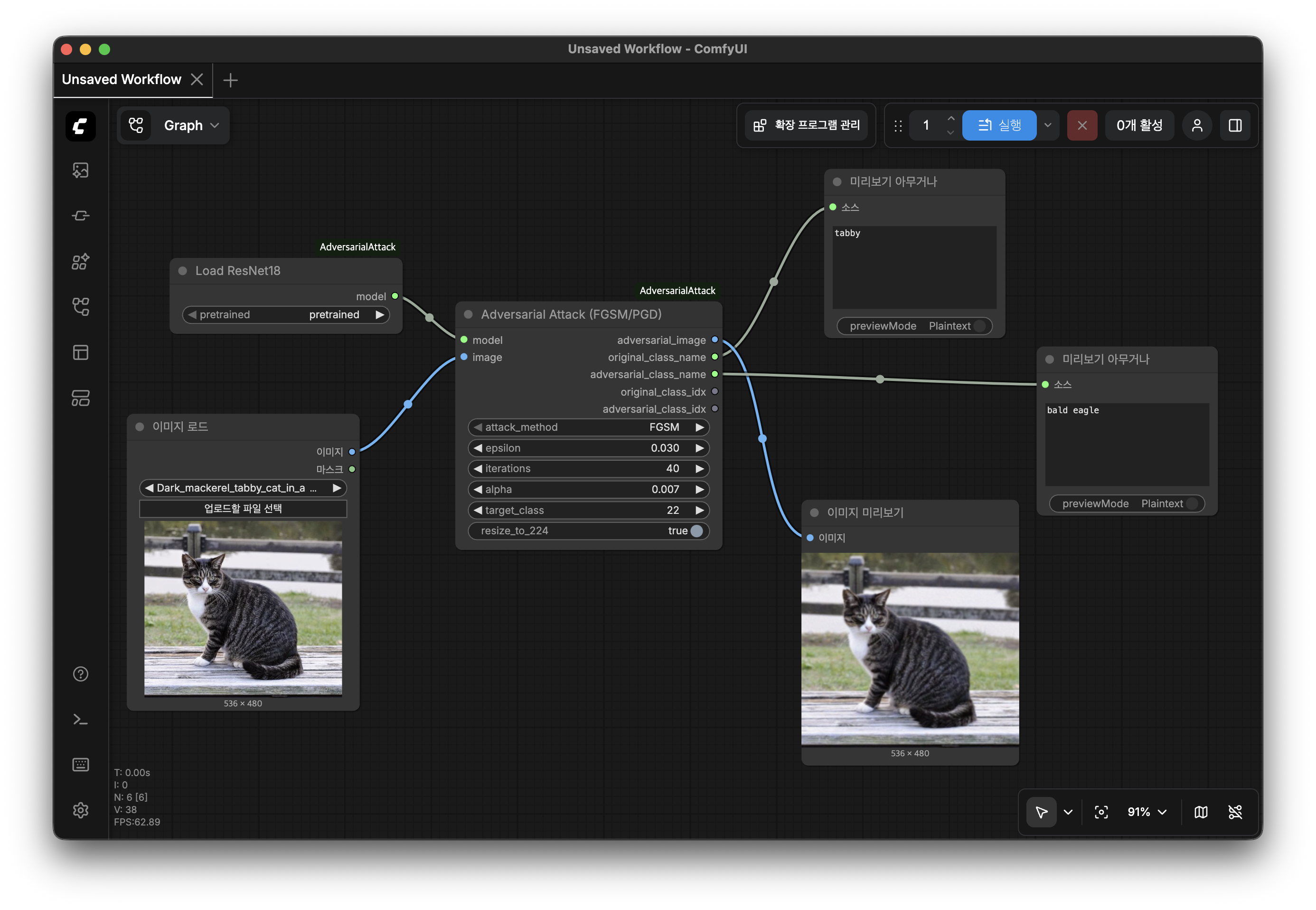
Example: A tabby cat image is fed into the node. After FGSM perturbation (ε = 0.03), ResNet18 classifies the output as bald eagle while the image remains visually identical to the original.
Nodes
1. Load ResNet18
Loads a ResNet18 model with optional ImageNet pretrained weights.
| Parameter | Type | Description |
|-----------|------|-------------|
| pretrained | Enum | pretrained — ImageNet weights; random — randomly initialized |
Output: RESNET_MODEL
2. Adversarial Attack (FGSM/PGD)
Applies an adversarial perturbation to the input image so that ResNet18 predicts a class different from the original.
| Parameter | Type | Default | Description |
|-----------|------|---------|-------------|
| model | RESNET_MODEL | — | ResNet18 from Load ResNet18 |
| image | IMAGE | — | Input image |
| attack_method | Enum | FGSM | FGSM or PGD |
| epsilon | Float | 0.03 | Maximum perturbation magnitude (L∞ norm, pixel space) |
| iterations | Int | 40 | Number of PGD steps (ignored for FGSM) |
| alpha | Float | 0.007 | Per-step size for PGD |
| target_class | Int | -1 | -1 = untargeted; 0–999 = force prediction toward this ImageNet class |
| resize_to_224 | Bool | True | Resize image to 224×224 before inference |
Outputs:
| Name | Type | Description |
|------|------|-------------|
| adversarial_image | IMAGE | Perturbed image (same spatial size as input) |
| original_class_name | STRING | Predicted class of the original image |
| adversarial_class_name | STRING | Predicted class of the adversarial image |
| original_class_idx | INT | ImageNet index of original prediction |
| adversarial_class_idx | INT | ImageNet index of adversarial prediction |
3. Classify Image (ResNet18)
Runs ResNet18 inference and returns the Top-K predictions. Useful for verifying results before and after an attack.
| Parameter | Type | Default | Description |
|-----------|------|---------|-------------|
| model | RESNET_MODEL | — | ResNet18 from Load ResNet18 |
| image | IMAGE | — | Image to classify |
| top_k | Int | 5 | Number of top predictions to return |
| resize_to_224 | Bool | True | Resize image to 224×224 before inference |
Output: STRING — ranked list of class names and confidence scores.
Attack Methods
FGSM (Fast Gradient Sign Method)
Single-step attack (Goodfellow et al., 2014):
x_adv = x + ε · sign(∇ₓ L(f(x), y))
Fast but relatively weak. Good for quick experiments.
PGD (Projected Gradient Descent)
Iterative attack (Madry et al., 2017):
x⁰   = x + Uniform(−ε, ε)
xᵗ⁺¹ = Proj_{B(x,ε)} [ xᵗ + α · sign(∇ₓ L(f(xᵗ), y)) ]
Stronger than FGSM. Increase iterations and tune alpha for harder attacks.
Suggested Workflow
[Load Image] ──────────────────────────────────────────┐
                                                        ▼
[Load ResNet18] ──► [Adversarial Attack] ──► [Preview Image]
                            │
                            ├──► original_class_name
                            └──► adversarial_class_name
Add Classify Image nodes on both the original and adversarial images to compare predictions side by side.
Installation
- Copy (or symlink) this folder into your ComfyUI
custom_nodes/directory:cp -r ComfyUI_AdversarialAttack /path/to/ComfyUI/custom_nodes/ - Install dependencies:
pip install torch torchvision - Restart ComfyUI. The three nodes will appear under the AdversarialAttack category.
Requirements
| Package | Version | |---------|---------| | Python | ≥ 3.9 | | PyTorch | ≥ 2.0 | | torchvision | ≥ 0.15 |
Tips
- Attack failed (same class)? Increase
epsilon(e.g.0.1) or switch from FGSM to PGD with more iterations. - Targeted attack: Set
target_classto any ImageNet class index (0–999) to steer the prediction toward a specific class. - Perturbation visibility: Larger
epsilonvalues produce stronger attacks but more visible noise. Values around0.01–0.05are typically imperceptible. - GPU support: The attack runs on whatever device the model is on. Move the model to GPU before connecting it to the attack node for faster PGD.
References
- Goodfellow et al. (2014) — Explaining and Harnessing Adversarial Examples
- Madry et al. (2017) — Towards Deep Learning Models Resistant to Adversarial Attacks