
Krea 2 SVDQuant
Krea 2, 2.42x faster than BF16 on an RTX 3090 (up to 2.90x), at a third the size. Native INT8/W4A4 quantization with an SVDQuant low-rank branch, no calibration dataset needed. Turbo and base.
Nodes (9)
Write your activation stats to disk
Teach the quantizer where your Krea 2 actually spends its activations
The 1-click Krea 2 SVDQuant loader
The 'why is my 4-bit Krea 2 slow' answer, in one node
Is the int4 kernel even available?
The right way to put a LoRA on a 4-bit Krea 2 (and why the stock one is wrong)
Quantize your own Krea 2 without leaving ComfyUI — no terminal required
Bake DiT + text encoder + VAE into one 12 GB Krea 2 checkpoint
The loader that makes Krea 2's 4-bit weights actually fast
Krea 2 SVDQuant & Native Quantization for ComfyUI
Weights and all example images: huggingface.co/AlperKTS/Krea-2-SVDQuant-ComfyUI
Quantized Krea 2 checkpoints for ComfyUI — about 2x faster and a third the size
of the usual FP8 version, with no calibration dataset needed, on both Krea 2 Turbo
(distilled, 8 steps) and the base release. This repo holds the custom nodes, the All-in-One
builder, and the quantize_krea2.py conversion script; the .safetensors files live on
Hugging Face.
Works on any modern NVIDIA GPU — INT8/W4A4 tensor cores go back to Turing (RTX 20-series). Benchmarked on an RTX 3090 (Ampere). Everything here was built from scratch against ComfyUI's own quantization backend and is 100% reproducible.
Requires a cu130 (CUDA 13) or newer PyTorch build. ComfyUI disables
comfy_kitchen's CUDA backend on older torch builds, which silently drops every quantized checkpoint onto a pure-Python fallback that is slower than bf16. If these checkpoints are slower than FP8 for you, see TROUBLESHOOTING.md.
🚀 Quick Start (Choose Your Setup)
Option 1: 🌟 1-Click All-in-One Checkpoint (Recommended)
Zero extra downloads! DiT model, 4-bit Qwen3-VL 4B text encoder, and VAE are combined into a single 12.77 GB file.
- Install custom nodes:
git clone https://github.com/alperktt/Krea-2-SVDQuant-ComfyUI custom_nodes/krea-2-svdquant - Download the unified checkpoint:
- Download
Krea2-Turbo-AllInOne-SVDQuant-W4A4-rank256-actaware-TEW4A4.safetensors(12.77 GB) from Hugging Face. - Place it in:
ComfyUI/models/checkpoints/
- Download
- Run in ComfyUI:
- Drag
workflows/krea2_turbo_all_in_one_t2i.jsoninto your ComfyUI canvas. - It uses the Krea2 SVDQuant Checkpoint Loader node to load everything in 1 click. Press Queue Prompt!
- Drag
Option 2: 📦 Modular 3-File Setup
If you prefer downloading the DiT, Text Encoder, and VAE separately:
- Install custom nodes:
git clone https://github.com/alperktt/Krea-2-SVDQuant-ComfyUI custom_nodes/krea-2-svdquant - Download the 3 files:
- DiT Checkpoint →
ComfyUI/models/diffusion_models/(from Hugging Face) - Text Encoder →
qwen3vl_4b_fp8_scaled.safetensors→ComfyUI/models/text_encoders/ - VAE →
qwen_image_vae.safetensors→ComfyUI/models/vae/
- DiT Checkpoint →
- Run in ComfyUI:
- Drag
workflows/krea2_turbo_svdquant_w4a4_t2i.jsoninto canvas.
- Drag
📥 Which Checkpoint to Download
| Checkpoint File | Format & Type | Size | Destination Folder | Loader Node | Recommended For |
|---|---|---|---|---|---|
| Krea2-Turbo-AllInOne-SVDQuant-W4A4-rank256-actaware-TEW4A4.safetensors | All-in-One (DiT + 4-bit TE + VAE, rank 256 act-aware) | 12.77 GB | models/checkpoints/ | Krea2 SVDQuant Checkpoint Loader | Best for 1-click generation. Easiest setup, and the rank that holds up under a LoRA. |
| Krea2-Turbo-SVDQuant-W4A4-rank256-actaware.safetensors | Standalone DiT (svdq r256 actaware) | 9.10 GB | models/diffusion_models/ | Krea2 SVDQuant W4A4 Loader | Best standalone DiT with LoRA support |
| Krea2-Turbo-SVDQuant-W4A4-rank64.safetensors | Standalone DiT (svdq r64) | 7.90 GB | models/diffusion_models/ | Krea2 SVDQuant W4A4 Loader | Smaller footprint without LoRA |
| Krea2-Turbo-W4A4-noLowRank.safetensors | Standalone DiT (branchless w4a4) | 7.50 GB | models/diffusion_models/ | Stock UNETLoader | Fastest (~9% faster per step) |
| Krea2-Base-SVDQuant-W4A4-rank256-actaware.safetensors | Standalone DiT (Base release) | 9.10 GB | models/diffusion_models/ | Krea2 SVDQuant W4A4 Loader | Base (50 steps, cfg 3.5, real negative) |
💡 Folder Tip:
- All-in-One files go into
ComfyUI/models/checkpoints/.- Standalone DiT files go into
ComfyUI/models/diffusion_models/.
📑 Workflows Overview
Eight ready-to-use workflows in workflows/:
| Workflow File | Purpose | Setup Type |
|---|---|---|
| krea2_turbo_all_in_one_t2i.json | 1-Click Generation (single 12.77 GB file) | All-in-One |
| krea2_turbo_svdquant_w4a4_t2i.json | Standard Turbo text-to-image (8 steps, cfg 1.0) | 3-File Modular |
| krea2_turbo_svdquant_w4a4_lora.json | Turbo with LoRA/LoKr support (bypass, svd delta, bake) | 3-File Modular |
| krea2_base_svdquant_w4a4_t2i.json | Base non-turbo model (50 steps, cfg 3.5) | 3-File Modular |
| krea2_quantize_all_in_one.json | Bake your own All-in-One checkpoint in ComfyUI | Quantizer |
| krea2_quantize.json | Quantize BF16 DiT to SVDQuant in ComfyUI | Quantizer |
| krea2_quantize_calibrated.json | Live activation capture + quantization | Quantizer |
| krea2_svdquant_diagnostics.json | Verify environment, CUDA kernel & memory stats | Diagnostics |
See it
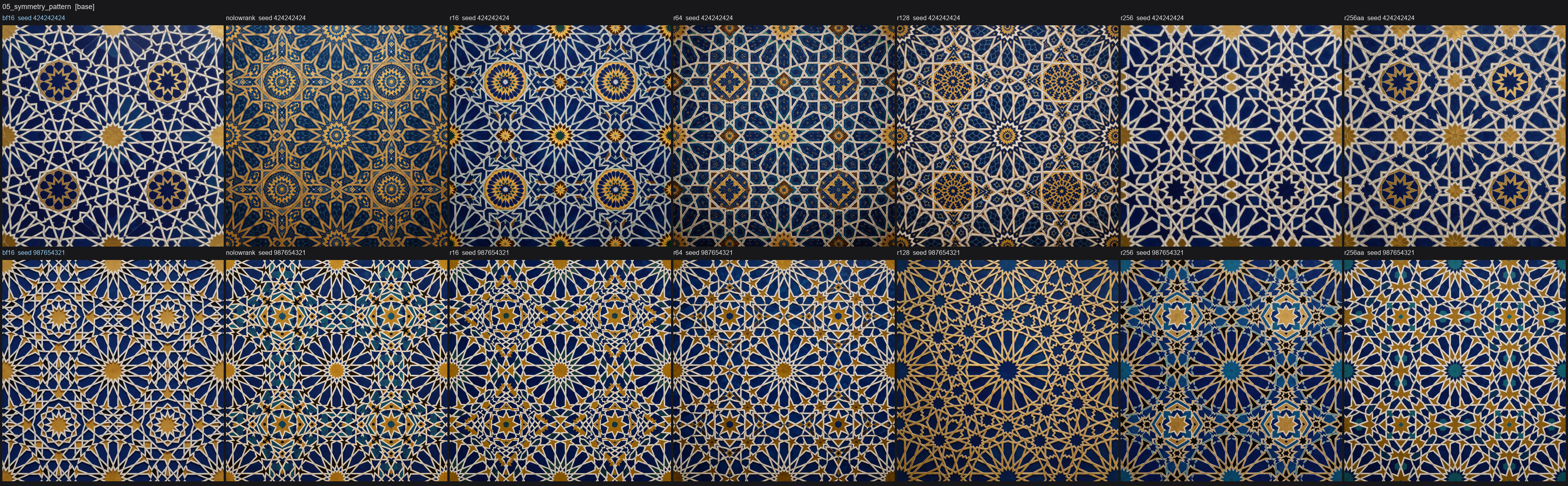
Six of the sixteen benchmark prompts, each rendered by all seven checkpoints at two seeds. The other ten, and the whole set again with a LoRA loaded, are in GALLERY.md.
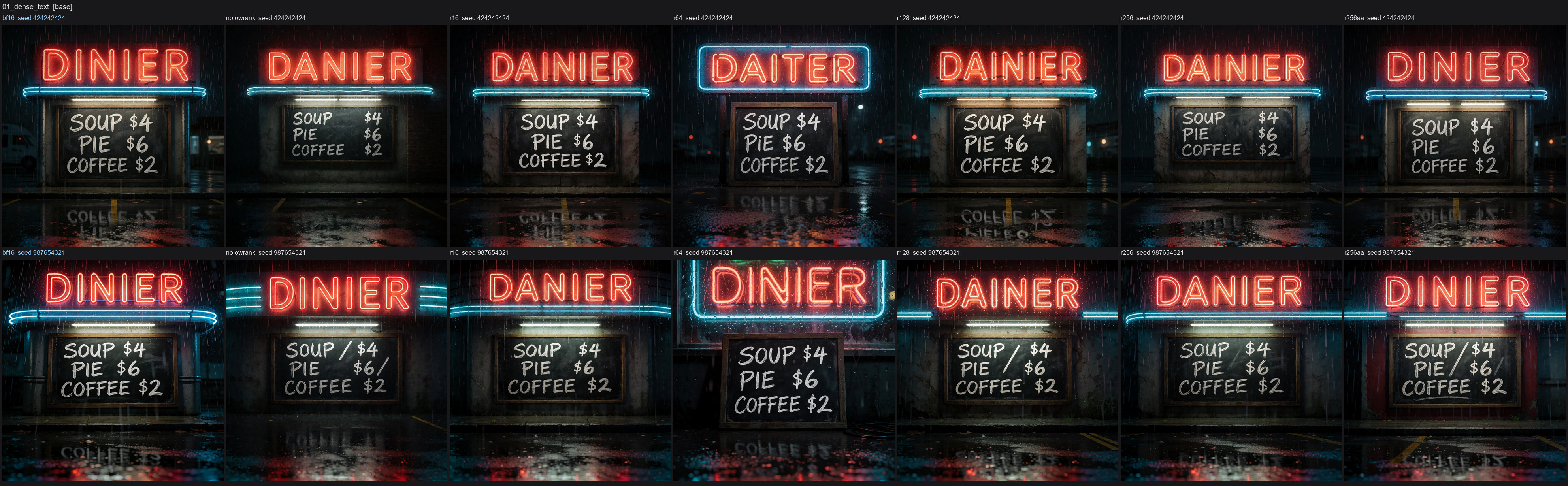
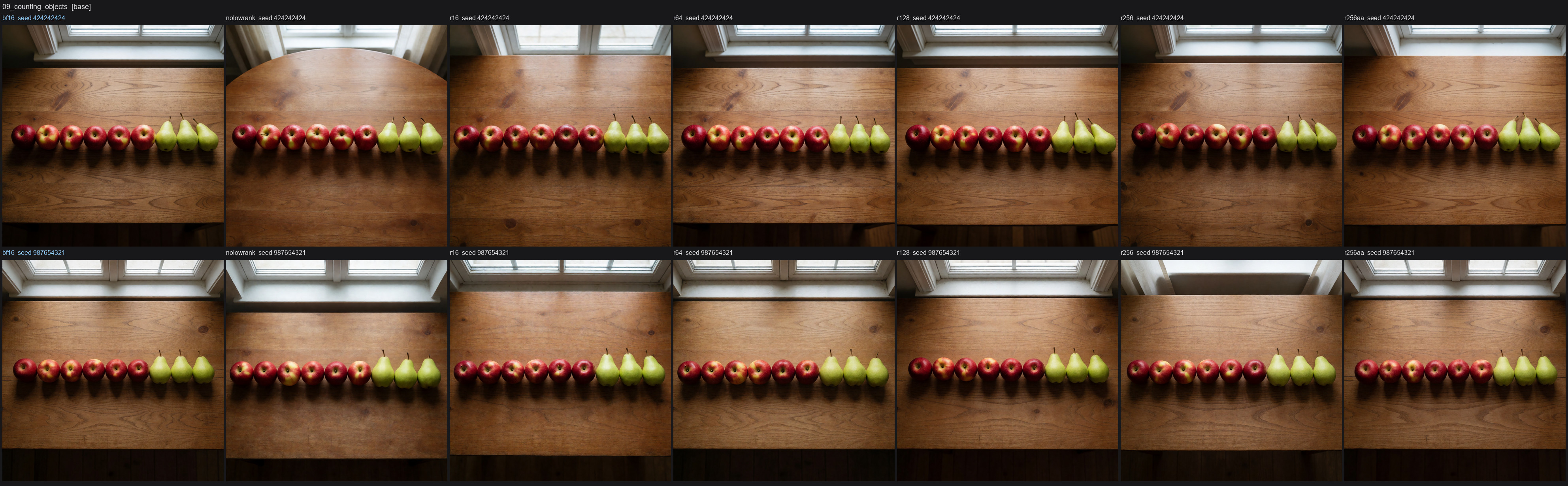
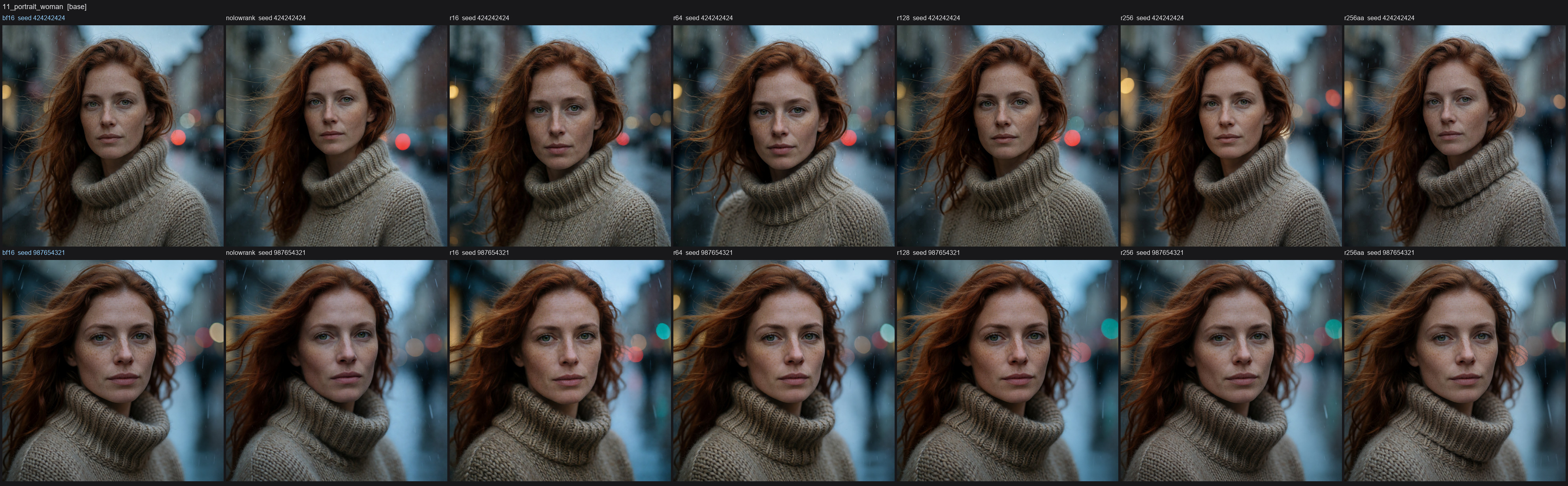
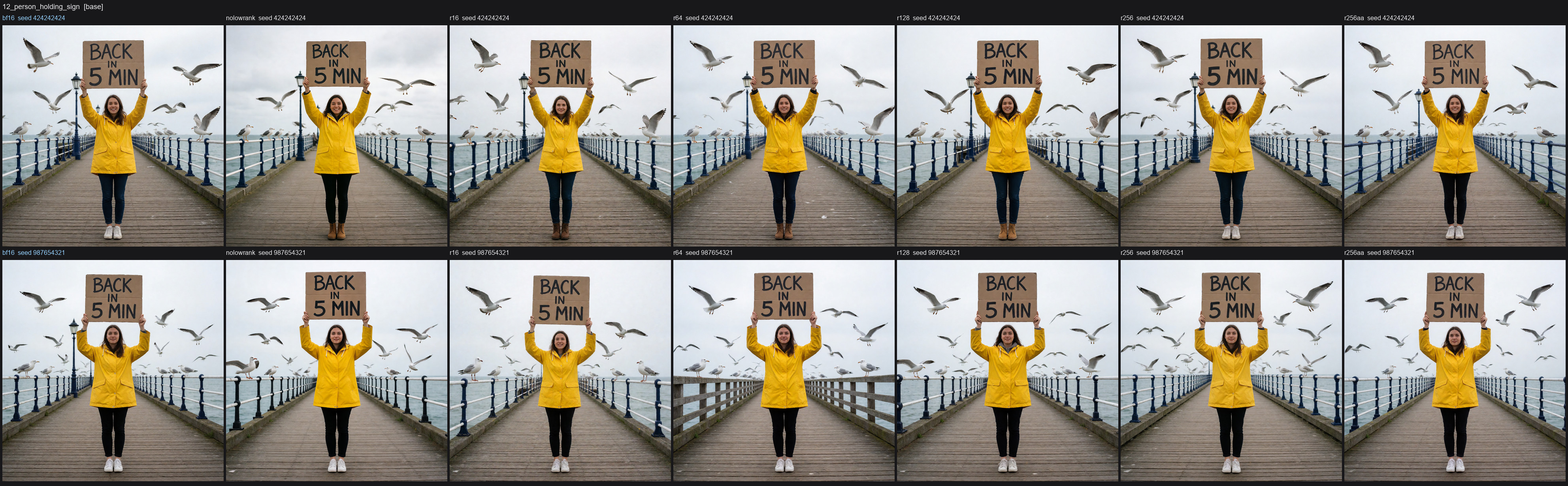
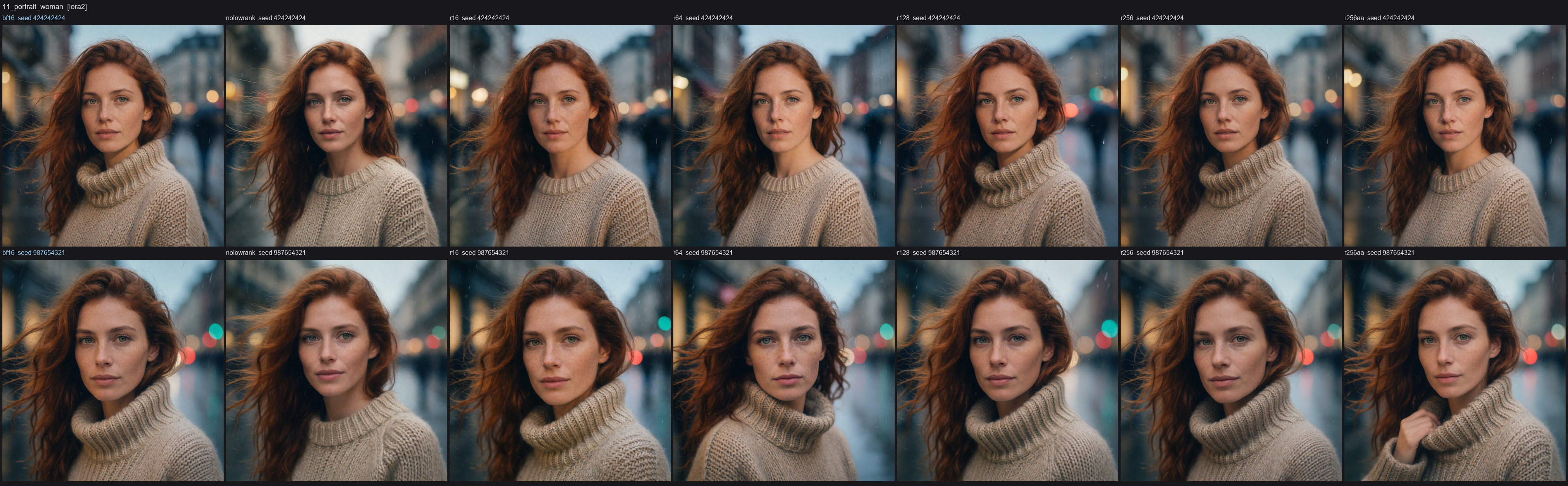
Columns run left to right in accuracy order: BF16 reference first, then no low-rank branch, then rising rank, ending with the activation-aware build. Rows are two seeds. So anything that differs between the two rows of a single column is sampling variance, not a property of the checkpoint -- and if a difference between columns is smaller than the difference between rows, it is not a difference.
Settings never change: 1024x1024, 8 steps, cfg 1.0, euler/simple, seeds 987654321 and 424242424.
01_dense_text
A rain-soaked neon diner sign at night, below it a handwritten chalkboard menu with three lines of text reading 'SOUP $4 / PIE $6 / COFFEE $2', reflections on wet asphalt, cinematic
Three lines of small chalkboard text. The hardest cell in the set: read the prices.
09_counting_objects
A wooden table from directly above with exactly seven red apples arranged in a neat row next to three green pears, soft natural light, flat lay photography
Seven apples, three pears. Miscounting is a structural failure, not a detail one.
11_portrait_woman
Close-up portrait of a woman with freckles and green eyes, windswept auburn hair, wearing a chunky knitted wool sweater, standing on a rainy city street at blue hour, shallow depth of field, natural skin texture with visible pores, catchlights in both eyes, 85mm lens, photorealistic
Skin texture, freckles, catchlights. Where a photographic LoRA earns its keep.
12_person_holding_sign
A young woman in a bright yellow raincoat standing at the end of a wooden pier, holding up a handwritten cardboard sign that reads 'BACK IN 5 MIN' in thick black marker, seagulls circling behind her, overcast diffused light, full body shot, 35mm documentary photography
Handwritten marker text on cardboard at arm's length -- text plus a full body.
05_symmetry_pattern
A perfectly symmetrical Islamic geometric tile mosaic, intricate repeating star and polygon pattern, deep blue and gold, overhead flat lighting, ultra sharp
Repeating geometry. Breaks in the tiling are far easier to see than colour drift.
11_portrait_woman, with a realism LoRA on top
Close-up portrait of a woman with freckles and green eyes, windswept auburn hair, wearing a chunky knitted wool sweater, standing on a rainy city street at blue hour, shallow depth of field, natural skin texture with visible pores, catchlights in both eyes, 85mm lens, photorealistic
The same prompt and seeds with bloomgirls-ultrarealism at strength 1.0. The BF16 column carries the LoRA too, so this compares quantized+LoRA against BF16+LoRA.
Why this exists
The usual advice for making Krea 2 cheaper is FP8. That only pays off if your GPU has FP8 tensor cores — Ada, Hopper, Blackwell. On anything older, FP8 weights get cast back to bf16 before the matmul, so you save VRAM and gain no speed; on an RTX 3090, FP8 measured slower than plain bf16. The same trap catches weight-only 4-bit (W4A16): if activations stay 16-bit, the matmul still runs at bf16 speed.
What moves the needle is quantizing activations too, on hardware that has the units for
it — and INT8/W4A4 tensor cores go back to Turing, far wider support than FP8. So this repo
quantizes Krea 2 into formats ComfyUI already ships native kernels for (int8_tensorwise and
convrot_w4a4 in comfy_kitchen) and adds an SVDQuant-style low-rank correction branch on
top of the native W4A4 kernel to claw back accuracy at 4 bits.
No calibration dataset is required: the convrot group-wise Hadamard rotation spreads
outliers analytically, and the kernel quantizes activations at run time. --act-stats can use
a calibration pass if you have one, but the default path needs nothing.
The nodes
Installing this adds nine nodes, all under Krea2/SVDQuant:
| node | what it is for |
|---|---|
| Krea2 SVDQuant W4A4 Loader | Loads standalone svdq DiT diffusion models |
| Krea2 SVDQuant Checkpoint Loader | Loads unified All-in-One checkpoints (DiT + 4-bit Qwen3-VL 4B TE + VAE) |
| Krea2 SVDQuant LoRA Loader | LoRAs, LoKrs, and LoHas on quantized blocks — supports bypass, svd delta, and bake modes |
| Krea2 SVDQuant Quantize | Builds a quantized DiT checkpoint without leaving ComfyUI |
| Krea2 SVDQuant Quantize All-in-One | Bakes DiT, 4-bit text encoder, and VAE into a unified ~12 GB checkpoint directly from ComfyUI |
| Krea2 SVDQuant Diagnostics | Backend dispatch, memory accounting, per-layer timings, profiler table |
| Krea2 SVDQuant Env Check | Is the int4 kernel available at all? Needs no model, so you can ask before downloading 8 GB |
| Krea2 SVDQuant Capture Start / Capture Save | Record activation statistics for an activation-aware build |
| file | what it is |
|---|---|
| quantize_krea2.py | Converts a BF16 Krea 2 checkpoint to int8, w4a4, or w4a4 + low-rank (svdq). Also the CLI |
| svdquant_w4a4.py | The W4A4 Loader & Checkpoint Loader nodes — loads standalone or All-In-One --format svdq checkpoints |
| svdquant_lora.py | The LoRA Loader node — applies LoRAs as a parallel branch so the 4-bit weight is never dequantized |
| svdquant_quantize.py | The Quantize node — the quantizer above, from inside ComfyUI |
| svdquant_capture.py | The Capture Start/Save nodes — record per-channel activation RMS for --act-stats |
| svdquant_diag.py | The Diagnostics and Env Check nodes |
| diagnose.py | The same reports from a terminal, without starting ComfyUI (--mode all for everything) |
| tools/build_all_in_one.py | Bakes DiT, 4-bit text encoder (Qwen3-VL 4B), and VAE into a single combined checkpoint (~12 GB) |
| tools/fidelity_bench.py | Paired multi-seed multi-LoRA LPIPS harness. Every fidelity claim in this repo comes from it |
| tools/speed_bench.py | Per-step speed, by timing each checkpoint at two step counts and taking the slope. Every s/step number in this repo comes from it |
| tools/contact_sheet.py | Builds the contact sheets in GALLERY.md — for looking at, not scoring |
| tools/pixel_metrics.py | The shared LPIPS/PSNR/SSIM implementation fidelity_bench imports. Not a CLI |
| tools/build_workflows.py | Regenerates workflows/*.json, both dialects. Edit this, not the JSON |
ComfyUI has two JSON dialects and mixing them up is a bad first five minutes: the plain names
are UI format (drag into the canvas — layout, titles, the READ ME note), and *_api.json
is API format (POST to /prompt, no layout). Both come out of build_workflows.py.
Build your own checkpoint
Without a terminal. Drag workflows/krea2_quantize.json in, point source_model at your
BF16 checkpoint, press Queue. Every widget carries a tooltip and the note on the left covers
the choices that matter (which format, which rank, how much disk).
Fill in act_stats while you are there — it is the cheapest quality you will get here and you
do not have to measure anything for it. Download the file matching your variant from
calibration/
(6.67 MB) into ComfyUI/output/ and type its name in: krea2_act_stats_turbo.safetensors for Turbo,
krea2_act_stats_base.safetensors for base.
You only need to capture your own statistics for weights those files do not describe — a
finetune, a merge, anything that is not the released checkpoint. Activation statistics describe
the weights they came from, and sharing an architecture is not enough: Turbo's file loads into a
base build without complaint and then describes the wrong model. check_act_stats_coverage
catches a genuinely foreign model before any GPU work, but it matches on layer names, which
Turbo and base share — so it cannot catch that particular mistake for you. For that case,
workflows/krea2_quantize_calibrated.json runs the capture and the quantize in one Queue press:
the Capture Save node's act_stats_path output feeds the Quantize node, and that wire is also
what guarantees the calibration runs first — without it ComfyUI is free to quantize before
sampling and you get an uncalibrated file with no warning.
Three things to know before you press Queue, in either graph: it blocks the queue for the
whole run (54 s to ~6 min), it unloads any resident model to take the GPU, and it writes ~8 GB
(refusing rather than overwriting unless you tick overwrite).
From a terminal:
cd ComfyUI/custom_nodes/krea-2-svdquant
python quantize_krea2.py /path/to/krea2_bf16.safetensors --format svdq --rank 256 \
  --act-stats krea2_act_stats_turbo.safetensors
--format int8 and --format w4a4 also work (int8 is the most faithful option and still
~2x FP8 on Ampere; w4a4 is the fastest and smallest). Add --variant turbo or
--variant base for a filename you will recognise later and to record the source release in
the metadata — it does not change the quantization, since layer selection keys off block
naming that Turbo and base share.
The Krea2 SVDQuant Quantize node calls this same function — the CLI and the graph are one quantizer, not two that drift.
Builds are reproducible, per device. The low-rank split is a randomized SVD, so before
--seed existed two runs of the same command on the same GPU produced different checkpoints —
around 1e-4 per weight, which a sampler then compounds over 8–50 steps into a visibly different
image. The seed defaults to 0; pass --seed -1 (or -1 in the node) for the old behaviour.
Across devices it still differs whatever the seed: CPU and CUDA neither draw the same numbers
nor reduce their GEMMs in the same order. Both the seed and the build device are recorded in
the checkpoint metadata (krea2_svdquant_seed, krea2_svdquant_device).
rank and refine_iters are one lever, not two. With refinement off a rank sweep is flat
— rank 16 and rank 256 land within noise of each other — so raising rank without
refine_iters > 0 is wasted file size. If you want a cheap build, lower the rank instead of
skipping refinement.
Only the 224 transformer-block linears (attention + MLP) are quantized; norms, modulation, the
text-fusion stack and the final layer stay at full precision, being small and
disproportionately sensitive. Expect quantized 224 layers; 206 tensors passed through; ...
— a run reporting 0 fails loudly with the leaf names it actually found rather than writing
a useless file. An FP8 source works too (it is reconstructed to BF16 first); INT8 and W4A4
sources are rejected, because unpacking those needs layer dimensions the file alone lacks.
Activation-aware branch (--act-stats)
The branch is normally fitted by minimising ||W - (Q + L1 L2)||, which treats every input
channel as carrying the same activation energy. It does not. --act-stats weights the
objective by measured per-input-channel activation RMS instead, so the branch spends its rank
where the activations actually are. d is normalised to mean 1 and floor-clamped at 0.05 so a
near-dead channel cannot dominate the fit.
This costs nothing at inference — same shapes, same format, same kernels; only the values
inside svdq_l1/svdq_l2 change. It is the largest fidelity gain measured in this repo
(Test 4), so it is worth the
extra calibration pass whether or not you use LoRAs.
Two nodes capture the statistics (they hook all 224 branched linears on a BF16 model):
- Krea2 SVDQuant Capture Start — between your model loader and the sampler.
- Krea2 SVDQuant Capture Save — takes the sampler's
LATENT, so it runs after denoising. Leavekeep_capturingon for every prompt but the last, and several prompts accumulate into one file underComfyUI/output/.
Use prompts that are not the ones you plan to judge the checkpoint with, then pass the file
to --act-stats (or to the Quantize node's act_stats input). The output filename gains an
-actaware tag and records which statistics built it in krea2_svdquant_act_stats. Stats
missing for any branched layer is a hard error, checked before any GPU work rather than
silently falling back.
For --format svdq, a single SVD of W is only a first guess: it finds the directions
largest in W, which are not the directions the quantizer handles worst. So the branch is
refit against the current quantization error and requantized, repeatedly, keeping the best —
the alternating scheme DeepCompressor uses. On Krea 2 Turbo at rank 64 this cuts
reconstruction error by 9.4%, with all 224 layers improving. Because iteration one is
exactly the plain single-shot split and the best result is kept, refining can never do worse.
It costs conversion time: ~6 minutes instead of 40-100 seconds. --refine-iters 0 skips it.
The default objective is weight reconstruction error, which needs no calibration data — it is
the true output error under the assumption that the input covariance is identity, and
spreading outliers with the convrot rotation is what makes that assumption reasonable.
--act-stats relaxes it to a measured per-channel diagonal. The full covariance, which is
what makes DeepCompressor's conversions take hours, is still not modelled.
Rank is uniform across all 224 layers by default, and that is measurably not the efficient
choice. At rank 64, error removed per million branch parameters spans 6.9x across the
eight projection types — attn.wk returns 0.0992 against mlp.up's 0.0143. The cause is GQA:
Krea 2 has 12 kv heads against 48 query heads, so wk/wv are 1536-wide and their branch
costs a third of an MLP branch while absorbing twice the error.
--rank-alloc gqa spends the same bytes accordingly (wk 360, wv 256, wq 72, wo 64,
gate 56, MLP 8 — 0.02% smaller than uniform rank 64, same speed). It does not improve the
images: LPIPS 0.3523 against uniform's 0.3403, better on 5 of 10 prompts, paired t = +0.55 —
no effect in either direction. It does halve the spread across prompts (variance ratio 4.64,
F-test p = 0.032) and improve the worst prompt, 0.4975 → 0.4470, which someone could re-test
at more than 10 images. uniform stays the default.
Kept because the mechanism is sound and the option is cheap to leave in. The transferable
result is negative: weight reconstruction error is a poor predictor of image outcome on this
model. Three attempts to optimise against it — the refinement objective, per-block depth
allocation, and this — failed to move LPIPS in the predicted direction. --act-stats is the
one that worked, and it optimises against something else.
All-in-One Checkpoint (tools/build_all_in_one.py)
Bake the diffusion model, text encoder, and VAE into a single file (~12 GB instead of 15.5 GB across three separate files):
python tools/build_all_in_one.py \
    --dit  models/diffusion_models/Krea2-Turbo-SVDQuant-W4A4-rank64.safetensors \
    --text-encoder models/text_encoders/qwen3vl_4b_bf16.safetensors \
    --vae  models/vae/Krea2-HD-vae.safetensors \
    --te-format w4a4 --variant turbo
- Streaming Safetensors writer: never holds the combined 12+ GB in memory simultaneously.
- Quantized Text Encoder: quantizes the 252 linear projections of Qwen3-VL 4B (
self_attn.*_proj,mlp.*_proj) to 4-bit (convrot_w4a4orint8) while leaving the vision tower and embeddings untouched. - Loading:
SVDQuantall-in-one checkpoints load with the Krea2 SVDQuant Checkpoint Loader node.- Branchless checkpoints (
--format w4a4orint8) load with stock CheckpointLoaderSimple.
- Workflow: drag
workflows/krea2_turbo_all_in_one_t2i.jsoninto ComfyUI for a streamlined 1-loader generation graph.
What was measured
Full tables, methodology and caveats: BENCHMARKS.md. Images: GALLERY.md. All of this on an RTX 3090 at 1024x1024 / 8 steps / cfg 1.0.
Speed, warm (model already resident), 10 prompts:
| checkpoint | warm | vs BF16 | |---|---|---| | BF16 (reference) | 18.80 s | 1.00x | | W4A4, no low-rank branch | 6.49 s | 2.90x | | SVDQuant rank 64 | 7.16 s | 2.63x | | SVDQuant rank 256 | 7.77 s | 2.42x |
-actaware is absent from that table because it cannot differ: same tensor shapes, same
format, same kernels, only different numbers inside the branch. FP8 is slower than BF16 on
Ampere (no FP8 tensor cores).
How much faster than INT8? The question everyone actually asks, and the table above does
not answer it — it has no INT8 row. Here it is, measured per sampling step rather than per
image, so CLIP text-encode and VAE decode (several seconds, identical across checkpoints)
stop hiding the difference. tools/speed_bench.py, one ComfyUI session, three timed runs at
8 and at 24 steps, per-step cost taken as the slope between them:
| checkpoint | s/step | with TorchCompileModel |
|---|---|---|
| INT8 + convrot (int8-fast) | 0.993 | 0.886 |
| SVDQuant rank 256, actaware | 0.845 | 0.718 |
| W4A4, no low-rank branch | 0.678 | crashes, see TROUBLESHOOTING.md |
So 1.18x over INT8 uncompiled, 1.23x with both compiled — not the 2-3x the "vs BF16" column suggests, and small enough at 8 steps (5.9 s against 7.3 s) that people report seeing no difference at all. The honest summary: W4A4's decisive win over INT8 is VRAM (8.50 GiB resident against 12.84 GiB, as ComfyUI reports them on load), and the speed win is real but modest.
Two corrections to earlier claims, both from this measurement:
- The low-rank branch costs ~25% of a step at rank 256, not 9-10% (0.845 against noLowRank's 0.678). The 9-10% figure came from rank 64 and does not carry to rank 256. Rank is still primarily a size and fidelity decision, but it is not free.
- Numbers taken in different ComfyUI sessions drift by up to ~5% on this machine (INT8
measured 0.948 in one session and 0.993 in another). Only compare rows measured in the
same run;
tools/speed_bench.pydoes one arm matrix per invocation for that reason.
Fidelity, LPIPS against a BF16 reference over 16 prompts x 2 seeds (lower is closer):
| checkpoint | no LoRA | with canon | with bloomgirls |
|---|---|---|---|
| W4A4, no low-rank branch | 0.3954 | 0.3944 | 0.3808 |
| SVDQuant rank 16 | 0.3758 | 0.3453 | 0.3672 |
| SVDQuant rank 64 | 0.3325 | 0.3611 | 0.3684 |
| SVDQuant rank 256 | 0.3378 | 0.2993 | 0.3215 |
| SVDQuant rank 256, actaware | 0.2825 | 0.3213 | 0.3097 |
Each column is scored against its own BF16 reference — a LoRA changes how seed-sensitive the
model is, so the reseed floor differs per column (0.547 / 0.519 / 0.551) and the numbers are
not comparable across columns, only down them.
Two findings come out of that table, both from paired differences over shared prompt+seed
cells rather than the marginal means above (|t| > 3 is the bar this repo treats as claimable):
| comparison | no LoRA | with a LoRA | |---|---|---| | rank 256 vs rank 64 | t=0.39, wins 16/32 — a coin flip | t=2.8-3.5, wins 23-26/32 | | rank 64 vs no branch at all | t=4.45, clearly better | t=0.73-1.72, barely better | | actaware vs plain rank 256 | t=4.68, wins 27/32 | t=0.7-1.7, no effect either way |
So: branch rank only matters under a LoRA, and the activation-aware objective is the biggest single gain here — which is why the download table starts with it.
Every fidelity number comes from tools/fidelity_bench.py (16 prompts x 2 seeds x 5 LoRA
arms), and it exists because the repo's earlier quality ranking could not be defended: it came
from an LLM judge that had saturated, 9 of 12 rows a flat 10.00/10, and a rank claim built on
one seed compared as marginal means. Both are struck through in place with the reason rather
than deleted.
LoRA
Use Krea2 SVDQuant LoRA Loader, not the stock LoraLoaderModelOnly. The stock loader
patches weight += down @ up, but on these models .weight is a QuantizedTensor, so
applying it that way means dequantize → add → requantize: the branch's whole point, keeping
the 4-bit weight untouched, is lost, and the LoRA delta gets quantized to 4 bits along with it.
This loader instead attaches the LoRA as a parallel low-rank branch, which is mathematically
identical for a linear layer ((W + BA)x == Wx + B(Ax)) and leaves the quantized weight alone.
Chain multiple nodes to stack LoRAs; the console reports what matched, e.g. 224 quantized layers, 32 normal layers.
The branch is installed as a ComfyUI object patch, so it belongs to that one model branch: two LoRA loader nodes on the same checkpoint loader do not contaminate each other, and nothing survives past the sampling run. A stack of N LoRAs on one layer folds into a single pair of GEMMs rather than N pairs, and LoRA files are cached by mtime, so changing a strength does not re-read them from disk.
<details> <summary>Does the stock loader silently skip the quantized layers? Measured: not any more</summary>This page used to claim "it matches only the ~32 non-quantized layers out of ~256 and misses
all 224 transformer-block layers, with no error." Re-tested against ComfyUI 0.28.0 (commit
f966a2b3) on both W4A4-convrot and SVDQuant-W4A4-rank256, by patching the same checkpoint
at LoRA strength 1.0 and 4.0 and diffing every weight — a skipped layer would be bit-identical
between the two:
key map offers 224/224 of the quantized layers
load_lora produced 256 patches; add_patches accepted 256 keys
strength 1.0 vs 4.0:  quantized 224/224 differ,  plain 32/32 differ
All 224 move, so the coverage claim does not hold on current ComfyUI, and we have not bisected when that changed. The reason to use this repo's node is the requantization above, not missing coverage.
</details>Troubleshooting
TROUBLESHOOTING.md covers the things that actually go wrong:
generation slower than FP8 (nearly always a pre-cu130 torch build), no speedup at all on
RTX 20-series, Pin error. in the console, iteration time jumping to 30-100 s past ~12 GB
(fixed — update if you see it), LoRA renders changing after this release (measured, and
the old behaviour was the unstable one), out-of-memory on a small card, LoRAs that match no
layer, sage-attention artifacts, and "left over keys in diffusion model" after re-saving.
Start with the Krea2 SVDQuant Diagnostics node between the loader and the KSampler, or:
python diagnose.py --no-load
Attribution
Krea 2 is developed by Krea AI. This repository contains derivative, modified weights and is licensed under the same Krea 2 Community License Agreement as the base model — see LICENSE.md for the full terms and how they apply to the code here. It is a community contribution, not an official Krea product, and is not endorsed by Krea.
The quantization kernels used here (int8_tensorwise, convrot_w4a4) are native to
ComfyUI's comfy_kitchen backend. The low-rank
branch construction follows the method described in the SVDQuant
paper (Li et al., MIT Han Lab), implemented here from
scratch on top of ComfyUI's native kernel rather than the paper's own Nunchaku engine, which
has no Krea 2 architecture support.