
FlashVSR Video Upscale (sm89, local)
4K video super-resolution on a 24 GB RTX 4090 — a free, local ComfyUI FlashVSR node (VIDEO in, VIDEO out) plus a Triton/FP8 operator pack at ~1.3x. No CUDA build.
flashvsr-sm89-ops



-green)

4K video super-resolution on a single 24 GB RTX 4090 — local, free, and ~1.3× faster than the official pipeline (1.34× end to end once the input preparation both paths pay per request is counted).
FlashVSR v1.1 (Tiny) is a real-time streaming video super-resolution model whose official pipeline targets A100-class GPUs — it renders the whole output canvas in one pass, so VRAM grows with output pixels and 4K simply does not fit a consumer card. This repo fixes both problems, without editing a line of FlashVSR source and without compiling a single CUDA extension:
- 🧩 A ComfyUI node — VIDEO in, VIDEO out: the local, free counterpart of ComfyUI's built-in (cloud, paid) FlashVSR node. Canvases above ~1080p render automatically as overlapping spatial tiles, so VRAM tracks one tile, not the canvas — 4K peaks at ~20 GB where the untiled render OOMs at 45 GB.
- ⚡ An operator pack —
flashvsr_sm89_ops.enable(pipe)is one call that runs the official pipeline ~1.3× faster on a 4090 (14.4–15.0 FPS @ 1408×768): FP8 linears, fused RMSNorm+RoPE and AdaLN, fused GELU→FP8 FFN, and a Triton block-sparse attention stand-in that removes the only CUDA build upstream required. The node's own input preparation is pooled and fused on top of that, so the node end-to-end ratio is 1.34× (benchmarks/node_e2e_ab.json).
Tiling is a memory technique and the operators are a speed technique — they stack. Every tile runs the same fused kernels, and the A/B proves it: 1.24× on the tiled path (benchmarks/tiled_ops_ab.json).
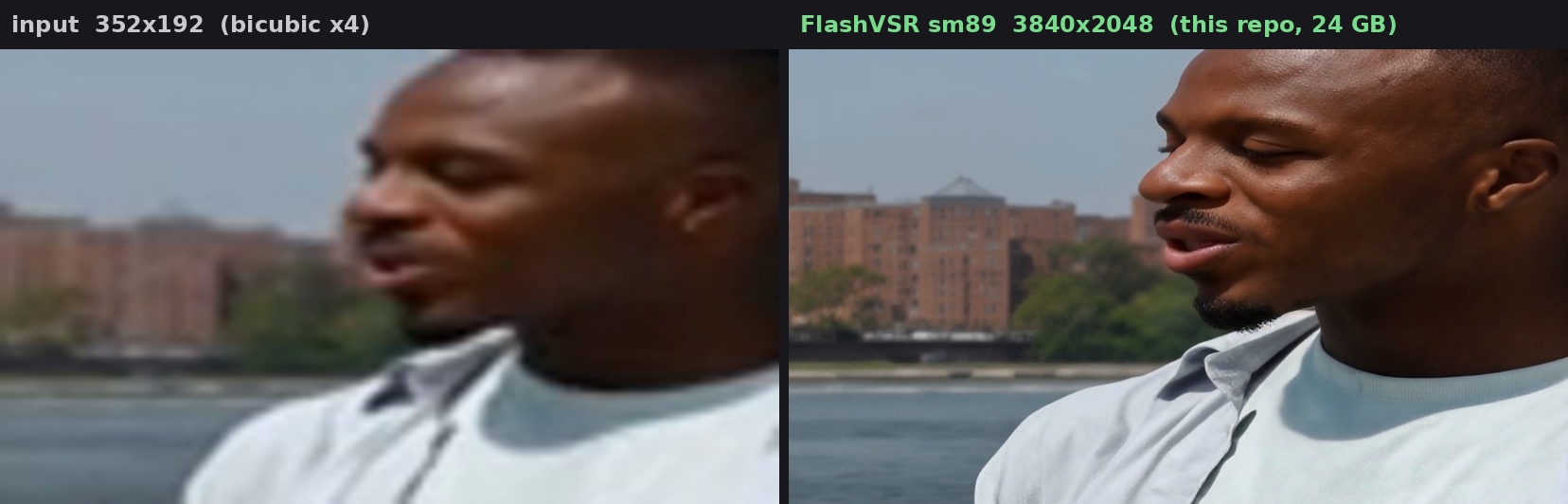
The headline numbers (RTX 4090 D, every number traceable to a JSON in benchmarks/):
| | measured | data |
|---|---|---|
| 4K · 3840×2048 · 85 frames on a 24 GB card | 19.96 GiB peak, ~61 s — untiled: OOM at 44.8 GiB | tiled_render.json |
| Speed vs official pipeline @ 1408×768 | 1.30× end-to-end (11.5 → 15.0 FPS); 1.26–1.28× on a pristine re-run | headtohead_*.json, pr2_harness_*.json |
| Node end-to-end vs the official example @1408×768 (input preparation + render, one host) | 1.34× (10.88 → 8.12 s) — pipeline-only is 1.26× on the same run | node_e2e_ab.json |
| Speedup retained under tiling (2K A/B) | 1.24× — and FP8 trims another ~1.3 GiB off the tiled peak | tiled_ops_ab.json |
| Node input preparation (85 frames → 4K canvas) | 17.2 s → 6.1 s — Pillow x4 bicubic on a thread pool + fused per-frame conversion, output bit-identical; node end-to-end 84.5 → 73.4 s on that path | input_prep_ab.json |
| Quality | LPIPS 0.011–0.012 vs official outputs (gate ≤ 0.05); tile seams below global noise | quality_cmp.json, tiled_render.json |
tiled_render.json times render_tiled only — the node's input preparation runs outside its timer, so those wall times and every ratio above are unaffected by the node-side host changes in input_prep_ab.json.
Use it in ComfyUI
This repository is a ComfyUI node pack. One node, the same two inputs as the built-in cloud FlashVSR node, running on your own GPU — no upload, no API key, no credits:
cd ComfyUI/custom_nodes
git clone https://github.com/aireet/flashvsr-sm89-ops.git
Restart ComfyUI (or install via ComfyUI-Manager's Install from Git). No pip step — the node imports the operator pack from the cloned checkout itself.
[Load Video]  ->  [FlashVSR Video Upscale (sm89, local)]  ->  [Save Video]
     core                      the only custom node                  core
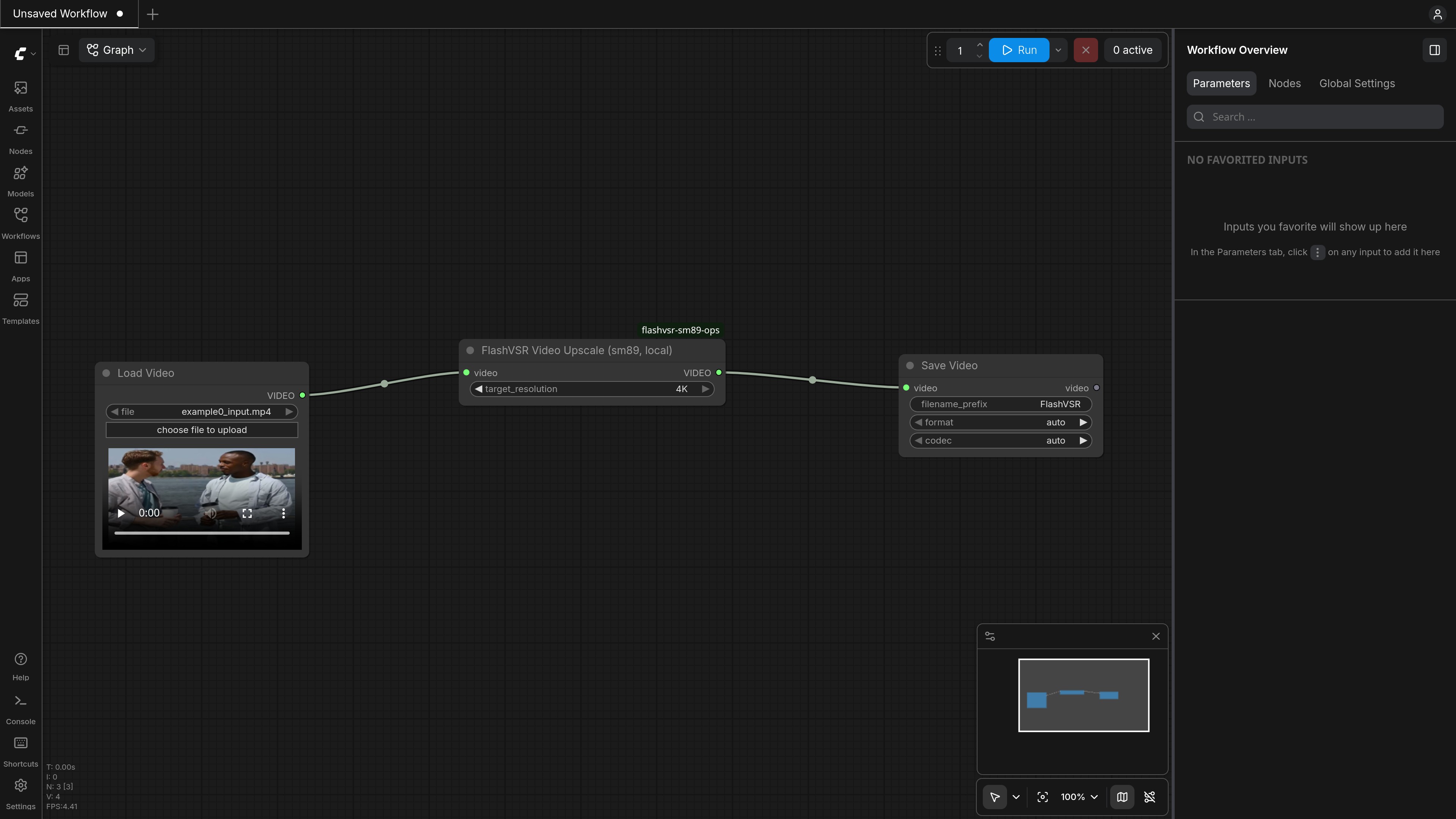
| input | default | meaning |
|---|---|---|
| video | — | the low-resolution clip, from the core Load Video node |
| target_resolution | 1080p | 720p · 1080p · 2K · 4K — roughly how tall the result should be |
A complete graph ships in comfyui/workflows/flashvsr_minimal.json — drop it on the canvas, put your clip in ComfyUI/input/, and hit Run. First run provisions itself (FlashVSR checkout, ~6.5 GB weights, one-time Triton JIT — same compiler requirement as the quickstart below).
Case: 352×192 in → 4K out, on a 24 GB card. Hit Run — the canvas renders as 5 overlapping tiles (~61 s on a 4090 D, 19.96 GiB peak), the node streams per-tile progress into the UI on one bar, and the result lands in Save Video with its own preview player:
| rendering | done |
|---|---|
| 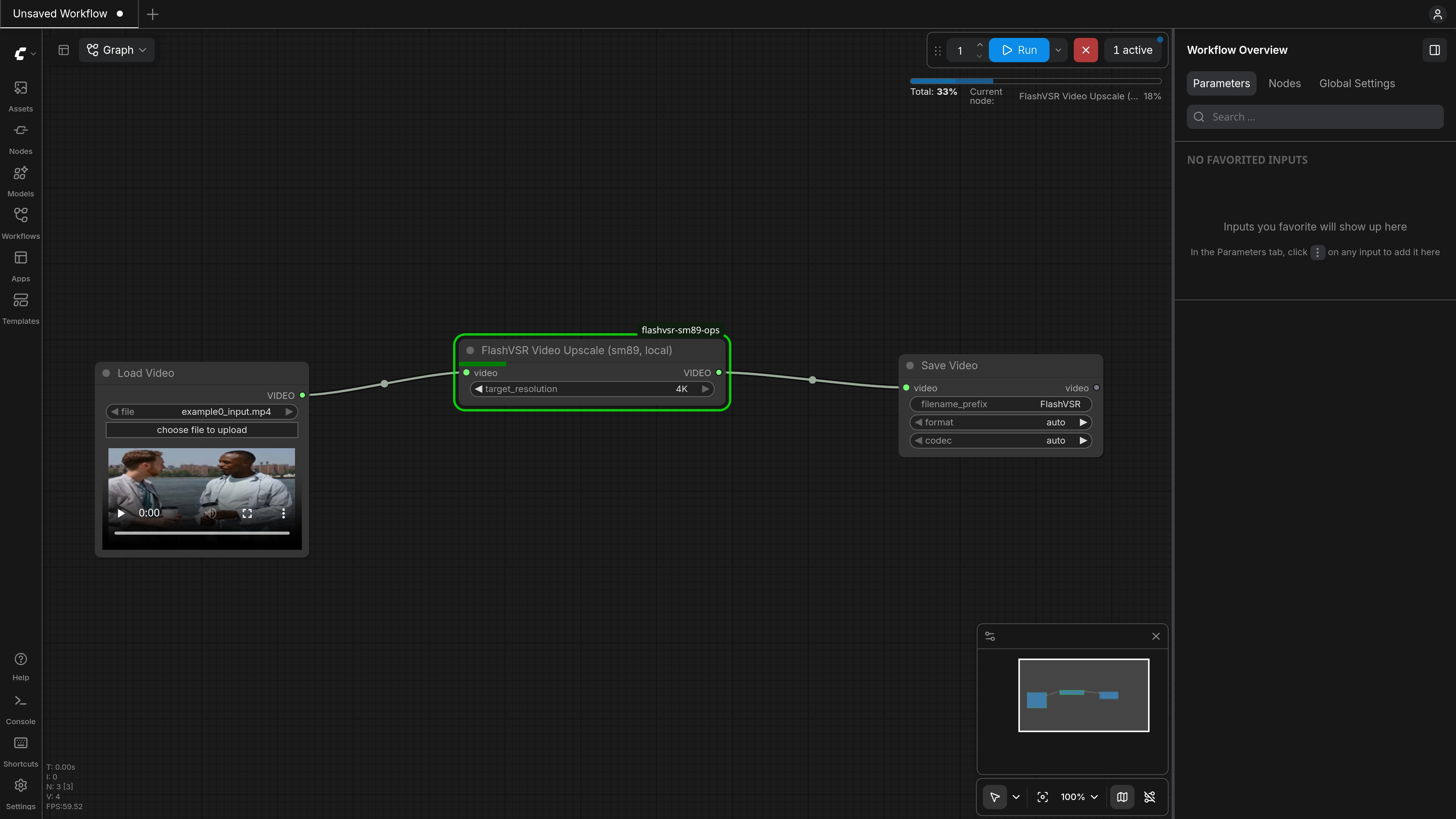 |
| 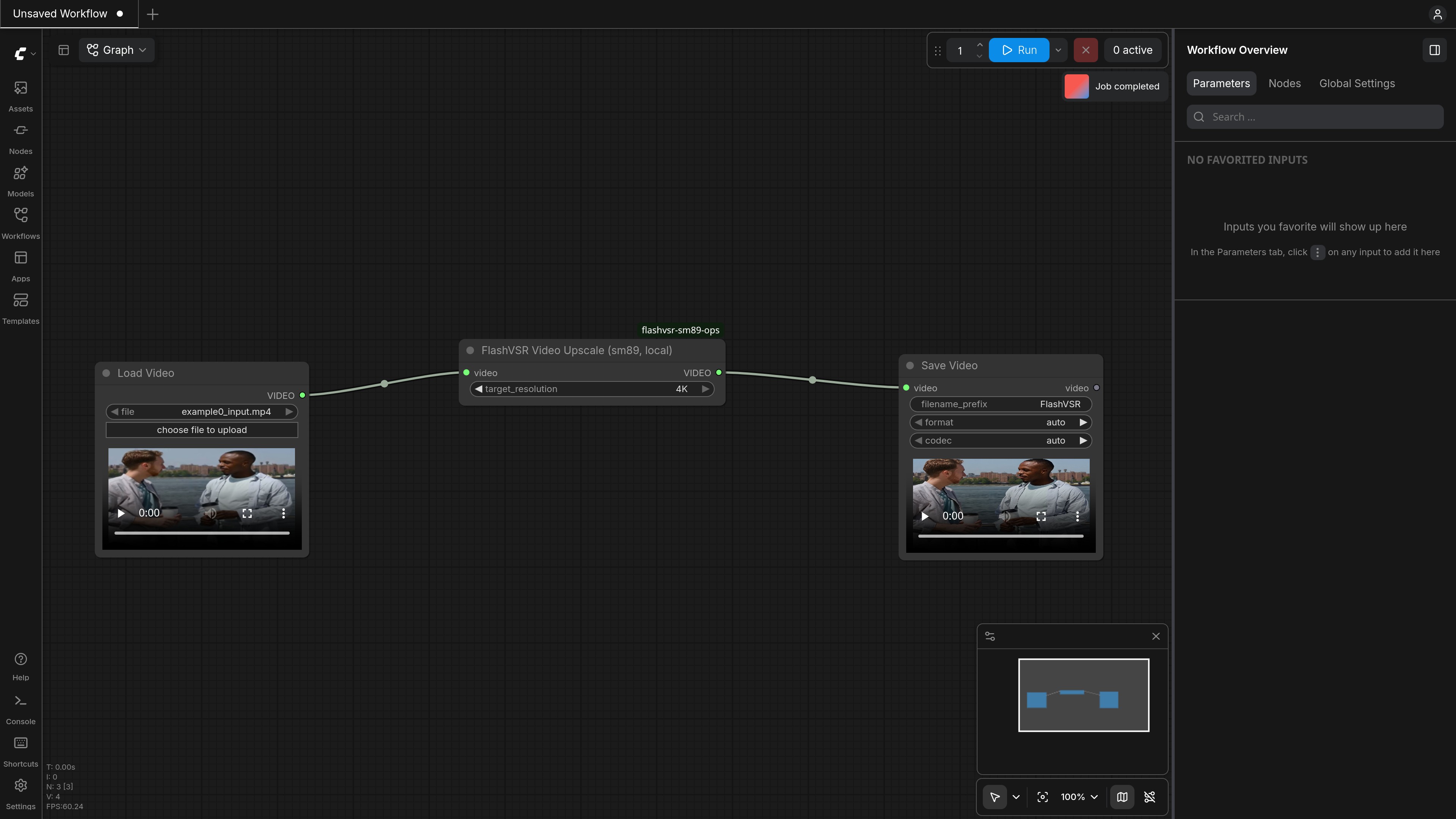 |
|
What the node does for you, automatically:
- Tiles anything over ~2.2 MP (128-px grid, 256-px blend overlap; how and why in
docs/tiling.md). Measured peaks for a ~3 s clip: 720p ≈ 9 GB · 1080p ≈ 19 GB · 2K ≈ 21 GB · 4K ≈ 20 GB — every bucket inside 24 GB. 1080p and below stay on the exact untiled path — and tile sizes shrink automatically to your free VRAM, so a 16 GB card tiles 1080p instead of OOMing. - Keeps the speed: the sm89 operators run inside every tile (measured 1.24× A/B; FP8 also cuts the tiled peak).
- Shows per-block progress in the UI while it runs (tiled renders keep counting across tiles on one bar — verified over WebSocket).
- Plays by ComfyUI's memory rules: before a run it checks free VRAM and frees models other nodes left on the GPU only when the card can't offer the ~22 GB a tile needs (on a roomy card upstream models stay resident and their next run is instant); after the run it parks its pipeline in CPU RAM — safe to chain after a video-generation node on the same card.
- Output snaps to the model's 128-px grid (16:9
1080p→ 1920×1024), keeps the frame rate, and carries audio through when the frame count is unchanged. Short clips are padded by holding the last frame (the streaming model consumes blocks of 8; output follows the8n+1rule). Split longer videos with the core Trim Video node.
COMFYUI_ROOT=/root/ComfyUI python comfyui/selftest.py <clip.mp4> drives the node end-to-end outside the server; python comfyui/test_tiling.py is the offline tile-math suite.
Quickstart (Python, no ComfyUI)
Three commands, no source edits. The reference runner mirrors the official example 1:1 (same input prep, same pipeline call, same output naming), auto-downloads weights (~6.5 GB, once, from HuggingFace) and prints per-clip timing:
git clone https://github.com/OpenImagingLab/FlashVSR
git clone https://github.com/aireet/flashvsr-sm89-ops
pip install ./flashvsr-sm89-ops

python flashvsr-sm89-ops/examples/run_flashvsr.py \
    --flashvsr-root "$(pwd)/FlashVSR" \
    --input "$(pwd)/my_video.mp4" \
    --out-dir "$(pwd)/results"
--input accepts a video file or a directory of frames (absolute or relative — both resolve against the directory you run from), and can be repeated for batches. Compare against the stock pipeline by adding --no-ops (same process, same weights). If weights are already in place at FlashVSR/examples/WanVSR/FlashVSR-v1.1/, add --no-download to skip the fetch. No clip handy? flashvsr-sm89-ops/assets/demo/example0_input.mp4 (352×192, the input of the timed workload below) works.
Or two lines in your own script — anywhere after enable_vram_management, before init_cross_kv():
import flashvsr_sm89_ops
flashvsr_sm89_ops.enable(pipe)     # FP8 linears + fused kernels + channels_last + Triton attention
Standalone use of any operator:
import torch
from flashvsr_sm89_ops import fused_ln_modulate, fused_gate_add, quantize_fp8

x = torch.randn(2, 4096, 1536, device="cuda", dtype=torch.bfloat16)
scale = torch.randn(2, 1536, device="cuda", dtype=torch.bfloat16)
shift = torch.randn(2, 1536, device="cuda", dtype=torch.bfloat16)

y = fused_ln_modulate(x, scale, shift)   # LayerNorm(x)*(1+scale)+shift — note the argument order
z = fused_gate_add(x, scale, x)          # x + gate * residual, bitwise-identical to eager
x8, s = quantize_fp8(x)                  # fused absmax + E4M3 cast, (fp8, per-tensor scale)
Tiled rendering is also available to direct callers — hand it your bicubic-×4 canvas, it handles the rest:
from flashvsr_sm89_ops import render_tiled

video = render_tiled(pipe, LQ_video, num_frames=F, height=H, width=W, ...)  # any canvas size
Integration details and env flags: docs/integration.md. The tiling contract: docs/tiling.md. Per-kernel API: docs/kernels.md. Reproducing every number: docs/benchmarks.md.
Results
Same machine, same session, A/B: official FlashVSR pipeline vs all operators enabled. RTX 4090 D, 1408×768 (the paper's 768×1408 workload), 1-step DMD, full videos. Raw data: benchmarks/headtohead_orig.json / headtohead_opt2.json.
| Clip | Frames | Baseline | Optimized | Δ | FPS (base → opt) | Peak VRAM (base → opt) | |---|---|---|---|---|---|---| | example0 | 89 | 7749 ms | 5952 ms | −23.2% | 11.49 → 14.96 | 13.1 → 11.3 GB | | example1 | 97 | 8468 ms | 6505 ms | −23.2% | 11.46 → 14.91 | 13.8 → 12.0 GB | | example2 | 97 | 8487 ms | 6537 ms | −23.0% | 11.43 → 14.84 | 13.9 → 12.0 GB | | example3 | 81 | 7066 ms | 5443 ms | −23.0% | 11.47 → 14.88 | 13.4 → 11.7 GB |
1.30× end-to-end, −1.9 GB peak VRAM. Quality gate vs official outputs: LPIPS 0.0108 / 0.0122 (threshold ≤ 0.05), PSNR 38.3 / 36.0 dB (benchmarks/quality_cmp.json). At 1920×1024 input (1080p-class) the pack holds −25.8% latency at 18.8 GB peak — comfortably inside a 24 GB card.
An independent re-run of the same methodology in fresh processes against the one-call integration (pristine upstream clone, no dev-venv crutches) reproduced it as 1.26–1.28× same-session (stock 11.45–11.49 FPS — identical to the published session; Triton attention backend 1.4% behind the CUDA one): benchmarks/pr2_harness_*.json, methodology in docs/benchmarks.md.
How 4K fits a 24 GB card
Measured VRAM model: ~1.9 GiB fixed + ~8.6 GiB per output megapixel (85-frame clip). A full 4K canvas asks for 44.8 GiB — that's the OOM. So above ~2.2 MP, render_tiled splits the canvas into overlapping strips of at most ~2.1 MP (the official 1080p workload's shape), runs the identical pipeline call once per tile, and blends with linear ramps that sum to exactly 1:
- every tile is an official-shape workload — the per-tile
topk_ratiois rescaled by canvas/tile area so the token budget lands on the same operating point; - the LQ canvas stays in CPU RAM and one tile's crop is uploaded at a time — no 4-GiB canvas parked on the GPU;
- seams sit inside a 256-px blend zone; measured seam-column error is below the frame's global maximum (no seam signature), and per-tile noise differs from an untiled run the way two seeds would;
- cost: ~+12% wall at 2K; the ops A/B shows the 1.24× speedup survives intact.
Full contract, tile-planner rules, and reproduction: docs/tiling.md, evidence in benchmarks/tiled_render.json + benchmarks/tiled_render_seam.png.

Demos — the official examples, original vs optimized
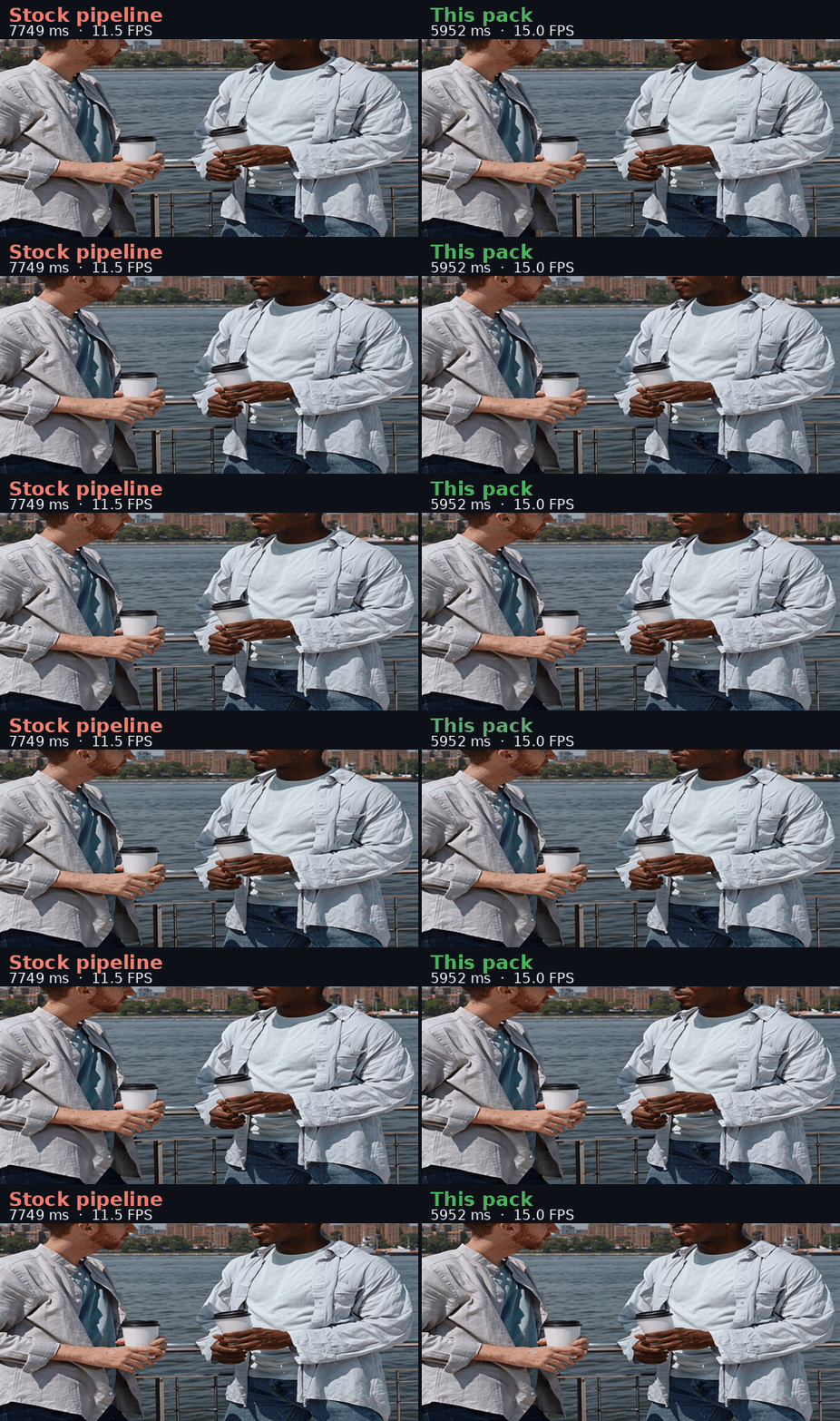
All four official example clips, rendered end-to-end on the same RTX 4090: the stock pipeline vs this pack (all operators on). Inputs are the official example videos pre-scaled to 352×192 (→ 1408×768 output, the timed workload).
Click any card to play the video (GitHub's built-in player).
| Case | Input | Stock pipeline (4090) ▶ | With this pack (4090) ▶ | |---|---|---|---| | example0 · 89F · 7749 → 5952 ms | <a href="assets/demo/example0_input.mp4"><img src="assets/demo/thumbs/example0_input.jpg" width="170" alt="input0"></a> | <a href="https://github.com/aireet/flashvsr-sm89-ops/blob/main/assets/demo/baseline/example0.mp4"><img src="assets/demo/thumbs/baseline_example0.jpg" width="270" alt="stock0"></a> | <a href="https://github.com/aireet/flashvsr-sm89-ops/blob/main/assets/demo/optimized/example0.mp4"><img src="assets/demo/thumbs/optimized_example0.jpg" width="270" alt="opt0"></a> | | example1 · 97F · 8468 → 6505 ms | <a href="assets/demo/example1_input.mp4"><img src="assets/demo/thumbs/example1_input.jpg" width="170" alt="input1"></a> | <a href="https://github.com/aireet/flashvsr-sm89-ops/blob/main/assets/demo/baseline/example1.mp4"><img src="assets/demo/thumbs/baseline_example1.jpg" width="270" alt="stock1"></a> | <a href="https://github.com/aireet/flashvsr-sm89-ops/blob/main/assets/demo/optimized/example1.mp4"><img src="assets/demo/thumbs/optimized_example1.jpg" width="270" alt="opt1"></a> | | example2 · 97F · 8487 → 6537 ms | <a href="assets/demo/example2_input.mp4"><img src="assets/demo/thumbs/example2_input.jpg" width="170" alt="input2"></a> | <a href="https://github.com/aireet/flashvsr-sm89-ops/blob/main/assets/demo/baseline/example2.mp4"><img src="assets/demo/thumbs/baseline_example2.jpg" width="270" alt="stock2"></a> | <a href="https://github.com/aireet/flashvsr-sm89-ops/blob/main/assets/demo/optimized/example2.mp4"><img src="assets/demo/thumbs/optimized_example2.jpg" width="270" alt="opt2"></a> | | example3 · 81F · 7066 → 5443 ms | <a href="assets/demo/example3_input.mp4"><img src="assets/demo/thumbs/example3_input.jpg" width="170" alt="input3"></a> | <a href="https://github.com/aireet/flashvsr-sm89-ops/blob/main/assets/demo/baseline/example3.mp4"><img src="assets/demo/thumbs/baseline_example3.jpg" width="270" alt="stock3"></a> | <a href="https://github.com/aireet/flashvsr-sm89-ops/blob/main/assets/demo/optimized/example3.mp4"><img src="assets/demo/thumbs/optimized_example3.jpg" width="270" alt="opt3"></a> |
Latency: stock → optimized (medians, −23%): 1.30× end-to-end, 11.5 → 15.0 FPS. Direct links: example0 · example1 · example2 · example3 (stock), same paths under assets/demo/optimized/ for the pack.
Visual quality between the two columns is gated: LPIPS ≤ 0.05 and PSNR ~36–38 dB against the stock outputs (benchmarks/quality_cmp.json). The rendered demo videos themselves: eval/demo_times_baseline.json / demo_times_optimized.json record the single-render wall times (6991/6482/6519/5422 ms optimized) and peak VRAM (13.3 → 11.2–11.5 GB).
Requirements
- GPU: RTX 4090 / 4090 D (sm_89). The FP8 path requires sm_89 tensor cores; the bf16 Triton kernels and the LCSA kernel run on anything sm_80+.
- Python ≥ 3.10, PyTorch ≥ 2.6, Triton ≥ 3.2. Newer stacks work too — the pipeline is verified end-to-end on torch 2.14 / triton 3.8 / transformers 5.17.
- A C compiler and your interpreter's dev headers for Triton's first-run JIT (Debian/Ubuntu:
apt install python3-dev; match the package to your Python version if you use a non-system interpreter). - A FlashVSR v1.1 checkout to import the pipeline from. No CUDA compilation of any kind — the mit-han-lab Block-Sparse-Attention extension is not needed; a Triton stand-in is installed automatically when it's absent. Other import-time landmines in upstream diffsynth (
modelscope, transformers-v5 renames) are defused by the pack as well.
What's inside
| Operator | Replaces | Measured (RTX 4090 D) | Data |
|---|---|---|---|
| fused_rms_rope | RMSNorm → RoPE (2 kernels + 4 elementwise passes) | 6.6–14× per instance (848 GB/s), ≈ −450 ms per full video | benchmarks/fused_rope_bench.json |
| fused_ln_modulate / fused_gate_add | LayerNorm+modulate / gate+add (5 eager kernels each) | 2.0–3.1× per instance; gate output bitwise-identical; ≈ −60 ms | benchmarks/fused_adaln_bench.json |
| FP8Linear (E4M3, per-tensor) | bf16 nn.Linear in DiT FFN/QKV/out-proj | GEMM 2.07× (M=18k) / 1.35–1.41× (M=55k), 276–292 TF on tensor cores | benchmarks/fp8_gemm_bench.json |
| FP8FFN (GELU→FP8 fusion) | FFN mid-section: GELU + separate quantize pass | bitwise-identical codes vs the two-pass chain; 1.12–1.16× chain, ≈ −235 ms | benchmarks/fp8_ffn_bench.json |
| TCDecoder channels_last (+ optional MemBlock torch.compile) | NCHW decoder convs | −16.7% decode, bitwise-identical; compile adds 1.06× (+0.95 GiB) | benchmarks/tcdec_bench.json |
| lcsa/ Triton block-sparse attention | official CUDA BSA kernel (sm_80 compat build) | parity: 104–116 vs 101–119 TF, max diff ≤ 1e-3, allclose; end-to-end within ~3% of the CUDA kernel | benchmarks/bsa_compare.json, benchmarks/quickstart_smoke.json |
The LCSA kernel is a validated drop-in alternative to the official CUDA kernel (which already runs at ~78% of achievable throughput on this chip), not the source of the speedup.
Correctness discipline
Every operator passed a three-level gate before integration:
- Op-level parity vs the eager reference — bitwise where reachable (
gate_add, GELU→FP8 codes, channels_last), else ≤ 1–2 bf16 ulp (fused norms). - Block-level A/B through a real
DiTBlock— catches wiring bugs op-level benches cannot. - End-to-end quality gate — full videos vs official outputs, LPIPS ≤ 0.05 and PSNR reported (
benchmarks/quality_cmp.json).
The tiling layer has its own suite: tile-coverage invariants over canvas sweeps, blending partition-of-unity, and an identity-render check against a fake pipeline (comfyui/test_tiling.py), plus the measured seam/PSNR evidence above.
FAQ
- Do I need to build Block-Sparse-Attention? No. Importing this pack installs a Triton stand-in for the
block_sparse_attnmodule when the real package is absent, so the FlashVSR DiT imports cleanly on a stock 4090. If you do have the CUDA extension installed it wins automatically (FS89_LCSA=auto, default);FS89_LCSA=triton|bsaforces either side. Measured end-to-end delta between the two: ~1.5–3% (benchmarks/quickstart_smoke.json). - Does tiling hurt quality or speed? Speed: ~+12% wall at 2K, and the ops A/B shows the 1.24× speedup retained on the tiled path (
benchmarks/tiled_ops_ab.json). Quality: the 256-px blend zone puts every seam in overlapping context; seam-column error measures below the frame's global maximum, and each tile runs at the official workload's operating point (docs/tiling.md). - First run fails with
fatal error: Python.h: No such file or directory? Your machine has no Python dev headers, which Triton needs to JIT-compile its kernel on first use (this is a Triton-wide requirement, not specific to this pack). Install the headers matching your interpreter — Debian/Ubuntu system Python:sudo apt install python3-dev; a non-system interpreter (e.g. 3.13):sudo apt install python3.13-dev. Then rerun; compilation happens once and is cached. - Why does the install pull in
ftfy? It's needed by the text-encoder path (upstream lists it in its own requirements but it's easy to miss — so this pack declares it). Similarly, diffsynth importsmodelscopeat import time but never calls it when loading the release weights locally; the pack stubs it and raises a clear error only if the downloader path is ever actually used. Details indocs/integration.md. - Which GPUs? FP8 paths need sm_89 tensor cores (RTX 4090 / 4090 D, L40, RTX 6000 Ada). The bf16 Triton kernels and LCSA run on anything sm_80+ (A100, 3090, …); on non-Ada cards convert with
parts=()and keep the fused norms + channels_last. In ComfyUI, tiles also auto-size to your free VRAM — a 16 GB card tiles 1080p into two strips instead of OOMing (seedocs/tiling.md). - Other resolutions / models? Numbers here are pinned to the 1408×768 / 1-step workload. The operators are shape-generic (per-tensor scales, no baked shapes); expect the FP8 GEMM gain to shift with the M dimension (see the M=18k vs M=55k rows). Tiling adapts to any canvas — see
docs/tiling.mdfor the planner rules. - Very short clips? The streaming loop needs
num_frames ≥ 25(upstream constraint:(F-1)//8 - 2iterations).examples/run_flashvsr.pyand the ComfyUI node hold the last frame until the minimum is reached. - Timing scope? Input prep (CPU bicubic ×4 + padding) is reported separately from
pipe()in the runner output — only thepipe()window is the comparable pipeline number. It is not free in the node, though: it now runs on a Pillow thread pool with fused conversions, 1.29 s vs the official example's 2.26 s for the same clip and canvas (6.1 s vs 17.2 s at 4K), which is what lifts the node end-to-end ratio to 1.34× (benchmarks/input_prep_ab.json,benchmarks/node_e2e_ab.json). Seetiming_scopeinbenchmarks/quickstart_smoke.json. Also: the first run on a machine is markedly slower — Triton JIT-compiles its kernels inside thepipe()window (measured on the demo clip: 9.5 FPS cold → 13.7 warm). Compilation is cached, so from the second run on you'll see the headline numbers, which are warm medians of the pinned 89-frame workload (methodology indocs/benchmarks.md). - Training? No — inference only; all converted params are frozen.
- Why isn't LCSA the speedup? The official CUDA BSA kernel already runs at ~78% of achievable throughput on this chip; the wins are in the elementwise/norm/linear paths.
Known limits
- Numbers are for the pinned 1408×768 / 1-step pipeline above; other resolutions shift the GEMM M-dimension and the FP8 speedups (see the M=18k vs M=55k rows).
- Tiled rendering trades ~+12% wall time (2K) for bounded VRAM; canvases ≤ 1080p keep the exact untiled path. VRAM still scales with clip length (peaks quoted for a ~3 s / 85-frame clip).
- A custom Triton FP8 GEMM measured 188–205 TF vs cuBLASLt's 204–300 TF —
torch._scaled_mmstays the backend. - CUDA Graphs: launch gaps are < 2% of wall for this pipeline; not worth the integration complexity.
- Conv rewrites (Winograd): full-res decoder convs sit at the memory-bandwidth wall; extra FLOPs buy nothing.
- Raw JSON in
benchmarks/.
Repository layout
| Path | What it is |
|---|---|
| flashvsr_sm89_ops/ | the operator pack (the pip package): kernels, the one-call enable() API, and render_tiled |
| examples/ | direct Python usage — the zero-patch runner and per-operator snippets |
| comfyui/ | the ComfyUI node pack (nodes.py, selftest, offline tiling tests, sample workflow); the root __init__.py is ComfyUI's entry point into it |
| benchmarks/, docs/ | the data behind every number above, and the integration/kernel/tiling contracts |
Acknowledgments & license
Built on FlashVSR (Wan2.1-1.3B, LCSA, TCDecoder), DiffSynth-Studio, and mit-han-lab/Block-Sparse-Attention. This pack is new code under Apache-2.0 (see LICENSE); upstream licenses govern the pipeline and model weights you run it with.