
ComfyUI MiniMax-H3 Video PixelHead (Experimental Preview)
[Experimental Preview - Not Recommended for Production] 3D video pixel readout head for MiniMax-H3 in ComfyUI
ComfyUI-MiniMaxH3-PixelHead (v0.2.0 Preview)
3D video direct pixel readout head for MiniMax-H3 in ComfyUI (45.7 MiB BF16 vs 2.68 GB stock ViT3D Video VAE).




[!WARNING] Not recommended for production use yet — please wait for upcoming optimizations.
This
v0.2.0checkpoint is published early as an experimental baseline and low-VRAM layout preview tool:
- Global colors, motion,
(1, 4, 4, 4, 4)non-uniform frame timing (17k + 5frames), and flat 2D graphics (36.73 dB) decode properly.- However, natural high-frequency textures (facial details, oil brushwork, foliage) and fast foreground occlusion (
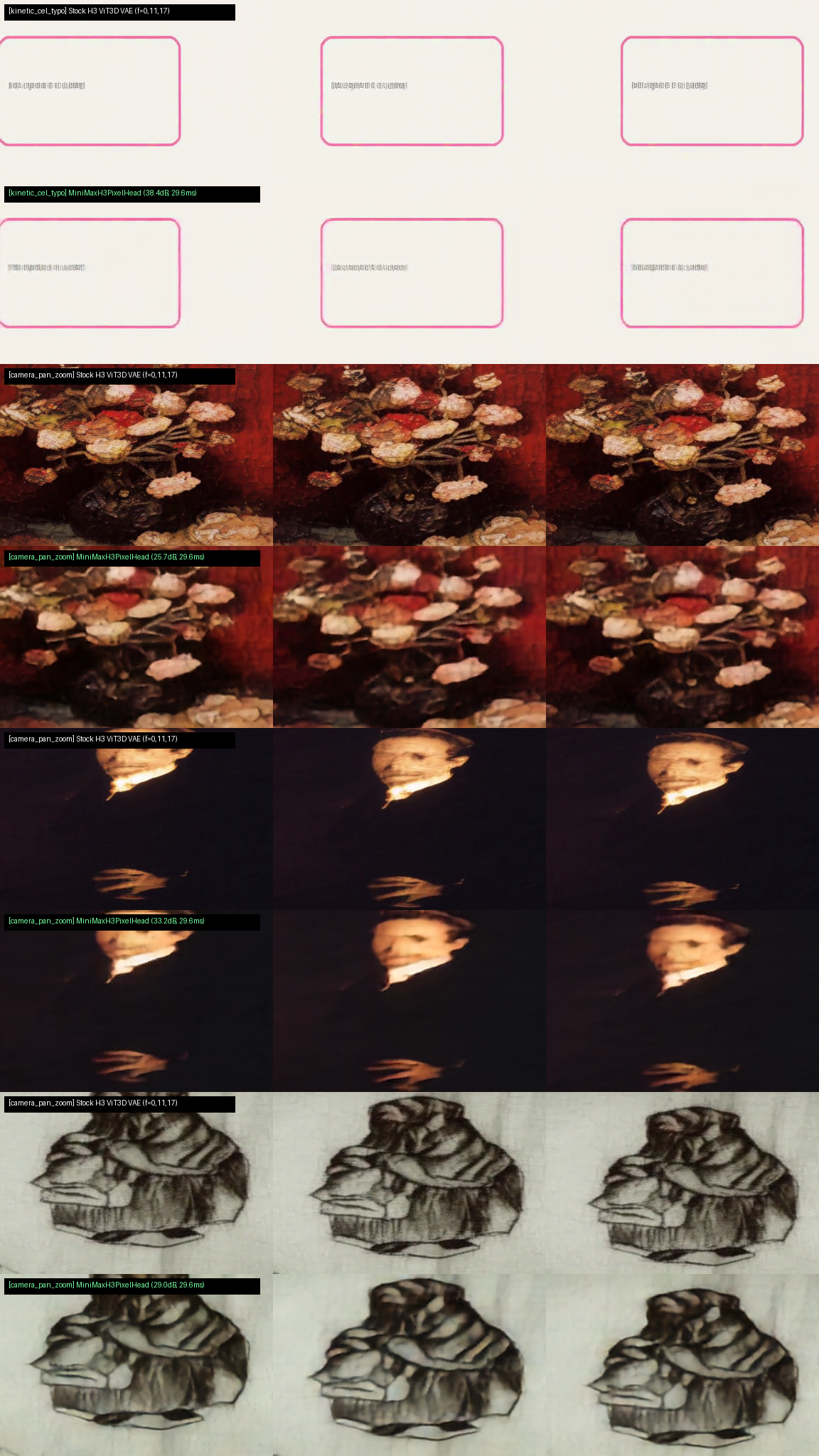
25.91 dB,LPIPS = 0.29–0.37) are noticeably over-smoothed compared to the official2.68 GB36-layer ViT3D Video VAE.- Do not use this version for final video renders. We are working on a follow-up update with perceptual LPIPS/frequency losses and native
16pxlatent injection.
Benchmark (384×256×22f, NVIDIA L4)
Tested on 20 held-out 22-frame clips (T_lat = 7, covering two (1, 4, 4, 4, 4) cycles; frames 0, 11, 17 shown below) against minimax_h3_video_vae_int8_convrot.safetensors:
| Video Decoder | Size | Median Latency | Speedup | Mean PSNR | Natural-Clip PSNR | LPIPS-VGG (↓) |
| :--- | :---: | :---: | :---: | :---: | :---: | :---: |
| Official minimax_h3_video_vae (ViT3D) | 2680.8 MiB | 251.30 ms | 1.0× | (ref) | (ref) | 0.0000 |
| MiniMaxH3VideoPixelHead (v0.2.0) | 45.7 MiB (BF16) / 91.4 MiB (FP32) | 29.59 ms | 8.5× | 31.03 dB | 25.91 – 30.13 dB | 0.2338 (0.29–0.37 natural) |
Breakdown by motion type:
| Subset | PSNR (↑) | LPIPS-VGG (↓) | Observation |
| :--- | :---: | :---: | :--- |
| kinetic_cel_typo (flat shapes & text) | 36.73 dB | 0.0547 | Clean edges; pulls the aggregate mean up to 31.03 dB. |
| camera_pan_zoom (art/photo pan & zoom) | 30.13 dB | 0.2923 | Overall structure matches, fine brushwork and facial details are soft (25.7–33.2 dB). |
| static_lockoff (static textures) | 29.17 dB | 0.3059 | No temporal flicker, softened surface grain. |
| parallax_occlusion (moving occlusion) | 25.91 dB | 0.3677 | Blur along fast occlusion boundaries. |
Known Issues
Four factors explain the current softness and are targeted for the next revision:
16×larger pixel volume per DiT token: 2D heads (Qwen-Image 2.1,Krea-2) reconstruct16×16 = 256pixels per token. MiniMax-H3 combines a16×spatial VAE with(1, 2, 2)DiT patching, so each token spans4 × 32 × 32 = 4,096pixels. The stock decoder uses a 36-layer2048-dim ViT3D, whereasv0.2.0uses a23.96M-parameter ConvNeXt (width = 768).- Pixel-space
MSEregression at high terminal noise ($\sigma_{\text{last}} = 0.6316$): Undervideo_shift = 12.0, 8-step sampling starts its last step at $\sigma = 0.6316$. Training with pixelL1 + MSE + gradientalone (without perceptual LPIPS) causes the small network to average out uncertain fine textures. - Latent injection resolution:
x0_hat_vid([B, 24, T_lat, H_lat, W_lat]) already sits on the16pxgrid, butv0.2.0folds it2×2into the32pxentry layer instead of feeding it into the16pxstage directly. - Calibration set size: Trained for
1,800rollouts on280clips at384×256(25%synthetic flat graphics).
Related Repositories
| Model | Status | ComfyUI Node | Weights | Notes |
| :--- | :---: | :--- | :--- | :--- |
| Qwen-Image 2.1 | Ready | Wither033/ComfyUI-QwenImage21-PixelHead | pocis/Qwen-Image-2.1-PixelHead | 48.8 MiB (1x) / 52.1 MiB (1x+2x), 4-ch RGBA, 5.55 ms (67.1×), 33.91 dB |
| Krea-2 | Ready | Wither033/ComfyUI-Krea2-PixelHead | pocis/Krea-2-PixelHead | 52.6 MiB BF16, 6144d bridged RGB, 59.55 ms (24.7×), 33.33 dB |
| MiniMax-H3 (this repo) | Preview | Wither033/ComfyUI-MiniMaxH3-PixelHead | pocis/MiniMax-H3-Video-PixelHead | Not recommended for production yet; 45.7 MiB BF16, 8.5× faster, soft fine detail |
| Training Code & Notes | Reference | Wither033/FastFrames-PixelHead-Trainer | HF Collection | Training toolkit, DiT hook notes, and Colab L4 scripts |
Installation (For Testing / Drafting Only)
- Clone into
ComfyUI/custom_nodes(orcomfy node install comfyui-minimaxh3-pixelhead):cd ComfyUI/custom_nodes git clone https://github.com/Wither033/ComfyUI-MiniMaxH3-PixelHead.git - Download
minimax_h3_video_pixel_head_bf16.safetensors(45.7 MiB) from pocis/MiniMax-H3-Video-PixelHead intoComfyUI/models/pixel_heads/. - Example workflows are in
example_workflows/. PlaceMiniMax-H3 Video Pixel Head TapafterMiniMaxH3SigmaShift, and connectMiniMax-H3 Video Pixel Decode (Zero Video VAE)toSamplerCustomAdvanced.
License & Credits
- License: MIT (clean-room PyTorch implementation).
- References: FastFrames (
arXiv:2611.23226) andsorryhyun/anima-pixel-decoder.