
ComfyUI Krea-2 PixelHead (Zero-VAE)
Bridged direct RGB pixel readout head for Krea-2 in ComfyUI (59.6 ms decode, 52.6 MiB BF16)
ComfyUI-Krea2-PixelHead
Bridged direct RGB pixel readout head for Krea-2 in ComfyUI, replacing the 242.0 MiB 3D-causal qwen_image_vae (WanVAE) decoder.



Following FastFrames (arXiv:2611.23226), this node hooks SingleStreamDiT's last.linear on the final sampling step to extract the 6144-dim modulated target-image tokens (stripping variable-length text and style-reference tokens) together with the denoised 2×2 latent patches (d_lat = 64), and decodes them to RGB with a 27.49M-parameter (52.6 MiB BF16) ConvNeXt + PixelShuffle head.
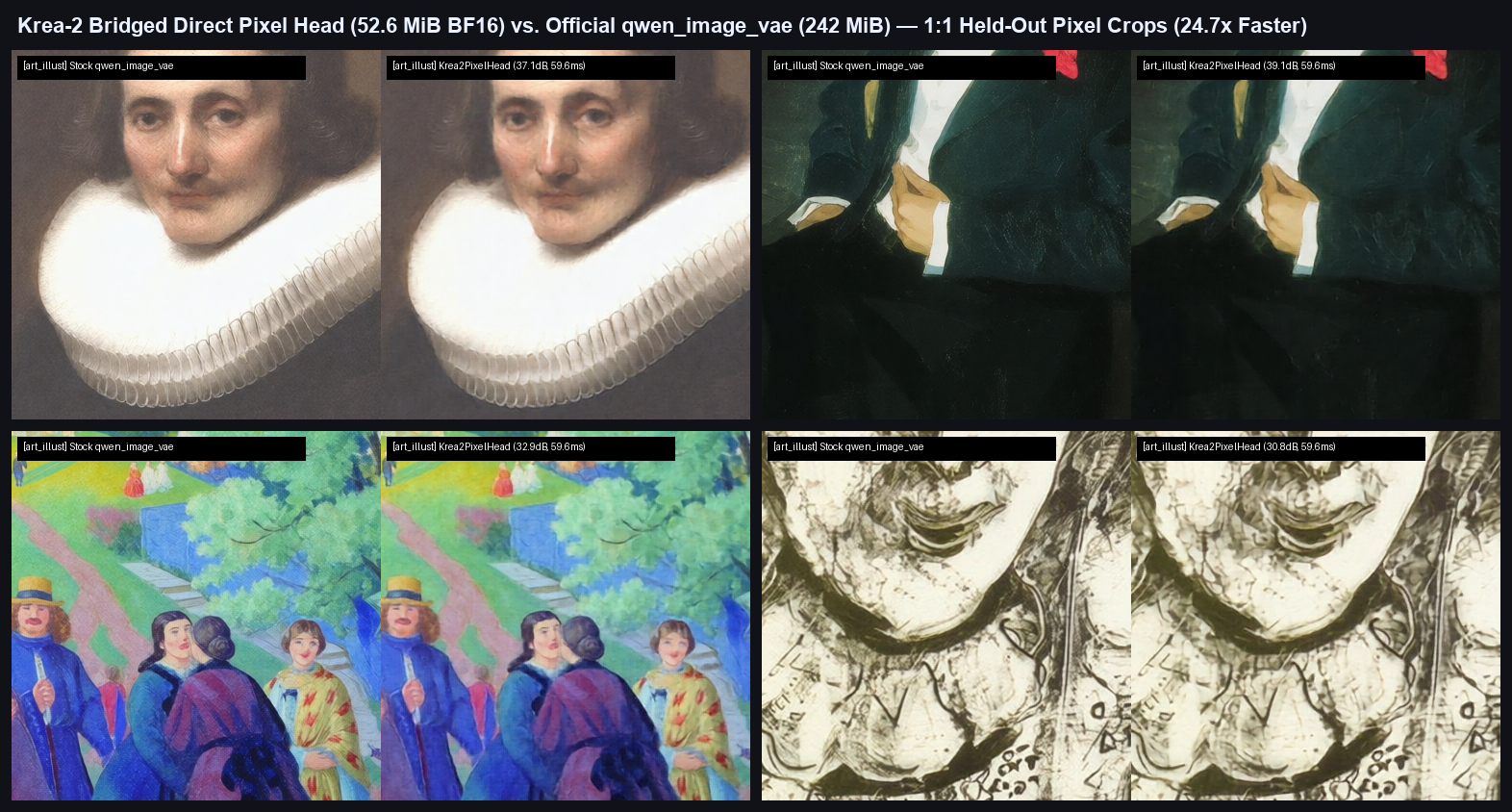
At 768×768 on an NVIDIA L4, median decode latency drops from 1468.9 ms (qwen_image_vae) to 59.55 ms (24.7×), with < 0.2 GB peak extra VRAM.
Features
24.7×faster decode, no VAE needed for T2I: Avoids running the 3D causal convolutions ofqwen_image_vaeand prevents end-of-sampling VRAM spikes at1024–2048px.6144 → 1024bridged readout: Uses a bias-free linear bridge (6144 → 1024) plusFP32output projection, preserving fine lace, brushwork, and dark tonal transitions withoutBF16banding.- Compatible across Krea-2 variants:
- Works with
krea2_turbo(8 steps,CFG = 1.0,shift = 1.15),krea2_raw(20–35 steps,CFG > 1.0), FP8/INT8/GGUF quantizations, and fine-tunes. - Supports both Text-to-Image and Style/Reference image conditioning (
tap.pycomputestxtlenandref_tokensdynamically to slice only the target image tokens).
- Works with
Benchmark (768×768 Held-Out Fine-Art Split, NVIDIA L4)
Evaluated against qwen_image_vae.safetensors (Comfy-Org/Krea-2) across 40 held-out paintings and engravings (alternating 8-step Turbo $\sigma = 0.3109$ and multi-step $\sigma = 0.1163$):
| Decoder | Size | Median Latency | Speedup | PSNR (↑) | LPIPS-VGG (↓) |
| :--- | :---: | :---: | :---: | :---: | :---: |
| Official qwen_image_vae | 242.0 MiB | 1468.90 ms | 1.0× | (ref) | 0.0000 |
| Krea2PixelHead | 52.6 MiB (BF16) / 104.9 MiB (FP32) | 59.55 ms | 24.7× | 33.33 dB | 0.2300 |
- Classical & low-key portraits:
37.1 – 41.6 dBPSNR - Multi-subject color illustration:
32.9 – 33.5 dBPSNR - Fine copperplate etchings:
30.8 dBPSNR
Related Repositories
| Model | ComfyUI Node | Weights | Notes |
| :--- | :--- | :--- | :--- |
| Krea-2 (this repo) | Wither033/ComfyUI-Krea2-PixelHead | pocis/Krea-2-PixelHead | 52.6 MiB BF16, 6144d bridged RGB, 59.55 ms (24.7×), 33.33 dB |
| Qwen-Image 2.1 | Wither033/ComfyUI-QwenImage21-PixelHead | pocis/Qwen-Image-2.1-PixelHead | 48.8 MiB (1x) / 52.1 MiB (1x+2x), 4-ch RGBA, 5.55 ms (67.1×), 33.91 dB |
| MiniMax-H3 (preview) | Wither033/ComfyUI-MiniMaxH3-PixelHead | pocis/MiniMax-H3-Video-PixelHead | Experimental preview (not recommended for production yet; high-frequency textures are soft) |
| Training Code & Notes | Wither033/FastFrames-PixelHead-Trainer | HF Collection | Training toolkit, DiT hook notes, and Colab L4 scripts |
Installation
1. Custom Node
Install via ComfyUI Manager (ComfyUI-Krea2-PixelHead), comfy node install comfyui-krea2-pixelhead, or git clone:
cd ComfyUI/custom_nodes
git clone https://github.com/Wither033/ComfyUI-Krea2-PixelHead.git
2. Weights
Download from pocis/Krea-2-PixelHead into ComfyUI/models/pixel_heads/ (or ComfyUI/models/vae/):
krea2_pixel_head_bf16.safetensors(52.6 MiB): recommended, BF16 trunk + FP32 output layer.krea2_pixel_head.safetensors(104.9 MiB): full FP32 checkpoint.
Usage
Example workflows are in example_workflows/:
[Load Diffusion Model (Krea-2)] ──► [Krea-2 Pixel Head Tap]
                                         │            │
                                    MODEL│            │pixel_tap
                                         ▼            │
                                    [KSampler]        │
                                         │LATENT      │
                                         ▼            ▼
            [Load Krea-2 Pixel Head] ──► [Krea-2 Pixel Decode (Zero VAE)] ──► IMAGE
Pure Text-to-Image requires no VAE. When using style/reference images, keep the VAE connected only to encode the reference input image, and use Krea-2 Pixel Decode (Zero VAE) after KSampler.
Limitations
- Step range: Trained across
ModelSamplingFlux(shift=1.15)final-step $\sigma \in [0.045, 0.420]$ (5–12 step Turbo and 18–35 step Raw). - Offline
.latentfiles: Requires live6144-dim DiT features from the final denoising step; cannot decode standalone.latentfiles without running the DiT. - Sub-pixel chaotic splatter: On dense ink-splatter abstractions, sub-pixel grain is slightly softer than
qwen_image_vae.
License & Credits
- License: MIT (clean-room PyTorch implementation).
- References: Direct pixel readout formulation from FastFrames: Video Generation at Interactive Latency (Apple Research, 2026); 2D feature readout and ComfyUI hook design informed by
sorryhyun/anima-pixel-decoder.