
Nunchaku (ROCm)
Run Nunchaku 4-bit SVDQuant models on AMD Radeon and Instinct GPUs (ROCm): up to 3.6x faster than stock ComfyUI on a 16 GB RX 7800 XT. Supported models: FLUX.2 [klein] 4B and 9B, FLUX.1-schnell, dev, Krea and Kontext, Qwen-Image, Qwen-Image Lightning and Qwen-Image-Edit, Z-Image-Turbo, SDXL and SDXL-Turbo. Includes a LoRA loader for all of them, including speed LoRAs (LCM, Qwen-Image Lightning). Needs nunchaku-rocm.
ComfyUI-nunchaku-rocm
ComfyUI nodes that run Nunchaku 4-bit SVDQuant models on AMD GPUs, on nunchaku-rocm (Triton kernels, plus native int4 kernels on RDNA3): FLUX.1, FLUX.2 [klein], Qwen-Image, Z-Image-Turbo and SDXL.
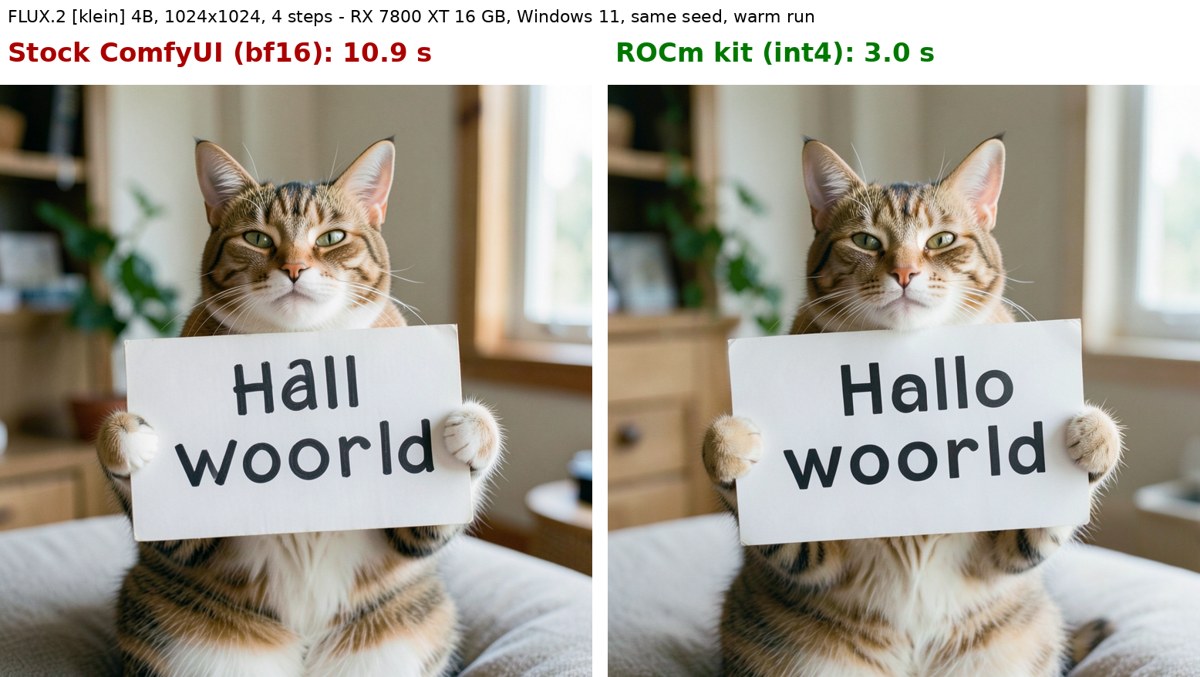
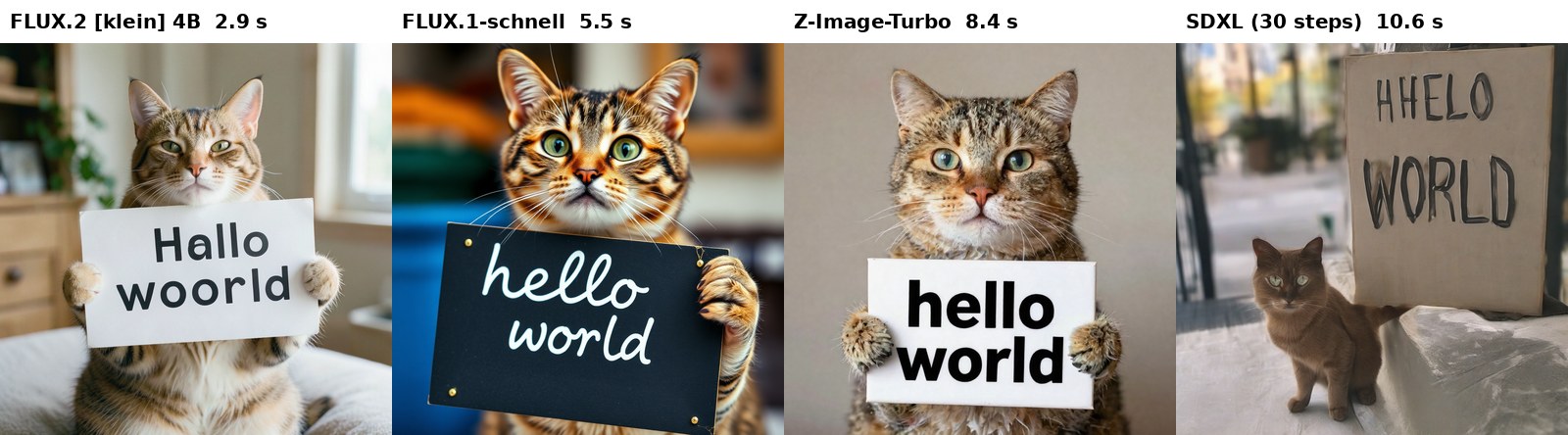
Only the diffusion model is replaced. Text encoders, VAE, sampler and scheduler are ComfyUI's own nodes, so the usual workflows apply with one node swapped.
| Workflow (1024², warm) | RX 7800 XT 16 GB, Windows 11 | | --- | --- | | FLUX.2 [klein] 4B, 4 steps | 2.9 s | | FLUX.1-schnell, 4 steps | 5.5-5.7 s | | Z-Image-Turbo, 8 steps | 8.4-8.5 s | | Qwen-Image Lightning, 8 steps | 11.6 s | | SDXL, 30 steps | 10.6-10.7 s |
Measurements, VRAM notes and accuracy checks against ComfyUI's bf16 models are in nunchaku-rocm's ComfyUI notes.
Nodes
Category Nunchaku (ROCm):
- Nunchaku DiT Loader (ROCm) loads a Nunchaku checkpoint from
models/diffusion_modelsas aMODEL. The model type is read from the checkpoint. Qwen-Image only:cpu_offload(auto/enable/disable) streams the transformer blocks from CPU memory, on by default below 20 GiB of VRAM;num_blocks_on_gpukeeps more blocks resident. - Nunchaku LoRA Loader (ROCm) adds a LoRA to any of these models (chain several for more). ComfyUI's own LoraLoader cannot reach the 4-bit layers. See LoRA.
Install
You need ComfyUI running on a ROCm PyTorch, e.g. ComfyUI's Windows portable for AMD GPUs or a Linux install with ROCm PyTorch.
-
Install this node pack with ComfyUI Manager (search for "nunchaku rocm"), or clone it into
ComfyUI/custom_nodesand run itsinstall.pywith ComfyUI's Python (python_embeded\python.exe install.pyon the Windows portable):git clone https://github.com/TwelveNights/ComfyUI-nunchaku-rocm.gitinstall.py(Manager runs it for you) installs nunchaku-rocm from PyPI with your installedtorch/torchvision/torchaudio/ ROCm packages pinned, so it never replaces your PyTorch. On Windows it also addstriton-windows, the ROCm SDK devel package matching your ROCm wheels, and the Pythoninclude/libsfolders the portable build leaves out (Triton compiles against them). It does nothing unless PyTorch is a ROCm build. -
Restart ComfyUI and open a workflow from
example_workflows.
The first image of each model compiles and autotunes kernels and can take a minute or two; later runs use the cache.
Tested from scratch on ComfyUI 0.45's Windows portable for AMD GPUs (PyTorch 2.9.1, ROCm 7.2.1, RX 7800 XT; installed
through ComfyUI-Manager, then as fast as a hand-built install) and on Linux (PyTorch 2.10 for ROCm 7.0, MI300X). With
other ROCm versions on Windows, install the matching ROCm SDK devel wheel yourself (install.py says so), or follow
nunchaku-rocm's install guide.
Models
Use the int4 checkpoints: AMD GPUs have no FP4 matrix units, so NVFP4 files run on a slower emulated path.
| Model | Checkpoint (models/diffusion_models) | Text encoder(s) (models/text_encoders) | VAE (models/vae) |
| --- | --- | --- | --- |
| FLUX.2 [klein] 4B | tonera/FLUX.2-klein-4B-Nunchaku: svdq-int4_r32-… | qwen_3_4b.safetensors (type flux2) | flux2-vae.safetensors |
| FLUX.2 [klein] 9B | tonera/FLUX.2-klein-9B-Nunchaku: svdq-int4_r32-… | qwen_3_8b_fp8mixed.safetensors (type flux2) | flux2-vae.safetensors |
| FLUX.1-schnell / dev / Krea / Kontext | nunchaku-ai/nunchaku-flux.1-schnell (or -dev, -krea-dev, -kontext-dev): svdq-int4_r32-… | clip_l + t5xxl_fp16 (DualCLIPLoader, type flux) | ae.safetensors |
| Qwen-Image, Lightning | nunchaku-ai/nunchaku-qwen-image: svdq-int4_r32-qwen-image… | qwen_2.5_vl_7b_fp8_scaled.safetensors (type qwen_image) | qwen_image_vae.safetensors |
| Qwen-Image-Edit, Edit-2509 | nunchaku-ai/nunchaku-qwen-image-edit (or -edit-2509): svdq-int4_r32-… | qwen_2.5_vl_7b_fp8_scaled.safetensors (type qwen_image) | qwen_image_vae.safetensors |
| Z-Image-Turbo | nunchaku-ai/nunchaku-z-image-turbo: svdq-int4_r32-z-image-turbo | qwen_3_4b.safetensors (type lumina2) | ae.safetensors |
| SDXL, SDXL-Turbo | nunchaku-ai/nunchaku-sdxl, nunchaku-ai/nunchaku-sdxl-turbo | clip_l + clip_g (DualCLIPLoader, type sdxl) | sdxl_vae.safetensors |
Qwen-Image-Edit works with ComfyUI's usual edit nodes (TextEncodeQwenImageEditPlus / ReferenceLatent).
Not supported yet: ControlNet, Z-Image's reference inputs, the index_timestep_zero reference method
(Qwen-Image-Edit-2511), and model-patching nodes that replace transformer blocks or attention (ignored with a
warning).
LoRA
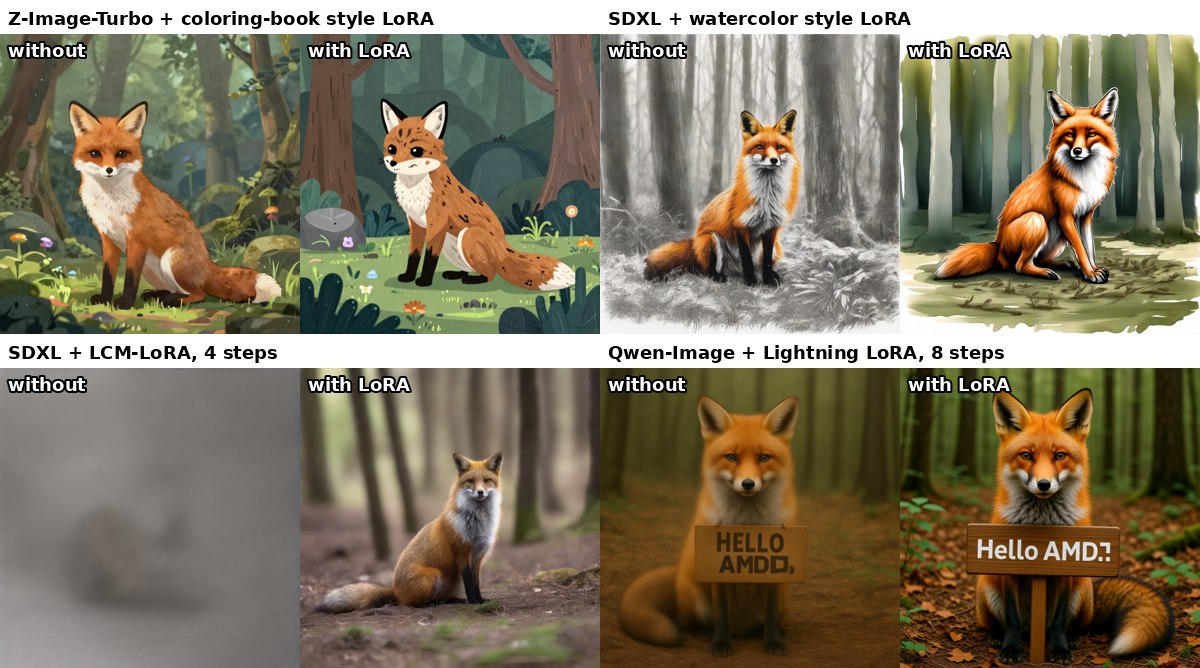
Put LoRAs in models/loras and add Nunchaku LoRA Loader (ROCm) between the DiT loader and the sampler; chain one
per LoRA. It reads ComfyUI, kohya (lora_unet_...) and diffusers / PEFT LoRA files for FLUX.1, FLUX.2 [klein],
Z-Image, Qwen-Image (with or without CPU offload) and SDXL, including SDXL convolution (LoCon) LoRAs such as
LCM-LoRA. Text-encoder weights in a LoRA file are ignored.
On the 4-bit layers the LoRA is added to their 16-bit low-rank branch, so it costs no extra kernels. Switching LoRAs or strengths between runs re-applies them in a fraction of a second, and workflow branches with and without LoRAs share one loaded model.
Checked against ComfyUI's own LoRA loading on the bf16 models (same seed): the images above match the bf16 + LoRA results in style and composition. The model is quantized to 4 bits, so a LoRA's effect is close to, not identical with, its effect on the full-precision model; very subtle LoRAs are the least precise.
License
Apache License 2.0, like Nunchaku and nunchaku-rocm.