
EasyLoRAMerger
A versatile LoRA merger for Flux (4B/9B/Dev), Z-Image, and SDXL. Features cross-architecture scaling, weight normalization, and live model baking.
Nodes (10)
Merge Two Checkpoints Without Summoning a Tensor-Math PhD
Stitch UNet + CLIP + VAE Back Into One Checkpoint
Grab the VAE, the Text Encoder, or Just the UNet
Merge Just the CLIPs, or Just the UNets, of Two Checkpoints
Have the Before and After? Get the LoRA Out of It
Merge Up to Three LoRAs in One Go
Read Your Forensic Reports Without Scrolling the Console
Shrink to FP8, Strip the VAE, or Ship a GGUF
Your LoRA Speaks a Different Trainer Dialect. This Node Translates.
Bake It Straight Into the Checkpoint
🛠️ Easy LoRA Merger Suite
Complexity Made Simple — Merge Anything
The Easy LoRA Merger Suite gives you a complete toolkit to merge, convert, extract, bake, and audit LoRAs and checkpoints — without worrying about tensor dimensions, sparsity mismatches, or arcane scaling math.
Every node is built with the same philosophy: powerful defaults when you need simplicity, full control when you need precision.
🔍 All Nodes at a Glance
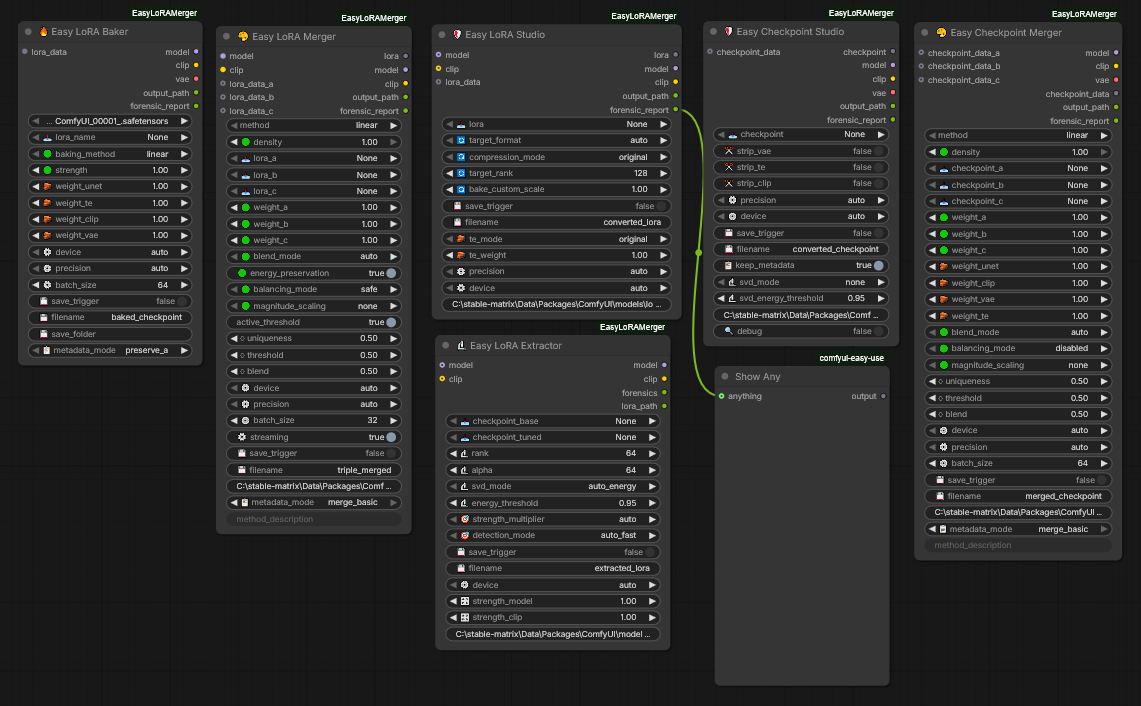
The complete node suite — drag, connect, and merge.
📦 Node Catalog
| Node | Display Name | Purpose | |------|-------------|---------| | 🎨 | Easy LoRA Merger | Merge 2–3 LoRAs with 15+ methods, auto‑format detection, smart defaults, and forensic reports. The core workhorse. | | 🛡️ | Easy LoRA Studio | Universal LoRA analyzer and converter. Transforms between Standard WebUI, Comfy Native, and Forge‑Optimized formats. SVD compression, TE scaling, weight adjustment. | | 🛡️ | Easy Checkpoint Studio | Precision surgery for full checkpoints — precision casting FP8/BF16/FP32, component stripping VAE/TE/CLIP, SVD compression, and structural remapping. | | 🎨 | Easy Checkpoint Merger | Merge 2–3 full model checkpoints with Weight Block Map component‑wise scaling. Streaming engine for low RAM usage. | | 🔬 | Easy LoRA Extractor | Extract a LoRA from the delta between a base and fine‑tuned checkpoint. SVD decomposition with auto‑energy rank selection. | | 🔧 | Easy Component Extractor | Split a checkpoint into its building blocks — extract UNet, CLIP, or VAE as separate files with precision control. | | 🧩 | Easy Component Combiner | Reassemble extracted UNet + CLIP + VAE components back into a single full checkpoint. | | 🧩 | Easy Component Merger | Merge 2–3 component state dicts (e.g., two different CLIP sets or UNets) using the full merge method suite. | | 🔥 | Easy LoRA Baker | Bake a LoRA (or merged LoRA) directly into a full checkpoint at the tensor level. Produces MODEL+CLIP+VAE with RAM Guard fallback. |
🎯 Merge Methods
| Method | Best for | Works on Checkpoints? | |--------|----------|:---------------------:| | linear | Simple weighted average — the safe starting point for any merge | ✅ Yes | | cross | Blending with a cross‑magnitude interaction term for richer mixes | ✅ Yes | | ties_strict | Conflicting styles — only keeps weights where both sources agree | ⚠️ Limited (all-positive weights reduce effect) | | ties_gentle | Softer version of TIES — applies only to strong disagreements | ⚠️ Limited (all-positive weights reduce effect) | | ties_contrast | Amplify differences between two sources, mute agreements | ⚠️ Limited (best on LoRA deltas) | | dare_lite | Random dropout — creates sparse, stochastic blends | ❌ LoRA only (risky on checkpoint weights) | | dare_rescale | Random dropout with rescaling — preserves magnitude distribution | ❌ LoRA only (risky on checkpoint weights) | | magnitude | Keep the stronger signal per-element from either source | ✅ Yes | | subtract | Remove unwanted features by subtracting one source from another | ✅ Yes | | feature_mix | Preserve unique features from each source — great for style + character | ✅ Yes | | slerp | Smooth spherical interpolation between two vectors | ✅ Yes (2‑way only) | | svd_preserve | SVD‑based rank reduction — keeps core structure while reducing noise | ✅ Yes | | block_swap | Swap blocks between sources using a seeded random pattern | ✅ Yes | | noise_aware | Suppress small noise values before merging for cleaner results | ✅ Yes | | gradient_alignment | Weight contributions by directional similarity between sources | ✅ Yes |
💡 Tip: When in doubt, start with
linearormagnitude— they're the most versatile and work well across LoRAs and checkpoints alike.
🧠 Smart Diagnostics
Every merge node outputs a detailed forensic report with:
- ✅ Alignment verification — cross‑architecture key matching stats
- 📊 Layer‑by‑layer statistics — energy distribution, sparsity, component breakdown
- ⚠️ Clear warnings — mismatched trainers, conflicting trigger words, density risks
- 🔍 Sparsity + scaling reports — magnitude distribution per layer
Console output keeps you informed at every step without overwhelming.
🏗️ Supported Architectures (aspirational — not all fully tested)
| Architecture | Status | |-------------|--------| | Flux.1‑Dev / Flux.1‑S | Tested | | Flux Klein 4B / 9B | Tested | | Z‑Image Turbo / Base | Tested | | SDXL | Tested | | SD1.5 | Tested | | Anima | Early support | | Lumina 2 | Early support | | SD3 | Experimental |
🚀 Get Started
- Download: github.com/Terpentinas/EasyLoRAMerger
- Install: Drop into
ComfyUI/custom_nodes/and restart ComfyUI. - Explore: Drag
assets/nodes.pnginto the workflow area to see the suite in action. - Experiment: Connect a Easy LoRA Merger → Easy LoRA Baker pipeline, or use Easy Checkpoint Studio to shrink a 12GB checkpoint to FP8.
- Optional — GGUF export: Install
pip install ggufto enable GGUF output format in Easy Checkpoint Studio. GGUF files are loaded with the ComfyUI-GGUF custom node. All other Easy LoRA Merger nodes work without either dependency. - Feedback: Open an issue on GitHub — contributions and ideas welcome.

⚙️ Precision Options
Different nodes expose different precision tiers depending on their capabilities:
Standard Tier — all float formats
Used by: Easy LoRA Merger, Easy LoRA Studio
| Option | Behavior |
|--------|----------|
| auto | Auto-select — defaults to BF16 on supported GPUs |
| float32 | Full precision, 4 bytes/param — maximum quality |
| bfloat16 | Half precision, 2 bytes/param — good balance |
| float16 | Half precision, 2 bytes/param — good balance |
Extended Tier — adds FP8 support
Used by: Easy Checkpoint Merger, Easy Component Extractor, Easy Component Combiner, Easy Component Merger, Easy LoRA Baker
| Option | Behavior |
|--------|----------|
| (all Standard options above) | |
| fp8_e4m3fn | FP8 quantization, 1 byte/param — memory efficient |
| fp8_e5m2 | FP8 quantization (wider range) — memory efficient |
Studio Tier — full conversion toolkit
Used by: Easy Checkpoint Studio
| Option | Behavior |
|--------|----------|
| (all Extended options above) | |
| int8 | Explicit INT8 quantization, 1 byte/param |
| int8_convrot | INT8 with convolution rotation handling |
| svd_only | SVD compression only, no dtype conversion |
| gguf_q8_0 / gguf_q5_0 / gguf_q4_0 | Block‑wise GGUF quantization — requires gguf Python package (pip install gguf). Output loads with ComfyUI-GGUF nodes. |
💡 Tip: For everyday use, just leave it on
auto. The nodes will pick the best format for your hardware automatically.⚠️ Note: The
ggufpackage is optional. All nodes work without it — GGUF output is only available in Easy Checkpoint Studio whenggufis installed. If missing, GGUF options are hidden from the dropdown and the Checkpoint Studio loads gracefully without them.
📐 Design Philosophy
The suite is engineered for stability and SSD-friendly operation:
- No unnecessary disk writes — intermediate data stays in RAM. Temp files are created only when RAM Guard activates or
save_trigger=True. - Clean resource management — file handles from checkpoint loading are closed immediately after model objects are constructed, preventing stale handles from causing I/O during garbage collection.
- Predictable performance — no background cleanup threads. All file I/O is explicit and happens at known points in the pipeline.
- Memory-efficient streaming — large checkpoints are processed in configurable batch sizes, keeping peak RAM usage under control.
💾 Saving Your Merged Models
Every node with save capability exposes three controls: save_trigger, save_folder, and filename.
How save_trigger Works
| Toggle | Behavior |
|--------|----------|
| False (default) | Preview mode — merge runs, MODEL+CLIP+VAE outputs are returned for testing, but no file is written to disk. |
| True | Save mode — result is written to a .safetensors file, then loaded from that file (or RAM) for downstream use. |
💡 Start with
save_trigger=Falseto test your merge settings. Toggle it toTrueonly when you're happy with the result.
Save Locations
- Checkpoint nodes (Checkpoint Merger, Baker) →
ComfyUI/models/checkpoints/ - LoRA nodes (LoRA Merger, LoRA Studio) →
ComfyUI/models/loras/
You can override the location with save_folder:
| save_folder value | Example | Where it saves |
|--------------------|---------|---------------|
| Empty | "" | ComfyUI default folder |
| Relative path | "my_merges" | default/my_merges/merged.safetensors |
| Absolute path | "D:\\ModelMerges" | D:/ModelMerges/merged.safetensors |
Filename & Auto-Increment
The filename parameter sets the output name (.safetensors is appended automatically).
If a file with that name already exists, most nodes auto-increment:
merged_checkpoint→merged_checkpoint_1→merged_checkpoint_2...triple_merged→triple_merged_1→triple_merged_2...
ℹ️ Studio & Converter nodes (Checkpoint Studio, LoRA Studio) add
_convertedbefore the extension:name_converted.safetensors,name_converted_1.safetensors.
⚖️ Weight Guidance
The global weights (weight_a, weight_b, weight_c) multiply with component weights (weight_unet, weight_clip, weight_vae, weight_te) to determine the effective strength per component.
Key Insight: Checkpoints vs LoRAs
| Type | What the weights multiply | Guidance |
|------|--------------------------|----------|
| Checkpoints | Absolute weight values (large, ~1.0 scale) | For linear: weights should sum close to 1.0 (e.g., 0.5 + 0.5, 0.7 + 0.3). With 1.0 + 1.0 the output becomes A + B — doubling magnitudes, resulting in noise. |
| LoRAs | Small delta values (≈1e‑3 scale) | Weights are independent — feel free to experiment. LoRAs are fast to iterate on. |
General Approach
- Start with equal weights —
0.5 + 0.5for checkpoints,1.0 + 1.0for LoRAs. - Use
save_trigger=False(preview mode) to test without cluttering your disk. - Adjust one weight at a time — small increments (0.05–0.1) and see how the output changes.
- Different architectures (Flux, SDXL, SD1.5, Z‑Image) may respond differently to the same weights — trust your eyes.
Per-Method Notes
| Method | Weight behavior |
|--------|---------------|
| linear | Direct weighted sum. For checkpoints: result = A×wa + B×wb — sum should be ≈1.0. For LoRAs: any values work. |
| feature_mix | Preserves unique features per-element. 1.0 + 1.0 is fine — not additive. |
| magnitude | Takes the larger signal per-element from either source. 1.0 + 1.0 is fine. |
| slerp | Uses \|weight\| as interpolation factor. Sign is discarded. |
| subtract | wa controls source strength, wb controls how much of B to remove. |
| ties_* | Sign-based. Limited effect on all-positive checkpoint weights. |
| dare_* | Uses density for sparsification, not weight sum. Risky on checkpoints. |
💡 The best weights depend on your models and goal. These are starting points, not rules. The suite is designed for exploration — iterate and find what works for your specific combination.
Built because merging different model formats shouldn't require a PhD in tensor math. 💪