
ComfyUI Quantization Toolkit
Quantization toolkit for ComfyUI with native W4A4, W4A8, and W8A8 conversion, mixed-precision loading, LoRA handling, and low-VRAM runtime controls.
Nodes (10)
Manual Triton tuning for the last few percent
Torch.compile that actually plays nice with quantization
Applying LoRAs without breaking your quantized model
Up to 10 LoRAs on a quantized model in one node
Turn any loaded checkpoint into fast W8A8 INT8
Export your quantized model so you stop re-quantizing it
The INT8-native loader for ComfyUI
The one-line LoRA switch for quantized models
Let a LoRA work the first two steps, then get out of the way
Keep your LoRAs fast on INT8 and 4-bit models
ComfyUI Quantization Toolkit
Quantize ComfyUI diffusion models to native W4A4, W4A8, or W8A8, load pre-quantized checkpoints, apply quantization-aware LoRAs, and tune low-VRAM inference.
Formerly published as ComfyUI-INT8-Toolkit. The public repository is now ComfyUI-QuantizationToolkit; the immutable Comfy Registry ID and established internal node IDs retain their original names for compatibility and discoverability.
Highlights
- Native ComfyUI/comfy-kitchen ConvRot W4A4, asymmetric W4A8, and tensorwise W8A8 support.
- On-the-fly W4A4/W4A8/W8A8 conversion from floating-point or FP8 checkpoints.
- Quantize an existing stock
MODEL, including workflows with loaded LoRAs. - Standard, stochastic-requantized, and dynamic-runtime LoRA modes.
- Native-format model export, Dynamic VRAM controls, and lazy Torch Compile.
- Architecture-aware mixed W4A4/W8A8 policies for current diffusion models.
Installation
Install ComfyUI Quantization Toolkit from ComfyUI Manager, or clone the repository into ComfyUI/custom_nodes:
git clone https://github.com/SparknightLLC/ComfyUI-QuantizationToolkit
Restart ComfyUI after installation or updates.
Requirements
- ComfyUI 0.32.0 or newer.
- A compatible
comfy-kitchen; W4A4 usesTensorCoreConvRotW4A4Layoutand W4A8 usesAsymW4A8Int8Layout. - An NVIDIA GPU with useful INT8 throughput.
- A PyTorch/CUDA environment supported by your ComfyUI installation.
- Optional: a compatible Triton installation for the alternative INT8 backend.
Native INT4 CUDA support is substantially faster than its compatibility fallback. See Advanced Usage for runtime and platform guidance.
Quick Start
Quantize A Stock MODEL
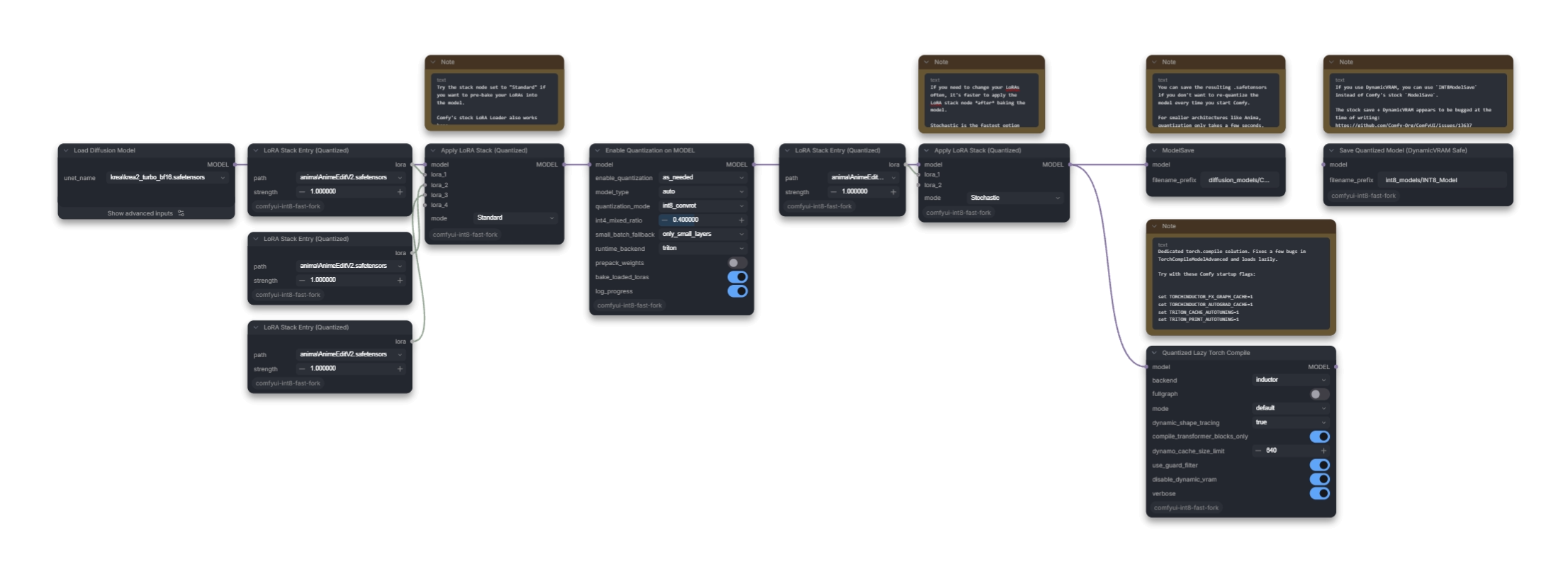
Use this route when an existing workflow already loads its model and LoRAs:
Load Diffusion Model
-> optional stock Load LoRA nodes
-> Enable Quantization on MODEL
-> optional Quantized Lazy Torch Compile
-> sampler
Leave enable_quantization=as_needed and bake_loaded_loras=True for the normal case. Loaded LoRA weight patches are applied before quantization and are not applied twice.
Load Or Create A Quantized Model
Load Diffusion Model Quantized
-> optional Apply LoRA Stack (Quantized)
-> optional Quantized Lazy Torch Compile
-> sampler
Leave on_the_fly_quantization=False for a native pre-quantized checkpoint. Enable it to convert eligible float or FP8 source weights using quantization_mode.
Quantization Modes
| Mode | Behavior |
| --- | --- |
| int8 | Direct tensorwise INT8; the simplest and default W8A8 path. |
| int8_convrot | Native-compatible ConvRot W8A8. |
| int8_quarot | Legacy Toolkit QuaRot W8A8. |
| int8_hadanorm | Experimental Toolkit HadaNorm W8A8. |
| int4_mixed | Mixed W4A4/W8A8 using an architecture-aware INT8 budget. |
| int4_full | W4A4 wherever supported, with safety exclusions and INT8 shape fallback. |
| w4a8 | Experimental asymmetric 4-bit weights with ConvRot INT8 activations; incompatible shapes fall back to W8A8. |
Start with int8 for broad compatibility. Use int4_mixed when memory pressure justifies a more aggressive format, then tune int4_mixed_ratio if needed. Treat w4a8 as experimental: it is a distinct kernel format, not an int4_mixed_ratio preset. Quantized Lazy Torch Compile supports it through a temporary compiler-safe custom-op boundary. See Quantization Policies for native export compatibility, architecture tiers, and method details.
In a preliminary RTX 3090/Krea2 comparison, W4A8 reduced ComfyUI's reported loaded model-weight footprint by 39.4% versus INT8 ConvRot, while warm sampling throughput was approximately 12.5–15% lower. Visual comparisons also showed model-dependent composition changes and a subjective loss of fine texture. See Preliminary Benchmarks for the conditions, limitations, and raw observations.
Quantized LoRAs
For LoRAs applied after quantization, connect one entry node per LoRA:
LoRA Stack Entry (Quantized) --\
                                Apply LoRA Stack (Quantized) <- quantized MODEL
LoRA Stack Entry (Quantized) --/
The apply node grows another input whenever an entry is connected and supports up to 100 entries. Set an entry strength to 0, bypass it, or disconnect it to disable that LoRA.
Available modes:
Stochastic: combines ordinary LoRA deltas in FP32 and requantizes once, including native W4A8 weights. This is the usual speed-oriented choice.Dynamic: keeps compatible INT8/W4A4 deltas as runtime matrix multiplications. W4A8 targets produce a console warning and use the Standard patch path instead.Standard: uses ComfyUI's regular MODEL patch path for comparison or compatibility.
The single and fixed-stack nodes remain available as Load LoRA (Quantized) and Load LoRA Stack (Quantized).
Set pool_stochastic_stacks on the apply node to keep several stacks wired separately while baking them as one: candidates from every apply node with the option enabled are combined and requantized once, just before inference, instead of being quantized stack by stack. The default keeps each apply node's stack independent, which quantizes a layer again for every additional node that touches it. Pooling applies to Stochastic mode.
To gate an individual entry while keeping your sampler setup, insert LoRA Gate (Quantized):
LoRA Stack Entry (Quantized) -> LoRA Gate (Quantized) -> Apply LoRA Stack (Quantized)
For Krea 2 Turbo SDA, use the Comfy-format LoRA and set active_steps to 2 with the author's 8-step sampling schedule. Other entries can connect directly to the same apply node. Gated entries always use runtime deltas, regardless of the stack mode, including on floating-point and W4A8 linear layers. Ungated entries retain the selected mode. Ordinary linear LoRAs and fused input/output slices are supported; unsupported adapters such as DoRA or convolutional LoRAs raise an error instead of remaining active throughout sampling.
The gate switches off at the sigma boundary after the selected number of intervals in the sampler's actual schedule. This is an exact first-two-step gate for Euler; solvers with intermediate evaluations use the same sigma cutoff. It is not a diffusion-percentage control. Each sampling invocation, including a partial-denoise invocation, uses its own schedule. Set active_steps to 0 to disable the entry, or bypass the gate to apply it throughout sampling. Custom samplers must supply ComfyUI's sample_sigmas transformer option. Gated LoRAs are runtime-only and cannot be baked with Save Quantized Model.
Nodes
| Node | Purpose |
| --- | --- |
| Load Diffusion Model Quantized | Load native quantized checkpoints or quantize during loading. |
| Enable Quantization on MODEL | Convert an existing floating-point or FP8 MODEL. |
| Save Quantized Model (DynamicVRAM Safe) | Export supported W4A4/W4A8/W8A8 layers with native metadata. |
| Quantized Lazy Torch Compile | Compile after quantized object patches are active. |
| LoRA Stack Entry (Quantized) | Define one independently bypassable LoRA path and strength. |
| LoRA Gate (Quantized) | Limit one stack entry to the first N sigma intervals without changing sampler wiring. |
| Apply LoRA Stack (Quantized) | Apply an autogrowing LoRA stack in a selected mode. |
| Load LoRA (Quantized) | Load and apply one LoRA. |
| Load LoRA Stack (Quantized) | Load and apply a fixed-size LoRA stack. |
| INT8 Kernel Config | Configure or benchmark the optional Triton INT8 backend. |
Node tooltips document individual controls. Advanced runtime, LoRA ordering, compile, and save behavior is collected in Advanced Usage.
FP8 Roadmap
The Toolkit already accepts FP8 source weights and can convert them to W4A4, W4A8, or W8A8. Native FP8 output, serialization, and quantization-aware LoRA handling would require a separate integration with ComfyUI's FP8 layouts and hardware dispatch. It remains a possible roadmap item pending user interest and upstream runtime maturity.
Documentation
- Advanced Usage: runtime controls, LoRA ordering, Torch Compile, Dynamic VRAM, and saving.
- Preliminary Benchmarks: early W4A8 speed, memory-footprint, and visual-quality observations.
- Quantization Policies: method semantics, mixed profiles, architecture presets, and native formats.
- Checkpoint Sources: known pre-quantized model links.
- Changelog: release history.
Credits
- ComfyUI and comfy-kitchen for native quantized layouts and runtimes.
- ComfyUI-INT8-Fast for the original implementation and preset groundwork.
- OneTrainer INT8 work, ComfyUI-QuantOps, and ComfyUI-ZImage-Triton for reference implementations and ecosystem work.
- The ConvRot and QuaRot authors for the underlying rotation-based quantization research.