
ComfyUI MiniMax H3 Timeline Director
A visual timeline and material planner for native MiniMax H3 video generation, with ordered image/video/audio references, editable Guides, prompt-planning integration, and long-video segment workflows.
Nodes (26)
Eight latent ticks of audio, handled for you
The quiet node that makes segments into one shot
Where the seam actually gets deleted
The seed value ComfyUI's native Loop needs
Turn the loop's final state into a file you can save
Latent carry, Drift-Control and audio locking in one step
Pick this iteration's media and prompt
Getting rid of the padding frames at the end
Deletes the overlap you just paid to generate
One node, one seed, a minute of continuous video
A 60-Second MiniMax H3 Video That Never Lives in RAM
Pin the soundtrack by zeroing its denoise mask
One continuous waveform instead of fifteen stitched slices
The right ten seconds of your recording, every time
Let an LLM actually look at your references first
Save the shot setup, not the whole workflow
Rebuild a whole timeline from one combo box
Inside the H3 Archive Node
This Node's Entire Job Is Making a Folder and Counting to Zero
The Node That Glues Your Segments Together and Deletes the Evidence
H3 with no sound, deliberately
Muting one segment's soundtrack on purpose
The one-node timeline that old workflows still point at
The node that breaks the prompt-rewriter deadlock
The timeline that keeps H3 workflows out of spaghetti
Three quarters of your steps at half size, none of them wasted
ComfyUI MiniMax H3 Timeline Director
Start with the MiniMaxH3 All-in-One Full Timeline Director workflow: one lightweight graph covers text-to-video, image reference, audio-driven generation, video editing, character replacement, motion transfer, digital humans, and manually segmented long-video generation.
简体中文 · English
Headline feature: lightweight unlimited-length video generation
The plugin splits any target duration into continuous segments and completes them in one ComfyUI execution: per-segment generation with one shared seed, direct continuation from the previous AV-latent tail, adaptive Drift-Control video masking, Soft AV audio continuity, overlap removal, and final synchronized assembly. Extend the result by increasing the segment count—without generic Loop nodes or duplicated sampler chains. Practical length is limited only by local VRAM, RAM, disk space, and ComfyUI execution limits.
For long-form digital humans, standalone audio can be set to Locked Original Audio. The source waveform is sliced on the timeline and injected through the native AV-latent mask/sigma path, so lip motion remains audio-driven while the final soundtrack preserves the uploaded recording unchanged.
Download the all-in-one workflow · Chinese guide · Chinese prompt specification

SelfLift two-stage sampling: fast 75% low-res + 25% high-res generation
The Material Planner now integrates a MiniMax H3 adaptation of SelfLift progressive-resolution
sampling. Enable Two-stage sampling, select an H3 Latent Upscaler from
ComfyUI/models/latent_upscale_models/, and set High-resolution sampling steps. A recommended
starting point is 25% of the scheduler's total steps: for an 8-step schedule, set 2 high-resolution
steps to run 6 low-resolution steps + latent lift + 2 high-resolution steps. The high-resolution
value must be greater than zero and lower than the scheduler's total step count.
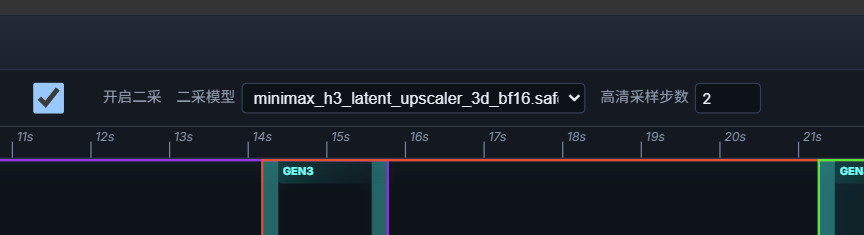
This is not a per-segment upscale shortcut. Every later segment carries both the preceding native low-resolution latent tail and the final high-resolution context, with Drift-Control applied at both resolution stages. The resulting long-video path avoids progressive quality loss from repeated resizing or VAE round trips and removes the blur, white flashes, and visible seams normally associated with multi-segment generation.
Creator benchmark: a 1536×832, 29-second video rendered directly in approximately 10 minutes
with a 75% low-resolution / 25% high-resolution schedule. Actual speed depends on GPU, VRAM,
model, step count, and reference complexity. When standalone audio is locked or reference-video source
audio is enabled, the native zero-denoise AV path restores one continuous source waveform; creator
tests retain 99%+ content and timing consistency. The final MP4 saver may still re-encode audio.
One workflow covers text-to-video, image-to-video, audio-reference generation, image plus audio, reference-video editing, character replacement, motion transfer, digital-human lip sync, and multi-segment long videos without visible seams or progressive degradation.
Two directly generated, approximately one-minute examples
Both videos were produced in one plugin execution and are 52.625 seconds / 1263 frames / 24fps.
Click a poster to play or download the original MP4. All media is hosted as GitHub Release assets, so
it adds nothing to the plugin clone or installation size.
| Finite direct-latent continuation | References with a 48-frame overlap |
| --- | --- |
|  |
|  |
|
Feature timeline
- 2026-08 — Introduced the editable media timeline, reference orchestration, per-segment prompts, and the first finite long-video path.
- 2026-09 — Added the all-in-one workflow, locked-original-audio avatars, bundled SelfLift two-stage sampling, low/high-resolution continuation, local presets, and native ComfyUI Loop nodes.
- 2026-09-15 — Merged community PR #9, fixing Nodes 2.0 DOM-widget width synchronization. Thanks to
permissionnine9. - 2026-10-08 — Merged community PR #17 (
spill-seg-offload), adding per-segment frame eviction and optional FP16 merged-frame storage. Thanks toFangZhangTNS. - 2026-10-14 — Added MiniMax H3 Low-Memory Segment Video Sampler and its example workflow. It decodes, encodes, and releases each segment before encoded-video assembly; uploaded image/audio delete controls now stay clickable above drag surfaces.
An editable reference-media timeline for ComfyUI's native MiniMax H3 Reference to Video workflow. It brings reference videos, paired soundtracks, fixed Guides, standalone images, and standalone audio into one compact editing surface.
Video-generation agents should read the Chinese segmented long-video guide.
Highlights
- Multi-clip timeline with move, trim, split, delete, snapping, and numeric positioning.
- Only media intersecting the cyan generation range participates in the current reference or Guide plan.
- Three per-clip modes:
Fixed Guide,Editable Reference, andBoundary Only. - Native text-to-video: with no uploaded media and no segment windows, Finite Segment Sampling internally creates a standard empty H3 AV latent from the Global Prompt and current GEN duration. Manual windows extend the same path to long-form T2V.
- Bound source audio follows video edits and can be disabled independently.
- Silent low-resolution monitoring proxies up to
480×270 / 12fps. - Multi-select, external file drop, deletion, and drag reordering for image/audio bins. The global standalone image and audio libraries have no upload-count limit; each generated segment still follows MiniMax H3's limit of at most 9 reference images and 3 reference audio clips.
- Locked-original-audio mode for long-video digital humans and singing avatars, with segment-aware AV latent locking and unchanged source-audio assembly.
- Stable
<Picture N>,<Video N>, and<Audio N>ordering from UI to H3 inputs. - Global and per-segment prompts: the global prompt is reused only when all segment prompts are empty; entering any segment prompt requires completing every segment and disables the global prompt.
- Decode-time resizing to the node's
width × heightfor VRAM protection. - Built-in two-stage sampling for every segment, including native low-resolution tail carry, learned H3 latent lifting, and high-resolution Drift-Control continuation;
comfyui-SelfLiftis not required. - In both one-stage and two-stage reference-video generation, enabled Video Original Audio is automatically locked through the native AV path and restored as one continuous original waveform. Disabling it fixes the AV audio stream and final master to silence; an explicitly uploaded locked audio asset takes priority.
- Segmented digital-human generation with locked source audio on the native AV mask/sigma path, preserving the soundtrack and lip-sync guidance through two-stage sampling.
- Separate merged outputs for timeline soundtracks and standalone reference audio.
- Timeline state is serialized into the ComfyUI workflow JSON.
Main long-video workflow nodes
| Node | Purpose |
| --- | --- |
| MiniMax H3 Material Planner | Edits media and outputs a compact H3 plan plus an ordered Omni media bundle. |
| MiniMax H3 Omni Media-Bundle Prompt Bridge | Sends the bundle to an installed Prompt Rewriter Omni backend and returns only rewritten_prompt. |
| MiniMax H3 Finite Segment Sampling | Expands an acyclic graph for direct-latent continuation, masking, sampling, deduplication, and assembly. |
| MiniMax H3 Low-Memory Segment Video Sampler | Decodes and encodes one segment at a time in ComfyUI's temporary folder, then joins encoded segments as VIDEO; no latent checkpoints or rerun state. |
| MiniMax H3 native-loop node set | Splits segment selection, continuation preparation, sampling, and assembly for free composition inside ComfyUI Start Loop / End Loop. |
| MiniMax H3 Preset Export | Connects to Material Plan or Segment Plan and saves configuration-only or complete media-bearing preset folders. |
| MiniMax H3 Local Preset Loader | Finds local presets and feeds the Material Planner's new Import Preset input. |
| MiniMax H3 Timeline Director (Compatibility) | Preserves the original all-in-one workflow and older saved workflows. |
Long-video generation needs only Material Planner Segment Plan → Finite Segment Sampling. The Plan Encoder is also public now so native Loop workflows can place it explicitly inside the loop body.
For long or high-resolution output, use MiniMax H3 Low-Memory Segment Video Sampler and connect its
Final Video directly to SaveVideo. It never creates one full RGB-frame tensor: each decoded segment is
immediately encoded to a temporary MP4 and released, then the encoded sources are joined. Segment files are
removed after assembly, the final temporary file is cleaned when its VIDEO object is released, and stale
24-hour spill folders are removed on the next run. See
the all-in-one low-memory workflow.
Local presets
Preset Export supports configuration (timeline and creative settings only) and complete (also copies
referenced video, image, and audio files). It creates an ordinary folder under
ComfyUI/output/MiniMaxH3_Presets/; no ZIP is required. Copy that folder to the same location on another
installation, refresh Local Preset Loader, and connect it to Material Planner's Import Preset input. The
first run writes all media, segment timings, and per-segment assignments back into the planner UI. The loader
can then be disconnected without losing the imported state. Import preset remains available for loading it
into the UI immediately before a run.
Presets intentionally omit workflows, model/LoRA selections, plugin versions, and ComfyUI versions. A complete
preset materializes media into the fixed ComfyUI/input/minimax_h3_timeline_director/presets/ subtree while
leaving the shared preset folder unchanged.
Native ComfyUI Loop workflow
The split nodes can drive ComfyUI's native generic loop. Connect Initialize Segment Loop state to
Start Loop.initial_iteration_value and its count to num_iterations. Inside the loop, use
iteration_index → Select Loop Segment → Plan Encoder → Prepare Loop Segment, then place either a
normal sampler or the bundled H3 two-stage sampler and decode the result. Feed Accumulate Loop Segment
state to both End Loop.next_iteration_value and output_value; connect End Loop.outputs to
Finish Segment Loop. The legacy one-node Finite Segment Sampling path remains available for saved workflows.
The split architecture avoids a ComfyUI dependency cycle:
Material Planner ──Omni bundle──> Omni Prompt Bridge ──rewritten_prompt──> Plan Encoder
       └────────────────────H3 plan─────────────────────────────────────> Plan Encoder
Installation
cd ComfyUI/custom_nodes
git clone https://github.com/Songssx/ComfyUI-MiniMaxH3-TimelineDirector.git
Restart ComfyUI and search for MiniMax H3.
The two-stage runtime is bundled with this plugin; do not install comfyui-SelfLift separately. Two-stage sampling still requires a compatible MiniMax H3 latent-upscaler checkpoint under ComfyUI/models/latent_upscale_models/; the Material Planner lists models from that standard directory automatically.
The source UI is English. Simplified Chinese is provided through ComfyUI's official localization system and follows the language selected in ComfyUI settings; restart or reload the frontend after changing the locale.
Requirements
- A recent ComfyUI build with the native MiniMax H3 nodes;
MiniMaxH3AddGuideis additionally required only when Guides are used. - MiniMax H3 Ref2VA model, CLIP, video VAE, and audio VAE.
- Python 3.10 or newer.
- ComfyUI's
imageio-ffmpegpackage for low-resolution preview proxies.
No extra pip dependency is declared. The plugin uses PyAV, Pillow, NumPy, PyTorch, torchaudio, aiohttp, and imageio-ffmpeg normally included with a compatible ComfyUI installation.
Example workflows
The plugin ships four example workflows: the normal all-in-one entry point, low-memory long-video output, Omni prompt expansion, and finite-segment generation with ComfyUI's native Loop nodes.
1. All-in-One Full Timeline Director (recommended)
This is the all-task, lightweight, no-rewiring workflow. Configure only the Material Planner's media, time windows, and prompts to run:
- Text-to-video with no media, as one segment.
- Long-form text-to-video with no media and multiple segments.
- Single-segment image-reference generation.
- Multi-segment image-reference generation.
- Single-segment image-and-audio reference generation.
- Multi-segment image-and-audio generation and digital-human lip sync.
- Single-segment editable-video reference, character replacement, and motion transfer.
- Manually segmented long-video reference generation, character replacement, motion transfer, and final AV assembly.
Connect the Material Planner's Segment Plan directly to MiniMax H3 Finite Segment Sampling. With no uploaded media it creates an empty AV latent; with references it encodes each segment's assigned media. Drag GEN windows to define duration and seam overlap, reuse one Global Prompt, or enter complete per-segment prompts. The plugin handles legal-frame alignment, Drift-Control, Soft AV, overlap removal, tail trimming, and final assembly.
The plugin does not auto-segment by reference-media duration or infer whether character identity should continue. Segment ranges, overlaps, and assignments are explicitly controlled on the timeline. For character replacement, use Editable Reference in most cases.
2. All-in-One low-memory video output
This keeps the complete Material Planner and the same one-/two-stage seam logic, but uses MiniMax H3 Low-Memory Segment Video Sampler. Every finished segment is decoded, encoded to temporary video, and released immediately; the node sends VIDEO directly to SaveVideo, making it suitable for longer or higher-resolution runs.
3. Timeline planning with Prompt generation
This variant adds the MiniMax H3 Omni Media-Bundle Prompt Bridge, allowing Prompt Rewriter Omni to inspect ordered images, videos, and audio before expanding an H3 prompt. Use it when multimodal material understanding should precede H3 generation.
This workflow requires MiniMax-H3-Prompt-Rewriter-ComfyUI. Follow that project for model, quantization, and VRAM requirements.
4. Native Loop finite-segment example
This workflow combines the split segment nodes with ComfyUI's native Start Loop / End Loop, making it easy to insert custom processing inside the loop body. It is shipped as a read-only example and retains the user's original configuration.
Basic usage
- Set
width,height, andgeneration_seconds. - Add video, image, and audio files using the toolbar or direct file drop.
- Move, trim, or split video clips, then place the cyan range over the interval to generate.
- Select a purpose for each video:
Fixed Guideanchors the overlap at its generated-frame positions.Editable Referencesends it as<Video N>without hard-locking the original subject.Boundary Onlyanchors only the first and last overlap frames.
- Enable or disable paired video soundtracks as needed.
- Verify the reference labels at the bottom and run the connected encoder or prompt workflow.
Videos are numbered left-to-right by their intersections with the cyan range. Standalone images and audio follow their visible bin order; drag reordering immediately updates the underlying H3 order.
Segmented long-video generation
Generate long videos in overlapping segments. Use the previous segment's final shot as the next segment's opening Guide, and describe that overlap as Shot 1 before new content. When assembling segments, remove the repeated Guide interval from the later segment. See the Chinese agent guide for the full procedure.
Finite direct-latent continuation
Finite sampling carries the previous sampled AV latent tail directly into the next opening and avoids an RGB decode/re-encode round trip. Drift-Control is always active and has no user-facing mode selector. The requested overlap is aligned down to H3's legal temporal grid (for example, 24 becomes 22 and 48 becomes 39), and that same actual value drives latent carry, decoded trimming, and assembly. The mask adapts both to the aligned overlap's video-token count and to the connected sampler's sigma schedule, including accelerated 4-step and 8-step schedules. It dynamically re-noises only the disposable video prefix while keeping the seam-side latent clean. When audio continuation is enabled, the carried overlap stays exact until its final eight audio-latent ticks, where a half-cosine Soft AV mask releases it into newly generated sound. Assembly replaces the preceding audio tail with this incoming Soft AV overlap so the transition is retained in the final output. All segments use exactly the seed shown on the sampling node. The old generic-loop helper nodes and PR #15923 dependency have been removed.
Drift-Control AV is adapted from ComfyUI-MiniMaxH3-Contex-Loop under GPL-3.0. It remains experimental and is intended for same-shot long-chain comparisons.
Credits
- Special thanks to facok/comfyui-SelfLift for the SelfLift progressive-resolution sampling technology. This plugin deeply adapts that work for MiniMax H3 AV latents, native audio mask/sigma locking, low- and high-resolution long-video continuation, and seam handling, and bundles the required runtime.
- MiniMax H3 learned latent-upscaler compatibility references LBH-123-AI/Comfyui_Minimax_h3_latent_Upscaler.
- The Omni bridge and prompt-generation workflow reference and adapt pytraveler/MiniMax-H3-Prompt-Rewriter-ComfyUI.
- See MiniMax-AI/MiniMax-H3 for the official model and prompt guidance.
- Thanks to the maintainers of ComfyUI's native MiniMax H3 and Guide nodes.