
ComfyUI-Switchboard
Client-side nodes for enabling/disabling parts of your graph - by hand or from a wired boolean. A more flexible take on rgthree's Fast Group Bypasser. Two nodes, identical behaviour, different target.
Nodes (2)
🎛️ Switchboard - Advanced Group/Node Controllers for ComfyUI
Nodes for enabling/disabling parts of your graph - by hand or from a wired boolean. A more flexible take on rgthree's Fast Group Bypasser, plus a couple of boolean utilities so you can build conditional pipelines without any other pack.
| Node | Targets / does | Add list shows |
|------|----------------|----------------|
| Group Controller | toggles groups, by title | the group titles in your graph |
| Node Controller | toggles individual nodes, by id | nodes as id: Title |
| Wired Controller | relays booleans to Controllers, by signal name | - |
| Value on Boolean | boolean -> one of two values (float/int/string) | - |
| Boolean Switch | routes one of two any-type inputs, lazily | - |
The three Controllers are client-side (they toggle node modes in the browser); the two utilities are real backend nodes (they move data at runtime). See Wired Controller and Bundled boolean utilities.
Install
Copy this folder into ComfyUI/custom_nodes/ (final path
ComfyUI/custom_nodes/comfyui-switchboard/), then restart ComfyUI and
hard-reload the browser (Ctrl/Cmd+Shift+R). There are no external Python
dependencies. The three Controllers are front-end only; the two boolean utilities
are lightweight Python nodes (which is why a server restart is needed, not just a
browser reload). Everything lives under the 🎛️ Switchboard category in the
Add-Node menu.
Group Controller
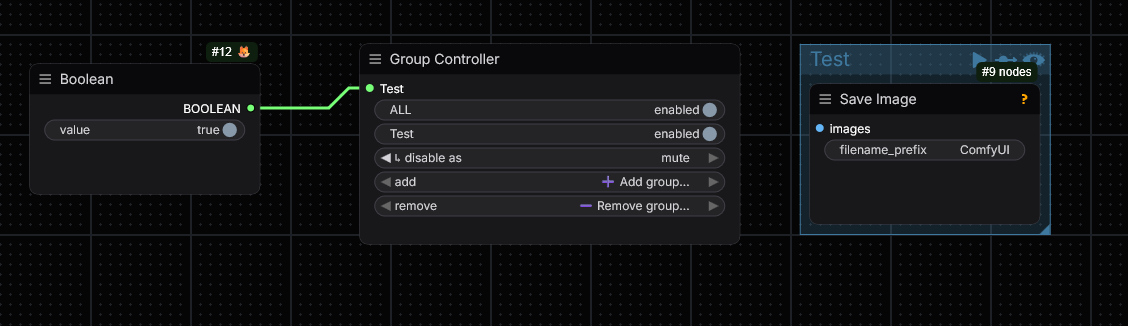
Above: a Boolean node (value = true) is wired into the controller's Test
input. The controller drives the Test group on the right (a Save Image
node). Because the boolean is true, the group is enabled; if it were
false, the group would be muted (its ↳ disable as setting).
Node Controller
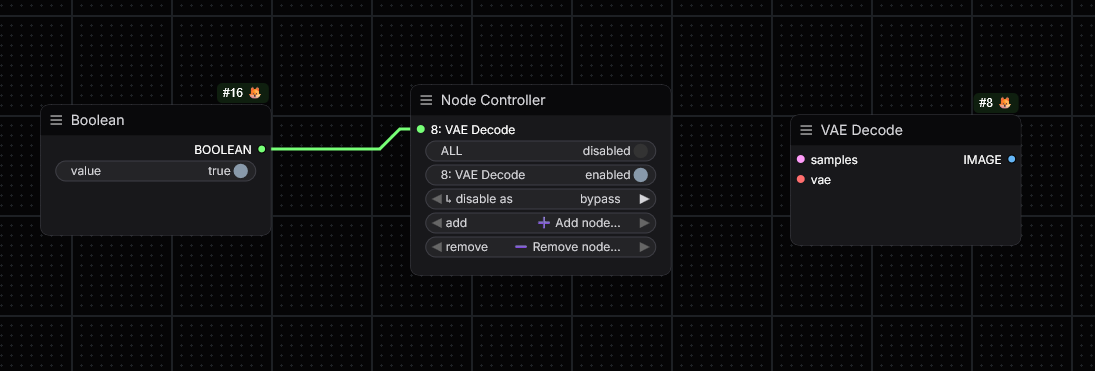
Above: the ALL master toggle is set to disabled, yet node 8: VAE Decode is still enabled - because a Boolean (true) is wired to it.
A connected boolean overrides the ALL broadcast. This is the key behaviour,
described in full below.
Putting it together - complex conditional control
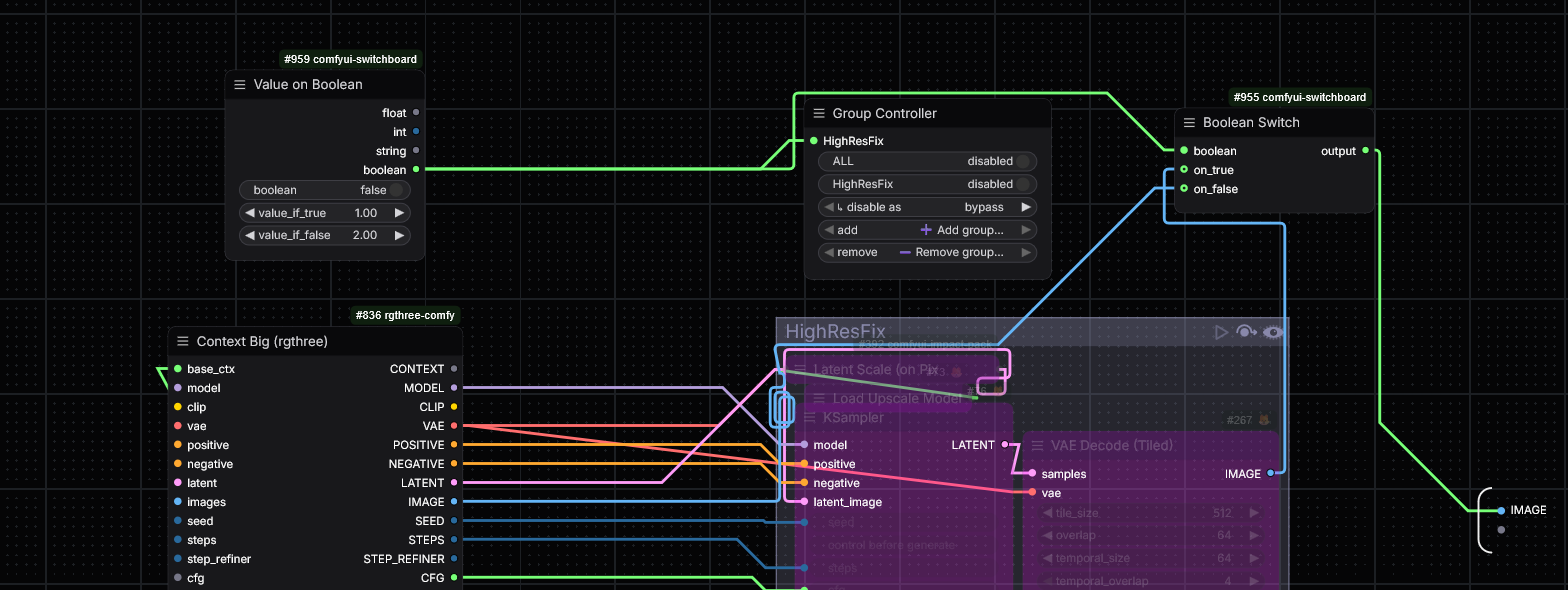
Because each controller target is a toggle any BOOLEAN can drive, you can route
booleans through the bundled Value on Boolean and Boolean Switch nodes
into one or more controllers to flip whole sections of a graph from a few inputs.
Above, a Group Controller gates several groups while data is routed by a
Boolean Switch - including targets inside a subgraph - turning a handful
of inputs into a full conditional pipeline. Every node shown ships in this
pack; no external custom nodes are needed.
Anatomy of a Controller
From top to bottom, a controller shows:
- Input sockets (top of the node). A
↦ patchinput (accepts a Wired Controller), plus oneBOOLEANsocket per controlled target, labelled with the target (the group title, orid: Titlefor nodes). Wiring is optional - see Boolean inputs. (Under Nodes 2.0 the sockets render at the very top of the node, slightly detached from their matching toggle row - that's a renderer quirk, not a bug.) ALL- the master broadcast toggle. Flips every manually-controlled target on/off at once (see precedence below).channel- subscribes this controller to a Wired Controller by name. Leave blank unless you're using one; empty = no subscription, no effect.- One row group per target:
<target>toggle -enabled/disabledfor that target. This is what a wired boolean drives.↳ disable as-bypassormute, i.e. how that target turns off. This stays editable at all times, even while a boolean holds the target on.⇄ input-normalorinverted. Wheninverted, this target follows the opposite of its input - see Inverting an input.
add- the ➕ Add group…/node… dropdown. Pick a target to start controlling it. Lists only targets not already controlled.remove- the ➖ Remove group…/node… dropdown. Drops a target and re-enables it (so removing the controller never strands something disabled). The right-click menu also has Remove controlled … and Refresh … list.
Driven by a Wired Controller? The
↦ patchinput andchannelfield are the two ways a Wired Controller feeds this node. Both are inert when unwired/blank, so they don't change anything until you connect one.
What bypass vs mute do
bypass- the target's nodes are bypassed; data routes around them and the graph still runs.mute- the target's nodes (and everything downstream of them) are muted and don't execute at all.
Boolean inputs
Every controlled target has its own BOOLEAN input socket. Wiring one is
optional.
- Not wired → the target is controlled manually: its own toggle and the
ALLmaster toggle. - Wired → the boolean governs that target.
True=enabled,False=disabled(turned off using that target's↳ disable asmode).
Precedence - a connected boolean wins
Once a boolean is connected to a target, it is authoritative for that target's on/off state and overrides everything else:
| Action | Target with no boolean wired | Target with a boolean wired |
|--------|----------------------------------|---------------------------------|
| Click the target's toggle | changes it | reverts to the boolean's value |
| Flip the ALL master toggle | changes it | ignored - boolean still governs |
| Change ↳ disable as | takes effect | takes effect (controls how it disables) |
| Set ⇄ input to inverted | no effect (no input to flip) | target follows the opposite of the boolean |
This is exactly the Node Controller screenshot above: ALL is disabled,
but 8: VAE Decode stays enabled because its boolean is true. Flipping ALL
does not touch boolean-governed targets - they only follow their input.
The boolean updates the target live as you flip the upstream value, and is re-read once more at queue time, so the prompt that actually runs always matches the inputs.
Inverting an input
Each target has a ⇄ input toggle (normal / inverted). Set it to
inverted and that target follows the opposite of whatever drives it:
| Input value | normal target | inverted target |
|-------------|-----------------|-------------------|
| true | enabled | disabled |
| false | disabled | enabled |
This lets one input drive two targets to opposite states - an either/or
switch. Wire the same boolean (or the same Wired Controller
patch signal) into two targets, set one of them to inverted, and a single
true/false turns one group on while turning the other off.
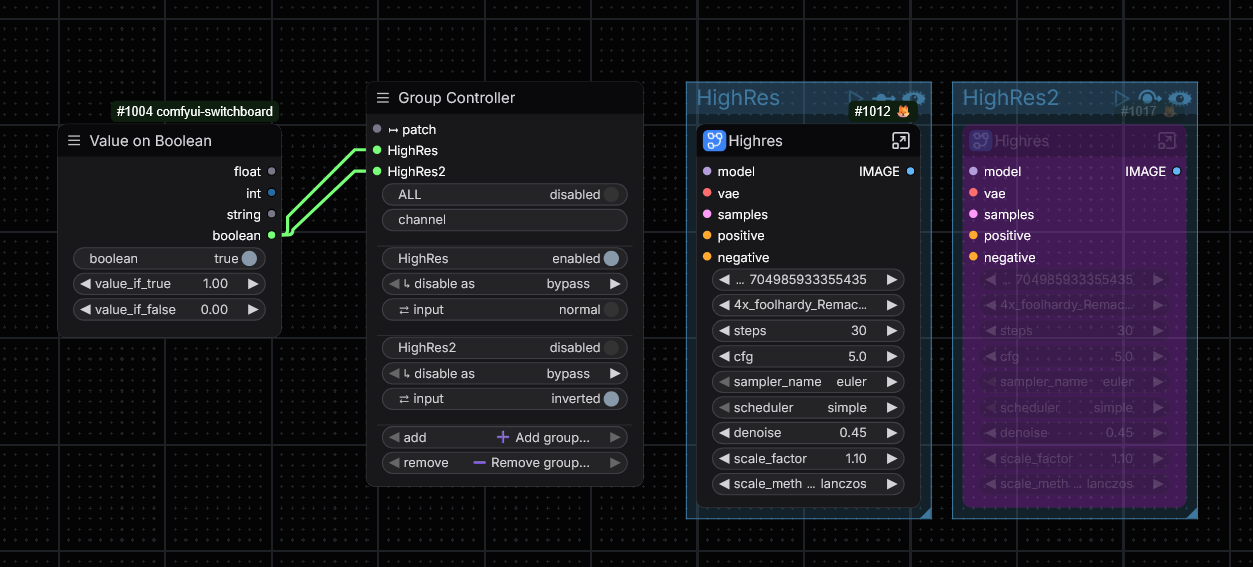
Above: a single Value on Boolean (true) drives both targets. HighRes is
normal so it stays enabled; HighRes2 is inverted so the same true
turns it off (the HighRes2 node on the right is greyed out). Flip the
boolean to false and they swap.
Inversion only affects input-driven targets - it flips the value coming from
a wired boolean or a patch signal. A manually-toggled target has no input to
invert, so the toggle is a no-op there. (↳ disable as still decides how the
off target turns off, independently.)
What the boolean reads (and its one limitation)
Enabling/disabling a target changes the mode of the underlying node(s) - a graph operation that happens before a prompt is queued. So the controller reads the upstream boolean's value in the browser, by following the wire to the source node's widget.
- ✅ Works great for constant Boolean/primitive nodes (a
True/Falseyou set in the UI). - ❌ Does not track a boolean that is computed at runtime by another node - that value doesn't exist until execution, by which point the target's on/off state is already locked for that run. For runtime-computed gating you'd need a backend execution-blocking node instead (open an issue if you want that).
Wired Controller
A source node that lives next to your booleans - typically inside a subgraph - and relays them to one or more Group/Node Controllers elsewhere. It exists to keep subgraphs tidy and to make cross-boundary control rock-solid.
Why it exists
A Controller reads a wired boolean by following the wire in its own graph - which is reliable. Reading a boolean across a subgraph boundary (controller inside, boolean outside, or vice-versa) is best-effort and can get confused when several subgraphs are involved. The Wired Controller flips this to the reliable side: it sits with the booleans, reads them locally, and only the result crosses the boundary - in the direction that always works.
How it works (it's automatic)
- Drop a Wired Controller into the subgraph that holds your booleans.
- Connect it to the Controllers it should drive, in either of two ways:
- By wire - wire the Wired Controller's
patchoutput across a subgraph output (IO) into a Controller's↦ patchinput. One output fans out to many Controllers. - By channel - type a name in the Wired Controller's
channelfield and the same name in each Controller'schannelfield. No wire needed; works across any subgraph nesting.
- By wire - wire the Wired Controller's
- That's it - the Wired Controller fills itself in. It reads the targets
already added on the Controllers it feeds and auto-creates one
BOOLEANinput per target, labelled to match. Add or remove a target on a Controller and the Wired Controller's inputs follow. You never type or manage signal names. Just wire your booleans (or promoted subgraph inputs) into the inputs it grows.
A signal behaves exactly like a wired boolean on its target: it governs the
target and overrides the master ALL toggle
(see Precedence). A target's own direct
BOOLEAN input, if also wired, wins over the bus signal for that one target. An
input you leave unwired is simply ignored - that target stays on manual/ALL.
Result: a subgraph can hold just booleans + one Wired Controller, while the real targets stay on Controllers out in the parent graph. One tidy box of promoted switches drives the whole pipeline.
The Wired Controller is client-side like the other Controllers. Use wire for a visible connection, or channel when you want zero wires across boundaries - or set both; the wire is tried first, the channel is the fallback. Either way the inputs are created for you.
Bundled boolean utilities
So you don't need a separate pack (e.g. Comfyroll) to build conditional pipelines, two small backend nodes ship alongside the controllers:
Value on Boolean
Outputs one of two values depending on a boolean. boolean = True returns
value_if_true, otherwise value_if_false (both set as FLOAT widgets on the
node). The same chosen value is emitted on four outputs so it can drive
almost any input without a separate convert node:
| Output | Type | What it is | Typical things it controls |
|--------|------|------------|----------------------------|
| float | FLOAT | the chosen value as-is | CFG, denoise/strength, guidance, LoRA/ControlNet weight, IPAdapter weight - any FLOAT input |
| int | INT | the value rounded to a whole number | steps, seed, width/height, batch size, a switch's select index, loop counts - any INT input |
| string | STRING | the value as text (e.g. "2.0") | filename prefixes, labels, text concat, anything taking a STRING |
| boolean | BOOLEAN | the input boolean, passed through | chain into another node's boolean, a Boolean Switch, or a Controller's BOOLEAN input - lets one toggle fan out to many places |
So a single toggle can, for example, output 7.0/3.5 to set CFG and
simultaneously pass its boolean on to flip a Controller - one decision, many
effects. Just connect the output whose type matches the target socket (ComfyUI
shows compatible sockets when you drag a wire).
Boolean Switch
Routes one of two inputs through based on a boolean: on_true when True,
on_false when False. Its boolean is an input socket (wire a BOOLEAN
in - there's no toggle widget, since a switch driven by a hidden widget is easy
to misread). Both data inputs are any type (*), so it switches images,
latents, models, conditioning - anything. It is lazy: only the selected
branch is evaluated, so the unused input's entire upstream chain is skipped
(cheaper than switches that compute both sides).
These are real executing nodes (Python), unlike the controllers. Adding/updating them requires a ComfyUI server restart, not just a browser reload. They live under the same 🎛️ Switchboard category.
Notes
- Node Controller targets by id. Nodes are matched by their stable id, so
retitling a controlled node still works; the
id: Titlelabel is captured when you add it. Controllers can't target other controllers. - Survives save/load. All state lives in node properties and is re-applied at queue time. Older saved Group Controllers are auto-migrated to the current format.
- Subgraph-aware. A controller operates on the graph it sits in, so a
controller placed inside a subgraph targets that subgraph's own groups/nodes
(and its
Add…list shows those, not the outer graph's). To drive an in-subgraph controller from outside, expose aBOOLEANas a subgraph input and wire your boolean to it - the controller traces that input back across the subgraph boundary to read the value (so only the boolean crosses; the controller keeps holding the inner node/group id). Nested subgraphs work too. To switch a whole subgraph instead, target the subgraph node itself with a Node Controller from the parent graph. - For control across subgraph boundaries, prefer the Wired Controller. Direct cross-boundary boolean reads are best-effort and can get confused with several subgraphs in play; the Wired Controller reads booleans in their own graph and relays the result by wire or channel, which is reliable at any nesting depth.
Nodes 2.0 compatibility
The three Controllers (Group, Node and Wired) are client-side (virtual) nodes built on the legacy LiteGraph API - the same class of node as rgthree's group tools. (The Value on Boolean and Boolean Switch utilities are ordinary backend nodes and aren't affected by any of this.) ComfyUI's Nodes 2.0 (Vue renderer) is currently opt-in and keeps a compatibility layer, so the Controllers load and function there (toggles, booleans and queue-time apply all work). Caveats for the Controllers:
- The core action (setting nodes to active/bypass/mute) is graph data, not rendering - it works regardless of renderer.
- The UI uses legacy patterns (virtual node, dynamic widgets/inputs, context
menu) that 2.0 may render inconsistently - e.g. input sockets float to the top
of the node, and links to dynamically-added sockets may draw as straight lines
instead of curves. These are cosmetic. Canvas-draw hooks are deliberately
avoided (a timer replaces
onDrawForeground) so live input tracking keeps working.
A Vue/V3-native rewrite would be the longer-term fix once those APIs are documented.