
MiniMax H3 RefMod
Extract, save and combine reusable MiniMax H3 image, video and audio references as RefMod safetensors, with a unified Master extractor, library, inspector and strength curves.
Nodes (16)
Where your RefMods actually get injected into H3
Turn a clip into a reusable audio reference for H3
A node kept alive for old workflows, and that's about it
One file per character instead of two
Bake the magic settings into the mod so the next person doesn't fight them
Keep references alive across long, chunked H3 generations
Compress a character reference into a few hundred tokens
Feed a whole folder of reference shots into extraction
Read a mod's vitals before you blame the generation
Collect H3 RefMod Masks keeps your masks the size they actually are
One node to extract a character's look and voice
Write your mods to disk without bolting on a Preview node
Morph young to old on one signed slider
Stack up to eight saved references, LoRA-loader style
Fade your reference in across denoising steps, not output frames
Give your H3 video references names the prompt can actually call
*Update: https://github.com/Luisacaotica/ComfyUI-MiniMaxH3Mod/discussions/36
ComfyUI-MiniMaxH3Mod - Changing the F#cking world with cigarretes and coffe.
🚧 Under construction — API and node schemas are still evolving. Mods stay compatible, but expect node names/inputs to shift between versions.

What's new — v0.2.6
-
Standalone creators — Create H3 RefMod and Master now run without a downstream output node. Both return a
detailsstring with token counts and saved paths.save=Falsestill produces an in-memory bundle without files. -
Different-size masks — route a MASK list through Collect H3 RefMod Masks into the creator's
mask_listinput. Each mask retains its dimensions until it is resized/cropped with its corresponding reference. The collector consumes the list once, avoiding one extraction per list item. Usemaskormask_list; one mask broadcasts, otherwise provide one per reference in image-slot, video-slot, then folder-bundle order. Existing MASK batches work as before. Pixels cropped by an upstream batch node cannot be recovered. -
Full Reference video sampling — choose a causal frame count before sampling, so frame limits such as 16 no longer drop the end of the clip.
-
Compact additive loaders — Loader and Axis start with one visible slot. Use + Add RefMod to reveal more, up to the existing eight slots. Each reference's controls stay together; connected slots are protected from removal.
-
Single-file visual + audio bundles — Master can save both modalities in one
.safetensorswithsave_layout=bundle. Save H3 RefMod Bundle also packs existing references without running extraction again. -
Independent loader controls — each Loader/Axis slot offers All / Visual / Audio, plus visual and audio strengths. Excluded modalities and modalities with strength zero are not loaded. Existing standalone files remain supported.
-
Bundle-aware library and Config — find combined files in the library and edit selected components without dropping the other contents.
This is a storage and selection update. It does not fix voice identity or enforce audiovisual synchronization. See single-file bundles.
v0.2.5 and subsequent fixes
On main after v0.2.5: Refresh RefMods updates the current Loader/Axis
dropdowns from the RefMod folders without refreshing all ComfyUI models.
Selections and connected inputs are preserved. The library's Refresh also
updates that loader's dropdowns.
- Clearer creation controls — Create node titles, Full/Compressed Reference modes and Refinement Steps; old workflows remain accepted.
- Explicit visual budget policy — choose truncate or error before saving, including Master.
- Compatibility fixes — projected ClipProj encoders and batched H3 VAE decoding in Text Encode.
- Full visual inspection — optional full-video preview, with a lightweight first-frame default.
Since v0.2.0: extraction widgets accept token budgets above
65,536 and frame limits above 16, including Master. The motion_sequence
preset now respects the requested frame limit. Counts remain integers;
defaults are unchanged.
Experimental: H3 RefMod Text Encode presents saved references to the native
H3 text/vision encoder and reports their <Picture n>, <Video n> and
<Audio n> labels. Character binding and voice quality still require generation
tests; this is not a validated voice-cloning fix.
- RefMod Master — extract image/video and audio references in one node, with separate VAE inputs, one output bundle and a combined token budget.
- Integrated audio — create and load audio RefMods directly in this pack; no H3AudioMod installation required. Mix visual and audio refs in Apply.
- Known failure: voice transfer — audio support includes an observed music reference result, but speaker-identity transfer failed in current tests. This update does not provide working voice cloning. See voice-transfer limitations.
- Library and inspector — search/filter your collection, select loader slots, inspect token costs and optionally preview stored visuals or audio.
- Save H3 RefMods — a dedicated output node saves bundles without needing a Preview, sampler or another downstream consumer.
- Linked loaders fixed — unresolved names from upstream nodes no longer fail queue validation, including both sides of the Axis loader.
- Subfolders and external drives — recursive discovery and saving to the
registered RefMod root respect
extra_model_paths.yaml. - Stale references and cache fixes — Step Curve no longer retains refs from previous calls; loaders detect overwritten files. Bridge injection is scoped to the MODEL branch, with cleanup after sampling errors.
- Extraction fixes — masks follow image crops, video sampling stays bounded when frame counts are unknown, and runtime token/copy limits are enforced. Saves use atomic file replacement.
- Fewer dependencies and repeated operations — removed sibling-pack imports; shared extraction helpers and grouped multi-ref refinement reduce duplication.
Full history: CHANGELOG.md. Validation and remaining limitations: REVIEW_FOLLOWUP.md.
RefMod in brief
RefMod saves MiniMax H3 image, video or audio references as reusable
.safetensors files. Load a saved reference, combine it with others, and pass
the bundle to Apply H3 RefMod. Create H3 RefMod Master brings visual
and audio extraction into one node.
Extraction uses the corresponding VAE. It does not train H3 weights or require
the diffusion model. The visual mode named training refines a compressed
latent; it is not LoRA training or supervised concept learning.
Saving avoids re-encoding the source on each run. Compression can reduce the number of reference tokens processed during generation, at the cost of lost information. Encode mode keeps more detail but does not remove the attention cost of those tokens. Neither mode guarantees that only the desired attribute will transfer: identity, clothing, background and composition can still mix.
Try it
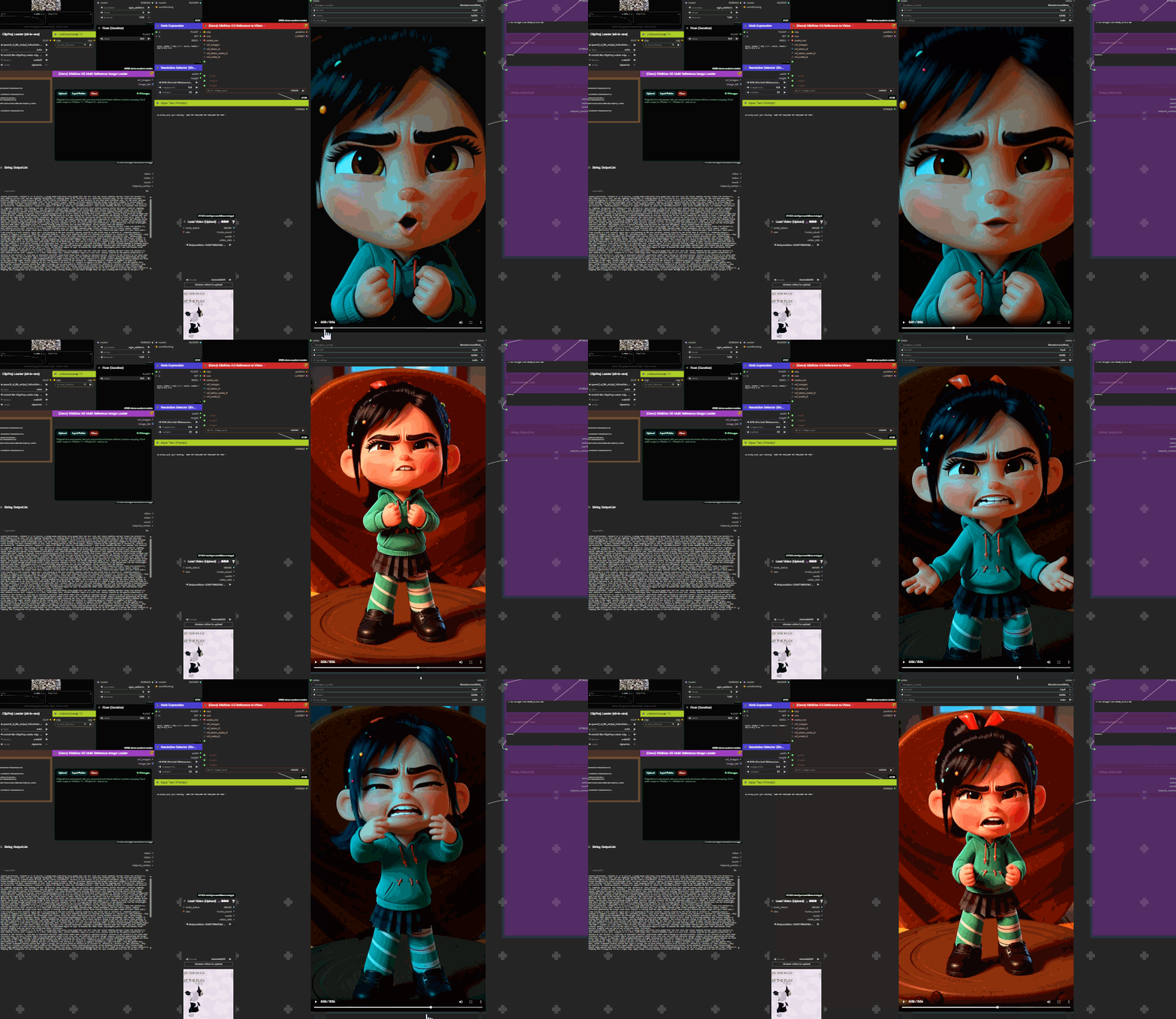
A ready-made example mod ships in the repo: mods/vanellope_example.safetensors.
It appears as vanellope_example in the Load H3 RefMods dropdown after
install — plug it into Apply H3 RefMod at strength 1.0 and prompt for
a candy racer in a karting scene.
Install
-
Use a current ComfyUI with native MiniMax H3 support. RefMod does not import or require ComfyUI-MiniMaxH3. Connect a standard H3 video VAE to
vae, the audio VAE toaudio_vae, and native CONDITIONING to Apply. Oldav_encoderconnections are supported by reading the VAERef video checkpoint through ComfyUI's native VAE loader; they no longer load the sibling pack's VAE implementation or its audio checkpoint. Prefervaeto share an already loaded instance. Existing pack-conditioning objects remain accepted by Apply without importing their package. -
This pack: clone into
custom_nodes/and restart ComfyUI. Python deps (safetensors,numpy,Pillow) are inrequirements.txtand are installed automatically by ComfyUI Manager (orpip install -r requirements.txtmanually).opencv-python/imageioare optional video backends for the folder loader.git clone https://github.com/Luisacaotica/ComfyUI-MiniMaxH3Mod custom_nodes/ComfyUI-MiniMaxH3Mod
Originally tested on Windows. Bounded Apple Silicon checks also cover preprocessing and the real H3 VAE on M5 Ultra, macOS 27 and PyTorch 2.14; they do not qualify every workflow or reference quality.
Visual creation also offers budget_policy: truncate (the default) uses
existing frame reduction to fit max_tokens; error stops before saving if
the combined visual latent exceeds the budget after the multiplier. This applies
to both Create and Master. max_tokens=0 disables the cap. Master's audio policy
and combined budget remain separate.
What extraction actually optimizes
Create/Master now print which visual controls the effective configuration ignores
and which values a preset replaces. Apply reports actual curve/retention overrides
and inactive scrambling controls. These are execution-time notices; widgets remain
visible and editable, and cached nodes do not rerun just to print a notice.
The preset tooltip lists exact assignments. motion_sequence preserves the frame
limit and Refinement Steps and disables frame-difference extraction (motion_only)
to retain the visual sequence. concept_type is metadata, not an algorithm selector.
On Apply, curve_shape still matters with constant for non-linear shapes; a missing
saved override does not disable manual controls or discard a valid graph preset.
The UI calls the modes Full Reference (encode internally) and
Compressed Reference (training internally). Refinement Steps retains
its historical input ID identity. Saved files and API workflows keep these
internal identifiers; the descriptions below use them when discussing code.
Node titles now use Create instead of Extract, with unchanged node IDs.
A saved visual latent enters H3 through the native reference-token path. That shares the model's reference mechanism, but does not establish parity with a complete native reference workflow: resizing, conditioning, prompt processing, sampling and other references can differ.
| Visual mode | Operation | Tradeoff |
| --- | --- | --- |
| encode | Resize/preprocess and store the VAE encode | Keeps more reference detail; larger token cost. Useful as the baseline for identity comparisons. |
| training | Pool the latent, then optionally refine it against the original VAE latent | Fewer tokens; detail and motion may be lost. |
The training loss is MSE between the full latent and a trilinearly enlarged
small latent. Only the small latent is optimized. No DiT, text instruction,
identity recognizer or motion objective participates. identity is the number
of refinement steps, despite its historical name; 0 means pooling only.
Increasing it does not teach the model which attribute to preserve or discard.
concept_type is descriptive metadata, not a separate learning algorithm.
The aliases full → encode and pooled → training remain supported.
Storage
Mods are saved in the first registered refmods folder, including mappings
from extra_model_paths.yaml. The fallback is ComfyUI/models/refmods/, created
when saving. Set is_default: true in the YAML mapping to prioritize that root.
A write failure is reported rather than silently switching drives. Config updates
keep the original path of a loaded file. Loaders search all registered roots and legacy locations, including
the pack's own mods/ folder, so existing files keep working. The standalone CLI
uses the folder registry available in its process; it does not load YAML mappings
on its own.
Both Load H3 RefMods and Load H3 RefMod Axis scan subfolders too:
models/refmods/celebs/person.safetensors appears as celebs/person.
Names use / without the .safetensors extension; linked Windows names
using \ work too. Only files with RefMod metadata (kind: image, video or audio) are listed. graph_presets/, .git/, and __pycache__/ trees
are skipped. Extract saves to the selected root by default; subfolder is optional.
You can convert mod_#, mod_a_#, or mod_b_# to inputs and connect a
STRING/combo output. Unresolved linked values are checked when the loader
runs. None, an empty string, "None", and "(none)" skip the slot;
a resolved missing filename raises a missing-file error. Fixed dropdown
values are still checked when queuing. After adding or moving files,
refresh ComfyUI's node definitions to update the visible dropdowns.
Loader regression checks (run with ComfyUI's Python from this pack):
python tests/test_loaders.py. They use temporary safetensors files and
ComfyUI's queue validator; no generation models are needed.
Integrated audio, library and inspection
One character extractor
Create H3 RefMod Master combines the visual extractor's inputs and controls
with optional audio and audio_vae inputs. Connect the visual H3 VAE to vae
(or the existing av_encoder) and the H3 audio VAE to audio_vae. Either modality
can be omitted. Video-frame inputs do not implicitly include an audio track;
connect the source loader's AUDIO output separately when needed.
The master extracts visual references first, then audio, returning one mods
bundle for Apply/Inspect and a details string with paths and token totals.
Visual max_tokens and audio_max_tokens are separate; max_total_tokens limits
their combined cost (0 disables that extra limit). A failed extraction or budget
check does not save either result. Each final file is saved atomically, but saving
the pair is not a filesystem transaction.
With the default save_layout=separate_files, name=hero and
subfolder=characters, saving creates
characters/hero_visual.safetensors and characters/hero_audio.safetensors.
Select both in Load H3 RefMods to reconstruct the bundle after restarting.
Choose save_layout=bundle to save characters/hero.safetensors instead;
load that one file and select its modalities in the loader.
The internal visual extractor reports (not saved) because Master postpones
saving until both extractions and the total-budget check succeed. Master's final
Created / Replaced messages show the actual paths. encode and training
both replace existing files at those paths; an older file without the modality
suffix is a different destination. With save=False, Master only returns the bundle.
These are appearance and voice references, not joint character training or a
guarantee of audiovisual synchronization. The individual extractors remain available.
Create H3 Audio RefMod accepts AUDIO and the H3 audio VAE (the
32 kHz codec, not the video VAE). The implementation follows the tested
ComfyUI-H3AudioMod encode path: stereo normalized [1,32,2,T] latents,
40 frames/second, 2 tokens/frame, bounded 10-second encode chunks.
max_seconds explicitly selects the initial duration of the clip. A token
budget overflow raises an error by default; optional truncate keeps a
contiguous prefix rather than resampling speech/music in latent time.
Chunk boundaries may affect codec continuity; this is reference conditioning,
not a promise of lossless audio reconstruction.
Save audio to the selected RefMod storage root with an optional subfolder. Existing files
from models/audio_refmods/ using audio_refmod_meta load directly. Both
common loaders, Apply, Step Curve, Config and the model-scoped bridge accept
mixed visual/audio bundles. Single-file bundles have per-slot visual/audio
strengths; multiple audio references inside one file share its audio strength.
Keep different voices in separate files if they need individual controls.
Standalone saves use format version 4; combined files use version 5. Older visual
mods remain readable. No <Name> prompt triggers are implemented.
Both loaders now have a RefMod library button: search names, subfolders, concepts and descriptions, filter image/video/audio/bundle, choose a slot and Use. Refresh rescans the disk. Connected slots are protected from widget replacement. Close and Escape dismiss the library. Registered extra model roots are honored.
Inspect H3 RefMod reports paths, shapes, metadata, saved config and total
cost after copies. Optional matching vae enables stored or
compare_strength previews: visual_preview=first_frame decodes the first
latent frame by default; full_video decodes the complete stored visual latent
as an IMAGE batch for a video-combine/save node. Full previews use more memory.
In comparison mode, the stored sequence is followed by the weakened sequence;
audio outputs preview up to two seconds. Comparison appends the weakened
preview after the stored preview. This shows stored information, not a
prediction of generated identity/style quality.
max_total_tokens on loaders/Apply/bridge limits the sum after copies
(0 disables it). Oversized bundles fail explicitly. Extraction also fails
when one frame alone exceeds its cap. Loaded-file cache checks file and
sidecar changes, and is bounded to 256 MiB and 24 entries.
Visual Extract offers opt-in presets: manual preserves current widgets;
identity_encode selects encode/1024px; style_experimental selects an
8×8 training grid; motion_sequence keeps an ordered temporal sequence.
These are starting settings, not quality guarantees or semantic disentanglement.
Both visual and audio Extract support an optional save subfolder.
Validation: python -m unittest discover -s tests -v runs production-code
regressions. python gauntlet_harness.py --device cuda compares resident,
streaming and grouped multi-ref refinement with numerical parity checks.
python issue_regression_test.py checks standalone creators, different-size
mask lists and video sampling without loading model weights.
python tests/audio_smoke.py PATH_TO_H3_AUDIO_VAE exercises the real codec,
safetensors roundtrip and native H3 reference layout without loading the DiT.
File format, resolution and token budget
How many references should I encode?
There is no validated optimum image count or clip duration. As a practical starting experiment, use 5–10 distinct, clear images of the same subject, one short video that shows the desired motion, or 5–15 seconds of clean audio. These are starting points, not enforced limits or measured quality optima. Compare against a smaller set with the same generation settings before adding more. Duplicate or conflicting examples can add cost without useful detail.
Check what actually survives extraction:
- Images: Folder Loader defaults to
max_items=32, so a folder containing 40 images is not fully loaded unless you raise that limit. The creator's default stack mode stores images along one temporal axis; it does not train a character model. More inputs can trigger the visual token cap and discard frames. Inspect the saved shape and token count. - Video: Folder Loader's
max_framesand the creator'slatent_framesboth affect the sequence. Full Reference limits source frames; Compressed Reference limits latent frames after VAE encoding. Frame reduction can lose motion and timing. Start with one relevant short clip and inspect its preview. - Audio:
max_seconds(Master:audio_max_seconds) defaults to 30 and selects the beginning of the input. A two-minute file therefore does not mean two minutes were encoded. Audio uses about 80 tokens/second: 15s is about 1,200 tokens, 30s about 2,400, and 120s about 9,600. Keeping all 120s requires raising the duration limit and the default 5,120-token budget (or disabling that budget with 0). The default overflow policy is an error;truncatekeeps only a prefix. Longer input is not guaranteed to improve voice similarity and raises sampling attention cost.
Small saved files and chunked encoding do not make reference conditioning free.
Generation cost depends on the retained tokens across all active references,
including copies. Use Inspect H3 RefMod to check the actual total before raising
budgets. Loader, Apply and bridge max_total_tokens limits are separate from
extraction limits.
Standalone files contain a latent and JSON metadata in the safetensors header.
Visual latents have shape [1,24,T,H,W]; audio latents use [1,32,2,T].
Version-5 bundles contain an ordered list of these references in one file;
they keep separate tensors, shapes and metadata. See BUNDLE_FORMAT.md
for the schema used by loaders and third-party pickers.
Visual token count is T × (H/2) × (W/2). H and W are even latent-grid dimensions, not image pixels. Audio uses 2 × T tokens.
| Visual latent grid | Tokens per latent frame | | --- | --- | | 8×8 | 16 | | 16×16 | 64 | | 32×32 | 256 | | 64×64 | 1024 |
For example, a square 1024×1024 image encoded to a 64×64 latent costs 1024 tokens and about 192 KiB of fp16 tensor data, plus metadata. A rectangular image with a 1024-pixel short edge can cost more. Four 16×16 latent frames cost 256 tokens; sixteen 64×64 frames cost 16,384 tokens before budget fitting.
A small grid is spatial compression, not a concept extractor. It may retain colors and large structures while losing face detail, texture or useful motion. A larger grid preserves more information, including unwanted content. There is no validated universal 8×8 concept / 16×16 identity sweet spot.
multiplier repeats the extracted visual latent along its time axis; loader
copies repeats a reference block. Both increase token cost. Neither adds new
information, and neither promises a proportional increase in influence.
Visual max_tokens defaults to 5120 (0 disables it). Budget fitting drops
near-duplicate latent frames, then resamples time if needed, after repetition.
This can damage motion timing; inspect the resulting frame/token count. If a
single spatial frame exceeds the cap, extraction raises an error. Audio instead
uses the explicit error/prefix-truncation policy described above.
Nodes (MiniMax-H3/mod)
| Node | Purpose |
| --- | --- |
| H3 RefMod Text Encode | Encode a prompt with numbered saved references; outputs conditioning and the reference map. |
| Create H3 RefMod Master | Visual and/or audio extraction into one bundle, with separate VAE inputs. |
| Create H3 RefMod | Visual extraction, masks, compression and optional refinement. |
| Collect H3 RefMod Masks | Pack a MASK list or batch without resizing; connect to the creator's mask_list. |
| Create H3 Audio RefMod | Audio extraction with duration and token limits. |
| Save H3 RefMods | Save a bundle as an output node; no downstream connection required. |
| Save H3 RefMod Bundle | Pack selected references into one .safetensors; no downstream connection required. |
| Load H3 RefMod Folder | Ordered image/video references from a folder. |
| Load H3 RefMods | Up to 8 slots with strength, copies and optional total budget. |
| Load H3 RefMod Axis | Select A or B with a signed strength; 0 skips the slot. |
| Apply H3 RefMod | Append refs to native CONDITIONING or an existing pack-conditioning object. |
| H3 RefMod Step Curve | Change marked RefMod latents during denoising via the MODEL connection. |
| Fix H3 RefMod Config | Persist Apply/Step Curve settings in mod metadata. |
| Inspect H3 RefMod | Metadata, token totals, reference map and optional VAE previews. |
| Continuum RefMod Bridge | Inject refs through the MODEL sampling hook. |
Older Apply H3 RefMod (Cond) workflows migrate to the unified Apply node.
The legacy Bridge Disarm node remains for compatibility; bridge state now
belongs to the MODEL branch.
Prompting with numbered RefMods (experimental)
Connect Load H3 RefMods → H3 RefMod Text Encode.mods, the native H3 CLIP
or an H3-compatible projected CLIP (current ClipProj Loader all-in-one),
and the H3 video VAE for visual references. Enter your prompt and connect the
CONDITIONING output to the sampler's positive input. Keep the workflow's normal
negative conditioning and generation latent. This node already attaches the
references: do not Apply or Bridge the same bundle again.
To generate a prompt with an LLM, connect the same mods to Inspect H3 RefMod
and H3 RefMod Text Encode. Set Inspect's preview=off, send its reference_map
output to the LLM, then connect the generated prompt to Text Encode. Inspect
produces the map without CLIP or VAE execution, avoiding a dependency cycle.
Connect reference_map to a text display to see the actual mapping. For example,
if it reports <Picture 1> = alice and <Picture 2> = beth, try:
[Shot1]
The woman in <Picture 1> stands on the left.
The woman in <Picture 2> stands on the right.
They turn toward each other and smile.
The map counts each modality separately, in bundle order, excluding zero-strength
entries. Copies receive additional labels. Stacked photos saved as one video-kind
RefMod receive one <Video n> label, not one Picture label per original photo.
Keep different characters in separate files. Neither the filename nor description
is a trigger, and <Subject n> is not automatically bound to a loader slot.
Visual presentation requires decoding the stored latent for Qwen; it adds VAE and
vision-encoder work. Compressed latents reconstruct less detail than the original
photos. Videos are decoded and then sampled for Qwen at 2 fps; reference_fps
sets reconstructed playback timing (default 24). Original timing is not recovered
from pooled or stacked refs. Audio presentation uses the native numbered label
without decoding audio. Loader strengths affect the latents; saved Apply curves
and overrides are not applied by this node. max_total_tokens limits DiT reference
tokens, not Qwen tokens or VAE decode memory.
Presentation/payload tests pass, but full GPU generation and identity/voice quality remain unverified. Compare against the old Apply workflow with the same references, prompt and seed.
Saving without a Preview or sampler
Connect Extract / Master / Loader → Save H3 RefMods and queue the workflow.
The Save node is an execution output, so its own output sockets may stay
unconnected. Set the extractor's save=False to avoid saving twice; the Save
node handles persistence. It also provides mods and saved_paths outputs.
filename_prefix is prepended to each mod name, and subfolder is relative to
the configured RefMod storage root. Existing destination files are replaced.
Repeated copies of the same mod are written once; distinct mods with the same
name receive numbered suffixes within the bundle. Files keep their stored
latents/config; loader strengths remain in the output bundle and are not baked
into the saved latents. As with other output nodes, ComfyUI may reuse cached
results when inputs have not changed.
Single-file bundles
For new references, set Create H3 RefMod Master → save_layout = bundle. For existing files, connect Load H3 RefMods → Save H3 RefMod Bundle, choose a name/subfolder, and queue. The output node writes one file; it does not require a sampler or Preview. Existing destinations are replaced atomically.
Both loaders expose these controls for each slot:
Only added slots are shown. Remove RefMod N clears that slot and restores its defaults; slots with connected inputs cannot be removed. Old workflows reveal their configured/connected slots automatically, and the library can reveal a hidden slot when selecting a file. Slot numbers stay stable when another slot is removed. Refresh the browser after updating to load the new interface.
| Control | Effect |
| --- | --- |
| components_N = All | Load every visual and audio member in that file. |
| components_N = Visual | Load images/videos only. |
| components_N = Audio | Load audio only. |
| visual_strength_N, audio_strength_N | Multiply the slot strength for the chosen modality; zero skips it. |
For example, load character A with All, and character B with Visual to
use both appearances and only A's audio reference. With slot strength 0.8
and audio strength 0.5, the resulting audio reference strength is 0.4.
The total-token budget counts only loaded components, including copies.
The file stores each distinct reference object once, preserving member order. Runtime copies and strengths are retained on the Save node's output but are not baked into the file. Loading the file later uses the loader's current controls. Config preserves unselected members when updating a combined file. To export members back into standalone files, use Save H3 RefMods with a different prefix or subfolder.
Existing standalone RefMods and workflows keep working. Version-5 files require
a bundle-aware reader; v0.2.5 and older third-party readers are not guaranteed
to load them. The default Master save layout remains separate_files.
Packaging visual and audio references together does not bind a voice to a character, fix reference mixing, or add synchronization timestamps. Original audio passthrough is also separate: this format stores encoded audio latents, not the original waveform. To preserve the original soundtrack, connect the source loader's AUDIO output to your video-saving workflow.
Strength and reference-frame curves
Loader strength and Apply retention are multiplied. For a positive resulting
weight w, the stored latent is transformed as:
w * latent + (1 - w) * blur(latent)
A zero row/master strength drops the reference block. A zero frame-curve weight instead leaves a blurred frame in the block; it does not remove tokens. At 1, the stored latent is unchanged. At 0.4, the mixture is 40% original and 60% blurred. This is not an attention weight or a percentage of identity. Blur can leave palette, framing and broad structure while discarding desired texture. Smooth identity fading and an in-distribution result are not guaranteed.
The curve on Apply runs across the reference's latent frames, including
stacked images. concept_at_start, concept_at_middle, concept_at_end and
concept_at_ends are historical labels for where the envelope is strongest
in that reference sequence. They do not schedule an event in the output video.
constant is the default. curve_shape selects the envelope shape and
curve_value its value; for one latent frame, value acts as a scalar cap.
Printed effective strength is a summary of the configured weights, not a
measurement of the model's actual attention or the resulting concept transfer.
Using RefMods with ComfyUI-H3-Continuum
Connect Load Model → Continuum RefMod Bridge → sampler.model, and connect
mods to the bridge. The bridge clones the MODEL and appends refs through
ComfyUI's public outer-sampling hook before each chunk's conditioning is
prepared. It restores the previous conditioning on completion, error or
cancellation. There is no global bundle, TTL, or patch of Continuum code.
Different model branches can carry different bundles. enable=False removes
this bridge from its output clone. The old Disarm node is retained for saved
workflows; use the bridge toggle or bypass its MODEL output instead.
Ref scrambling (seed)
scramble_seed=-1 disables scrambling and keeps all bundle entries in order.
With a nonnegative seed, scramble_mode=shuffle changes only their order;
subset selects up to scramble_keep entries. The selection is deterministic
for the same seed and bundle. legacy_subset retains the old random-size subset
behavior for workflows missing the new option. These operations act on bundle
entries, not on frames inside one saved mod.
Curve graph and presets
Apply's debug IMAGE output plots the configured envelope, not a prediction
of where a concept will appear. save_preset_as writes a PNG with embedded
curve metadata under the selected RefMod root's graph_presets/ folder.
Choose it in graph_preset to override the manual curve widgets. Share that
PNG to share the settings. Older JSON presets remain readable.
Ref strength over denoising steps
Connect H3 RefMod Step Curve between the model loader and sampler. It applies an envelope over denoising progress, relative to the run's schedule start. This is different from the reference-frame curve and from output time. Early/late weighting can change the result, but there is no guarantee that it isolates composition, identity, texture or any particular semantic attribute.
The wrapper processes the current payload without retaining reference tensors between calls. It transforms only marked RefMod references; empty payloads pass through. Other reference latents are not directly modified, although generated content can still change through interactions among all conditioning inputs. Chained Step Curve nodes compose their transformations.
Fixing configs into a mod (override)
Fix H3 RefMod Config stores your chosen Apply and Step Curve settings in the mod file. Recipients can reuse those settings, although results still depend on their model, prompt, sampler and other references:
- Creator: tune the Apply + Step Curve until the concept behaves,
then set the same values on
Fix H3 RefMod Config(wiremodsthrough it —Loader → Config → Apply). Run once: the config (retention+curve+step_curve) is written into the mod's safetensors metadata and the file is re-saved in place. Share the.safetensorsas usual. - User: load the mod, flip
overrideon Apply H3 RefMod (and/or connect the bundle to H3 RefMod Step Curve's optionalmodsinput and flip itsoverride) — the node reads the first mod in the bundle that carries a config and uses those settings instead of the widgets.overrideoff (default) = today's behavior, manual parameters.
If a bundle has no mod with a saved config, override falls back to the
manual widgets and prints a note to the console — it never silently does
nothing. The curve graph debug output shows the overridden curve, so it's
obvious which settings actually ran.
Concept axes (signed A/B sliders)
Load H3 RefMod Axis pairs an A-side mod and a B-side mod on one signed
value slider per row ([-1, 1]): negative values use the A mod, positive
values use the B mod, and the magnitude is the reference strength (same 0-1
math as the loader). A value of 0 skips the row. This selects between two references; it does not learn a continuous semantic
age axis. For example:
- Extract a mod from your young refs (baby photos) and another from your old refs (elder man).
Load H3 RefMod Axis:mod_a= young mod,mod_b= old mod,value = -0.6→ young at 60% strength,value = +0.8→ old at 80%,value = 0→ no age reference at all.
Same for other contrasting references: clean ↔ weathered, modern ↔ vintage, calm ↔
energetic. Rows are independent, so several axes can live in one node (up to
8), and the output feeds the same Apply H3 RefMod nodes with the
same retention master control.
Minimal workflow
- Connect images/video frames to Create H3 RefMod or Master, with the standard H3 video VAE. On Master, connect AUDIO and the H3 audio VAE if wanted. Image slots use the first image of a batch; video slots preserve a sequence.
- Choose a name and optional subfolder. For a visual baseline, compare
encodeagainsttrainingusing the same refs and generation settings. The visual node defaults aretraining, 16×16 grid,latent_frames=16,identity=500,ref_resolution=1024, andmax_tokens=5120; presets can override some of them. - Connect the output bundle directly to Apply H3 RefMod, or load the saved file(s) with Load H3 RefMods. Connect your H3 conditioning to Apply and its result to the sampler's matching conditioning input.
- Use Inspect H3 RefMod for stored information and token cost. Evaluate the generation against a no-RefMod baseline with the same prompt and seed.
Describe the desired subject/action in the prompt and what should remain from
other inputs. A prompt can clarify intent, but it does not guarantee selective
transfer, exact dance/camera reproduction, face replacement or silence between
spoken phrases. RefMod currently has no <Name> trigger parser.
Examples
Development examples; screenshots may show older names/defaults. Individual results are illustrations, not controlled benchmarks or quality guarantees.
Voice-transfer limitations
Current voice tests did not reproduce the reference speaker's voice reliably. In one test, a masculine voice reference was supplied for a female character, but the output retained a feminine voice instead of matching the reference. Treat speaker-identity transfer / voice cloning as not working in this update, even though music-reference conditioning has produced a successful example.
H3's architecture or checkpoint behavior may contribute, but the cause has not been isolated. There is also a known difference in the current RefMod integration: Apply appends audio latents after text encoding, while the native H3 reference node also presents numbered audio labels during tokenization. The experimental H3 RefMod Text Encode node now uses that native presentation path, but voice transfer has not been retested with it. Until a matched native-versus-RefMod comparison rules out that difference, we cannot attribute the failure exclusively to H3 or rule out RefMod integration.
Music reference with RefMod
In this example, the author supplied a music clip to RefMod and reported that the generated video included the reference music as background audio.
Input music — waveform preview with audio. Enable sound in the player.
https://github.com/user-attachments/assets/a3e1c07a-cc88-47e2-b754-2d8ca2bc3c19
Generated video — the RefMod music-reference result.
https://github.com/user-attachments/assets/ef72642c-80c2-4152-82fe-915e6dd57824
Prompt used, unchanged:
[Shot1]
The ginger woman is walking on an office and dancing, the camera viewer is tracking in her head following every rotation and position.

music playing on background.
Extracting
An image and a video ref being extracted and fed into a conditioning node:
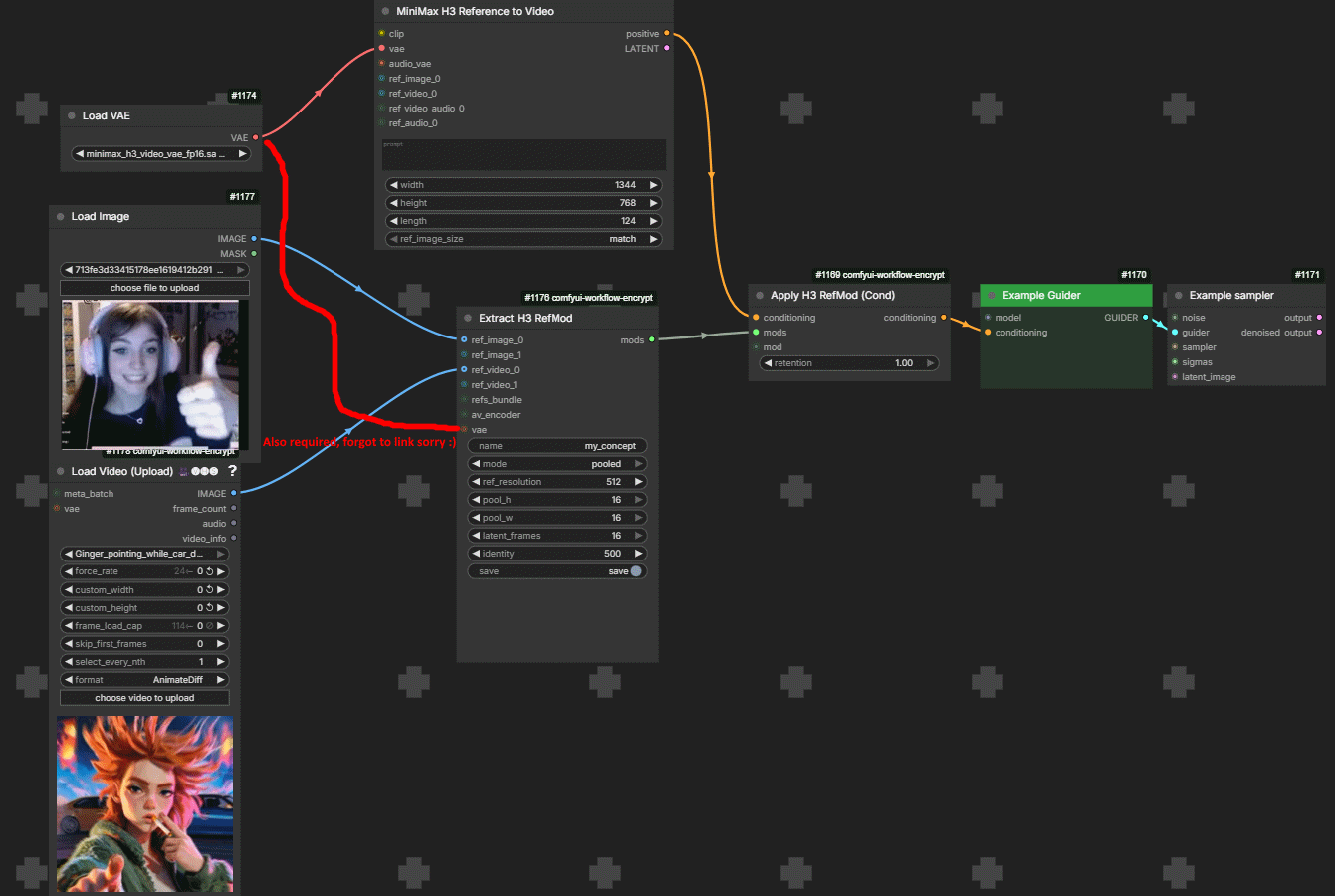
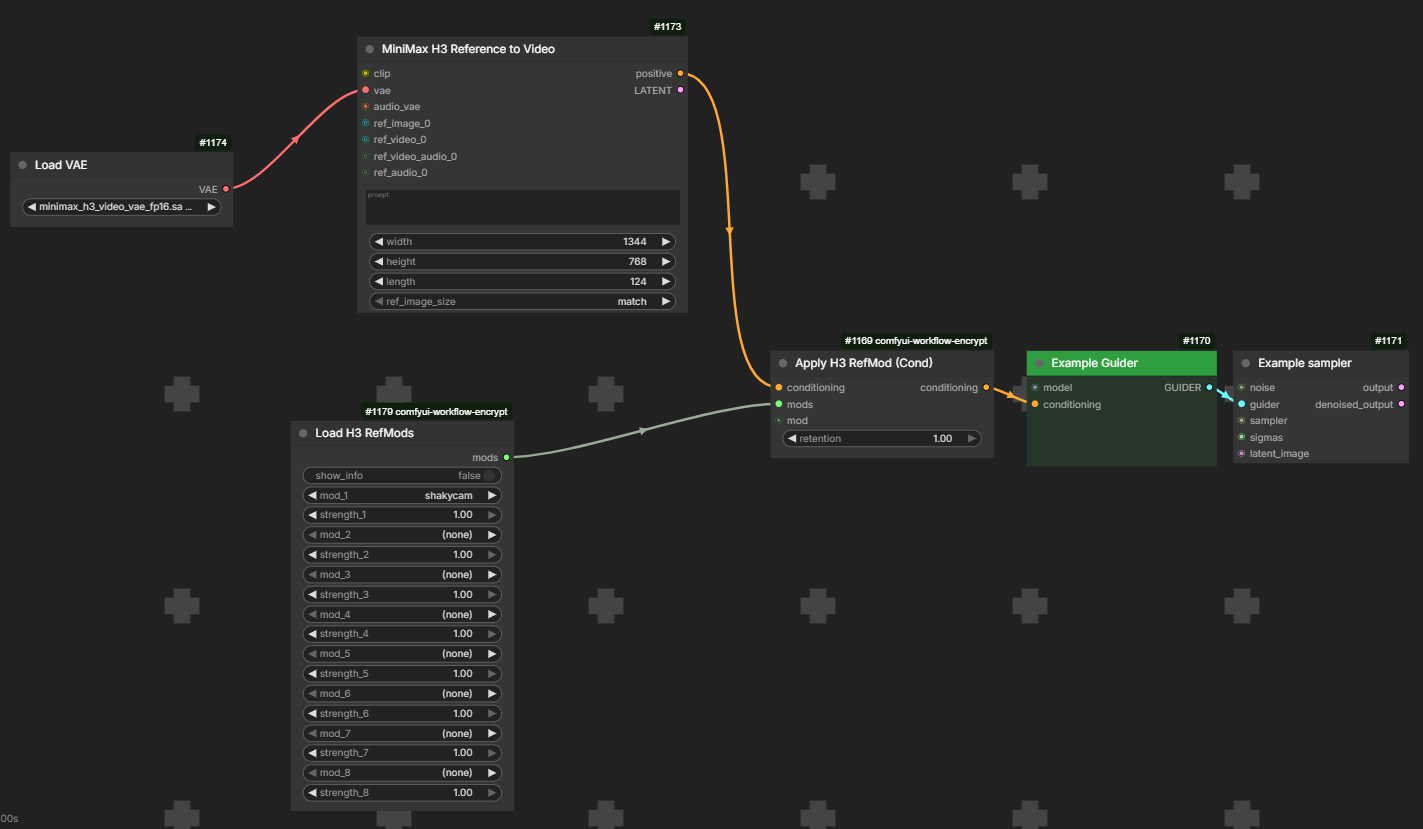
Loading mods
Load H3 RefMods with several mods stacked (LoRA-loader style, one
strength per row):
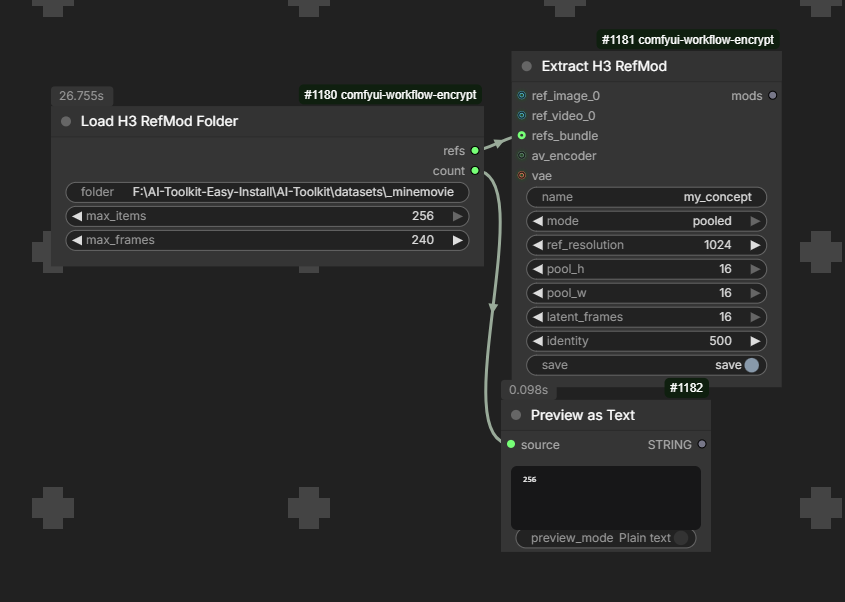
Loading a ref folder
Load H3 RefMod Folder pointed at an absolute path (a whole movie
dataset) — images + videos loaded in one shot, with the count shown in
the preview text:
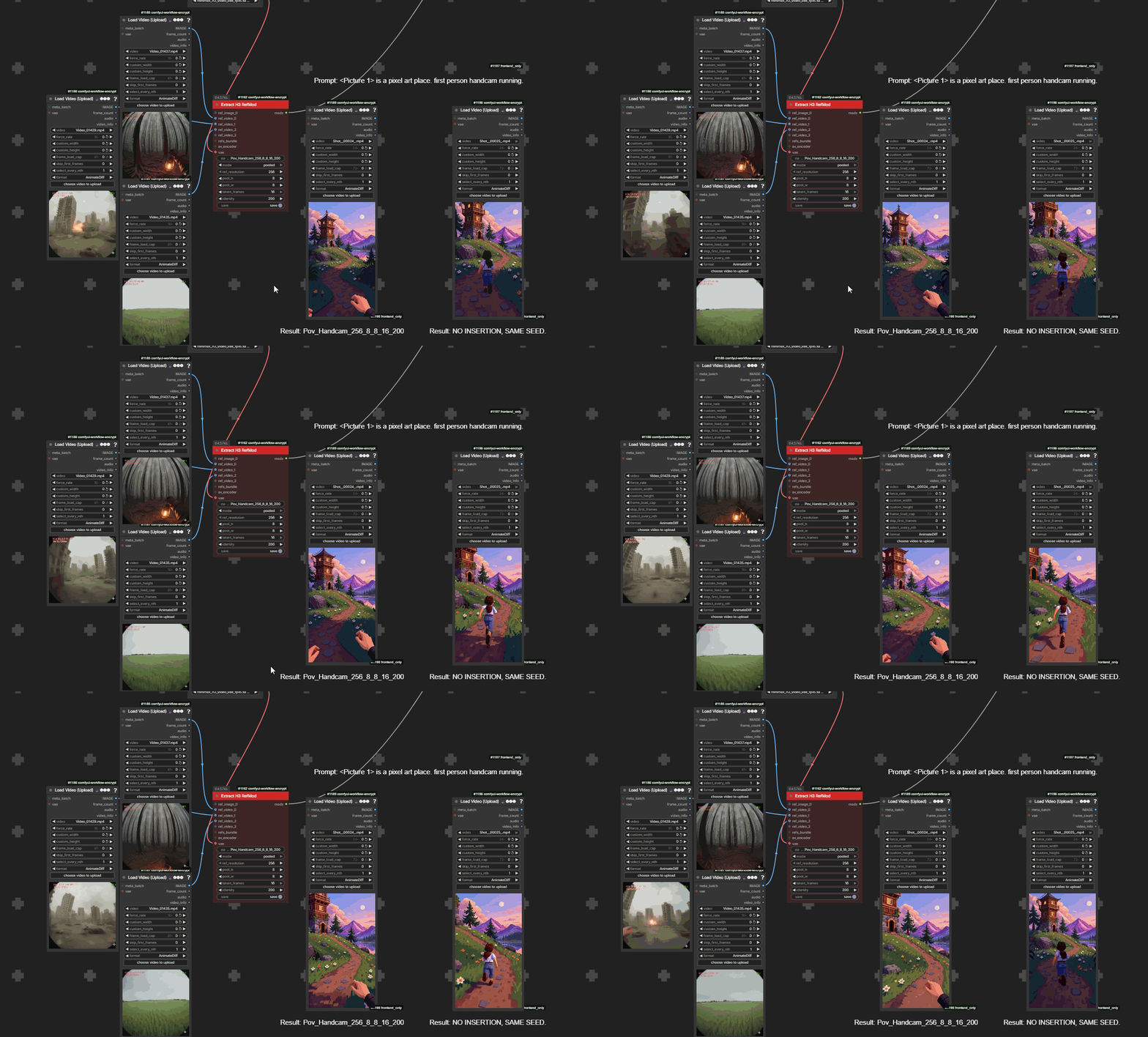
Pool-size examples
Observed results with 8×8 and 16×16 pools. These examples do not establish a universal concept/identity split:
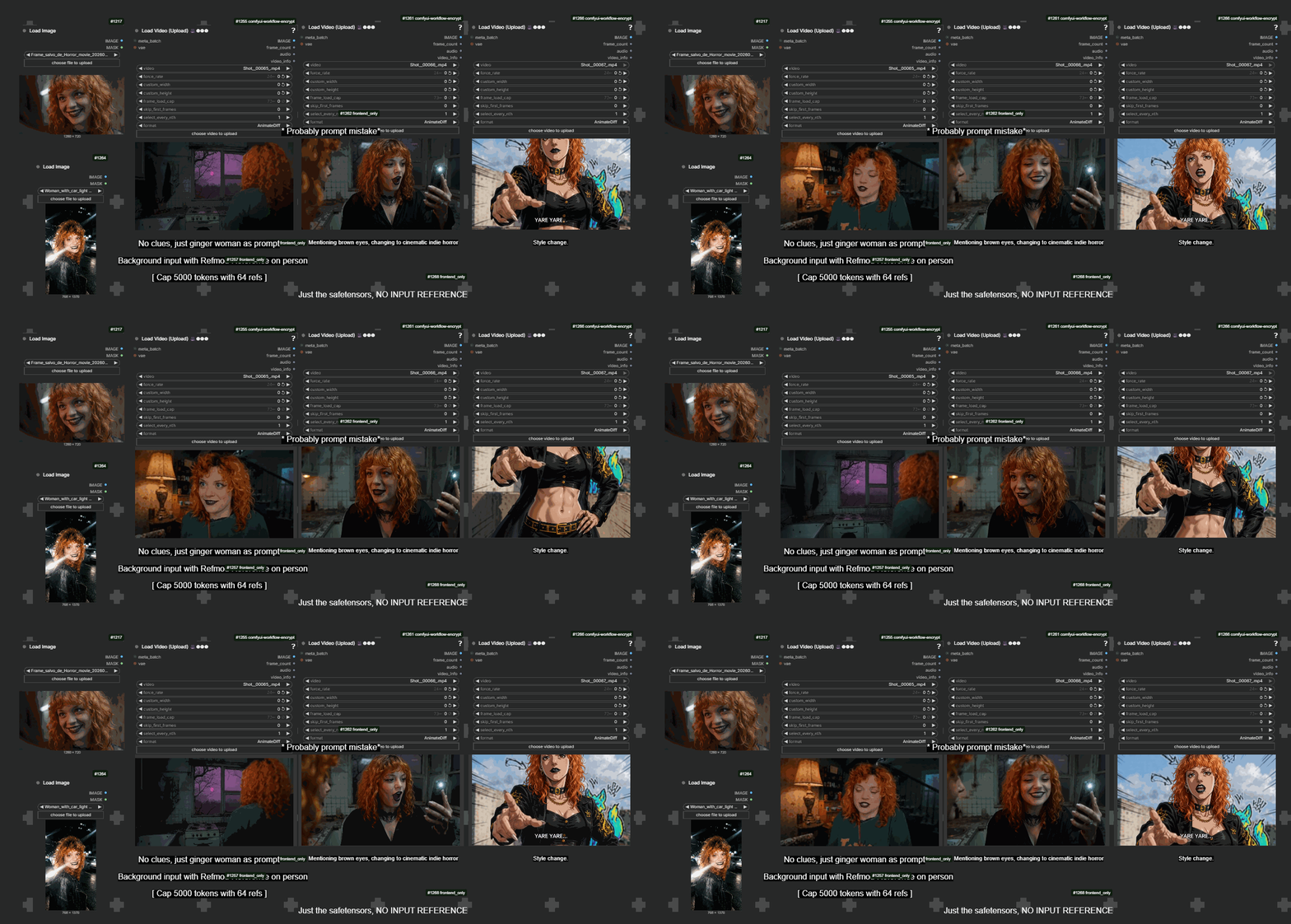
An identity success from real use — the author's own face extracted as a mod and prompted as "ginger woman", and a third example pushed into JoJo Bizarre-style rendering:
Curve controls
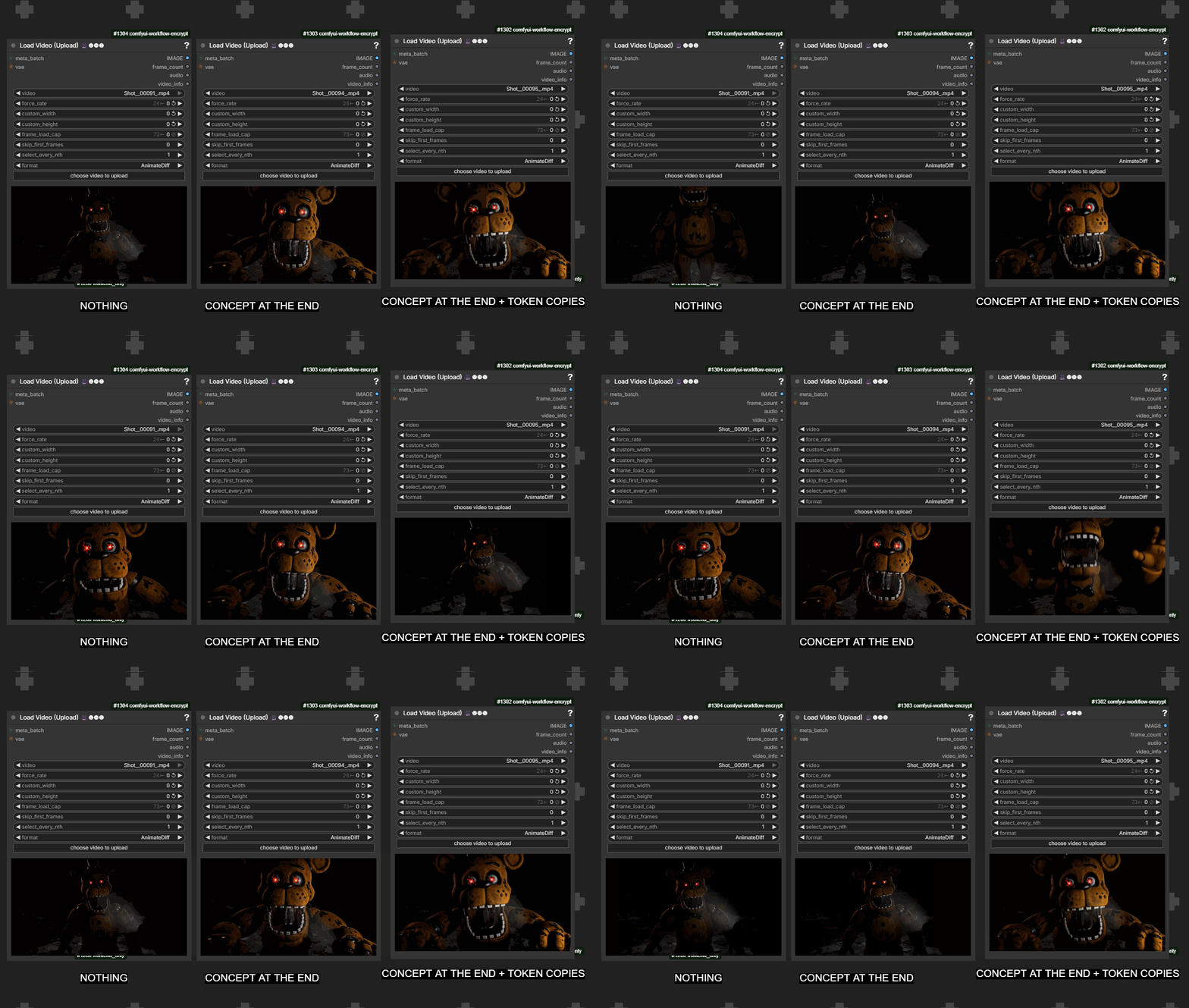
The same mod run three ways — no curve, concept_at_end, and
concept_at_end with the loader's copies set to 3 (the same row injected
three times; this example showed a stronger effect):
Known limitations
Fast, high-speed motion is the hard case. A quick sequence — Sasuke doing hand signs, a fight flurry, a rapid dance step — gets smeared into something slower and softer, because the reference is compressed into a handful of latent frames and the model fills the gaps with its own idea of how motion looks:
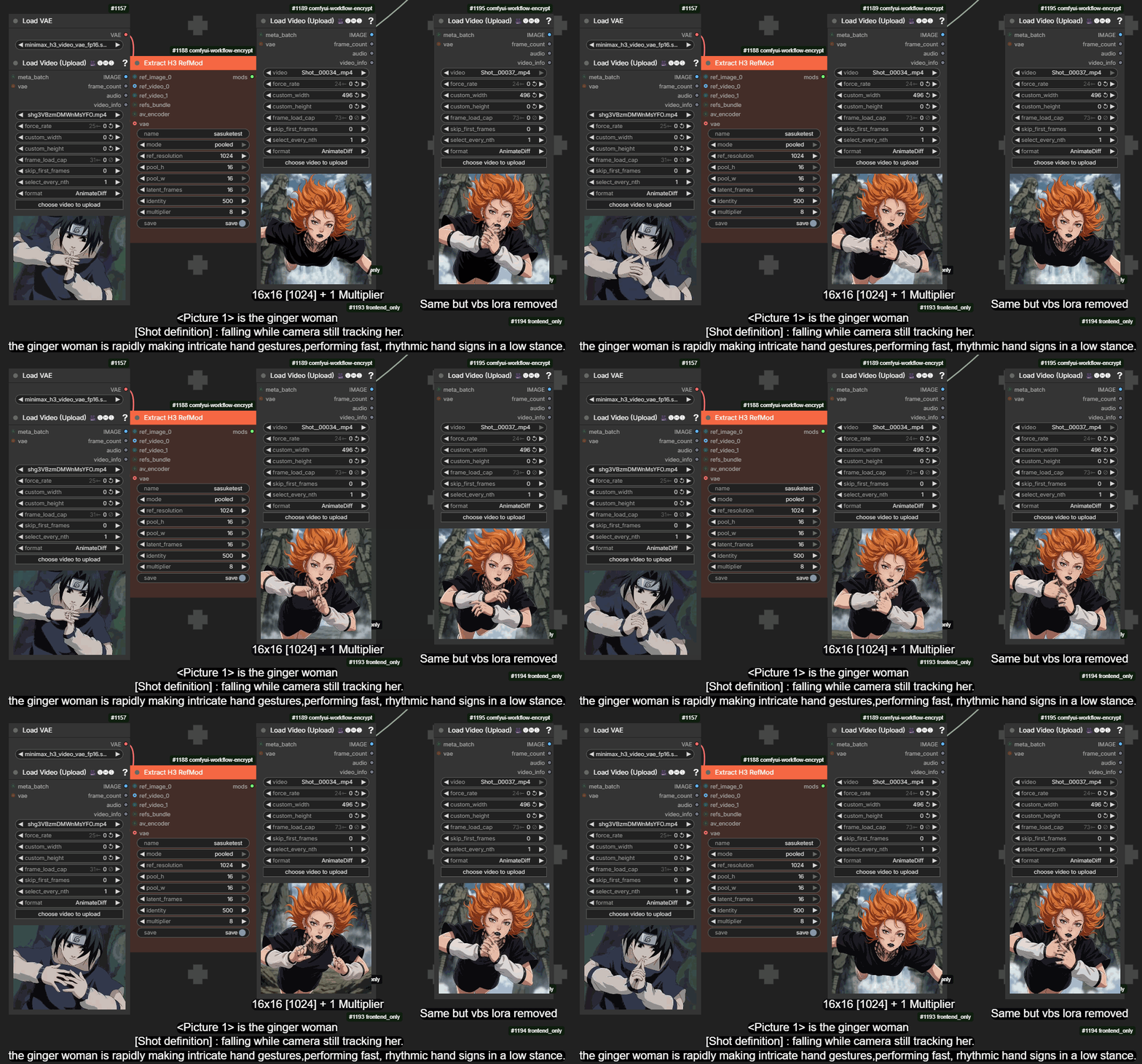
Things that help today: extract only the moments that matter (trim the
clip to the actual hand-sign burst instead of the whole scene), use more
latent_frames / a higher ref_resolution, and describe the motion in
the prompt so the model has an anchor for what it's seeing.
Bulk folder loading
Load H3 RefMod Folder reads supported images (png/jpg/webp/bmp/gif) and video
(mp4/webm/mov/mkv/avi) in a folder — images first, then videos, by filename.
Type an absolute path, or a folder name inside ComfyUI's input/ (empty =
input/ itself). Feed its refs_bundle output into Create H3 RefMod to
bulk-extract a whole character shoot in one go:
Load H3 RefMod Folder (folder: E:/vanellope_refs) ──refs_bundle──┐
                                                                  ├─ Create H3 RefMod ─> vanellope.safetensors
ref_image_1 (hand-picked shots) ─────────────────────────────────┘
Bundle refs are appended after the autogrow refs, so ref_image_1 still
anchors the canvas. Unreadable files are skipped with a note; max_items
caps the item count and max_frames caps the number of sampled video frames.
Multiple references and merge
By default, visual refs are encoded separately and stacked along the latent time axis. A video contributes a sequence, not just one frame. Spatial resizing, temporal pooling/sampling and the token cap can still discard information. In encode mode, multiple refs use a common canvas based on the first source; other aspect ratios can be center-cropped to fit it.
With merge=True in training mode, one grid minimizes mean reconstruction
error across targets. For equal target shapes, this has the same gradient as
reconstructing their average. That is not semantic discovery of what the
examples share: misaligned faces, motion and backgrounds can average into blur.
Compare merge against stacking rather than assuming it removes unwanted content.
The current refinement groups same-shaped targets on CPU and processes gradient contributions sequentially. This reduces repeated work; it does not change the objective into DreamBooth, Textual Inversion or control/target edit training.
Motion-only extraction (experimental)
For a motion-transfer comparison with native Ref2VA, start with one video,
Full Reference, multiplier=1, max_tokens=0 (or an adequate budget with
budget_policy=error), and enough source frames. On Apply, use retention=1,
curve_direction=constant, curve_shape=linear, curve_value=1, no preset
override, and scramble_seed=-1. A constant linear curve at 0 replaces
every reference frame with its blurred version; it does not disable the curve.
Spatial pooling and Refinement Steps do not affect Full Reference mode.
Use a Ref2VA checkpoint and reference workflow for this comparison.
MiniMax's model card
distinguishes FL2VA first/last-frame conditioning from Ref2VA video references.
Using the same first image in extraction and FL2VA generation does not make a
RefMod a motion controller. A still alone contains no temporal sequence;
connect the source clip to ref_video. RefMods guide generation through visual
references and do not guarantee an exact motion replay, even with Ref2VA.
Apply alone does not present the reference video to Qwen. Compare with H3 RefMod Text Encode when the workflow accepts external conditioning, using the reported Video label and without applying the same refs twice. This reconstructs visual presentation from saved latents, so it is still not an exact replay of native Ref2VA preprocessing or source timing. Dense textual motion descriptions are not a replacement for the reference's visual input. These are diagnostic settings, not validated optimal settings or a guarantee of motion fidelity.
For longer video references, increase latent_frames and the token budget
together. In encode, latent_frames limits sampled source frames before
the VAE's temporal compression. The count is snapped down to H3's 17k+5
video grid (5, 22, 39, ...), then sampled across the full clip, including its
last frame when more than one frame survives. For example, a limit of 16
selects 5 frames; a limit of 22 preserves all 22 frames of a 22-frame clip.
A source or limit below 5 uses only the first image, retaining RefMod's
still-image fallback. Already-aligned clips at or below the limit are unchanged.
The same grid applies before compressed-mode encoding and in the CLI;
motion-only differences are aligned after they are calculated. Uniform
sampling preserves the endpoints but changes the temporal spacing: it does
not preserve original timestamps or synchronize a separate soundtrack.
In training, latent_frames limits the
latent frames retained after encoding. It is not a duration in seconds.
max_tokens=0 disables the extraction token cap; loader/Apply/bridge budgets
are separate. Higher values increase memory and attention cost and do not
guarantee faithful motion transfer.
motion_only in training mode encodes normalized absolute frame differences,
abs(frame[t+1] - frame[t]). These highlight change, including camera motion,
lighting variation and compression artifacts. They can still reveal contours
and appearance, and absolute differences do not explicitly encode direction.
This is not optical flow, a pose trajectory or a trained motion-conditioning channel. H3 may interpret the difference images as visual content. Still-image refs retain their appearance with a warning. Treat this mode as an experiment, not as guaranteed separation of motion from identity or background.
Standalone extraction (visual only)
Use the Python environment that runs ComfyUI. Both commands set their mode
explicitly; the CLI default is training.
# Store the VAE encode as an identity comparison baseline
python custom_nodes/ComfyUI-MiniMaxH3Mod/extract_mod.py \
    --image char.png --vae path/to/h3_video_vae.safetensors \
    --name my_character --mode encode --resolution 1024

# Compressed video reference; evaluate motion loss against encode
python custom_nodes/ComfyUI-MiniMaxH3Mod/extract_mod.py \
    --video dance.mp4 --vae path/to/h3_video_vae.safetensors \
    --name dance --mode training --pool 16 --latent-frames 16 --identity 500
Other options include --pool-w, --max-tokens, --multiplier, --subfolder,
--output, --max-edge, --max-frames, --description, --concept-type and
--device. Run --help for defaults. Video decode uses OpenCV or imageio.
Files use embedded metadata; legacy JSON sidecars remain supported.
Validation and experimental training status
Apple Silicon
RefMod uses native ComfyUI H3 models and ordinary PyTorch operations. Visual
pooling and strength blurring explicitly use CPU for MPS-resident latents,
then return the result to the original device and dtype. This covers GPU-only
intermediates without requiring PYTORCH_ENABLE_MPS_FALLBACK=1. CPU and CUDA
paths retain their existing arithmetic; model/VAE execution can still use MPS.
The transfers add preprocessing work for GPU-resident references, rather than
moving diffusion inference to CPU.
Run PYTORCH_ENABLE_MPS_FALLBACK=0 python -m unittest compatibility_regression_test -v
with ComfyUI's Python for the frame-grid, CPU/MPS pooling, blur, gradient and
timing-backend checks. MPS tests skip on other platforms. A checkout outside
ComfyUI needs its ComfyUI directory on PYTHONPATH. The existing
python issue_regression_test.py also checks node/CLI frame selection.
python gauntlet_harness.py --device mps --output gauntlet_mps.json synchronizes
MPS before and after each timed refinement. Its CUDA memory field remains null
on MPS; it is not an Apple GPU peak-memory measurement.
The corrected video grid changes newly extracted video RefMods that previously used 4k+1 sampling/trimming. Existing saved RefMods remain readable, but must be re-extracted to recover source frames that were discarded. These compatibility fixes are not a claim of improved identity, motion or voice quality.
Other validation
Run production regressions with python -m unittest discover -s tests -v.
The suite covers loaders/queue validation, storage, caches, curves, bridge,
Master orchestration and audio storage. Codec checks used a real audio VAE;
these are not full H3 voice/visual quality evaluations.
gauntlet_harness.py compares three implementations of the existing model-free
MSE refinement. tests/h3_gradient_probe.py is a separate gradient-feasibility
experiment with a small randomly initialized H3 architecture. Its success does
not establish compatibility with a full INT8/ConvRot checkpoint, memory fit,
concept learning or edit quality. A train-through-H3 ComfyUI node is not yet
implemented. See REVIEW_FOLLOWUP.md for recorded results.
License
MIT — © 2026 Luisa (luisacaotica).