
KurdKnight ComfyUI System Check Node
A comprehensive system information node for ComfyUI that provides detailed information about your system, GPU, CUDA, and AI libraries configuration. Works on both Windows and Linux systems.
Nodes (3)
The node that tells you why your ComfyUI got slow and weird
The node that tells you why your ComfyUI setup is being weird
The quiet second half of the System Check node
ComfyDoctor
Diagnoses what is actually broken in a ComfyUI Python environment — and repairs it in one click.
ComfyUI runs on a single shared Python environment that dozens of independently written
custom nodes install into. In practice that environment drifts: a CPU-only PyTorch quietly
replaces a CUDA build, two nodes demand incompatible versions of the same package, or three
installs fight over the same cv2 folder. Nothing errors at startup — things simply run slowly,
or fail deep inside a render.
ComfyDoctor scans for these specific, real-world failures. For each one it explains the concrete effect on your setup and, where possible, offers a one-click fix that runs against the correct Python interpreter for your install.
<table> <tr> <td width="50%"><img src="docs/panel.png" alt="ComfyDoctor findings"></td> <td width="50%"><img src="docs/environment.png" alt="ComfyDoctor environment inventory"></td> </tr> <tr> <td align="center"><b>Findings</b> — what is wrong, what it means for you, and a one-click fix</td> <td align="center"><b>Environment</b> — your full stack, and what each library is for</td> </tr> </table>It also works when ComfyUI won't start. A broken PyTorch stops ComfyUI from finishing boot, so a diagnostic node can never load — it is unavailable at exactly the moment it is needed. ComfyDoctor therefore ships a standalone command-line launcher for that case.
Every finding states what it is, what effect it has, and how to resolve it — with a button that runs the fix against the correct Python for your install. The Environment tab provides a full system-and-library inventory.
<details> <summary><b>Exported report</b> (self-contained HTML, works in light and dark, paths anonymized)</summary>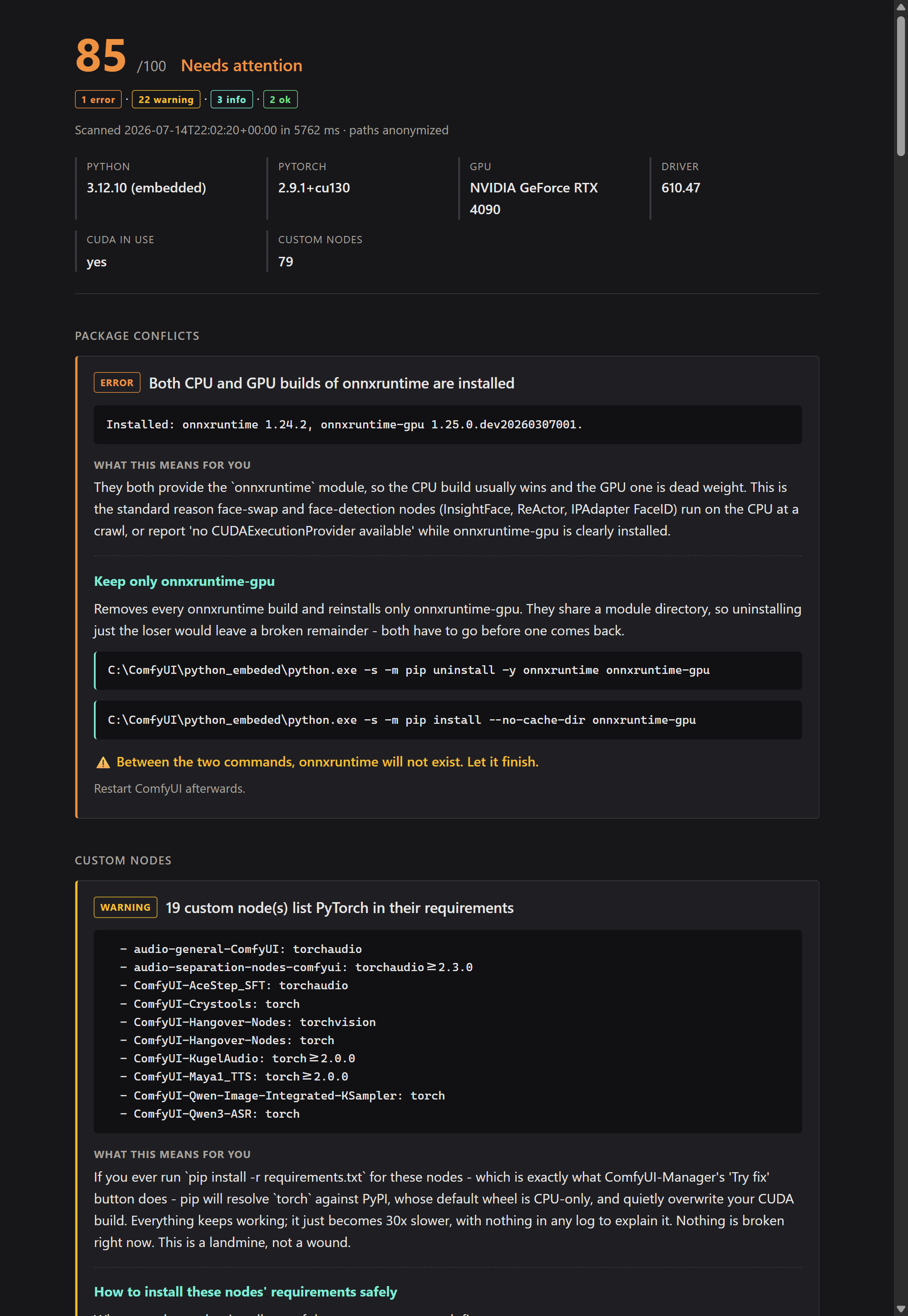
Installation
Via ComfyUI Manager — search for ComfyDoctor, click Install, then restart ComfyUI.
Manually:
cd ComfyUI/custom_nodes
git clone https://github.com/Kurdknight/Kurdknight_comfycheck
Restart ComfyUI. There are no heavy dependencies — ComfyDoctor needs only psutil and
packaging, both of which ComfyUI already installs.
Usage
The sidebar panel
Open the Doctor tab in the ComfyUI sidebar. It scans automatically when opened and lists every issue grouped by severity, with a Fix this button wherever an automatic fix exists. Fixes run in the background, and their pip output streams live into the panel.
The command line (works even when ComfyUI won't start)
When a broken environment prevents ComfyUI from starting, the panel cannot load. The command-line launcher runs off the same engine and reports the same findings.
Windows: double-click comfydoctor.bat in this folder. It locates ComfyUI's real Python
interpreter automatically and prints a full diagnosis.
Any platform:
# ComfyUI portable
python_embeded\python.exe -s ComfyUI\custom_nodes\Kurdknight_comfycheck\doctor.py

# venv / conda / system install
python ComfyUI/custom_nodes/Kurdknight_comfycheck/doctor.py
Common options:
python doctor.py                    # full diagnosis
python doctor.py --quiet            # only the problems
python doctor.py --env              # full environment inventory
python doctor.py --markdown         # anonymized report, ready to paste into an issue
python doctor.py --html report.html # a self-contained HTML report
python doctor.py --fix <finding-id> # apply one fix (id shown in brackets)
The exit code is 0 when clean, 1 on warnings, and 2 on errors — so a launch script can be
gated on it.
The node
A single node, ComfyDoctor Report (category utils/ComfyDoctor), outputs the report as a
STRING alongside a 0–100 health score, for use inside a graph — for example piping the report
into a text overlay or saving it beside a batch render. The interactive panel remains the primary
way to view and fix issues.
What it checks
PyTorch
- CPU-only PyTorch installed on a machine with an NVIDIA GPU. Nothing errors; renders are simply
20–50× slower, indefinitely. Usually caused by a custom node's
requirements.txtpulling plaintorchfrom PyPI over an existing CUDA build. torch/torchvision/torchaudiofrom mismatched releases (which surface as errors such asoperator torchvision::nms does not exist).- Build tags that disagree — for example a
cu124torch beside acputorchvision. - An NVIDIA driver too old for the installed CUDA build.
Attention backends
- xformers / flash-attn / sageattention compiled against a different PyTorch than the one installed. This is read from package metadata, so the mismatch is caught without importing the package (which would otherwise abort the process).
- The Linux-only
tritonpackage installed on Windows, wheretriton-windowsis required.
Package conflicts
- Everything
pip checkwould report, restated with the cause and the fix in plain language. onnxruntimeandonnxruntime-gpuboth installed — a common reason InsightFace / ReActor / IPAdapter FaceID silently fall back to CPU.- Multiple OpenCV variants competing for the same
cv2folder. - numpy 2.x installed alongside packages built for numpy 1.x (
_ARRAY_API not found). - The same package installed twice in different site-packages directories, so
pip install --upgradeappears to work while ComfyUI keeps loading the old copy. - Any two distributions claiming the same import name.
Custom nodes
- Which nodes failed to import, cross-referenced with why — for example "IPAdapter_plus failed, and it requires insightface, which is not installed."
- Nodes that loaded but whose requirements are unmet, which typically fail later, mid-render.
- Nodes whose version pins genuinely contradict one another, where no single install can satisfy both and a choice has to be made.
- Nodes that list
torchin theirrequirements.txt— a risk, because installing them can silently replace a CUDA PyTorch with the CPU wheel.
System — Python version against what the ecosystem supports, free space on the drive ComfyUI
is actually installed on, system RAM, VRAM, and the exact pip command for your interpreter.
How it works
Findings come from package metadata, not from importing packages. Version and build
information is read from the .dist-info records on disk (importlib.metadata) and from
nvidia-smi. ABI-bound packages such as xformers and flash-attn are never imported, because
importing one built against a mismatched PyTorch does not raise a clean ImportError — it aborts
the process. PyTorch itself is the one package that must be probed directly; when it is not
already loaded, that probe runs in an isolated subprocess, so a crashing CUDA/driver pairing is
reported rather than fatal.
Fixes are safe by construction. The browser never sends a command. It sends a finding id,
and the server runs only the argument list it generated itself during the last scan. Commands are
executed as argv lists with shell=False — no shell, no quoting, no injection surface. Only one
repair runs at a time, because two concurrent pip processes writing the same site-packages is how
a recoverable environment becomes an unrecoverable one.
Reports are anonymized. Your username and home path are stripped from exported reports, so a report can be pasted into a public GitHub issue or a Discord help channel without leaking personal details.
Compatibility with earlier versions
The previous SystemCheck and SystemViz nodes are aliased onto the new ComfyDoctor Report
node, so workflows saved with an older version continue to open without changes.
License
MIT — see LICENSE.