
ComfyUI Flakes
Stackable preset 'flakes' (prompt + LoRA + resolution + ControlNet) inserted between a checkpoint and a sampler.
Nodes (12)
Queue every character × style × pose combination and go make tea
Unpack one flake_data wire into every value it's hiding
Unpack a flake_data bundle, but only the pins you actually need
The whole sampler pipeline in one node — with optional face-fixing and upscaling bolted on
Fix one region of the frame without leaving your preset ecosystem
IPAdapter FaceID, minus the wiring
Flake Model Combo
Model, VAE, prompts, sampler, resolution
Stack LoRAs, prompts, and ControlNets from one YAML file
Push your ordinary ComfyUI graph into the flake_data world
Swap one thing in a flake_data bundle without rebuilding it
See what's actually in that flake_data wire — without breaking it

Reusable config presets — swap characters, styles, poses, checkpoints and more without rewiring your workflow
ComfyUI Flakes is a set of nodes aiming to facilitate batch generation of images with reusable presets. Combine LoRAs, prompts, controlnets and more into a flake.yaml file that can be loaded, swapped, disabled and tweaked easily within the Flakes ecosystem.
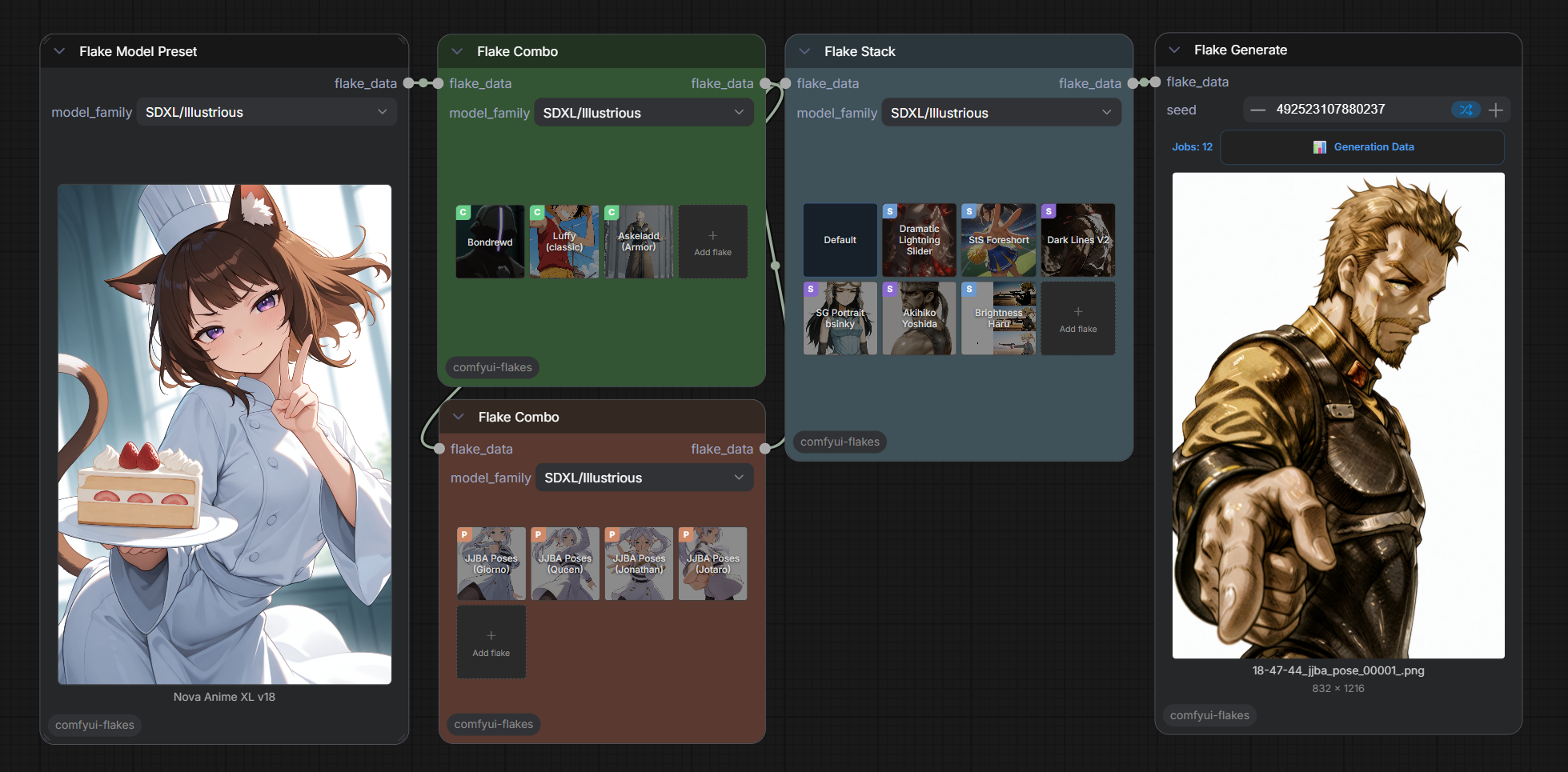
Installation
Via ComfyUI Manager (Recommended)
Search for ComfyUI Flakes and click Install.
Manual
cd ComfyUI/custom_nodes
git clone https://github.com/JeyzerMC/comfyui-flakes
No extra dependencies — PyYAML is already part of ComfyUI's core.
Flake file format
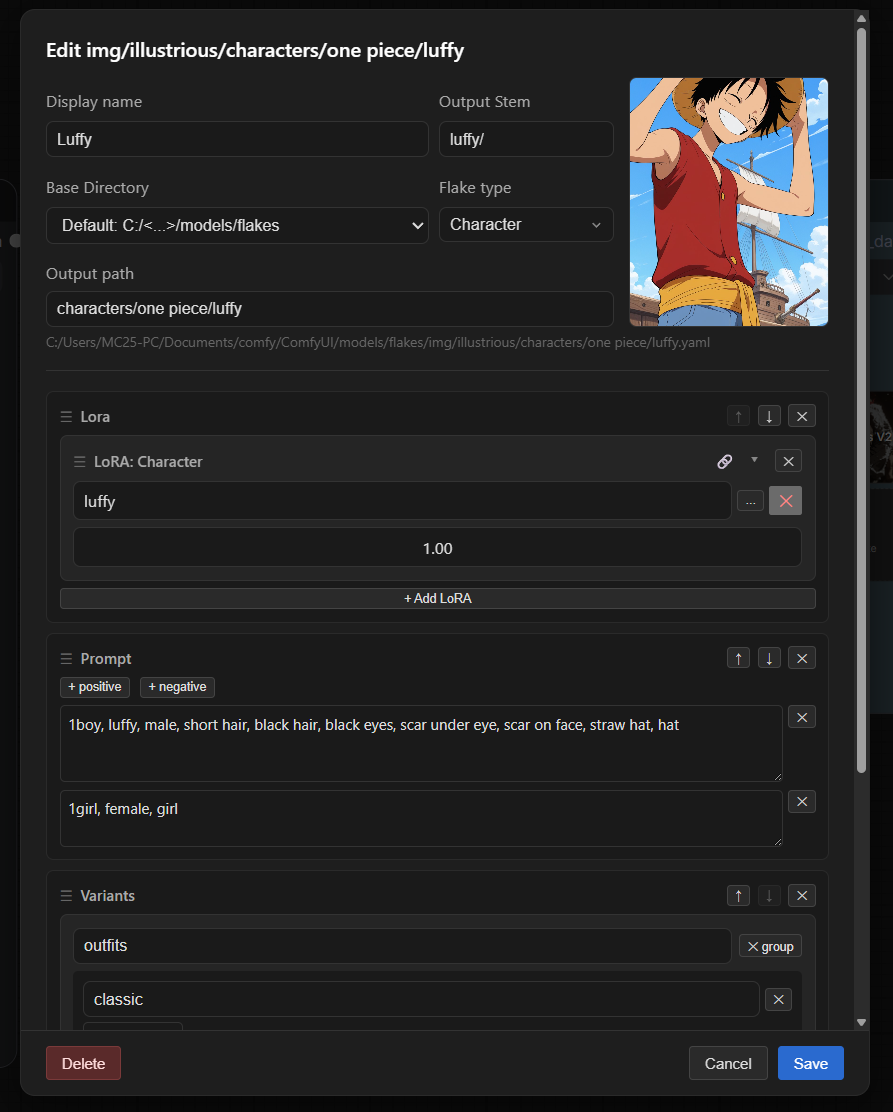
Flakes are reusable .yaml config files under ComfyUI/models/flakes/. They can represent any image generation concept, such as a character, a style, an environment, a pose, etc. Each flake has a number of different fields it can have that will be passed during the generation.
The only field required inside the YAML is name — the display label used everywhere in the UI. The flake's stable identifier is its filename relative to models/flakes/ (subfolders included — characters/musashi.yaml is loaded as characters/musashi); that's the "output path" and lives in the filesystem rather than the file. Every other field below is optional — include only what your flake needs.
# ─── Required ─────────────────────────────────────────────────────────────
name: "Miyamoto Musashi"        # Display name shown in the UI and pickers

# ─── Optional fields ──────────────────────────────────────────────────────

# Prompt fragments contributed to the stack. Either side can be omitted.
prompt:
  positive: "1boy, miyamoto musashi, long wild black hair"
  negative: "modern clothing, glasses"

# LoRAs — list of one or more entries. `path` is the model path under
# `models/loras/`; `name` and `url` are metadata for the picker / link icon.
loras:
  - name: "Musashi"
    url: "https://civitai.com/models/..."   # optional, shown as link icon
    path: "<lora_path>/musashi"                # under models/loras/
    strength: 0.9                           # default 1.0

# Default resolution for the generation. The first flake in the stack that
# declares a `resolution` wins; otherwise it falls back to 1024 × 1024.
resolution: [832, 1216]

# Cover image shown on the flake's grid block and in the picker. Path is
# resolved under `models/loras/` (or, for legacy flakes, the sibling image
# of a .safetensors file).
cover_image: "<lora_path>/musashi.png"

# Variant groups — the UI lets you pick one choice per group. Each choice
# can contribute extra positive/negative text and an optional preview image.
variants:
  outfit:
    ronin:
      positive: "tattered kimono, frayed hakama"
      negative: "armor"
      image: "<lora_path>/musashi_outfit_ronin.png"    # optional preview thumbnail
    shirtless:
      positive: "shirtless, hakama only"
  mood:
    calm:
      positive: "serene expression"
    fierce:
      positive: "battle stance, narrowed eyes"

# ControlNets — one entry per ControlNet to apply.
controlnets:
  - type: openpose                            # ControlNet category label
    model: control_openpose_xl.safetensors    # file under models/controlnet/
    image: standing_openpose                  # file under ComfyUI/input/
    strength: 0.8                             # default 1.0
    start_percent: 0.0                        # default 0.0
    end_percent: 1.0                          # default 1.0

# Filename stem injected into `Save Image`'s filename_prefix when this flake
# is in the stack. Multiple flakes' stems are joined with underscores.
output_stem: "musashi"

# Flake links — pull in one or more other flakes' loras + prompts when this
# flake is used. Each link can set default variant choices and lora-strength
# overrides for its target. (A single legacy `flake_link:` mapping is still
# read for backwards compatibility.)
flake_links:
  - target: "styles/ink_wash"          # another flake's output path
    variant:
      intensity: heavy                 # default variant choice on the target
    lora_strengths: [0.8]              # per-lora overrides (null = target default)
  - target: "poses/standing"
Prompts are joined with BREAK between flakes so each flake acts as an independent CLIP region. LoRA strengths and variant choices can be overridden per-instance from the grid item's option panel without modifying the file on disk.
Flake Model Preset
A Flake model preset is a config for checkpoints. Alongside the SDXL family it supports Anima, Krea2 and Z-Image.
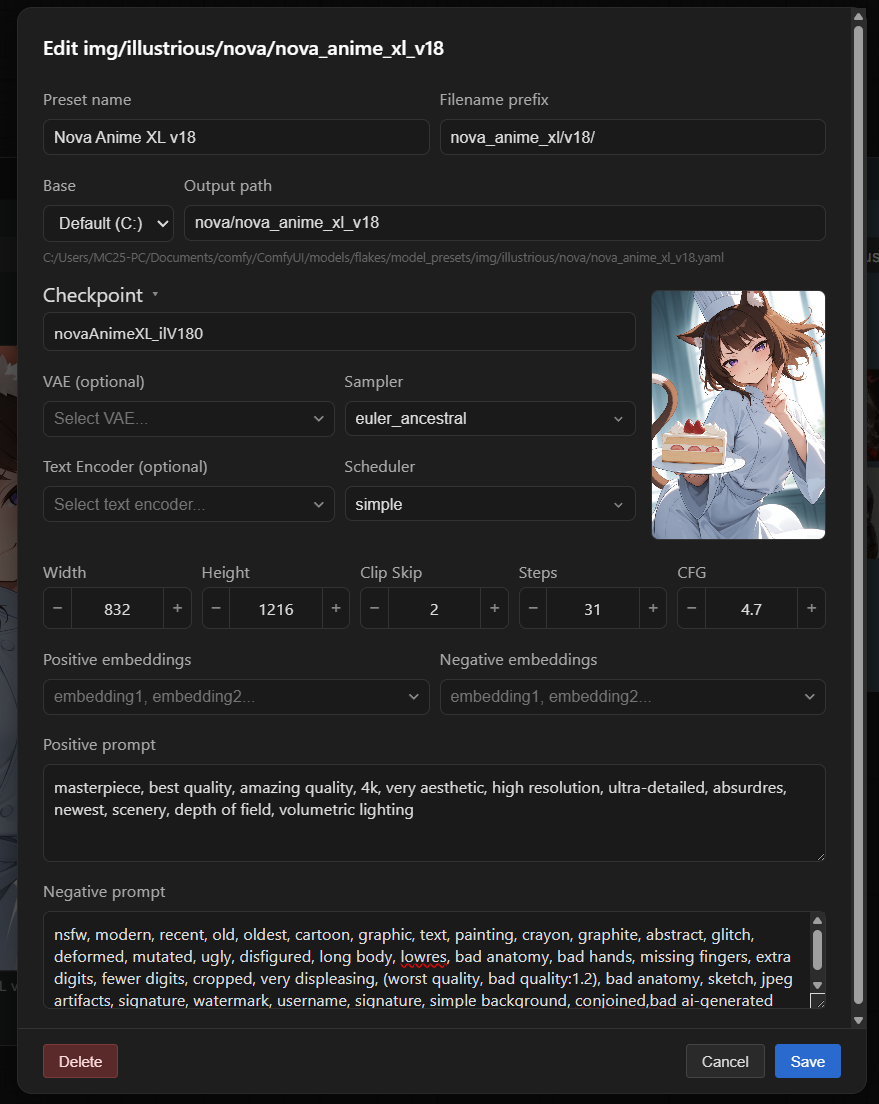
Model families
The model_family dropdown picks both the on-disk layout (img/<folder>/ under
models/flakes/, models/flakes/model_presets/ and output/) and how the model
is loaded and sampled.
| Family | Folder | Model file | Text encoder | Encoder type | VAE |
|---|---|---|---|---|---|
| SDXL/Base, SDXL/Illustrious, SDXL/Pony | sdxl, illustrious, pony | all-in-one checkpoint | baked in | STABLE_DIFFUSION | baked in |
| Anima/Base | anima | anima-base-v1.0 | qwen_3_06b_base | STABLE_DIFFUSION | qwen_image_vae |
| Krea2/Turbo | krea2 | krea2_turbo_fp8_scaled | qwen3vl_4b_fp8_scaled | KREA2 | qwen_image_vae |
| ZImage/Base, ZImage/Turbo | zib, zit | z_image_turbo_bf16 | qwen_3_4b | LUMINA2 | ae.safetensors |
SDXL presets need only a Checkpoint. The other families ship as a bare
diffusion model, so they also need a Text Encoder, its Text Encoder Type
and a VAE. Point the preset at either a Checkpoint or a Diffusion
Model — a UNET-only file that happens to live in models/checkpoints/ is
detected automatically, so you don't have to move it.
Presets seed their sampler defaults from the family (Z-Image and Krea2 Turbo: 8 steps at CFG 1; Anima base: 30 steps at CFG 4). At CFG ≤ 1 the negative prompt is zeroed out, matching how distilled models are sampled. Clip Skip is hidden for the Qwen-based families, where it does not apply.
Anima, Krea2 and Z-Image require ComfyUI v0.34 or newer. Their architectures and the
KREA2encoder type do not exist in older releases.
ControlNets for Anima and Z-Image
A flake's ControlNet field works the same for every family: pick an image, a
type, then tweak strength, start and end. Anima and Z-Image don't use regular
ControlNets, though. Their ControlNets are model patches that hook the
diffusion model, so the files go in models/model_patches/, not
models/controlnet/:
| Family | Folder | Files | Types |
|---|---|---|---|
| Anima/Base | models/model_patches/anima/ | anima-lllite-{pose,depth,lineart,scribble}-1 (Comfy-Org/Anima-LLLite) | openpose, depth, lineart, scribble |
| ZImage/Base, ZImage/Turbo | models/model_patches/zimage/ | Z-Image-Turbo-Fun-Controlnet-Union (any version) | openpose, depth, canny, softedge |
- Anima depth expects a Depth Anything V2 map (white = near). The pose model is noticeably weaker than depth; for locking a pose, depth works better.
- The Anima LLLite weights are Preview3 releases and lose some quality on Anima Base v1.0.
- Z-Image's Fun ControlNet has no start/end: it applies to every step.
- The base model is not reloaded when switching flakes. Each patch is a hook on a clone that shares its weights, and recently used patch files stay cached.
Nodes
Flake Stack
Sits between your checkpoint loader and sampler. Loads an ordered list of flakes (YAML presets), merges their prompts and LoRAs, and outputs everything the sampler needs.
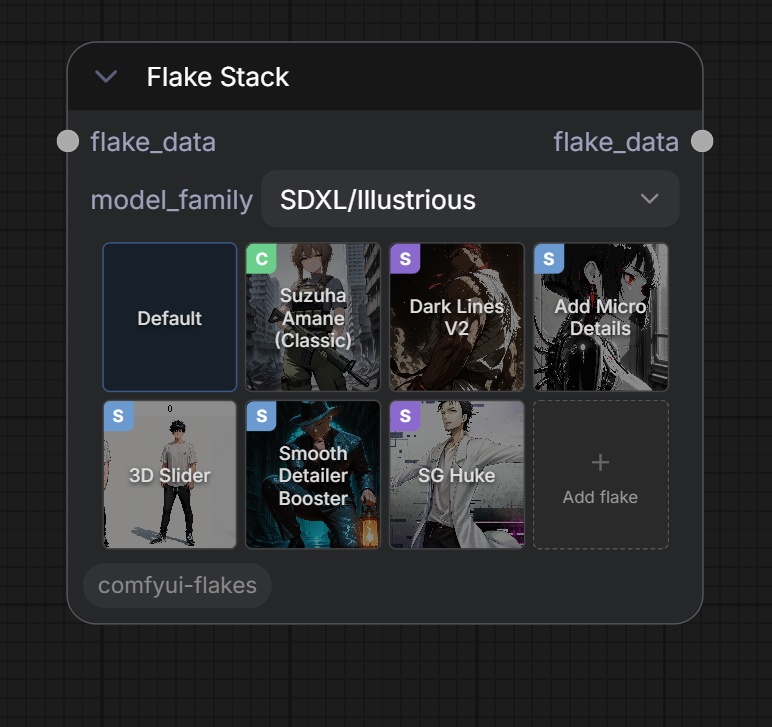
Flakes can be reordered, enabled / disabled, and edited. You can also open a small dropdown menu to make small non-persistent tweaks, such as changing a variant option, or a lora strength.
<div align="center">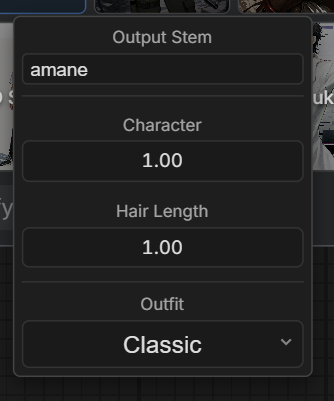
Flake Combo
TODO
Flake Model Preset
TODO
Flake Model Combo
TODO
Flake Generate
TODO
Flake Data Split
TODO
Roadmap
- Flux support
- Video support (Starting with WAN)
- Post Process (ADetailler / Upscalers)
- IP Adapters
- LoRA training
- Controlnet preprocessing
- Variant LoRAs?
Fill free to open an issue if you'd like more features supported by Flakes.
Changelog
See CHANGELOG.md for the full release history.