
Wan-video-extender
Wan Video Extender extends a short video or a single image into a longer, temporally consistent clip using a VACE based control latent. It runs in multiple extension loops. Each loop can have its own prompt and optional LoRA, so you can evolve the scene step by step without rebuilding the graph.
Nodes (2)
WAN Video Extender PRO
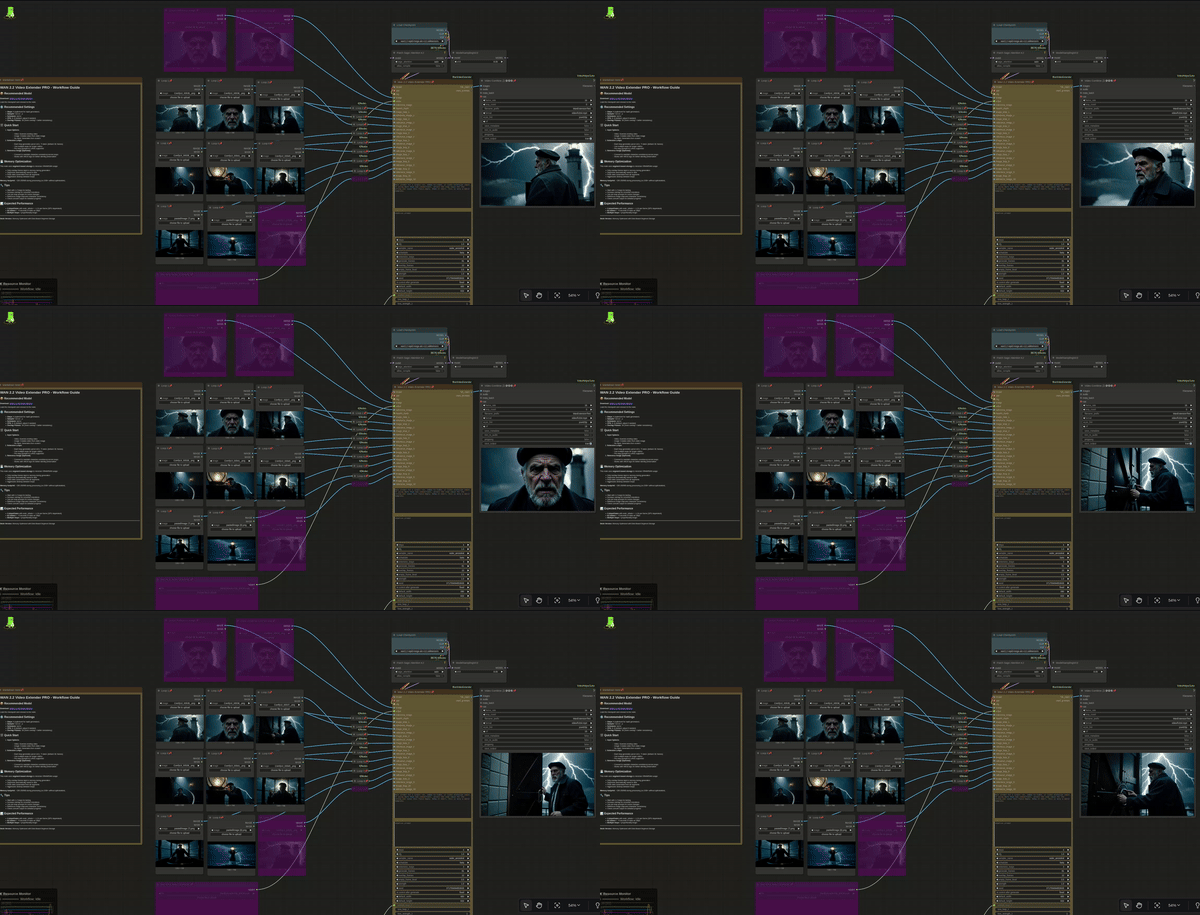
⚠️ Yes, I know this node looks like a high-rise building on your canvas. It's a skyscraper. But I built it this way because I'd rather give you a luxury high-rise of functionality than a sprawling slum of spaghetti wires.
[Update v2.0]: Added Memory-Optimized disk caching (infinite length support), VACE Endframe guidance, per-loop Image/Reference injection, and a new High/Low Noise Extender node.
🚀 Latest Update: Memory Optimization & Endframe Control
-
True High/Low LoRA Support: The High/Low Noise node now features dedicated, independent LoRA slots for both model stages, giving you granular control over the diffusion process.
-
Enhanced Loop Controls: Per-loop support for Hard Cuts (Image Injection), Reference Images (Character Consistency), and distinct LoRA patching.
v1.3.3
- fix for high-low-noise-node
- optional endframe für Extender-native-node
v1.3.2 - Logic Fixes & Memory Optimization
- Memory Fix: Resolved high RAM usage during final video assembly in both nodes - segments now merge incrementally instead of loading all at once.
- Reference Image Logic Fix (Native): Fixed
use_reference_loop_Xflags not being evaluated correctly - global reference image now properly respects per-loop toggles. - Workflow Updates: Updated example workflows for both native and high/low-noise nodes.
v1.3.0 - High/Low Noise Support (Beta)
- New Node: Added
WanVideoExtenderLowHighsupport. You can now use separate High/Low noise diffusion models and LoRAs for more precise control. - New Workflow: Included
wan-video-extender-high-low.jsonto get started with the split model setup. - Fix: Resolved issues with VACE module integration.
- ⚠️ Beta Warning: The High/Low node is currently in Beta. Please monitor your System RAM (CPU RAM, not VRAM). Usage may increase significantly after Loop 5 depending on your hardware configuration.
v1.2.1: VACE Fixes & Per-Loop Control
-
🐛 VACE Logic Fix: Fixed a critical bug where the Reference Image would overwrite the Input/Start frames. The start context is now correctly injected and protected.
-
🔄 Per-Loop Control: You can now set a unique Reference Image and toggle Overlap individually for every iteration loop.
-
💡 Transition Tip: Supports using the target image of the upcoming loop as the Reference Image for the current loop to create smoother transitions.
-
📂 New Workflow: Added an updated workflow example demonstrating these new looping features.
-
**(Note: Support for "High/Low Noise Models" is coming in a future update.)
Extend your WAN 2.2 videos with advanced features: per-loop prompts, LoRA switching, reference images, and smart overlap for maximum character consistency.
NEW: Memory-optimized architecture with disk-based segment storage - efficient RAM usage even for long videos!
📦 Recommended Model
Download: WAN2.2-14B-Rapid-AllInOne
Recommended Settings:
- Steps:
4(optimized for rapid generation) - Sampler:
euler_a - Scheduler:
beta - CFG:
1.0 - Overlap Frames:
8-24(more = better consistency)
🚀 Features
✅ Core Features
- Flexible Input Modes - Video input (extend existing), Image input (animate static image), or No input (pure T2V generation)
- Multi-Loop Video Extension - Extend videos through multiple generation cycles
- Memory Optimized - Segment-based storage keeps RAM usage efficient
- Smart Overlap System - Use last N frames as context for seamless transitions (4-64 frames)
- Custom Resolution - Set any resolution when starting without input (256-2048px)
🎨 Advanced Character Consistency
- Reference Image Support - Use a character portrait for consistent appearance across all loops
- Intermediate Image Injection - Insert new images between loops to guide the generation
- Per-Loop Prompts - Different prompt for each loop (up to 10 loops)
- LoRA Support - Load different LoRAs for specific loops
- Flexible Overlap - Higher overlap = better consistency (recommended: 16-24 frames)
💾 Memory Optimization
- Disk-Based Segments - Each loop saves to disk, only overlap kept in RAM
- Aggressive Cleanup - Unloads all models between loops to prevent VRAM leaks
- Smart Input Handling - Efficient video processing
- Final Assembly - Combines all segments from disk at the end
🔧 Installation
- Available directly via ComfyUI Manager! Just search for 'Wan Video Extender' or copy the node file to your ComfyUI custom nodes:
git clone https://github.com/Granddyser/wan-video-extender.git
pip install requirements.txt
🎯 Quick Start
Input Modes
1. Video Input (V2V) - Extend existing video
Input: Video → WAN Video Extender PRO
Result: Original video + extended frames
2. Image Input (I2V) - Animate static image
Input: Image → WAN Video Extender PRO
Result: Animated video from still image
3. No Input (T2V) - Pure text-to-video generation
No input connected
Settings: default_width=832, default_height=480
Result: Video generated from prompt only
Basic Settings
Settings:
  - extension_loops: 2-3
  - generate_frames: 81
  - overlap_frames: 16
  - steps: 4
  - cfg: 1.0
  - sampler: euler_a
  - scheduler: beta
  - positive_prompt: "your scene description"
⚠️ Resolution Handling
Important: The default_width and default_height parameters are only used for T2V (Text-to-Video) generation when no input image is provided.
When using I2V (Image-to-Video) or providing any image input:
- The node automatically uses the resolution of the input image
default_widthanddefault_heightare ignored- Make sure your input images are already at the desired resolution before feeding them to the node
🎓 Understanding Overlap
Overlap determines how many frames from your existing video are used as context for the next generation.
How it works:
Input: Your video frames

Loop 1:
  - Takes last N frames as context (overlap_frames)
  - Generates new frames
  - Adds only the new frames (skips overlap duplicates)

Loop 2:
  - Takes last N frames as context from previous output
  - Generates new frames
  - Adds new frames

Result: Original + all generated frames combined
Understanding Image Inputs
The node has two types of image inputs that serve different purposes:
1. Global image Input (Top of Node)
- Purpose: Initial starting image for the entire workflow
- Used once: Loaded at the beginning and provides context for Loop 1 (if
image_loop_1is empty) - Automatic context: Last N frames are kept as overlap context for subsequent loops
2. Loop-Specific image_loop_X Inputs (Per Loop)
- Purpose: Optional override for each individual loop
- Hard cut: When provided, creates a scene cut using these frames as new context
- Fallback behavior: When empty, automatically uses context from previous loop
Behavior Matrix
| Scenario | Global image | image_loop_1 | Result |
|----------|---------------|----------------|---------|
| Normal start | ✅ Provided | ⬜ Empty | Loop 1 uses global image |
| Hard cut Loop 1 | ⬜ Empty | ✅ Provided | Loop 1 uses loop image |
| Both provided | ✅ Provided | ✅ Provided | Loop 1 uses loop image (overrides global) |
| Auto-extend | ✅ Provided | ⬜ Empty (Loop 2) | Loop 2 extends from Loop 1's last frames |
Typical Workflow Example
Global image: Initial scene
  ↓
Loop 1: image_loop_1 = empty → Uses global image
  ↓
Loop 2: image_loop_2 = empty → Auto-extends from Loop 1
  ↓
Loop 3: image_loop_3 = Next-Scene LoRA output → Hard cut to new scene
  ↓
Loop 4: image_loop_4 = empty → Auto-extends from Loop 3
Key Point: Set the global image input once at the start. Use image_loop_X only when you want to inject a new scene at a specific loop.
Overlap Settings Guide
| Overlap | New/Loop | Speed | Consistency | Best For | |---------|----------|-------|-------------|----------| | 8-12 | 69-73 | ⚡ Fast | ⭐⭐ | Quick tests | | 16-20 | 61-65 | 🚀 Good | ⭐⭐⭐ | Recommended | | 24-32 | 49-57 | ⏱️ OK | ⭐⭐⭐⭐ | High quality | | 40-48 | 33-41 | 🐌 Slow | ⭐⭐⭐⭐⭐ | Maximum consistency |
Rule of thumb: More overlap = Better consistency, but slower generation.
🎨 Using Reference Images
Reference images drastically improve character consistency.
Setup:
LoadImage (Character portrait)
  ↓
WAN Video Extender PRO
  └─ reference_image input
Tips:
- Alternative: First frame from your input video
- Increase overlap up to 20 for higher consistence, but the final video will be shorter
🔄 Per-Loop Prompts
Each loop can have its own prompt for storytelling.
Example:
extension_loops: 4

positive_prompt: "woman in forest"  (fallback)

prompt_loop_1: "woman walking through sunlit forest"
prompt_loop_2: "woman discovers ancient ruins"
prompt_loop_3: "woman examining mysterious artifact"
prompt_loop_4: "woman holding glowing artifact at sunset"
Result: A video with narrative progression!
🎭 Per-Loop LoRAs & Prompts
Custom Prompts: Each loop can use a different prompt for scene changes.
LoRA Support:
Load different LoRAs for specific loops (without .safetensors extension).
💾 How Memory Optimization Works
Our efficient approach:
- Input: Extract only overlap frames needed → Delete rest
- Generation: Each loop generates segment
- Storage: Save segment to disk (
/tmp/wan_segments_XXX/) - Memory: Only overlap + current segment in RAM
- Final: Load all segments from disk and combine
Result: Generate long videos without running out of RAM!
Intermediate Images: You can also inject new images between loops by connecting different images to the image input for each workflow run, allowing you to guide the generation at specific points.
🎯 Advanced Workflows
Maximum Character Consistency
- Input: Portrait image
- reference_image: Same portrait
- extension_loops: 5
- overlap_frames: 24
- lora_loop_1: "your_character_lora" @ 0.8
- steps: 4, sampler: euler_a, scheduler: beta
Long Video Generation
- Input: 81 frames
- extension_loops: 8
- overlap_frames: 20
- generate_frames: 81
- Result: Extended long-form video
Style Evolution
- extension_loops: 4
- overlap_frames: 32
- Different LoRAs per loop for smooth style transitions
📝 Parameter Reference
Key Parameters
| Parameter | Default | Range | Description | |-----------|---------|-------|-------------| | extension_loops | 1 | 1-10 | How many times to extend | | generate_frames | 81 | 16-200 | Frames per loop | | overlap_frames | 16 | 4-64 | Context frames | | steps | 20 | 1-100 | Sampling steps (try 4 for rapid) | | cfg | 1.0 | 0-100 | CFG scale (1.0 recommended for WAN 2.2 Rapid) | | sampler_name | - | - | euler_a recommended | | scheduler | - | - | beta recommended | | strength | 1.0 | 0-10 | VACE strength | | seed | 0 | 0-∞ | Random seed |
Optional Inputs
| Input | Description | |-------|-------------| | image | Input image to extend | | video | Input video to extend | | reference_image | Character reference for consistency | | prompt_loop_1..10 | Per-loop custom prompts | | lora_loop_1..10 | Per-loop LoRA files | | lora_strength_1..10 | LoRA strengths |
📄 License
This node is provided as-is for use with ComfyUI and WAN 2.2.
Special thanks to phr00t for the complete model.
☕ Support the Project
Building optimized tools requires deep dives and long hours. I build this because I believe in pushing the boundaries of what's possible locally. If you share that vision, your support helps bridge the gap between a rough experiment and a polished tool for everyone.
<a href="https://www.buymeacoffee.com/granddyser"> <img src="https://img.shields.io/badge/Buy%20Me%20a%20Coffee-ffdd00?style=for-the-badge&logo=buy-me-a-coffee&logoColor=black" alt="Buy Me a Coffee" /> </a>