
Eric LoRA Catalog
Find your LoRAs by what they do, not by folder name. A local vision LLM (LM Studio or Ollama, e.g. Qwen3-VL) writes a card for every LoRA in your library: its role (style, lighting, detailer, subject...), look, genre and mood, trigger words, good weights and NSFW level. You review and correct the cards in a fast browser editor that also searches, rates, de-duplicates and moves files with undo. Civitai data shows how each LoRA ranks against others of its base model, the weights people really use and the prompts they make with it. The LoRA Suggester node reads your prompt and stacks the LoRAs that fit, with per-stage weights and an NSFW gate. A ComfyUI sidebar panel refreshes the catalog. Everything runs on your machine; works standalone for Forge and A1111 too.
Eric LoRA Catalog
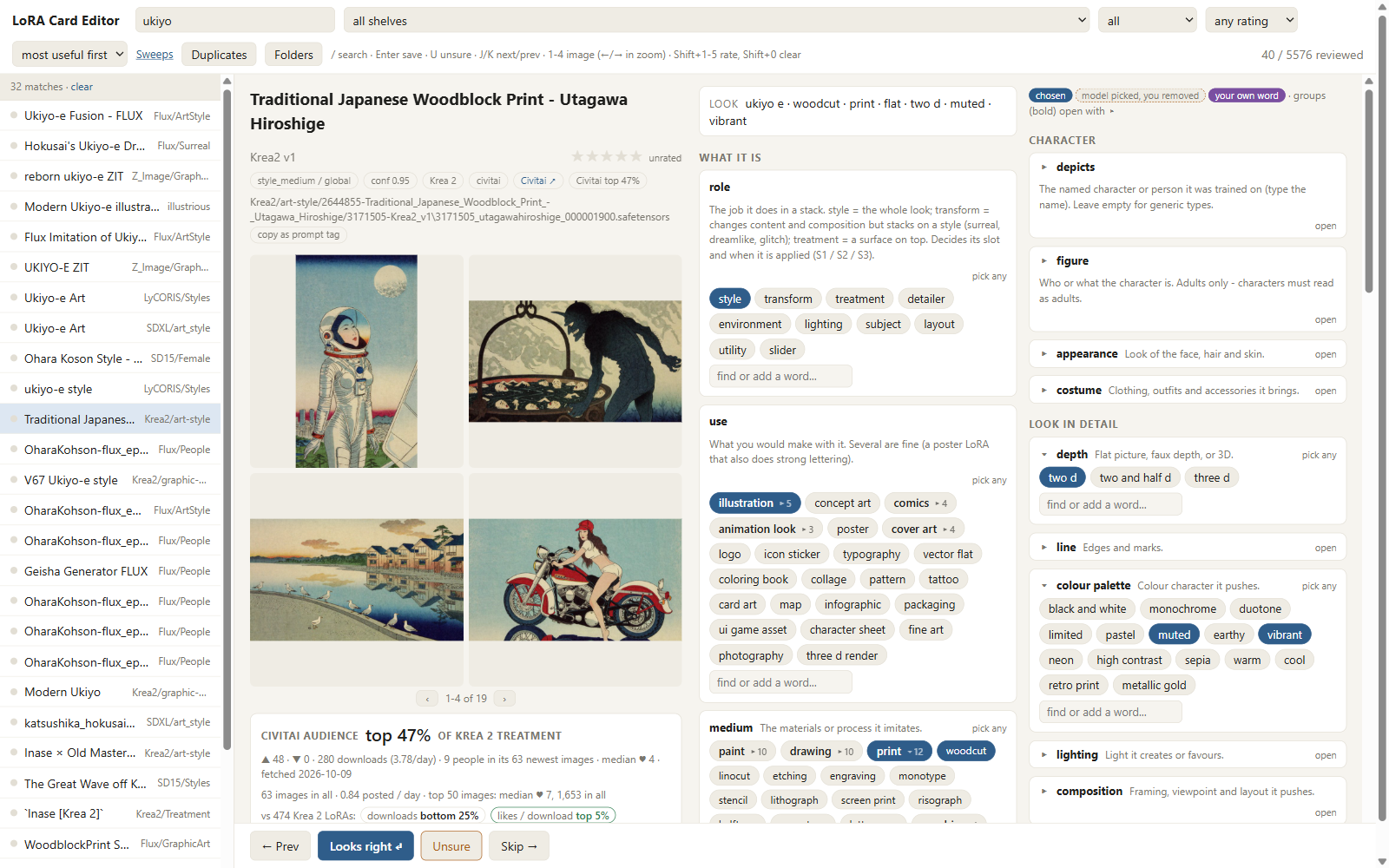
Find LoRAs by what they do, not by folder. A local catalog of your LoRA library: a local vision LLM writes a card for every LoRA (what it does, its role, style facets, genre and mood, trigger words, good weights, NSFW level), you correct the cards in a fast browser editor, and the LoRA Suggester node picks LoRAs for a prompt from it.
- Card editor (browser): search everything, filter, rate, fix cards, move / rename / de-duplicate files with undo.
- Civitai audience data: how people rate each LoRA against others of its base model, the weights they actually use, the prompts they make with it.
- LoRA Suggester (ComfyUI node): reads your prompt (or a Wildcard Composer's sections) and stacks the LoRAs that fit, by role (style, treatment, detailer, lighting, subject ...) with per-stage weights and an NSFW gate.
- ComfyUI sidebar panel: refresh the catalog, card new LoRAs, open the editor, settings.
- Works without ComfyUI too (Forge, AUTOMATIC1111, SwarmUI, Invoke users): the catalog and editor are a
standalone app; copy
<lora:name:weight>tags from any card, or export Forge / A1111 sidecar files.
Status: testing release - feedback very welcome (see Feedback).
What you need
-
Python 3.12 (ComfyUI portable ships it in
python_embeded). Older Pythons are not supported. -
A local LLM server that speaks the OpenAI API: LM Studio or Ollama (llama.cpp server and vLLM work too), with
- a vision model for the cards, e.g. Qwen3-VL 8B (about 6-8 GB VRAM at Q4) or Qwen2.5-VL 7B;
- optionally a larger text model for genre and mood (any instruct model; blank = the vision model).
A Qwen3 text encoder file you use inside ComfyUI workflows is not a chat server and cannot be used for this.
-
A Civitai API key (optional but recommended: civitai.com/user/account) for model records, stats and example images. Without one only public records are fetched.
-
Disk: the catalog is small (tens of MB per few thousand LoRAs); the Civitai cache and review pages add 100-300 MB.
Install
Inside ComfyUI
-
ComfyUI Manager → Install via Git URL:
https://github.com/EricRollei/Eric_LoRA_Catalog, or:cd ComfyUI/custom_nodes git clone https://github.com/EricRollei/Eric_LoRA_Catalog ..\..\python_embeded\python.exe -m pip install -r Eric_LoRA_Catalog\requirements.txt -
Restart ComfyUI. A LoRA Catalog tab appears in the left sidebar, and the LoRA Suggester node under Eric Prompt Enhancers.
-
In the sidebar tab open Settings: add your LoRA folder(s), pick the LLM server and models, paste your Civitai key, Save, then Test LLM.
Your data (catalog, cache, logs, your copies of the pick lists) goes to ComfyUI/user/lora_catalog/, not into the
node folder, so updating or reinstalling the node keeps it.
Standalone (Forge, A1111, no ComfyUI)
git clone https://github.com/EricRollei/Eric_LoRA_Catalog
cd Eric_LoRA_Catalog
python -m pip install -r requirements.txt
copy settings.example.json settings.json      (cp on macOS / Linux) - then edit library_roots and the LLM
python run.py check
launch.bat / launch.sh open the card editor, refresh.bat / refresh.sh update the catalog. Data goes to
user_data/ next to the code (set data_dir in settings.json to put it elsewhere).
First catalog build
Inside ComfyUI: sidebar → Refresh catalog. Standalone: refresh.bat (or python run.py refresh).
The refresh runs eleven steps, each skipping what is already done, so it is safe to run any time - and it is what you run again after adding LoRAs:
| # | step | what it does | |---|---|---| | 1 | index | new or changed LoRA files (headers, sidecars, LoRA Manager data) | | 2 | hash | sha256 of files that have none yet | | 3-7 | identify, crawl, creators, images, community | Civitai: versions by hash, records, creators, example images, audience data (internet; failures are skipped) | | 8 | cards | the vision model writes a card for every LoRA without one | | 9 | genre-mood | genre and mood for cards that have none (text model) | | 10 | review-all | HTML review pages | | 11 | facets | the table the LoRA Suggester reads |
Rough time on one GPU: indexing a few thousand files takes minutes; the Civitai steps a few seconds per LoRA; cards 3-10 s per LoRA (an 8B vision model, 3 in parallel) and genre-mood 2-6 s per LoRA. A first build of 1,000 LoRAs is an evening; later refreshes only touch the new ones. Jobs started from the panel run in their own process - ComfyUI keeps working and restarting it does not stop them - but a card pass and image generation share the GPU.
Then open the card editor (sidebar → Open card editor, or launch.bat) and go through the cards: Enter accepts,
fix what is wrong, rate what you like. Everything you change wins over the model's card from then on.
LoRA Suggester (ComfyUI)
Inputs: a prompt as text (or a Wildcard Composer's sections from the
video_prompter pack). Outputs:
suggestions→ the Eric Krea2 Multi-LoRA Stacksuggestionsinput (Eric_Krea2): three-stage weights;lora_text→ any loader that reads<lora:name:weight>tags (one weight per LoRA);triggers,prompt_with_triggers,report(what was picked and why, the runner-up per role, what was excluded).
Start in suggest mode (report only), switch to apply when you like what it picks. Hover any widget for help.
exclude / pin take names, folder:, role: and axis: entries. The nsfw gate decides what may be applied;
NSFW LoRAs are only used when the prompt itself asks for that content.
Forge, AUTOMATIC1111 and other UIs
- copy as prompt tag on any card in the editor:
<lora:name:weight>plus its trigger words. python run.py export-sidecars --write: writes the<lora name>.jsonfiles Forge and A1111 show in their LoRA browser (trigger words, preferred weight, description). Never touches a sidecar the tool did not write. Dry run without--write.
What leaves your machine
- Calls to the Civitai API with your key: model and version records, stats, community image metadata (prompts, weights, reactions - usernames are hashed before storing), and example images saved next to your LoRAs.
- Calls to the LLM server you configured (normally on your own machine): the evidence for each card and up to two preview images.
- Nothing else. No telemetry, no accounts.
NSFW: every card gets a level (0 none, 1 suggestive, 2 nudity, 3 explicit) shown in the editor; filters and the Suggester's gate use it. Thumbnails and example images are stored locally like any other.
Settings
settings.json next to run.py (never in git; the panel writes it, or copy settings.example.json). Every key is
optional. The main ones: library_roots, llm_base_url, card_model, genre_model, civitai_api_key (or the
CIVITAI_API_KEY environment variable), data_dir. All keys are described in
lora_catalog/config.py. python run.py check shows what the tool sees.
Known limits
- Cards are as good as the vision model; review the ones you care about (the editor's queue puts uncertain ones first).
- Civitai data needs the LoRA to be on Civitai (found by its hash); self-trained LoRAs get cards from their training captions instead.
- Sweeps (testing LoRA pairs by rendering) need the Eric_Krea2 nodes.
- The Suggester's platform list knows the common base models by folder name and Civitai base model; add your own under
"suggest": {"platforms": ...}insettings.json. - Windows is what it is developed on; macOS / Linux should work (the code avoids Windows-only calls) but are less tested.
Feedback
Please open an issue with the Feedback template: OS, GPU, LLM server + models, how many LoRAs, what happened. The
sidebar's log view (or <data folder>/logs/refresh.log) helps a lot.
More
- docs/USER_GUIDE.md - the editor, search and folders, Civitai data, genre and mood, sweeps, sliders, every command.
- docs/design/ - design notes.
License
Dual license: free for non-commercial use under CC BY-NC 4.0; commercial use needs a license. See LICENSE. (c) Eric Hiss (@EricRollei).