
HaDeS Anima Suite
Complete 25-node Anima ecosystem suite for ComfyUI: Native Diffusers-aware Model/Qwen3-CLIP/16ch-VAE Loaders, Multi-Format ConvRot INT8/INT4 Model Saver, LoRA Extractor, Block Weight & SVD Resizer, Offline Danbooru Artist/Character Picker, Smart Tiled VAE Decode, Corner Scribble Shield, Block-level Model/CLIP/LoRA Mergers, TIES/DARE/Model Stock/SLERP Multi-Model Merger, QR-SVD Exporter, Prompt Studio & Aesthetic Slop Guard, NAG CFG-1.0 Attention Guidance, 16ch Latent/VAE Guard, Universal Diffusers LoRA Remapper, Single/Dual/Triple-Pass Anima Rectified Flow KSamplers, Image Saver Sampler Metadata, and Centralized Suite Telemetry & Flight Auditor.
Nodes (25)
HaDeS Anima Suite v0.4.7
25 ComfyUI nodes for the Anima model family (CircleStone Labs / Comfy Org: MiniTrainDIT DiT + Qwen3-0.6B text encoder + 6-layer llm_adapter + 16-channel Wan 2.1 VAE): loaders, block, multi-model (TIES / DARE / Model Stock / SLERP) and LoRA mergers, a LoRA extractor and resizer, per-block LoRA strength, a model saver, prompt and pipeline helpers (including a local artist / character catalog), three samplers with a metadata reader for image savers and a telemetry node, with a shared canvas UI.
Claims about what block groups, presets and schedulers do are measured with tools/anima_ablation.py; results are in tools/ABLATION_RESULTS.md.
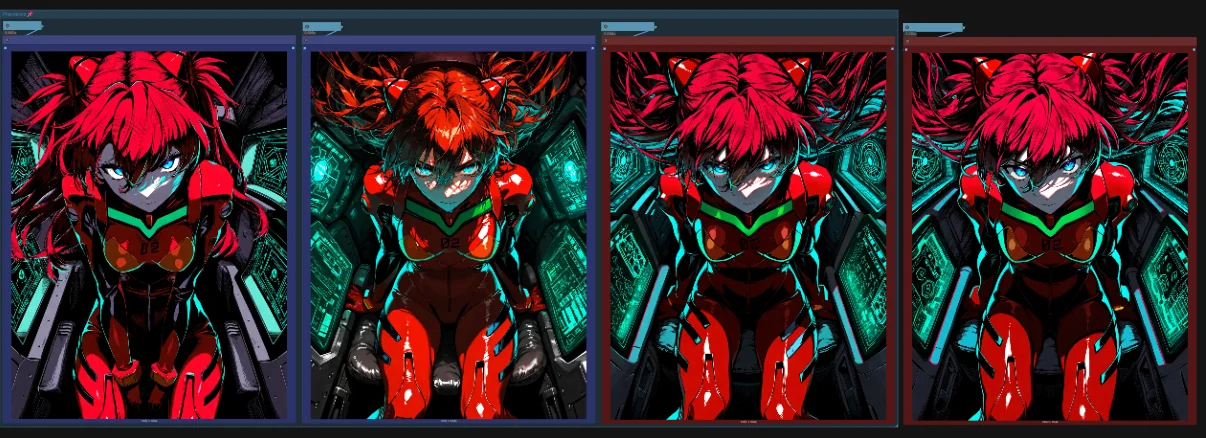
What the suite does
- Topology detection (
28L / 40L / 52L). Detects Anima-2.0B (28 DiT blocks), 2.9B (40) and 3.8B (52) plus the 6-layerllm_adapter, and maps any depth proportionally onto a 34-band index (0..27DiT,28..33adapter) used by every merger. llm_adapterprotection. Mergers keep Model 1's adapter (0.0) and LoRA loaders strip adapter keys by default, following the training rulellm_adapter_lr = 0. Most finetunes leave the adapter untouched, but not all:anima-aesthetic-v1.1retrained it (see the results file).- Diffusers / Kohya / OneTrainer / Musubi key remapping. ComfyUI does not translate Diffusers-format Anima LoRAs (
transformer_blocks.X.attn1.to_q,ff.net.0.proj,text_conditioner, …). A 24-rule converter maps them to nativeMiniTrainDITkeys, so Diffusers and Kohya LoRAs can be loaded or merged together. - Pipeline helpers.
- Prompt Studio: strips
score_*(and optionallymasterpiece) tags for Anima-Aesthetic, normalizes Booru tags while keeping kaomojis and whitelisted tokens, builds theye-pop/deviantartheader, and scales theT5XXLemphasis weights. - NAG: Normalized Attention Guidance on cross-attention, for negative prompts at
CFG = 1.0(Turbo / Lightning). - Latent: 16-channel latents with VAE validation (blocks the 64-channel Qwen-Image 2.1 VAE), 11 aspect presets, sizes snapped to 32 px.
- Corner Shield: detects and heals or masks scribble-like marks in image corners.
- Artist & Character Picker: searchable local catalog of Danbooru tags (83k artists, 57k characters, 12k series), output in Anima prompt form.
- Prompt Studio: strips
- Telemetry. Reads the
infooutputs of the other nodes and checks flow-shift consistency, CFG = 1 without NAG, the 16 px resolution grid, the 16-channel VAE and adapter protection. Outputs a Markdown report, JSON and a one-line summary. - LoRA Extractor. Turns a finetune or merge into a LoRA against its base (SVD of the weight difference). Rank 32 of
anima_pixelart_from_hades_v1.0againstanima-base-v1.0is 132 MB instead of 4 GB and renders close to the full model. - LoRA Block Weight. Applies one LoRA with a separate strength per DiT depth group. Where a LoRA acts differs per LoRA, so there are no fixed style / identity presets;
tools/anima_ablation.py --mode lorameasures a given LoRA. - LoRA Resize. Lowers a LoRA's rank (fixed, or per layer by an energy target). Measured: keeping about 90% of the energy or more stays visually close to the source.
- Model Saver. Saves merged / LoRA-patched models with the patches baked in, in native ComfyUI or Diffusers layout, as
bfloat16,fp8_e4m3fn, ComfyUI-native ConvRotINT8/W4A4, orfloat32. Native files load in the stockLoad Diffusion Modelnode.
Nodes
HaDeS Anima Suite v0.4.7
├── HaDeS/Anima Loaders (4 Nodes)
│   ├── 14. Anima Diffusion Model Loader
│   ├── 15. Anima Text Encoder Loader
│   ├── 16. Anima VAE Loader
│   └── 17. Anima VAE Decode
├── HaDeS/Anima Mergers (10 Nodes)
│   ├── 1. Anima Model Block Merger
│   ├── 2. Anima Predictive Model Merger
│   ├── 25. Anima Multi-Model Merger
│   ├── 3. Anima Predictive Multi-LoRA
│   ├── 4. Anima LoRA Merger
│   ├── 5. Anima CLIP Block Merger
│   ├── 19. Anima Model Saver
│   ├── 20. Anima LoRA Extractor
│   ├── 21. Anima LoRA Block Weight
│   └── 22. Anima LoRA Resize
├── HaDeS/Anima Pipeline (7 Nodes)
│   ├── 6. Anima Prompt Studio
│   ├── 23. Anima Artist & Character Picker
│   ├── 7. Anima Attention Guidance (NAG)
│   ├── 8. Anima Latent
│   ├── 9. Anima Universal LoRA Remapper
│   ├── 10. Anima Corner Shield
│   └── 18. Anima Suite Telemetry
└── HaDeS/Anima Samplers (4 Nodes)
    ├── 11. Anima KSampler
    ├── 12. Anima Dual-Pass KSampler
    ├── 13. Anima Triple-Pass KSampler
    └── 24. Anima Sampler Metadata
34-Band Block Index (measured)
Input names (BLOCKS_Layout_Geometry, …) are kept for workflow compatibility; the UI shows depth-based labels. "Share" is how much of an A→B change the group alone carries (swap-in, two model pairs, see tools/ABLATION_RESULTS.md).
| Index | Native keys (28L / 40L / 52L) | Input name | UI label | Share of an A→B change |
| :--- | :--- | :--- | :--- | :--- |
| 00–04 | blocks.0 .. ~18% depth | BLOCKS_Layout_Geometry | Early Blocks | 0.22–0.84 |
| 05–09 | ~18% .. ~36% | BLOCKS_Global_Composition | Early-Mid Blocks | 0.18–0.57 |
| 10–14 | ~36% .. ~54% | BLOCKS_Subject_Identity | Core Blocks (strongest) | 0.44–0.75 |
| 15–19 | ~54% .. ~71% | BLOCKS_Material_Substance | Mid-Late Blocks | 0.38–0.62 |
| 20–23 | ~71% .. ~86% | BLOCKS_Art_Style_Medium | Late Blocks | 0.19–0.38 |
| 24–27 | ~86% .. 100% | BLOCKS_Lighting_Sharpness | Final Blocks (weakest) | 0.12–0.32 |
| 28–33 | llm_adapter.blocks.0..5 | ADAPTER_Text_Alignment | LLM Adapter Bridge | 0 when the finetune kept the adapter |
No group isolates one attribute: each moves composition, structure, texture and color together. Neither per-sublayer merges nor a late model switch separate style from composition either.
Node Reference
Part A — Mergers & LoRA tools (HaDeS/Anima Mergers)
1. Anima Model Block Merger
- Class:
HaDeSAnimaModelBlockMerger - Purpose: Merges two Anima
MODELs per block group, reading patched (merged / LoRA) weights and skipping identical tensors. - Inputs:
model1,model2(MODEL).base_ratio(FLOAT, default0.50): ratio for non-block layers (x_embedder,t_embedder,final_layer).0.0= Model 1,1.0= Model 2.BLOCKS_Layout_Geometry..BLOCKS_Lighting_Sharpness(FLOAT, default0.50).ADAPTER_Text_Alignment(FLOAT, default0.00): keeps Model 1'sllm_adapter.recipe_override(STRING, optional): 34-float CSV or the JSON export of the Predictive Merger.
2. Anima Predictive Model Merger
- Class:
HaDeSAnimaPredictiveModelMerger - Purpose: Derives per-block ratios from weight similarity and divergence between the two models (or task vectors against
base_modelwhen connected) and outputs the merged model plus a reusable recipe. - Inputs:
model1,model2(MODEL),base_model(MODEL, optional).preset:Style Transfer (Keep A identity, B style),Interference Guard (Anti-Burn / Artifact Shield),Complementary Richness (Fill gaps of A with B), orBalanced Geometric Fusion. Measured, the presets mainly scale Model 2 strength;Style Transferstays closest to Model 1 and is shown as Conservative (mostly Model 1) in the HaDeS UI, since no merge keeps Model 1's composition with Model 2's style. For Model 2 detail on Model 1's composition, use the Dual-Pass KSampler withmodel_pass2at low denoise.target_influence(0.0..1.0, default0.50),aggressiveness(0.1..2.5, default1.00).protect_llm_adapter(BOOLEAN, defaultTrue): locks blocks28..33to Model 1.
25. Anima Multi-Model Merger
- Class:
HaDeSAnimaMultiModelMerger - Purpose: Merges 2–4 Anima models with the community's standard methods. Every method except SLERP works on task vectors (
model − base_model):TIES: keeps each task vector's largest entries (density), elects a sign per entry from their sum and averages the agreeing ones.DARE/DARE-TIES: drops entries at random with keep probabilitydensityand rescales the rest, then averages (DARE) or elects signs like TIES (DARE-TIES).seedfixes the drop mask.Task Arithmetic: weighted average of the task vectors.Model Stock(Jang et al. 2024): the average of the models pulled towardbase_model, per tensor, by the angle between their task vectors; it ignores weights,densityandscale. When the models changed the base in unrelated directions it stays close to the base.SLERP: spherical blend ofmodel_1andmodel_2only,t = weight_2 / (weight_1 + weight_2); needs nobase_model.
- Inputs:
model_1,model_2(MODEL),model_3,model_4,base_model(MODEL, optional;base_modelis required by every method except SLERP and should be the checkpoint the models were finetuned from).weight_1…weight_4(0.0..2.0): relative weights, normalized by their sum over the connected models.density(0.05..1.0, default0.5),scale(0.0..2.0, default1.0;1.0has the strength of an average, higher extrapolates),seed.protect_llm_adapter(BOOLEAN, defaultTrue): keeps thellm_adapterfrombase_model(frommodel_1for SLERP).
- Memory: like the other mergers it adds lazy patches that reference the input models and are evaluated when the model loads. Measured with four models (base + 3): about +0.05 GiB of RAM, and sampling takes ~3 s longer than a single model at 1024² (the merge is recomputed whenever the model is loaded).
- Not measured: which method gives better images. On a test with
anima-aesthetic-v1.1, a pixel-art and a 3D finetune, the methods gave clearly different results and none kept the pixel-art look; pick by eye for your models.
3. Anima Predictive Multi-LoRA
- Class:
HaDeSAnimaPredictiveMultiLoraLoader - Purpose: Loads up to 4 Anima LoRAs (
PRI,S2–S4), remaps Diffusers / Kohya keys, and damps secondary slots by their overlap with the primary LoRA (reduced QR on the low-rank factors). - Notes: per-slot 34-band curve; strips
llm_adapterkeys whenprotect_llm_adapter = True;1/√Ndamping on shared CLIP layers. - Presets (measured with two style LoRAs):
Character + Style Fusion (A identity, B style)leans towards slot 1 in composition and style alike and is shown as Favor Slot 1 (PRI) in the HaDeS UI;Anti-Overcook,Orthogonal SynthesisandBalanced 50/50 Adaptivestay within 0.03 of stacking the LoRAs at 1.0.
4. Anima LoRA Merger
- Class:
HaDeSAnimaStandaloneLoraMerger - Purpose: Merges two Anima LoRAs (Diffusers and Kohya / ComfyUI formats can be mixed) into one
.safetensorsfile with reduced QR-SVD: $$\Delta W = U_{\text{cat}} D_{\text{cat}} = Q_U (R_U R_D^T) Q_D^T$$ so the SVD runs on a $2r \times 2r$ core instead of the full $M \times N$ matrix. - Modes:
Additive (A + B, Multi-LoRA match)(default) orInterpolated (Lerp (1-r)A + rB), optional DARE pruning, and protection against overwriting a donor file. - Presets: same formula family as the Multi-LoRA presets;
Character + Style Fusionis shown as Favor Donor A.
5. Anima CLIP Block Merger
- Class:
HaDeSAnimaCLIPBlockMerger - Purpose: Merges two Anima text encoders (
Qwen3-0.6B28 layers orQwen3.5-4B36 layers) across 5 bands: token embeddings (vocab_embeddings), early[0–35%](syntax_rigidity), middle[35–72%](semantic_focus) and late[72%+](style_abstraction) layers, and the final norm (final_projections); the input names are kept for saved workflows. - Measured (
qwen_3_06b_basevsqwen_3_06b_abliteratedonanima-base-v1.0,tools/ABLATION_RESULTS.md): the late layers carry almost all of the difference. Taking only them from CLIP 2 gives 79–105% of the full image change (per metric), while the early, middle and embedding bands give 13–53% each. Every band changes composition, pose, texture and color together, like a different seed; none isolates syntax or style. TheLate Bbutton is therefore close to CLIP 2.
19. Anima Model Saver
- Class:
HaDeSAnimaModelSaver - Purpose: Saves a
MODELwith its merge / LoRA patches baked in (same lazy path as ComfyUI's checkpoint saver), as native ComfyUI or Diffusers layout, and passes the model through for downstream samplers. - Inputs:
model: inputMODEL.filename_prefix: path underComfyUI/output(defaultdiffusion_models/Anima_HaDeS_Merged).save_format:Native ComfyUI (MiniTrainDIT)orDiffusers (HuggingFace / Trainer).precision:bfloat16 (Original Master),fp8_e4m3fn (ComfyUI Native FP8),convrot_int8 (Hadamard Rotated INT8),convrot_int4 (Hadamard Rotated INT4),float32 (Uncompressed). ConvRot uses ComfyUI's owncomfy.quant_opslayouts (int8_tensorwise+ convrot,convrot_w4a4) on the DiT block linears, with per-layercomfy_quantconfigs.llm_adapter_mode:Embed in Checkpoint (Full),Strip (Pure DiT),Export Adapter Separately(barellm_adapterkeys, asexternal_llm_adapterexpects).include_metadata,custom_author,custom_model_title: SAI ModelSpec metadata.
- Outputs:
model(pass-through),saved_path,info.
20. Anima LoRA Extractor
- Class:
HaDeSAnimaLoraExtractor - Purpose: Saves
model_tuned − model_baseas a LoRA inmodels/loras/: truncated SVD per linear layer (lora_up/lora_down/alpha), full.diff/.diff_bfor norm weights and biases, identical tensors skipped. Merge and LoRA patches on either input are included (same baked path as the Model Saver); quantized inputs are rejected with an error. - Inputs:
model_tuned,model_base(MODEL).rank(4..256, default32).export_filename(STRING, saved undermodels/loras/).include_llm_adapter(BOOLEAN, defaultFalse): also extractllm_adapterdifferences, for releases that retrained it (e.g.anima-aesthetic-v1.1).overwrite_existing(BOOLEAN, defaultFalse).
- Outputs:
saved_lora_path,info(includes the share of the difference kept by the rank, "energy kept"). - Measured: base → pixelart, rank 32: 132 MB, 94.5% energy kept, all keys load in the stock
LoraLoader, renders at 0.87–0.96 of the way from base to the finetune on the suite's metrics; rank 128: 529 MB, 0.91–0.98.
21. Anima LoRA Block Weight
- Class:
HaDeSAnimaLoraBlockWeight - Purpose: Applies one LoRA with a multiplier per DiT depth group (
blocks_00_04…blocks_24_27, canonical 28-block index; 40L / 52L models are mapped proportionally) andother_layersfor the embedders, final layer and unprotectedllm_adapter. Keys are remapped like the other LoRA nodes. - Inputs:
model,lora_name,strength_model, the six group multipliers andother_layers(-2..3, default1.0); optionalclip,strength_clip,protect_llm_adapter(defaultTrue). - Measured: one style LoRA acted mostly in blocks 05–19, another in 00–04 (with most of its color change in 20–23); blocks 24–27 carried the least change for both. Fixed "style only" / "identity only" presets would be wrong for one of them, so the node has none; use
tools/anima_ablation.py --mode lora --lora <name>to see where a LoRA acts.
22. Anima LoRA Resize
-
Class:
HaDeSAnimaLoraResize -
Purpose: Lowers a LoRA's rank with an exact SVD of its low-rank factors (QR + small core SVD) and saves a new file in
models/loras/; the source is never overwritten. Norm / bias diffs and unsupported formats (LoHa, LoKr, DoRA) are copied unchanged; keys are written in native Anima form. -
Inputs:
lora_name,target_rank(max rank per layer,1..256, default32),export_filename; optionaldynamic_energy(0= fixed rank; otherwise the smallest rank per layer that keeps that share of the layer's energy, capped attarget_rank) andoverwrite_existing. -
Outputs:
saved_lora_path,info(size before / after, rank, mean and worst-layer energy kept). -
Measured (renders vs. the source LoRA, 0 = base model, 1 = source LoRA; every key loads in the stock LoRA loader):
| LoRA | Variant | Size | Energy kept | layout / edges / texture / color | |---|---|---|---|---| | Niji_semi_realism_v5 (264 MB) | rank 16 | 66 MB | 86% | 0.79 / 0.80 / 0.88 / 0.92 | | | rank 32 | 132 MB | 94% | 0.85 / 0.87 / 0.91 / 0.95 | | | dynamic 0.90 | 85 MB | 93% | 0.82 / 0.83 / 0.89 / 0.94 | | dungeon_squad_style_anima_v1 (175 MB) | rank 16 | 44 MB | 75% | 0.57 / 0.59 / 0.65 / 0.61 | | | rank 32 | 88 MB | 89% | 0.68 / 0.72 / 0.79 / 0.80 | | | dynamic 0.90 | 80 MB | 90% | 0.69 / 0.73 / 0.74 / 0.77 |
How far a LoRA compresses depends on the LoRA; the info output warns below 90% mean energy, where the dungeon rank-16 result visibly lost its pixel style.
Part B — Pipeline nodes (HaDeS/Anima Pipeline)
6. Anima Prompt Studio
- Class:
HaDeSAnimaPromptStudio - Purpose: Applies the CircleStone Labs prompt rules and exposes the
T5XXLemphasis multiplier. - How it works:
- Aesthetic tag guard: with
Anima Aesthetic (Strip score_* & Slop Guard)it stripsscore_*,masterpiece,best quality,8kand similar tags, which the Aesthetic models were trained without.Anima Aesthetic v1.0b (Keep masterpiece, best quality)keeps those two quality tags and still stripsscore_*. - Booru sanitizer: lowercases tags and replaces
_with spaces, except whitelisted tokens (score_*,score_*_up,safe_for_work) and kaomojis (^_^,o_o,>_<, …). - Style header: in
Flat Vector / Graphicmode, writes the non-anime header: one trigger (ye-popordeviantart) on line 1, optionalartwork_titleon line 2, prompt on line 3.header_mode = "Dual Legacy"keeps the old two-trigger header; prompts that already start with a trigger are kept verbatim. - Artist / character inputs: a linked
artist/charactersocket replaces the matching inline field (shown dimmed), even when the linked value is empty. Names are normalized to Anima form (@artist, spaces, literal parentheses escaped). Unescaped,@hammer (sunset beach)turns(sunset beach)into a weighted concept that leaks into the image (results). t5_weight_multiplier: ComfyUI's Anima tokenizer (comfy/text_encoders/anima.py) forces the Qwen3 token weights to1.0and passes(tag:weight)through theT5XXLtokenizer to thellm_adapter; this slider scales those emphasis weights.
- Aesthetic tag guard: with
23. Anima Artist & Character Picker
- Class:
HaDeSAnimaArtistCharacterPicker - Purpose: Picks artists, a character and a series from a local Danbooru tag catalog shipped in
web/data/(83,355 artists, 57,653 characters, 12,405 series with at least 20 posts; nothing is downloaded) and outputs them in Anima prompt form for Prompt Studio'sartist/characterinputs or any text node. - Inputs:
artists(comma-separated tags, optional:weight, e.g.dairi:1.2, ebifurya),character,series,random_artists(0..4, extra artists drawn by seed, never repeating a listed one),random_min_posts(default200),seed. - Outputs:
artist(e.g.(@hammer \(sunset beach\):1.2), @dairi),character(character + series, e.g.firefly \(honkai: star rail\), honkai: star rail),info. - UI: click a row to open a search popup (prefix matches first, post counts shown; the catalog loads on first use); the current entries appear on top of the popup with −/+ for their prompt weight (artists, character and series; written as
(tag:1.2)) and × to remove them; Shift+click edits the text.
7. Anima Attention Guidance (NAG)
- Class:
HaDeSAnimaAttentionGuidance - Purpose: Normalized Attention Guidance on cross-attention only (recognized by its text keys, which are shorter than the image queries), inside a
start_percent→end_percentwindow converted withpercent_to_sigma. The positive queries re-attend over the negative prompt's keys / values and are blended with the reference NAG formula (scale, L1-norm ceilingnag_tau,nag_alpha). - Use: negative prompts at
CFG = 1.0on Anima-Turbo / Lightning.nag_scale = 1.0disables it.only_anima = True(default) bypasses non-Anima models viaunet_config.image_model.
8. Anima Latent
- Class:
HaDeSAnimaLatentPipelineGuard - Purpose: 16-channel latents (
[B, 16, H // 8, W // 8]) with optionalmodel/vaevalidation. - Checks:
- 64-channel VAE: raises a clear error if the 64-channel Qwen-Image 2.1 VAE is connected instead of the 16-channel
qwen_image_vae.safetensors. - Anima-2.9B
1280×1280: withprevent_29b_white_bg_bias(off by default), shifts1280×1280to1216×1216, following the community report that this size biases 2.9B towards white backgrounds (not measured here). - Sizes: 11 aspect presets (including
1:4and4:1); custom sizes snap to 32 px, which also satisfies Anima's 16 px grid.
- 64-channel VAE: raises a clear error if the 64-channel Qwen-Image 2.1 VAE is connected instead of the 16-channel
9. Anima Universal LoRA Remapper
- Class:
HaDeSAnimaUniversalLoraLoader - Purpose: Loads a third-party Anima LoRA (Diffusers
transformer_blocks.*,ai-toolkit, Kohya, OneTrainer, Musubi), converts keys with the 24-ruleDIFFUSERS_TO_COMFYmap, stripsllm_adapterweights (strip_llm_adapter = True), optionally scrubsNaN/Infand $>10\sigma$ outliers, and optionally saves a ComfyUI-native copy tomodels/loras/.
10. Anima Corner Shield
- Class:
HaDeSAnimaCornerScribbleShield - Purpose: Handles the signature-like scribbles Anima sometimes draws in corners (learned from signed training art; negative prompts only reduce them).
- Detection: a corner is flagged when its high-frequency energy (99th percentile) exceeds that of the ring around it (99.5th percentile, one box size wide) by
0.14 - 0.10 × detection_sensitivity. A mark on a flat background stands out from its surroundings; line art, texture or grain that continues into the ring does not. The box defaults to10%of the image (0.03–0.50), with expansion for large marks capped at 50%. - Measured (
tools/ABLATION_RESULTS.md, 968 Anima renders and 240 synthetic signatures):detection_sensitivity0.5 / 0.75 (default) / 0.9 flags 0.4% / 0.9% / 1.7% of clean corners and catches 84% / 87% / 90% of the signatures. Misses are mostly signatures over busy backgrounds; false positives are mostly hard edges (window frames, pixel art) at the corner. - Modes:
Mask Only (No Pixel Modification): feathered[B, H, W]mask of the detected strokes for a second inpainting pass. Best on busy backgrounds.Smart Edge-Inward Blend (Auto-Heal): replaces the detected strokes (dilated, feathered outwards) with the clean edge ring (8–16 px outside the box) continued inwards. Removes marks cleanly on flat backgrounds and leaves a soft patch on busy ones; measured corner error drops 38%. Default.Aggressive Corner Fill (Forced): skips detection and always fills the corner boxes.Soft Corner Blur: feathered local blur of the detected strokes. Softens marks but does not remove them (corner error unchanged).
Part C — Samplers (HaDeS/Anima Samplers)
11. Anima KSampler
- Class:
HaDeSAnimaKSampler - Purpose: Single-pass sampler for Anima's rectified flow. Flow shift
0inherits the shift already set on the model (from the loader); other values override it withmultiplier = 1.0(Anima's own setting;ModelSamplingSD3defaults to1000). - Features:
- Extra schedulers:
anima_beta57(Beta α = 0.50, β = 0.70; more steps at low noise — measured, it converges slower than stockbeta) andanima_lightning_tdm(the documented 4-step schedule, sigmas1.0 → 0.9 → 0.75 → 0.5 → 0at shift 3; other step counts use an improvised spacing; not tested on a TDM model). - Variant profiles:
Anima Base / Raehoshi,Anima Aesthetic Crisp,Anima Aesthetic Painterly (beta57),Anima Turbo,Anima Lightning TDM,Anima 2.9B / 3.8B. - Optional decode: when a VAE is connected, checks
latent_channels == 16and also outputs the decoded image.
- Extra schedulers:
12. Anima Dual-Pass KSampler
- Class:
HaDeSAnimaDualPassKSampler - Purpose: Composition pass followed by an upscaled refinement pass (
1.25x–2.0x), with the intermediate size snapped to 32 px. - Features:
- Latent bridge: bicubic latent upscale that restores per-channel mean / std on the 16 channels (bicubic lowers latent variance), or a
Pixel-Space VAE Round-Trip (Lanczos 32px). model_pass2: optional different model for the refinement pass, e.g. composition with a character LoRA, detail with Anima-Aesthetic or Turbo. This is also the way to get Model 2 detail on Model 1's composition.
- Latent bridge: bicubic latent upscale that restores per-channel mean / std on the 16 channels (bicubic lowers latent variance), or a
13. Anima Triple-Pass KSampler
- Class:
HaDeSAnimaTriplePassKSampler - Purpose: Three passes: composition at
1.0x, an intermediate pass at ~1.35x(denoise ~0.38) and a low-denoise pass at ~1.75x–2.0x(denoise ~0.20), as an alternative to one large upscale step that must trade duplicated details (high denoise) against blur (low denoise). Optionalmodel_pass2/model_pass3. - Real noise depends on the shift: a partial denoise is cut from the shifted schedule, so the same denoise starts at more noise with a higher shift. Denoise 0.48 at shift 3.5 on
betaalready starts at ~0.76 sigma and repaints the background. The defaults and theBackground-Safepreset (pixel-space bridge,euler+anima_beta57, shift 3.0) keep Stage 2 at ~0.48 and Stage 3 at ~0.17; lowerdenoise_stage2toward 0.30 if a finetune still changes the background.
24. Anima Sampler Metadata
- Class:
HaDeSAnimaSamplerMetadata - Purpose: Connect a KSampler's
infooutput; it outputsseed,steps,cfg,sampler_name,scheduler(strings) anddenoisefor image-saver metadata nodes (e.g. Image Saver Metadata). The values are the ones actually sampled with, after the profile / preset is applied, so the metadata cannot drift from a separate settings node. Dual / Triple-Pass report pass 1, the pass that generates the image. Any otherinfostring raises an error instead of saving made-up values.
Part D — Loaders & VAE Decode (HaDeS/Anima Loaders)
14. Anima Diffusion Model Loader
- Class:
HaDeSAnimaModelLoader - Purpose: Loads Anima checkpoints in native ComfyUI or Diffusers layout (
transformer_blocks.*,patch_embed.proj.*,time_embed.t_embedder.*,text_conditioner.*, converted in memory), optionally injects an externalllm_adapter(e.g.Anima-3.8B-expanded_adapter.safetensors), detects28L / 40L / 52Ltopology, and sets the flow shift (multiplier = 1.0).
15. Anima Text Encoder Loader
- Class:
HaDeSAnimaCLIPLoader - Purpose: Loads
qwen_3_06b_base.safetensorsafter checking its header for the 1024-dim Qwen3-0.6B architecture (rejects T5-XXL, CLIP-L or 3584-dim Qwen2.5-7B files), with acpu (Low-VRAM 6GB Safe)placement option. ComfyUI selects the Anima text encoder from the weights themselves, whateverclip_typeis used.
16. Anima VAE Loader
- Class:
HaDeSAnimaVAELoader - Purpose: Checks the VAE header before loading to reject the 64-channel Qwen-Image 2.1 VAE (which shares the filename
qwen_image_vae.safetensors), withbfloat16as the default precision.
17. Anima VAE Decode
- Class:
HaDeSAnimaVAEDecode - Purpose: Decodes 16-channel latents, switching to tiled decode above
auto_tile_mp_threshold(default1.35 MP) or when free VRAM is low. UseAnima Corner Shieldafter it to handle corner marks.
18. Anima Suite Telemetry
- Class:
HaDeSAnimaSuiteTelemetry - Purpose: Collects the
infooutputs of HaDeS nodes, groups them by pipeline phase (architecture, conditioning & LoRAs, sampling & guidance, post-processing) and checks: flow-shift consistency between loader and sampler,CFG = 1without NAG, the 16 px resolution grid, the 16-channel VAE, andllm_adapterprotection. Outputs a Markdown report, a JSON payload and a one-line summary. - Info contract: every HaDeS node ends its
infooutput with one machine-readable line,HADES_META {"node": ..., ...}(keys per node inHADES_META_SCHEMA). Telemetry reads values from that line; the prose above it is for humans only and can change freely.infostrings without the line (older versions, other packs) still go through the legacy text parser.
Regional Prompts
ComfyUI's stock ConditioningSetArea / ConditioningSetMask work on Anima. In a two-character test (left / right, 8 seeds) a single natural-language prompt ("the girl on the left has …, the girl on the right has …") placed both correctly 8/8 and separated them better than area or mask conditioning, so the suite has no regional node (results).
HaDeS Node UI vs. Standard ComfyUI Widgets
The suite draws its own canvas widgets (web/hades_widgets.js): a neutral dark palette with one accent color (green / amber / red only signal state), quiet uppercase row labels, preset buttons that highlight the active preset, and a compact status panel per node. Every node enforces a minimum width so nothing clips or overlaps, and hover tooltips explain each control.
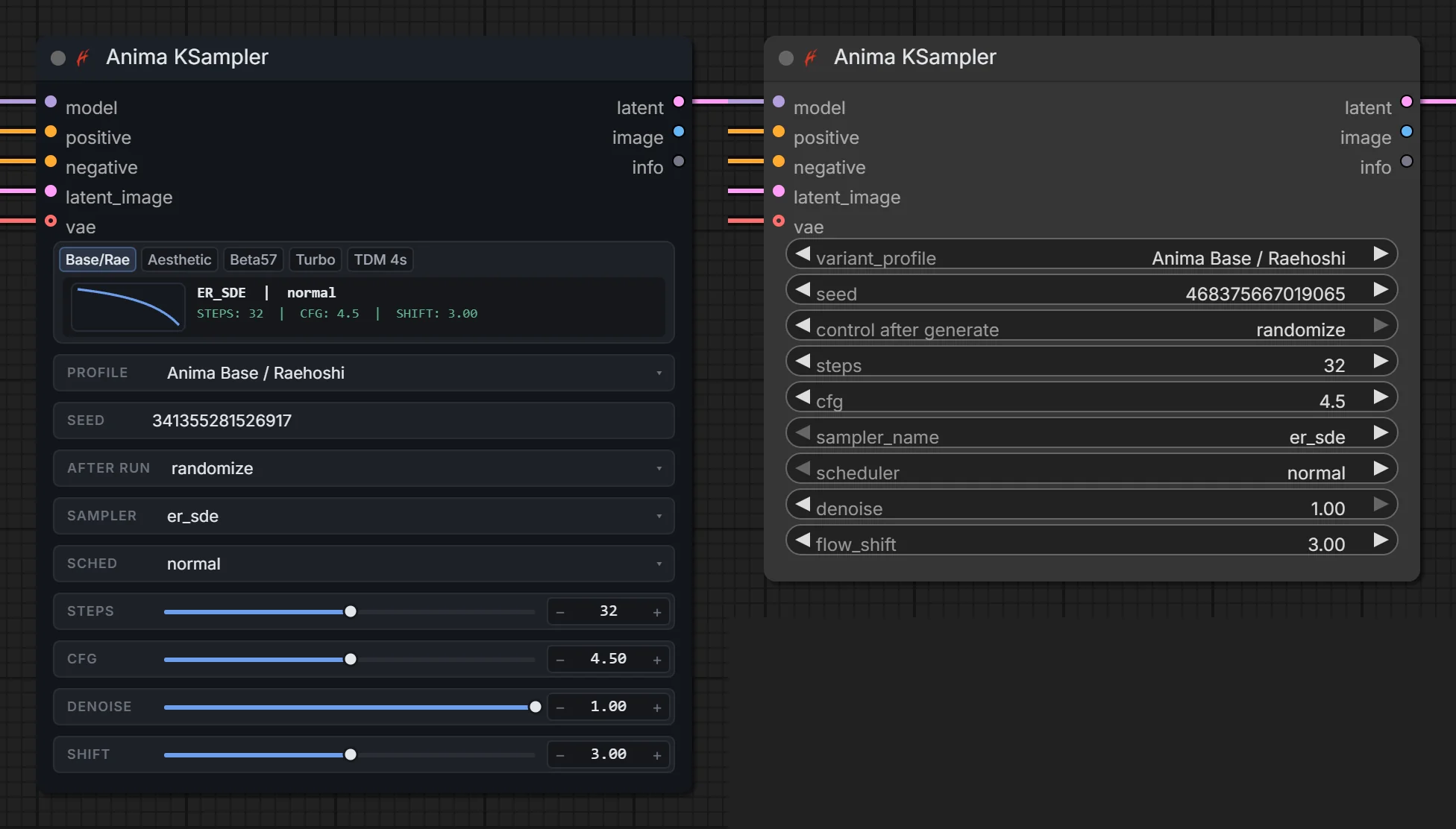
To use the plain ComfyUI inputs instead, open Settings → HaDeS Anima Suite → Appearance and enable Use standard ComfyUI widgets on HaDeS nodes (setting id HaDeS.ClassicUI). It applies immediately to all 25 nodes; a single node can also be switched from its right-click menu (HaDeS Suite → Use standard ComfyUI widgets).
Both the classic LiteGraph canvas and the Vue node renderer (Nodes 2.0, Comfy.VueNodes.Enabled) are supported, including the classic-widget toggle.
Example Workflows (examples/)
HaDeS Anima Suite - Simple Pass Generation Example.json: loaders, Prompt Studio, Latent,Anima KSamplerand VAE decode.HaDeS Anima Suite - Dual Pass Generation Example.json: composition at 1.0 MP and a 1.5x refinement pass with the 16-channel latent bridge andmodel_pass2.HaDeS Anima Suite - Triple Pass Generation Example.json:1.0x → 1.35x → 1.75xwithAnima Triple-Pass KSampler.HaDeS Anima Suite - Artist Picker & Sampler Metadata Example.json: the Simple Pass graph withAnima Artist & Character Pickerfeeding Prompt Studio's artist / character inputs (one listed artist plus one random draw) andAnima Sampler Metadatareading the KSampler's info; previews stand in for an image-saver metadata node.HaDeS Anima Suite - LoRA Toolkit Example.json:Anima Universal LoRA RemapperandAnima LoRA Block Weightin the generation graph, plus a bypassed group withAnima LoRA Extractor,Anima LoRA ResizeandAnima LoRA Merger(they write files tomodels/loras; enable a node with Ctrl+B).HaDeS Anima Suite - NAG, Corner Shield & Telemetry Example.json:Anima Attention Guidance (NAG)before the KSampler,Anima Corner Shieldafter the decode andAnima Suite Telemetryauditing the info outputs of 8 nodes.HaDeS - Anima Suite - Merge Workflow Example - Medium.json: two donors (anima-base-v1.0,anima-aesthetic-v1.1) throughAnima Model Block Merger,Anima Predictive Model Merger,Anima Multi-Model Merger(SLERP of the two donors),Anima CLIP Block MergerandAnima Predictive Multi-LoRA, with a preview per result, merge telemetry and a bypassedAnima Model Saver.
All examples use only HaDeS and core ComfyUI nodes.
Measuring Block Groups, Presets and Schedulers
tools/anima_ablation.py queues fixed prompt × seed grids on a running local ComfyUI (HTTP API only) and compares the results with numpy + Pillow image statistics (layout, edges, texture, color). Modes: groups, presets, schedulers, lora (one LoRA per block group, through LoRA Block Weight), lora_presets (Multi-LoRA presets) and clip (CLIP Block Merger bands, --clip vs --clip-b).
python tools/anima_ablation.py --mode groups --model-a anima-base-v1.0.safetensors --model-b <finetune>.safetensors --out <folder>
Re-running with the same --out resumes. Check the contact sheets as well as the numbers: noise artifacts can score as texture change.
tools/corner_shield_measure.py measures the Corner Shield in-process (no server): flagged clean corners per sensitivity on a folder of renders, then recall and heal error on synthetic signatures drawn into clean corners.
python tools/corner_shield_measure.py --images "<renders>/**/*.png" --out <folder>
Project Structure
Comfyui-HaDeS-Anima-BlockMerger/
├── .github/workflows/ci.yml  # CI (Python 3.10-3.12 + JS syntax checks)
├── __init__.py               # 34-band topology, Diffusers remapper, info contract, 5 mergers, Model Saver, LoRA Extractor, LoRA Block Weight, LoRA Resize
├── anima_pipeline_nodes.py   # Prompt Studio, Artist & Character Picker, NAG, Latent, LoRA Remapper, Corner Shield, Telemetry
├── anima_ksampler_nodes.py   # Single, Dual-Pass and Triple-Pass KSamplers, Sampler Metadata, Anima schedulers
├── anima_loader_nodes.py     # Model / text encoder / VAE loaders and VAE Decode
├── web/
│   ├── icon.png
│   ├── hades_suite.js        # Extension entry point and settings (25 nodes)
│   ├── data/                 # Local Danbooru tag catalog (artists, characters, series) for the picker
│   ├── hades_widgets.js      # Shared canvas widgets, design tokens, Vue-node adapter
│   ├── hades_mergers_ui.js   # Merger, LoRA, Saver, Extractor, Block Weight and Resize node UIs
│   ├── hades_pipeline_ui.js  # Pipeline, Picker (catalog search) and Telemetry node UIs
│   ├── hades_ksampler_ui.js  # Sampler node UIs
│   └── hades_loaders_ui.js   # Loader and VAE Decode node UIs
├── examples/                 # Example workflows
├── docs/images/              # README screenshots (not in the Registry package)
├── tools/
│   ├── anima_ablation.py     # Measurement script (dev tool, not a node)
│   ├── corner_shield_measure.py  # Corner Shield detection / heal measurement (dev tool)
│   └── ABLATION_RESULTS.md   # Measured results
├── tests/
│   ├── test_hades_suite.py   # 31 test suites (standalone stubs or real ComfyUI)
│   ├── smoke_test.py         # Boots a real ComfyUI server and runs graphs through it
│   ├── frontend_test.py      # The HaDeS widgets in a headless browser (classic + Nodes 2.0)
│   └── frontend_checks.js    # In-page checks used by frontend_test.py
├── CHANGELOG.md
├── pyproject.toml
├── LICENSE
└── README.md
Running Tests
python tests/test_hades_suite.py
Set HADES_FORCE_STANDALONE_STUBS=1 to run against the bundled stubs instead of a ComfyUI install.
The smoke test starts a real ComfyUI with only this pack loaded, checks that all nodes and web files register and runs a graph through the execution engine (CI does this on CPU with the latest ComfyUI):
python tests/smoke_test.py --comfy-dir /path/to/ComfyUI
Add --models --lora <an Anima LoRA> to also merge, apply a LoRA, sample, extract a LoRA and save a ConvRot INT8 checkpoint with real Anima models (defaults: anima-base-v1.0, anima-aesthetic-v1.1, qwen_3_06b_base, qwen_image_vae; override with --unet, --unet2, --clip, --vae). Run it from the ComfyUI environment before a release.
The frontend test opens that server in a headless browser and checks the HaDeS widgets on all 25 nodes, in the classic canvas and in Nodes 2.0: native widgets hidden, links dropped on a row reaching its input, sockets on their rows, the vanilla view complete and the dropdown filter box. It needs pip install playwright; CI runs it with Playwright's Chromium, locally --channel msedge or --channel chrome uses an installed browser:
python tests/frontend_test.py --comfy-dir /path/to/ComfyUI --channel msedge
License
MIT License — © 2026 HaDeS.