
ComfyUI Needle 2
Cactus Needle 2 in ComfyUI: a 45M-parameter CPU model that turns text into typed graph parameters, plus nodes that read a ComfyUI workflow back out of a PNG.
Nodes (8)
Free text to JSON, with a schema you actually control
The wildcard output that turns JSON into whatever type you need
Type a natural-language prompt, get real KSampler settings out
Classify a request into a branch, without spending GPU on an LLM
The node that tells you why the engine won't load
Read the workflow out of a PNG you didn't build
Turn a workflow PNG into typed numbers you can wire up
When the parser can't find the prompt, list every text node
ComfyUI × Cactus Needle 2
ComfyUI nodes around Needle 2 — a 45M-parameter model that turns text into JSON. It runs on the CPU in a 14 MB binary, so it costs your GPU nothing: ~0.2–1.5 s per call at 550–840 tok/s prefill.
Plus a set of nodes that read a ComfyUI workflow back out of a PNG. Those use no model at all.
- Model: https://huggingface.co/Cactus-Compute/needle2
- Upstream engine (Cactus Compute): https://github.com/cactus-compute/needle
- Architecture paper: arXiv:2607.18363
Needle 2 is not a generation model. It does tool calling and structured extraction, and there is no free-text fallback — every answer is structured. In a ComfyUI graph its value is control, not generation: natural language in, typed graph parameters out.
Read a workflow back out of a PNG
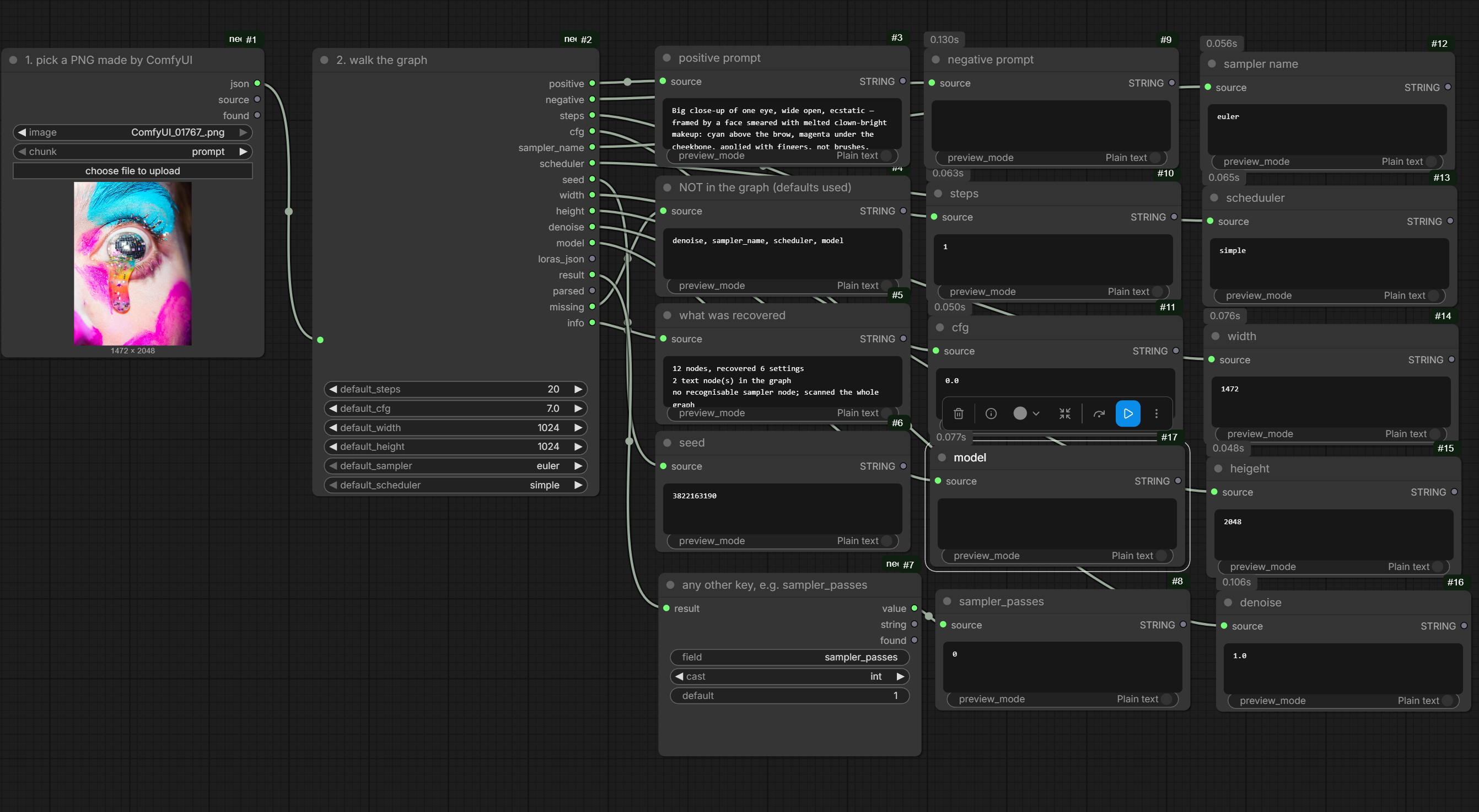
Pick an image, walk its embedded graph, get the prompt, seed, size, model and sampler
settings back as real INT/FLOAT/STRING outputs. The missing output names
everything that was not in the graph, so a default never quietly passes itself off as
a recovered setting — above, denoise, sampler_name, scheduler, model were genuinely
absent.
Route a request to a branch
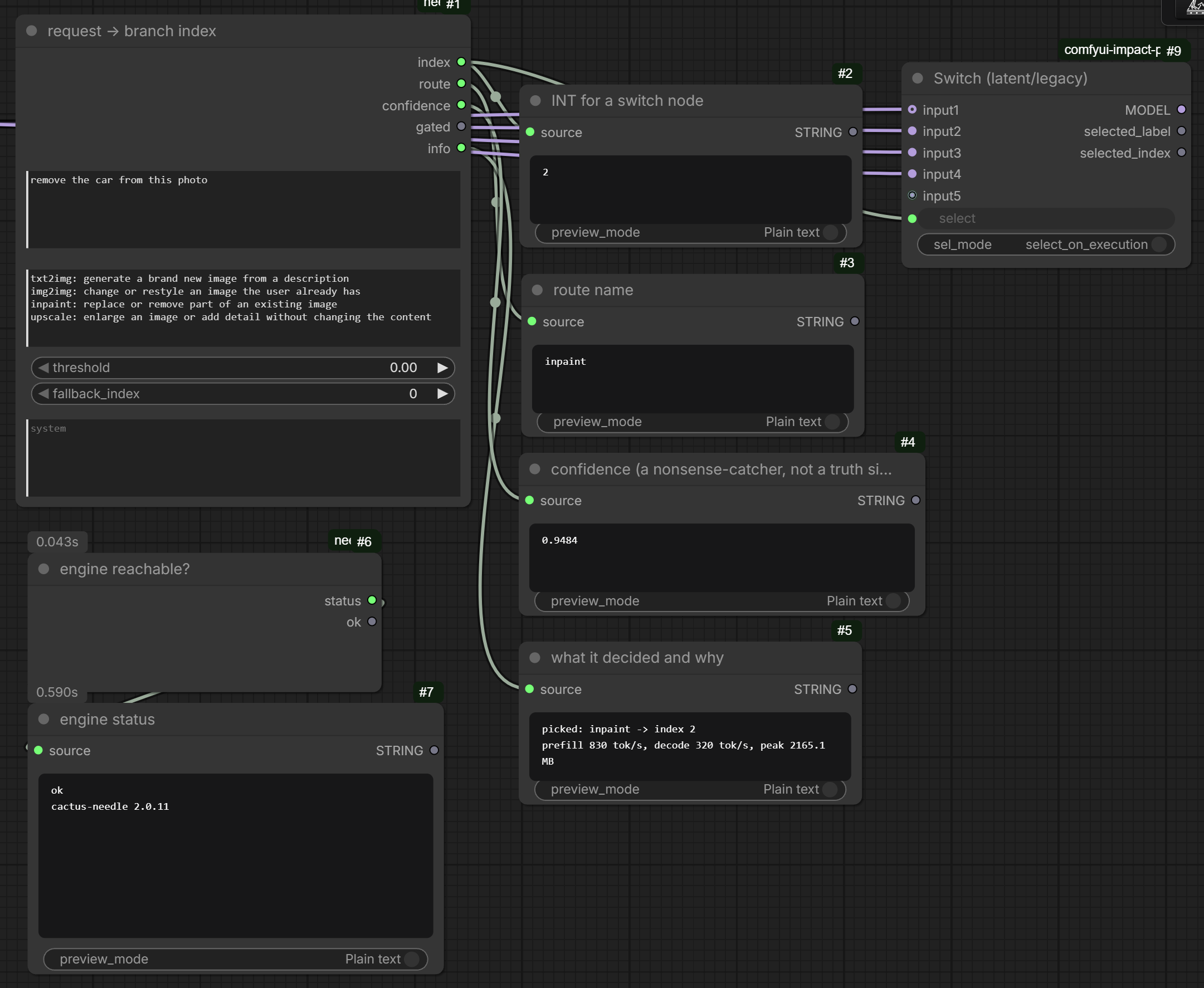
"remove the car from this photo" → inpaint → index 2, wired straight into an
Impact Pack switch. Zero VRAM, ~0.16 s.
Nodes
| Node | Does | Uses the model |
|---|---|---|
| Needle Extract | Text → JSON against a schema you define | yes |
| Needle Get Field | Pull one field out as a wildcard (ANY) output | no |
| Needle Router | Classify a request into a branch, gated on confidence | yes |
| Needle Prompt to Sampler Params | Prompt → width/height/steps/cfg/sampler/scheduler/seed | yes |
| Needle Engine Status | Reports whether the engine can load at all | yes |
| Workflow From Image | Pull the prompt JSON out of a PNG | no |
| Workflow Parse | Graph → prompts, seed, steps, cfg, sampler, model | no |
| Workflow Texts | Every text node, for graphs the sampler walk cannot map | no |
Not for prompt enhancement, captioning, translation, or chat. Needle 2 is not multimodal and its context is a 256-token sliding window. Use a real LLM/VLM node for those.
Install
ComfyUI Manager — search for ComfyUI Needle 2 and install, then restart ComfyUI.
Manually:
cd ComfyUI/custom_nodes
git clone https://github.com/DenRakEiw/Comfyui_Needle2
python_embeded\python.exe -m pip install cactus-needle
The directory must not be called
needle. That name collides with the engine's own Python package. ComfyUI's own loader is fine with it, but any custom node pack that putscustom_nodesonsys.path—comfyui-vrgamedevgirldoes — makesimport needlefind this pack instead of the engine, and every node fails with a clear error telling you to rename.Comfyui_Needle2is safe.
The wheel is 83 KB and pulls only huggingface_hub. On first run the engine downloads
libneedle.dll / .so / .dylib (14 MB) into ~/.cache/cactus-needle/.
JAX and Flax are needed only for finetuning. Do not install the [train] extra into
ComfyUI's Python — it upgrades numpy to 2.x and will break torch-based custom nodes.
Windows: Smart App Control blocks the engine
libneedle.dll is unsigned, so Smart App Control or a WDAC policy refuses to load it:
OSError: [WinError 4551] An application control policy has blocked this file
Check with Get-MpComputerStatus | Select-Object SmartAppControlState. The only fix is
turning Smart App Control off in Windows Security → App & browser control, which is
irreversible — it cannot be re-enabled without reinstalling Windows. Needle Engine Status reports this condition explicitly instead of failing with a bare ctypes error.
Measured behaviour — read this before trusting it
This is a 45M model. What it does well and badly was measured, not assumed.
- Extraction from prose is good.
"Invoice from Acme Corp for 1200.50 dollars, due 2026-09-01"→ all three fields correct, and off-topic text correctly yields{}rather than an invented invoice. - Routing is decent, not reliable: 4/6 on the built-in routes. Wrong answers came back
with middling confidence (0.65–0.68) and correct ones sometimes with 0.00 — so the
confidence gate is a backstop against nonsense input, not a correctness signal.
Leave
thresholdat 0 unless you have measured your own routes. - Sampler params work on dense prompts, not sparse ones. A prompt naming everything
extracts cleanly.
"a portrait, 40 steps"returns nothing at all and the node falls back to your defaults. Measured 7/11 numeric fields across five prompts; the other four were defaults, never wrong values. - English only in practice. German input produced no call at all (confidence 0.48) where the English equivalent scored 0.996.
The guarantee these nodes give you is not accuracy — it is that a miss degrades to your configured default, never to a made-up number, and that a sampler outside the list you offered can never reach KSampler.
Tried and rejected: a text → BOOLEAN classifier
A "does this text match this statement" node would fit the model's shape perfectly — one
typed value out — but it does not work. Four framings were measured on
"the text describes a photo of a person":
| Framing | Correct | Abstained |
|---|---|---|
| single boolean parameter | 1/6 | 5 |
| enum field ["yes","no"] | 3/6 | 3 |
| two tools yes / no | 0/6 | 6 |
| two action tools keep / skip | 3/6 | 1 (2 outright wrong) |
The best framing, widened to 12 cases, answered only 6 times and got one of those wrong. Phrasing the criterion as an explicit command — closer to the model's training domain — made it worse (7/8 abstentions). Needle 2 extracts facts that are stated in the text; it does not make judgements about the text. No such node ships here.
The workflow nodes
No model is involved here. A workflow graph is exact structured data, walking it is exact too, and a 45M model reading JSON through a 256-token window would be strictly worse.
Measured on 400 real graphs (0 exceptions), counting only the 129 that contain a sampler:
| | recovered | |---|---| | seed, sampler, model, steps | 129/129 (100%) | | cfg | 125/129 (96%) | | width / height | 97/129 (75%) | | positive prompt | 317/400 of all graphs |
The gaps are the workflows, not the parser. Sigma-driven graphs (ManualSigmas) have no
steps input at all, so the count is derived from the length of the sigma schedule.
Latent sizes are often computed at runtime via GetImageSize, so no literal exists to
read.
Three things make this harder than it looks:
- The sampler is not
KSampler. In the install this was built against,SamplerCustomAdvancedaccounts for 1031 of the sampler nodes and plainKSamplerfor 51. The walk follows the sampler's own links — guider, sigmas, noise — instead of matching a class name. - Multi-pass graphs share nodes. A two-stage or latent-upscale workflow has two samplers
whose conditioning chains overlap, so "the first sampler in the JSON" mixes settings
from both passes.
Workflow Parsewalks back from the output node to find the pass that actually produced the file, and reportssampler_passeswhen there is more than one. - Values hide behind links.
noise_seedoften points at aPrimitiveIntandCLIPTextEncode.textat a string node, so links are resolved transitively. Node ids are strings and may be subgraph-namespaced ("29:39").
When a graph builds its prompt at runtime, positive comes back empty with a note
rather than handing you an unrelated text node — some of them hold Python snippets.
Workflow Texts lists everything so you can pick by hand.
Every key found is also on the result output, so Needle Get Field reads anything
without its own slot.
The wildcard (ANY) outputs
Needle Get Field returns ANY, so one node feeds an INT, a STRING, or anything else
depending on the schema. ComfyUI implements this in comfy_execution/validation.py:
validate_node_input short-circuits when either side is "*", and also honours the older
__ne__-override idiom. This pack uses the AnyType(str) subclass, which satisfies both.
The cost is that nothing is checked until the receiving node runs — a mistyped field name
surfaces as a runtime error downstream, not as a refused connection in the UI. Use the
cast widget to force the type you want.
Schema shorthand
Needle Extract accepts three shapes. The shorthand is usually enough:
{ "vendor": "string", "total": "number", "note": "string?" }
A trailing ? marks a field optional. A bare JSON Schema and a full needle tool schema
also work. Needle omits fields it found no evidence for, so Needle Get Field has a
default widget and a found output.
Examples
Drag any file from examples/ onto the ComfyUI canvas:
| File | Shows |
|---|---|
| 01_read_workflow_from_png.json | PNG → graph walk → prompt, seed, steps, and what was not in the graph |
| 02_extract_text_to_fields.json | text → JSON → individual fields through the ANY output |
| 03_router_and_status.json | request → branch index with the confidence gate, plus the engine probe |
They are generated from the node definitions rather than typed by hand, so widget order
cannot drift out of sync, and each one is checked against ComfyUI's own
execution.validate_prompt. Example 1 has an image name preselected that will not exist
on your machine — pick one of your own ComfyUI PNGs in the widget.
Implementation notes worth keeping
Not style choices; each one was measured and changes the output.
reset()before every call. Agents are cached and the engine keeps a 256-token conversation window. Without a reset, one off-topic prompt makes every later extraction return{}.- The router declares one tool per route, not one enum-valued field. Needle is trained to select a tool: the enum form scored 0/6, one-tool-per-route 4/6.
- Numeric bounds feed the decoding grammar. Without
"maximum"oncfg, the model reads"cfg 4.5"as45— its own reasoning says so. - Enum fields are declared first. With them last,
schedulercame backNone0/4; declared first, sampler and scheduler are both correct 4/4. drop_ungroundeduses the engine's undocumentedvalidation.ungroundedlist to discard values it could not ground in the input. On"a car, 768x512, 12 steps"the model returned600x600and flagged exactly those fields.- The engine is a process-global singleton with module-level state. Every call goes through one lock; 8 concurrent node runs were verified clean.
- Finetuned
.cactweights cannot be unloaded. Once one is loaded, every base-model node in the process fails, and confidence becomesNone. - Telemetry is disabled by default here; re-enable with
NEEDLE_COMFY_TELEMETRY=1. peak_ram_mbin the envelope is process-wide, not engine-only.
Credits & license
Needle 2 is built by Cactus Compute and released under Apache 2.0. This node pack follows suit — see LICENSE.
All of the model's own capabilities, limits and file formats belong to the upstream project; this repository only wires it into ComfyUI.