
comfyui-nodes-docs (EN + 中文)
In-app documentation for 3500+ ComfyUI nodes, in English and Chinese. The doc panel language follows ComfyUI's Comfy.Locale setting.
中文文档 | English Document
A ComfyUI plugin that shows rich, per-node documentation right inside the graph — select a node and read what every input, output, and option does without leaving the canvas. This fork adds English documentation for 5800+ nodes alongside the original Chinese, picked automatically from your ComfyUI language setting.
Fork of the original CavinHuang/comfyui-nodes-docs (created by 水门Minato & Leo). The Chinese documentation is theirs and is kept untouched; this fork adds the parallel English docs and language-aware serving.
Installation
comfyUI Manager
Search comfyui-nodes-docs in the ComfyUI Manager and install it.
Custom installation
-
Open a terminal in ComfyUI's plugin directory (e.g.
ComfyUI\custom_nodes) and run:git clone https://github.com/Delcado19/comfyui-nodes-docs…or download the ZIP, extract it, and copy the resulting folder into
ComfyUI\custom_nodes\. -
Restart ComfyUI.
comfy-cli
If you have comfy-cli installed, run comfy node registry-install comfyui-nodes-docs and restart ComfyUI.
Usage
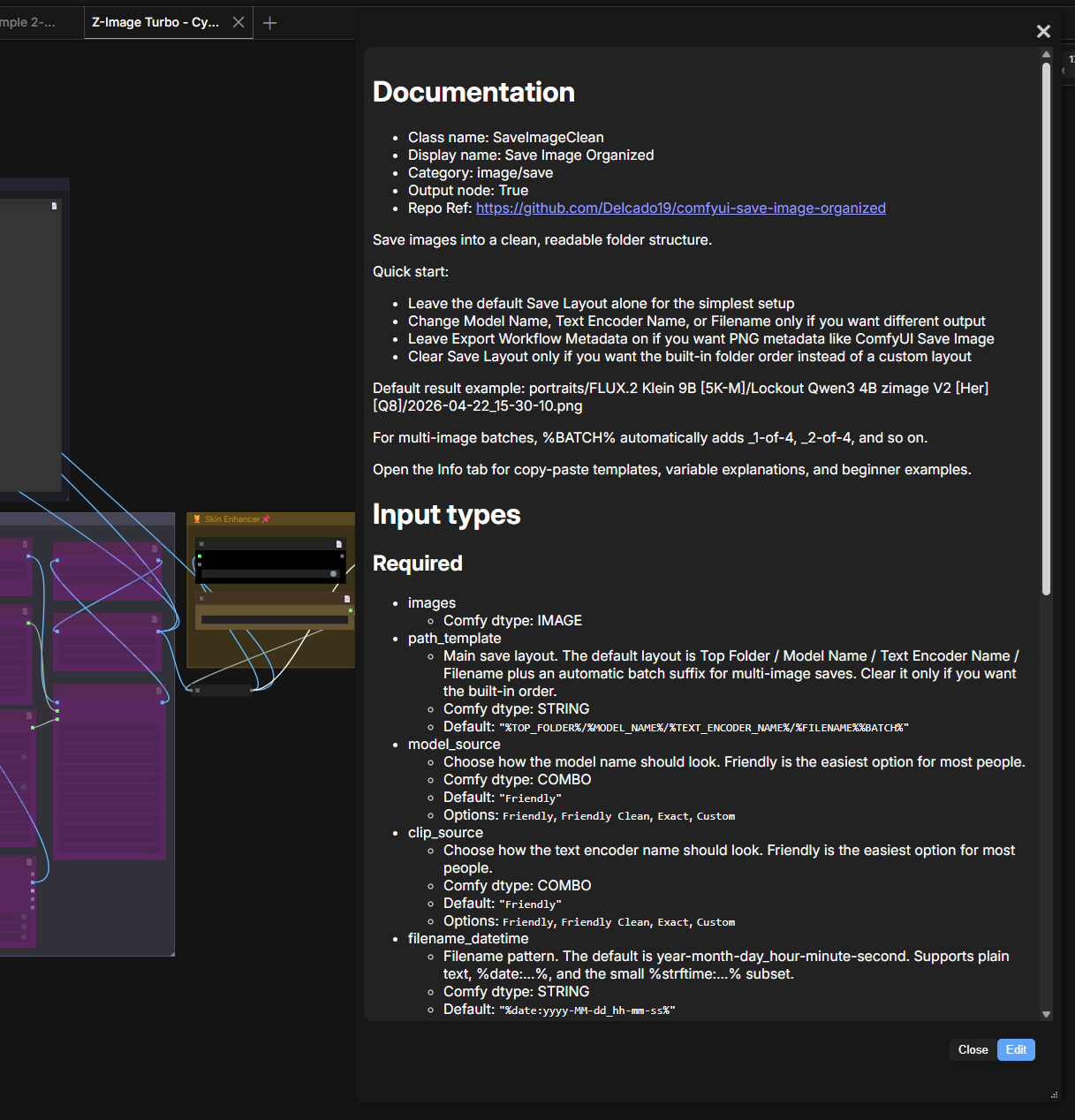
Open any workflow, right-click a node (or use the node's docs button) and the documentation panel opens beside it. The panel language follows ComfyUI's own Comfy.Locale setting — no separate switch:
zh*locales → the original Chinese doc (docs/<NodeType>.md)- any other locale → the English translation (
docs/<NodeType>_en.md) - if a translation is missing, the server falls back to the Chinese source, so every node stays documented (zero regression)
You can edit a node's doc locally from the panel; local edits are stored on your machine and never co-built into the shared Chinese cloud DB when you are viewing the English locale.
English documentation
All 5800+ English node docs ship as *_en.md files beside the original Chinese sources. Most are a machine-translated first pass; docs added from a live ComfyUI install use the node's /object_info metadata plus Comfy Registry or installed-repo links where available. Improvements welcome. The language-aware serving feature touches only two code files:
server/request.py— language-aware doc lookup (alangquery/body parameter, plus a guard so English edits are never co-built into the Chinese cloud DB)web/comfyui/creatDocsElement.js— readsComfy.Locale, passeslangto the doc endpoints, and localizes the doc-panel labels
Everything else is additive *_en.md content.
Source-code links
In the English docs, the embedded source-code snippet that used to sit under each # Source code heading is replaced with a link to the node pack's repository (derived from the doc's Repo Ref: metadata). Embedded snippets go stale on every pack update, whereas a repository link stays current and keeps the docs lean. Chinese sources are unchanged.
Translation & doc-generation tooling
The scripts used to translate the docs, retrofit the source-code links, and generate new docs from a running ComfyUI's /object_info live in a separate companion repo (comfyui-nodes-docs-tools), so this plugin stays lean. Clone it next to this repo (as a sibling directory); its scripts default docs/ to ../comfyui-nodes-docs/docs, or set COMFY_DOCS_DIR to override.
In short, from the tools repo you point the translator at any OpenAI-compatible chat endpoint via environment variables and run npm run translate:docs:
$env:OPENAI_BASE_URL = "https://your-endpoint/v1"
$env:OPENAI_API_KEY  = "your-key"
$env:OPENAI_MODEL    = "your-model"
npm run translate:docs            # or: -- --limit 50
The script writes a matching _en.md file for each source document, preserves code blocks, metadata lines, and Markdown structure, and supports caching plus resume-friendly reruns. See the tools repo's README for all scripts, flags, and environment variables.
Node list
Being compiled — the docs/ folder currently holds 9400+ Markdown documents, including 5800+ English node docs.
Contributing
There are two ways to help:
- Maintain the plugin — fix issues, improve the experience, optimize the code.
- Improve the docs — add docs for nodes not yet covered, correct mistakes in existing docs (including the machine-translated English first pass), or update docs that lag behind a pack upgrade.
How to contribute
- Fork the repo to your own GitHub account.
- Create a branch for your changes, make and commit them.
- Open a pull request against the
mainbranch. - After review, your changes are merged and released.
Add a new node doc
Create a Markdown file named after the node type in the docs folder, e.g. CLIPMergeSimple.md (see docs/CLIPMergeSimple.md for a full example), using this structure:
For an English doc, name the file <NodeType>_en.md and follow the same structure (English prose, repository link under # Source code).
Changelog
See CHANGELOG.md for the fork's changes (English docs, language-aware serving, source-code links, tooling extraction). The upstream Chinese update log lives in README_zh.md.
Credits
- Original plugin and Chinese documentation: CavinHuang/comfyui-nodes-docs by 水门Minato & Leo.
- English translation, language-aware serving, and tooling: this fork.