
ComfyUI-NAG (Delcado fork)
Maintenance fork of ChenDarYen/ComfyUI-NAG (Normalized Attention Guidance) with compatibility patches for ComfyUI v0.21+.
Nodes (5)
Negative prompts that actually work on CFG-1 models
NAG for multi-stage and refiner sampling chains
Get real negative prompting back in the custom-sampling chain
The BasicGuider swap for pure guidance-distilled models
NAG bolted straight onto SamplerCustom
ComfyUI-NAG (Delcado fork)
Maintenance fork of ChenDarYen/ComfyUI-NAG by Dar-Yen Chen. All credit for the original implementation goes to the upstream author; this fork only adds compatibility patches and packaging.
See
NOTICE.mdfor the change list andLICENSEfor the unmodified MIT license terms.
Install
- Comfy Registry:
comfyui-nag-delcado(publisher@delcado) - From source:
git clone https://github.com/Delcado19/ComfyUI-NAG.gitinto yourComfyUI/custom_nodes/directory.
What this fork fixes vs. upstream
chroma/layers.pyNone-stub crash on ComfyUI v0.21+ Upstreamchroma/layers.py:10doesclass NAGDoubleStreamBlock(DoubleStreamBlock):after importingDoubleStreamBlock/SingleStreamBlockfromcomfy.ldm.chroma.layers. Recent ComfyUI versions deprecate those symbols and set them toNone(the real classes moved tocomfy.ldm.flux.layers), so the import fails withTypeError: NoneType takes no arguments. This fork detects both theNonestub and a missing legacy import path, then falls back to the new location. Closes the same root cause as upstream issues #79, #60, #54, #53, #55.- Flux / Flux Kontext missing
flipped_img_txtattribute Recent ComfyUI Flux blocks no longer exposeflipped_img_txt. This fork treats a missing attribute as ComfyUI's currenttxt, imgattention ordering, avoiding anAttributeErrorduring Flux and Flux Kontext sampling. - Flux2 / Flux.2 klein position-ID compatibility Flux2 models can use a different positional-ID axis count than older Flux models. This fork derives the NAG Flux text-ID shape from the loaded model instead of assuming three axes, matching ComfyUI's current Flux behavior.
- Flux2 / Flux.2 klein gated MLP compatibility
Current ComfyUI Flux2 / Flux.2 klein variants can use a gated single-stream
MLP layout. This fork keeps those core single-stream blocks untouched for the
gated or four-axis-ID variants, passes the combined positive/negative RoPE
data through to the core blocks, and applies NAG only to the double-stream
path to avoid the shape regressions that were crashing sampling. The combined
RoPE is also left-padded along the txt axis to the shared padded txt length
when the positive and negative contexts differ in token count, fixing
RuntimeError: Sizes of tensors must match except in dimension 0. Expected size 6052 but got size 4388on Flux.2 klein 9B NAG workflows where the positive and uncond contexts have different lengths. - SamplerCustomAdvanced empty-token / batch compatibility
NAG's direct
nag_negativeconditioning path now repeats the NAG negative tensor to the latent batch size using ComfyUI's batching helper and replaces zero-token text conditioning with a minimal zero-token fallback. This avoids shape errors such asshape '[2, 0, 4096]' is invalid for input of size 4096when custom samplers run batched Flux-style workflows with empty or very short NAG negative prompts. Flux2 paths that omit pooled CLIP output fornag_negativenow either use a neutral vector fallback or skip vector conditioning when the model has no vector branch, avoiding'NoneType' object has no attribute 'to'crashes inSamplerCustomAdvanced. Flux2 global-modulation blocks are handled through ComfyUI's tuple-based modulation path, so NAG no longer expects removedimg_mod/txt_modblock attributes. - Flux2 / current ComfyUI forward compatibility
The Flux NAG wrapper now preserves the loaded model's
patch_sizewhen reshaping outputs, so Flux2 128-channel latents are not collapsed into the older Flux 32-channel layout. It also passes optional ComfyUI Flux forward parameters by keyword, keeping the NAG path aligned with current ComfyUI signatures that added positional arguments afterattn_mask. - README Usage section direction — closes upstream #39.
- Packaging / Registry —
pyproject.tomlplus GitHub Actions for smoke-import test and Comfy-Registry publish.
Implementation of Normalized Attention Guidance: Universal Negative Guidance for Diffusion Models for ComfyUI.
NAG restores effective negative prompting in few-step diffusion models, and complements CFG in multi-step sampling for improved quality and control.
Paper: https://arxiv.org/abs/2505.21179
Code: https://github.com/ChenDarYen/Normalized-Attention-Guidance
Wan2.1 Demo: https://huggingface.co/spaces/ChenDY/NAG_wan2-1-fast
LTX Video Demo: https://huggingface.co/spaces/ChenDY/NAG_ltx-video-distilled
Flux-Dev Demo: https://huggingface.co/spaces/ChenDY/NAG_FLUX.1-dev
News
2025-07-06: Add three new nodes:
KSamplerWithNAG (Advanced)as a drop-in replacement forKSampler (Advanced).SamplerCustomWithNAGforSamplerCustom.NAGGuiderforBasicGuider.
2025-07-02: HiDream is now supported!
2025-07-02: Add support for TeaCache and WaveSpeed to accelerate NAG sampling!
2025-06-30: Fix a major bug affecting Flux, Flux Kontext and Chroma, resulting in degraded guidance. Please update your NAG node!
2025-06-29: Add compile model support. You can now use compile model nodes like TorchCompileModel to speed up NAG sampling!
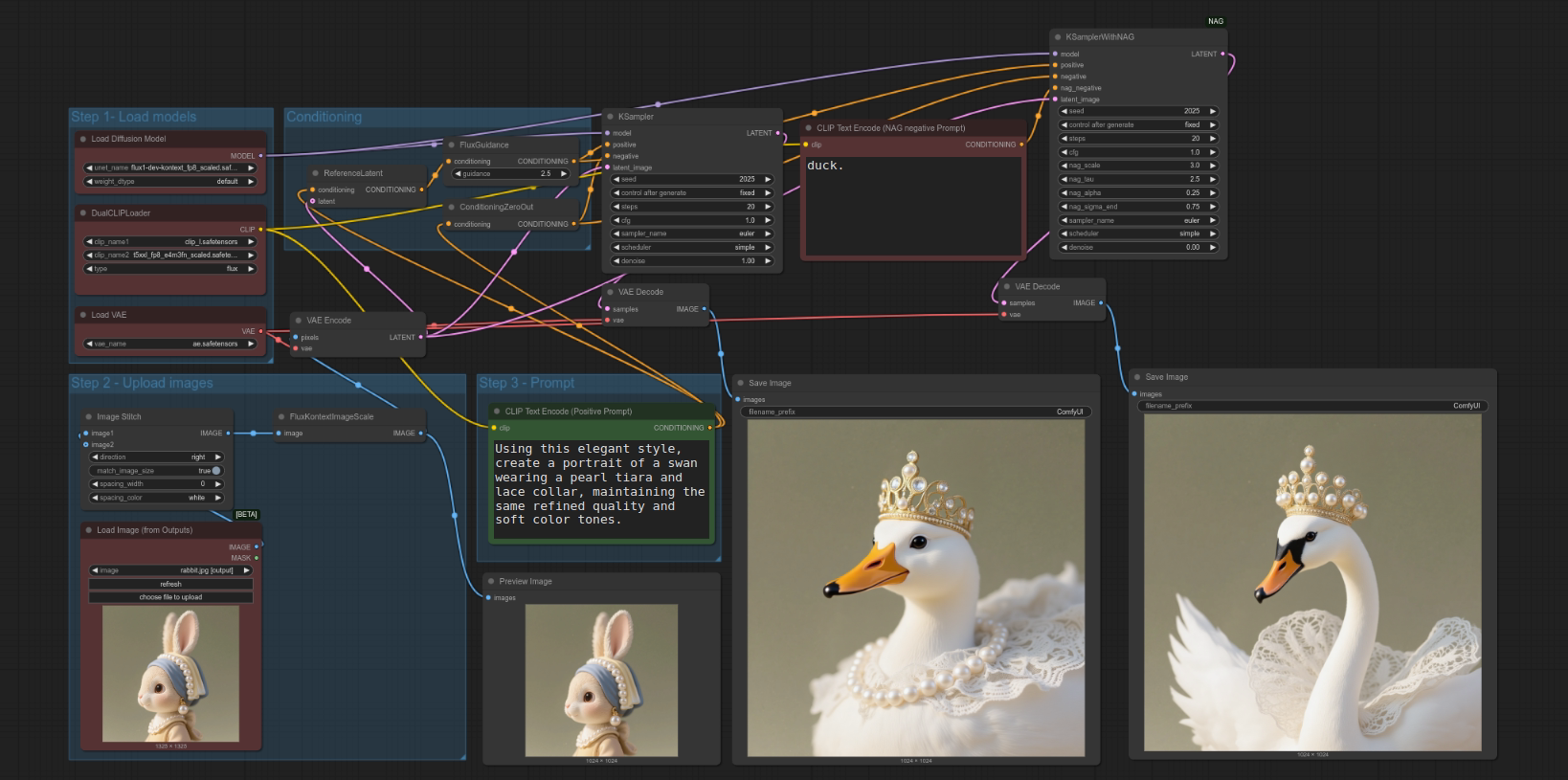
2025-06-28: Flux Kontext is now supported. Check out the workflow!
2025-06-26: Hunyuan video is now supported!
2025-06-25: Wan video generation is now supported (GGUF compatible)! Try it out with the new workflow!
Nodes
KSamplerWithNAG,KSamplerWithNAG (Advanced),SamplerCustomWithNAGBasicGuider,NAGCFGGuider
Usage
To use NAG, simply replace
KSamplerwithKSamplerWithNAG.KSampler (Advanced)withKSamplerWithNAG (Advanced).SamplerCustomwithSamplerCustomWithNAG.BasicGuiderwithNAGGuider.CFGGuiderwithNAGCFGGuider.
We currently support Flux, Flux Kontext, Flux2 / Flux.2 klein, Wan, Vace Wan, Hunyuan Video, HiDream, Chroma, SD3.5, SDXL and SD.
Example workflows are available in the ./workflows directory!
Key Inputs
When working with a new model, it's recommended to first find a good combination of nag_tau and nag_alpha, which ensures that the negative guidance is effective without introducing artifacts.
Once you're satisfied, keep nag_tau and nag_alpha fixed and tune only nag_scale in most cases to control the strength of guidance.
Using nag_sigma_end to reduce computation without much quality drop.
For flow-based models like Flux, nag_sigma_end = 0.75 achieves near-identical results with significantly improved speed. For diffusion-based SDXL, a good default is nag_sigma_end = 4.
nag_scale: The scale for attention feature extrapolation. Higher values result in stronger negative guidance.nag_tau: The normalisation threshold. Higher values result in stronger negative guidance.nag_alpha: Blending factor between original and extrapolated attention. Higher values result in stronger negative guidance.nag_sigma_end: NAG will be active only untilnag_sigma_end.
ComfyUI validates these ranges before running the prompt. Values outside the allowed range are rejected rather than clamped automatically.
| Input | Minimum | Maximum | Default | Notes |
|-------|---------|---------|---------|-------|
| nag_scale | 0.0 | 100.0 | 5.0 | NAG guidance is applied only when nag_scale > 1.0. |
| nag_tau | 1.0 | 10.0 | 2.5 | Normalization threshold. |
| nag_alpha | 0.0 | 1.0 | 0.25 | Attention blend factor. |
| nag_sigma_end | 0.0 | 20.0 | 0.0 | For Flux-style models, 0.75 is a useful speed/quality default. |
Rule of Thumb
- For image-reference tasks (e.g., Image2Video), use lower
nag_tauandnag_alphato preserve the reference content more faithfully. - For models that require more sampling steps and higher CFG, also prefer lower
nag_tauandnag_alpha. - For few-step models, you can use higher
nag_tauandnag_alphato have stronger negative guidance.