
JK HeartMuLa (Style Transfer)
HeartMuLa music generation + lyrics transcription with MuQ-MuLan reference-audio style transfer (fork of ComfyUI-HeartMuLa)
Nodes (10)
Where tokens stop being math and start being a song
The quiet half of the audio pipeline
Turn any audio back into words
The ~20 GB friend at the front of the music graph
The 2.5 GB style brain, and the one thing that auto-downloads
Local music with great vocals and a mind of its own
The mastering chain nobody thinks to read about
The reference-audio switch the README tells you to leave off
The prompt box that keeps your tags honest
The Whisper babysitter
ComfyUI-JK-HeartMuLa
HeartMuLa music generation + lyrics transcription, with MuQ-MuLan reference-audio style transfer.
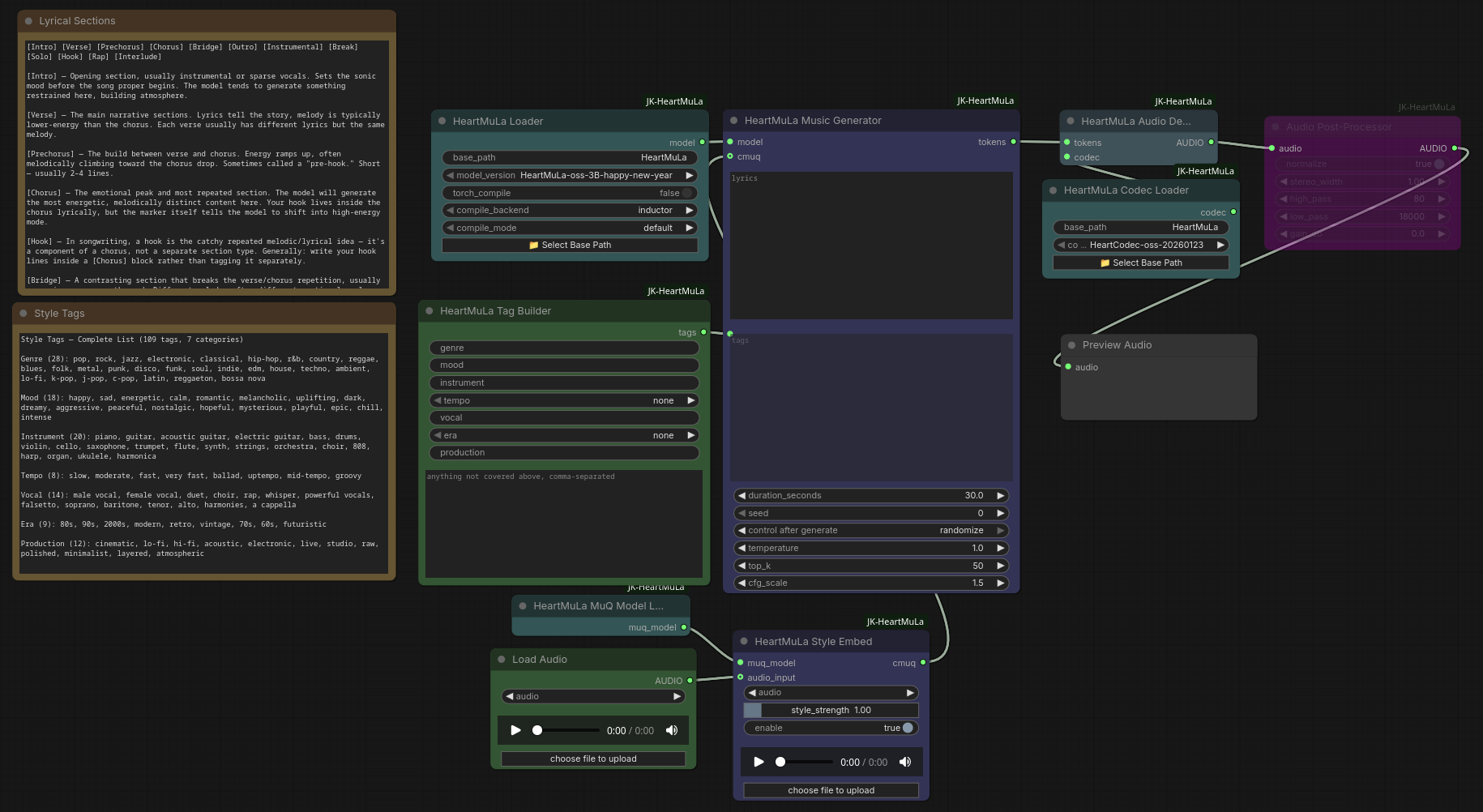
A fork of BobRandomNumber/ComfyUI-HeartMuLa (Apache-2.0) that adds MuQ-MuLan reference-audio style conditioning to HeartMuLa music generation. It bundles the full HeartMuLa toolset (loaders, generator, decoder, post-processor, lyrics transcription) so it works as a complete, standalone pack.
Heads-up: the style-transfer feature is experimental / research-only. In practice, generating with tags alone gives the best results. The MuQ-MuLan style node is included to expose the capability for experimentation — it does not reliably improve output. The bundled default workflow ships with it disabled. See What style transfer does (and doesn't) below before using it.
All node ids use the JKHeartMuLa* prefix and live under the JK-HeartMuLa category, so this pack installs alongside the original ComfyUI-HeartMuLa (or other HeartMuLa packs) without conflicts.
What style transfer does (and doesn't) — read this
This feature is experimental / research-only — tag-only generation gives the best results. It's exposed so others can explore it, not because it improves output. The HeartMuLa authors themselves ship the embedding disabled by default (heartlib hardcodes it to zeros), describe it as "a global stylistic cue," drop it 50% of the time in training, and deliberately strip voice/timbre from it ("MuQ-MuLan does not include any speaker timbre information" — paper §). In our own testing, a tag-only generation matched a reference's tempo/energy/brightness better than any style-transfer setting did.
MuQ-MuLan turns the whole reference clip into a single global genre/mood/instrumentation vector. In practice that makes it behave more like an alternative way to specify tags than a precise style clone or an enhancer on top of tags — set expectations accordingly:
- ✅ It nudges the overall genre / mood / instrumentation toward the reference.
- ❌ It does not reliably transfer tempo, loudness/energy, or spectral balance (brightness) — those are emergent from generation and tend to drift (often quieter/darker), and no setting fully controls them.
- ❌ It does not clone voice, melody, or groove, and it is not a continuation engine — it won't seamlessly extend a clip.
- ⚠️ If the reference's genre already matches your text tags, it adds little — tags alone usually get you closest — and can even drift the sound away from the reference. In testing, a tag-only generation matched a techno reference's tempo/energy/brightness better than any style-transfer setting did.
- 👍 It helps most when the reference conveys a vibe your tags can't easily put into words. Treat it as a loose anchor used alongside or instead of tags, not a high-fidelity copy.
Best behavior: style_strength ~1.0 with normalize on. Over-driving (higher strength) destabilizes output (short, subdued).
Installation
cd ComfyUI/custom_nodes
git clone https://github.com/Crono141/ComfyUI-JK-HeartMuLa.git
cd ComfyUI-JK-HeartMuLa
pip install -r requirements.txt
Restart ComfyUI; the nodes appear under the JK-HeartMuLa category. Requires a recent ComfyUI with the V3 node API (same as the original HeartMuLa pack).
Model setup
HeartMuLa weights are not auto-downloaded (so models stay in one place and aren't duplicated across packs). Download them once with git + Git LFS into ComfyUI/models/HeartMuLa/:
# from your ComfyUI root
cd models
git lfs install

# Base config files (gen_config.json + tokenizer.json) — this creates the HeartMuLa/ folder
git clone https://huggingface.co/HeartMuLa/HeartMuLaGen HeartMuLa
cd HeartMuLa

# Recommended model + codec (cloned as subfolders)
git clone https://huggingface.co/HeartMuLa/HeartMuLa-oss-3B-happy-new-year
git clone https://huggingface.co/HeartMuLa/HeartCodec-oss-20260123
Optional extras — clone these inside the same HeartMuLa/ folder:
# Lyrics transcription (Whisper-based)
git clone https://huggingface.co/HeartMuLa/HeartTranscriptor-oss

# Alternate / older models
git clone https://huggingface.co/HeartMuLa/HeartMuLa-RL-oss-3B-20260123
git clone https://huggingface.co/HeartMuLa/HeartMuLa-oss-3B
git clone https://huggingface.co/HeartMuLa/HeartCodec-oss
Resulting layout:
ComfyUI/models/HeartMuLa/
├── gen_config.json
├── tokenizer.json
├── HeartMuLa-oss-3B-happy-new-year/
├── HeartCodec-oss-20260123/
└── …optional extras
In the loader nodes, set base_path to HeartMuLa (the 📁 button browses folders) and pick the model/codec version from the dropdown — these correspond to the subfolder names above.
The MuQ-MuLan style model (OpenMuQ/MuQ-MuLan-large, ~2.5 GB) is the one exception: it auto-downloads from Hugging Face the first time the HeartMuLa MuQ Model Loader runs (it has no ComfyUI models folder), into your Hugging Face cache.
Nodes
Reused from HeartMuLa (rebranded JKHeartMuLa*):
- HeartMuLa Loader — loads the generator LLM.
base_path,model_version, optionaltorch_compile+ backend/mode. - HeartMuLa Codec Loader — loads the audio codec (fp32).
- HeartMuLa Music Generator — the core generator: lyrics, tags, duration, seed, temperature, top_k, cfg_scale, plus an optional
cmuqinput for style transfer. Withcmuqunconnected it behaves exactly like the stock generator. Outputs tokens. - HeartMuLa Audio Decoder — tokens → 48 kHz audio.
- Audio Post-Processor — normalize / stereo width / high-pass / low-pass / gain.
- HeartMuLa Transcription Loader / HeartMuLa Lyrics Transcriber — Whisper-based audio → lyrics.
New in this fork:
- HeartMuLa Tag Builder — per-category fields (genre / mood / instrument / vocal / production free-text with tag-suggestion tooltips; tempo / era dropdowns) plus a multiline
additional_tagsbox. Lowercases, de-dupes, and comma-joins into a singletagsstring for the Music Generator. (Original implementation; concept inspired by RT-HeartMuLa.) - HeartMuLa MuQ Model Loader — loads
OpenMuQ/MuQ-MuLan-largefor style embedding. Singleton; loads once per session. Adeviceswitch runs it on cpu (~2.5 GB RAM, no VRAM — default) or gpu (faster embedding, but holds ~2.5 GB VRAM resident — it isn't freed between runs and competes with generation). Style Embed runs on whichever device is selected. - HeartMuLa Style Embed — produces the 512-D style embedding from a reference clip (24 kHz mono), with a per-clip progress bar.
enabletoggle — flip style transfer on/off with a single switch. When off, it outputs a zero embedding (the Music Generator then runs tag-only, identical tostyle_strength = 0) and skips all audio + MuQ work — so one switch toggles a shared workflow between styled and tag-only without rewiring.- Reference input — drag an audio file onto the node / use the upload button (stored in ComfyUI's
input/), or wire the optionalaudio_inputsocket from any AUDIO source (Load Audio, Record Audio, a trimmed clip, generated audio…). The socket wins when connected. style_strength(0–2, type or drag) scales influence:0= off,1.0= natural/calibrated,>1over-drives (can destabilize — short/subdued output). Start at ~1.0.normalize(default on) — re-normalizes the reference embedding to unit length before applyingstyle_strength, so the strength means the same thing regardless of reference length (MuQ averages 10 s clips, so a longer reference otherwise yields a weaker vector).free_vram_after(default on) — after embedding, offloads MuQ-MuLan back to CPU and frees its VRAM so the HeartMuLa models have room to generate. No effect when MuQ runs on CPU. The model stays cached in RAM (no reload) and is moved back to the chosen device automatically on the next embed. Pair with the loader'sdevice = gpufor fast embedding without holding VRAM through generation.
Example workflow
The recommended starting point is example_workflows/HeartMuLa Music Generator.json — the full default pipeline (Tag Builder → Music Generator with style transfer → Audio Decoder → Post-Processor → Preview, plus MuQ Loader / Style Embed / Load Audio), with all fields at defaults. Flip the Style Embed enable switch off for plain tag-only generation.
Also included: style_transfer_basic.json (minimal style-transfer graph), HeartMuLaGeneration.json (plain generation), and HeartMuLaTranscription.json (lyrics transcription).
Notes
- Reference audio that errors in Load Audio: core Load Audio decodes with PyAV, which rejects some malformed MP3s (
avcodec_send_packet()/ "Invalid data"). The Style Embed node's own upload widget uses librosa (more tolerant) — drag the file straight onto Style Embed, or re-encode it to WAV/FLAC.
torch_compile (HeartMuLa Loader)
torch.compile JIT-compiles the model into fused kernels to cut Python dispatch and GPU launch overhead — the first run is slower (it compiles), later runs are faster. It's optional and off by default: it needs a matching Triton/CUDA toolchain and is wrapped in suppress_errors, so it falls back to eager if compilation fails.
- compile_backend —
inductor(default; generates fused Triton/C++ kernels; most reliable),cudagraphs(CUDA-graph capture; can log a harmlessunexpected keyword argument 'mode'warning on some torch builds), oreager(no compilation, the baseline). - compile_mode —
default(compile + fuse, quick to build),reduce-overhead(adds CUDA graphs to cut per-step launch overhead; uses more memory),max-autotune(benchmarks kernel variants for top speed; much longer first compile).
⚠️ CUDA-graph modes vs ComfyUI's allocator:
reduce-overheadandmax-autotuneenable CUDA graphs, whose memory-pool check isn't supported by thecudaMallocAsyncallocator ComfyUI uses by default — you'll hitRuntimeError: cudaMallocAsync does not yet support checkPoolLiveAllocations. To use those modes, launch ComfyUI with--disable-cuda-malloc. Otherwise keepcompile_mode = default(no CUDA graphs).
Reliable combo: inductor + default. Use max-autotune only together with --disable-cuda-malloc.
Credits & license
This pack is Apache-2.0, as a derivative of:
- BobRandomNumber/ComfyUI-HeartMuLa — base nodes and bundled
heartlib. SeeNOTICEfor the list of modifications. - HeartMuLa/heartlib — the model library, and the HeartMuLa team for the open weights.
- OpenMuQ/MuQ — the MuQ-MuLan style-embedding model.
The Tag Builder's design was inspired by monnky/ComfyUI-RT-HeartMuLa (reimplemented from scratch; no code or data taken).
@misc{yang2026heartmulafamilyopensourced,
      title={HeartMuLa: A Family of Open Sourced Music Foundation Models},
      author={Dongchao Yang and Yuxin Xie and Yuguo Yin and others},
      year={2026},
      eprint={2601.10547},
      archivePrefix={arXiv},
      primaryClass={cs.SD},
      url={https://arxiv.org/abs/2601.10547},
}