
Latent-Tiled PiD
Tile the latent, not the pixels: latent-native tiled decoding for NVIDIA PiD. Seam-free masters up to 244MP; size-picker dropdowns with render-tested presets for Krea2/qwen AND FLUX.2 Klein 4B/9B; avoids the past-envelope color collapse of single-shot decoding. No VAE re-encode round-trip.
Nodes (4)
One node between your KSampler and a 33MP print
Is your PiD decode collapsing in slow motion? This node tells you
The 56-entry dropdown that replaced your resolution math
The Klein size picker that also feeds Flux2Scheduler
ComfyUI-Latent-Tiled-PiD
Tile the latent, not the pixels.


Latent-native tiled decoding for NVIDIA PiD (Pixel Diffusion Decoder, arXiv:2605.23902) as native ComfyUI nodes. One node between KSampler and SaveImage: slices the generation latent into overlapping tiles, decodes every tile as a normal-sized in-envelope PiD job, feather-blends the pixels. Seam-free 33MP from a 2MP latent in about a minute — verified up to 244MP (15616x15616), with 56 render-tested sizes across 9 aspect ratios and cost scaling ~linearly at roughly 1MP of finished output per second on a single RTX 5090.
v1.3.0 adds the FLUX.2 family — Klein 4B, Klein 9B and FLUX.2-dev (128-channel, 16x-downscale latents) with its own dedicated Size Picker and its own 55-entry preset ladder, render-tested the same way: all 56 candidate rungs swept end-to-end on Klein 4B distilled up to 244MP, 55 shipped, one culled on a repeat QA-gate failure (docs/preset_sweep_report_flux2.md).

Why this exists
Single-shot PiD decoding is only trained for the 1024→4096 envelope. Push a 2MP latent through it and midtone color collapses — whites turn pink, chroma noise everywhere. The model isn't broken; you're just asking it to perform outside its contract, and it answers in magenta:
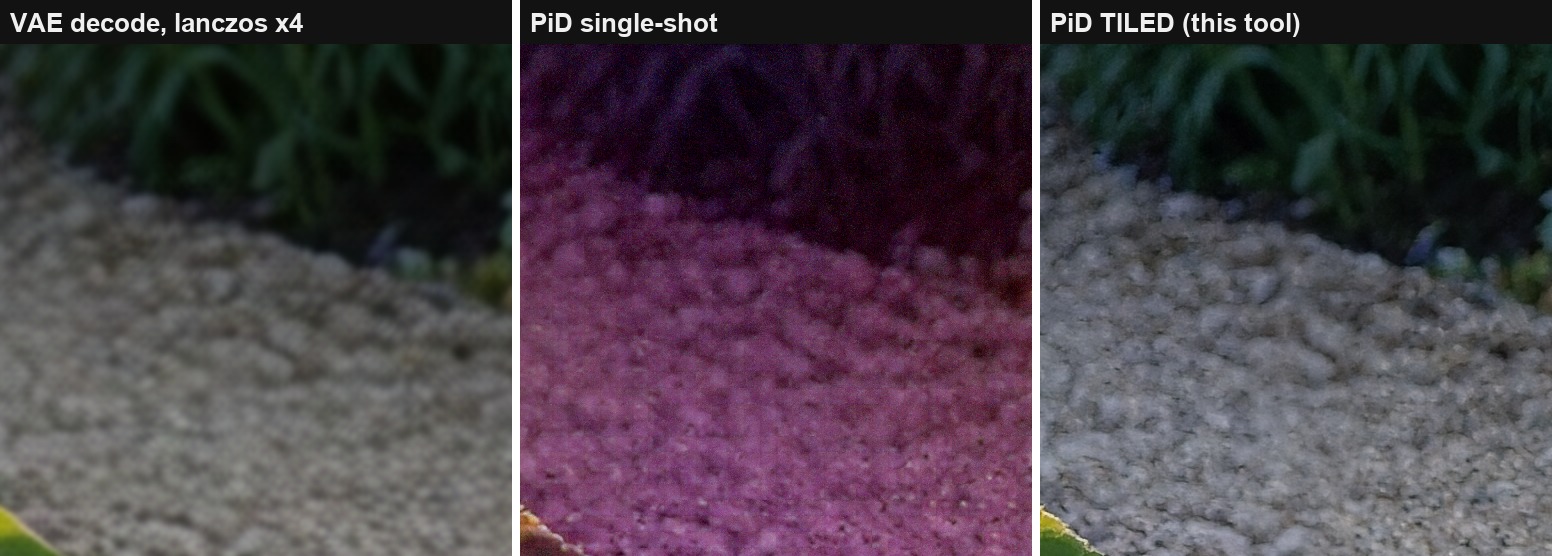
That crop sits directly on the vertical tile seam — find it. And the same decode that fixes the color is a genuine detail upgrade over the plain VAE decode:
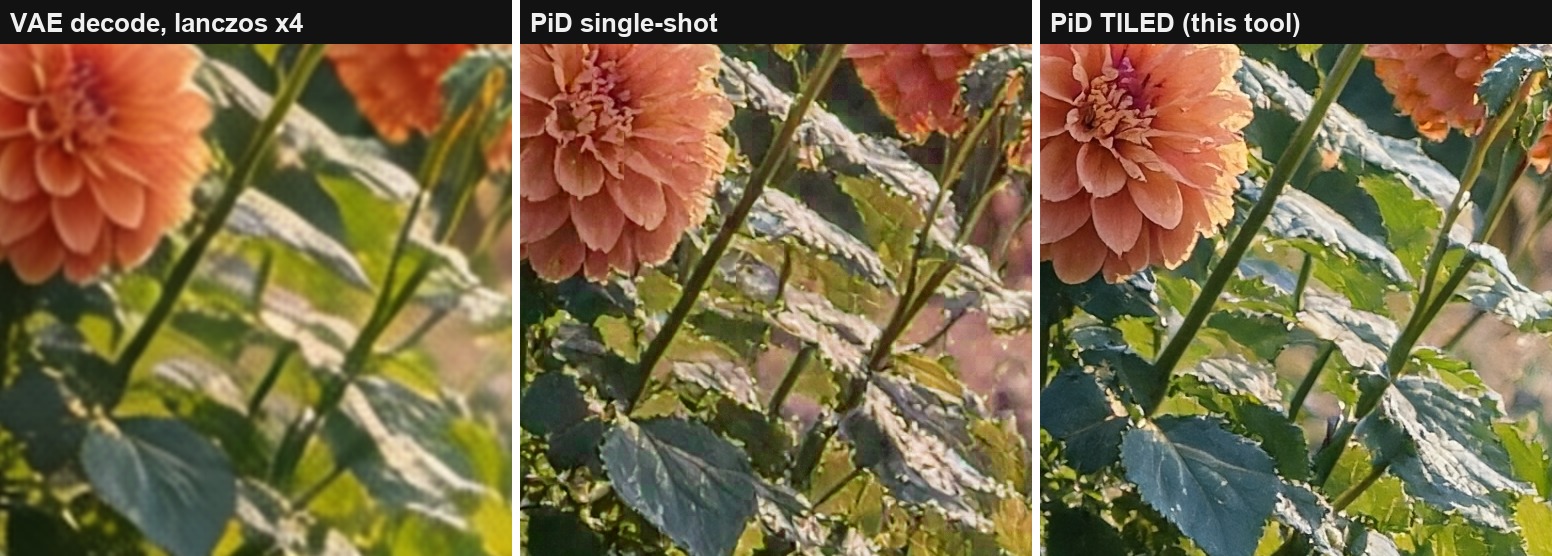
Existing tiled-PiD flows tile the decoded image and VAE-encode each tile back to latent space before running PiD — a lossy round-trip through tiles that were never real latents. Tiling the generation latent itself skips all of that: every tile conditions on a bit-exact crop of the latent the sampler actually produced, PiD's sigma-gated LQ injection keeps tiles globally coherent, and the complementary raised-cosine feather (weights sum to exactly 1) leaves no seams (worst measured seam gradient ratio across all test runs: 0.77–1.04, where 1.0 is statistically invisible).
The idea came from a simple observation while measuring the collapse: PiD's RoPE is relative, so a cropped latent decoded as its own image is indistinguishable from a native render of that size. I wanted the decode path the paper actually describes — latent in, pixels out — at sizes the single shot can't reach. This pack is that, as two nodes.
Nodes
The one rule to internalize: output resolution = 4x your latent, always. Feed a bigger latent and the node adds tiles automatically — there is nothing to configure. 1MP latent → 1 tile → 16MP. 2MP → 4 tiles → 33MP. 6.7MP → 8 tiles → 107MP. 15.2MP → 16 tiles → 244MP. Same node, same settings.
Latent-Tiled PiD Size Picker
(nothing) -> LATENT — start here. One dropdown, zero math. Wire it where
EmptySD3LatentImage would go and pick a line:
16:9 | render 1920x1088 -> output 7680x4352 | 33 MP | 4 tiles
Every entry is a complete configuration: aspect, the stage-1 render size this latent will have, the exact output resolution the tiled decode will produce, and how many tiles it takes. 56 presets across 9 aspect ratios, every single one render-tested end-to-end — full QA sweep on Krea 2 Turbo, per-preset verdicts in docs/preset_sweep_report.md. Range: single-tile 4K-class up to 244 MP (1:1, 15616x15616). Three ~210MP 15-tile rungs briefly shipped culled (their chroma tested just past the gate on the v1 checkpoint) and were restored in v1.2.0 when PiD v1.5's color-fidelity fix cut their chroma roughly in half on retest (9.8–11.8 vs 20.1–21.1). There is deliberately no sub-1024 single-tile entry: below their trained res, stage-1 models go mushy and PiD reinterprets instead of decoding — the ~1024 single-tile entry is the floor on purpose. Nothing in this dropdown is theoretical.
Model support: two render-tested lanes. Krea 2 Turbo (qwen-family, 8x latents) — the original full sweep — and, since v1.3.0, FLUX.2 Klein 4B distilled (flux2 family, 16x latents) with its own full 56-preset sweep (docs/preset_sweep_report_flux2.md). Klein 9B (fp8): spot-validated clean through the 59MP rungs (chroma 10.2–13.9) but degrades progressively from ~111MP up — shadow drift first, then chroma past the gate at 137MP+ (docs/preset_sweep_report_flux2_9b.md); use 4B for the monster rungs, which sweeps clean to 244MP. Other qwen-family stage-1 models should behave like Krea 2; the flux1 path is validated (Z-Image-Turbo stage-1, 2026-08-28 — see the FLUX.1 section below); sd3/sdxl paths exist in the Decode node but are untested. If you run something else, run the QA node and trust its verdicts over hope.
Latent-Tiled PiD Size Picker (FLUX.2 / Klein) — v1.3.0
The FLUX.2 twin of the Size Picker: same one-dropdown contract, but every entry sits on the
16-px grid the flux2 latent space requires (a handful of rung sizes differ slightly from the
8x ladder for that reason — e.g. the 8-tile 16:9 rung is 3520x1968 here vs 3456x1944 there).
Three outputs instead of one: the empty 128-channel flux2 latent, plus width/height INTs —
wire those two into Flux2Scheduler so its resolution-dependent sigma shift always matches the
preset. Stage-1 recipe for Klein distilled (4B and 9B): Flux2Scheduler steps=4 → euler via
KSamplerSelect → CFGGuider cfg=1.0 → SamplerCustomAdvanced, exactly as in the shipped
example workflows.
Latent-Tiled PiD Decode
MODEL + CONDITIONING + LATENT -> IMAGE
| input | notes |
|---|---|
| model | PiD checkpoint via UNETLoader — use v1.5 for your family: pid_1.5_qwenimage_… (qwen), pid_1.5_flux2_1024_to_4096_4step_bf16.safetensors (FLUX.2 dev + Klein 4B/9B), pid_1.5_flux1_… (flux1); v1 works but is deprecated upstream and measurably worse on color |
| positive | Gemma-2 CLIPTextEncode (CLIPLoader type pixeldit); empty prompt works — same encoder for every family |
| latent | generation latent straight off the sampler — flux / flux2 (Klein) / sd3 / sdxl / qwen-family |
| latent_format | qwenimage default; flux2 for FLUX.2 dev / Klein (also auto-detected from the 128-channel count under flux, matching core PiDConditioning); flux for FLUX.1 / Z-Image-Turbo |
| max_tile | max tile edge in stage-1 px; 1024 = the trained envelope, leave it there |
| overlap | feather band in stage-1 px (x4 in output); 64 default |
| seed | tile i noises with seed + 101*(i+1) |
| degrade_sigma | PiD noisy-latent conditioning for early-exit latents; 0.0 for clean latents |
Runs the checkpoint's distilled 4-step schedule (0.999, 0.866, 0.634, 0.342, 0) with lcm at
cfg 1.0 internally — the reference PiD configuration; do not expect other schedules to work on a
DMD2-distilled student. Per-tile progress bar, interruptible, no temp files.
There is no "tile mode" switch — the latent size is the mode
Tile count is derived, not selected: output is always 4x the latent, and the planner grows the
grid to cover whatever you feed it while keeping every tile inside the envelope. The Size Picker
node's dropdown IS this table — use it and skip the math. If you'd rather use a stock
EmptySD3LatentImage, set it to one of these (all render-proven on Krea 2 Turbo) and you get the
tile count in the left column:
| tiles | landscape latent | portrait latent | output (landscape) | megapixels | |---|---|---|---|---| | 1 | up to 1024x1024 | up to 1024x1024 | up to 4096x4096 | ≤ 16.8 | | 4 (2x2) | 1920x1088 | 1088x1920 | 7680x4352 | 33.4 | | 6 (3x2) | 2560x1440 | 1440x2560 | 10240x5760 | 59.0 | | 8 (4x2) | 3456x1944 | 1944x3456 | 13824x7776 | 107.5 | | 12 (4x3) | 3904x2192 | 2192x3904 | 15616x8768 | 136.9 | | 15 (5x3) | 4864x2736 | 2736x4864 | 19456x10944 | 212.9 | | 16 (4x4, 1:1 only) | 3904x3904 | — | 15616x15616 | 243.9 |
(That's the 16:9/9:16/1:1 spine — the Size Picker dropdown carries all 56 tested sizes across nine aspects, with per-size verdicts in docs/preset_sweep_report.md.)
Every other knob has exactly one correct value — copy the sizes above and leave these alone:
| setting | value | why |
|---|---|---|
| max_tile | 1024 | the trained envelope; lowering it shrinks tiles for VRAM headroom without changing output size, raising it re-invites the color collapse |
| overlap | 64 | the validated feather band (x4 in output px) |
| degrade_sigma | 0.0 | only raise it when decoding deliberately half-denoised latents |
| latent_format | qwenimage | for Qwen-family models (Krea 2, Qwen-Image); flux2 for FLUX.2 dev / Klein 4B / 9B; flux for FLUX.1 / Z-Image-Turbo; sd3/sdxl for those families |
| seed | anything | tile i noises with seed + 101*(i+1) |
Want more resolution? Render a bigger latent. There is deliberately no way to force fewer tiles than planned — that would push tiles past the trained envelope, the exact failure this node exists to prevent. The node prints its plan to the console on every run so you can see what it decided.
FLUX.2 / Klein calibration (measured 2026-08-10)
Full 56-candidate sweep, Klein 4B distilled stage-1 → PiD v1.5 flux2 decode, QA'd against
the flux2-vae twin on every rung: chroma delta 9.2 min / 11.9 median / 18.9 max — all 56
inside the <20 chroma gate, including the 208–244MP monster rungs; the whole sweep took ~50
GPU-minutes on the 5090. Two rungs flagged the secondary shadow green-bias gate (±3) and got a
seed-shifted retest: the 4:3 6-tile rung failed twice (−3.66, −5.15) and is culled from the
dropdown — chroma healthy, but it doesn't ship until it measures clean, same discipline as the
v1.1.1 qwen culls; the 4:5 9-tile rung passed its retest (−0.66) and stays. 55 entries ship.
Note the flux2 lane runs a few chroma points warmer than qwen at the biggest rungs — still
comfortably inside the gate, and the QA node prints both numbers on every run so drift is visible
immediately.
Stage-1 content reality check (same doctrine as the qwen ladder): Klein's native render envelope is ~1–4MP. The decode stays faithful at any ladder size — what changes at monster rungs is the stage-1 model's compositional coherence, so scenery holds up best up there; keep faces and hero subjects at the ~2MP rungs.
FLUX.1 / Z-Image-Turbo calibration (measured 2026-08-28)
The flux1 lane is validated: Z-Image-Turbo stage-1 at 1920×1088 → pid_1.5_flux1 tiled
decode → 7680×4352, QA'd against the flux ae.safetensors twin across three test articles —
chroma deltas 3.4–8.1, all gates green, decode character indistinguishable from bf16 at 100%.
Stage-1 recipe (as in the shipped example workflows): z_image_turbo_bf16.safetensors +
qwen_3_4b.safetensors on CLIPLoader type lumina2 (auto-detects as the Z-Image text
encoder) + ModelSamplingAuraFlow shift 3.0 → KSampler 8 steps, cfg 1.0, res_multistep /
simple. Set the Decode node's latent_format to flux.
⚠ One family quirk that makes this node MORE necessary here, not less: flux1's single-shot envelope is tighter than qwen/flux2. Past-envelope single-shot decodes (e.g. 1344×768 → 5376 wide) break down visibly where the other families still hold; at 4096 output the stage-1 is pinned to ~1MP, which starves detail. The tiled path dodges the whole trade — 2MP stage-1 composition quality with every tile inside the trained envelope. For flux1, tiled isn't the big-print option, it's the default.
Licensing: Klein 4B is Apache-2.0; Klein 9B and FLUX.2-dev are non-commercial licenses, and the PiD weights are NVIDIA non-commercial regardless — the strictest license in your chain wins.
Latent-Tiled PiD QA (vs VAE twin)
IMAGE + IMAGE -> STRING. Wire in the decode and the normal VAEDecode of the same latent.
Reports midtone chroma delta (the collapse detector — healthy decodes calibrate ~8–12 on PiD
v1.5 (10–15 on v1), collapsed ~30, flag > 20) and shadow green-bias delta (flag ±3). Run it
whenever you push a new resolution or model combo.
Install
cd ComfyUI/custom_nodes
git clone https://github.com/BennyDaBall930/ComfyUI-Latent-Tiled-PiD
Restart ComfyUI. Nodes are under latent/pid. Requires ComfyUI ≥ 0.28 (PiD in core) and the PiD
checkpoints (NVIDIA weights under the
NVIDIA License —
non-commercial research/evaluation use). No python dependencies beyond ComfyUI itself.
The FLUX.2/Klein lane additionally needs a ComfyUI new enough to ship FLUX.2 support
(Flux2 latent format, Flux2Scheduler, CLIPLoader type flux2 — late-2025 or newer; developed
and swept on 0.31.1).
Example workflows
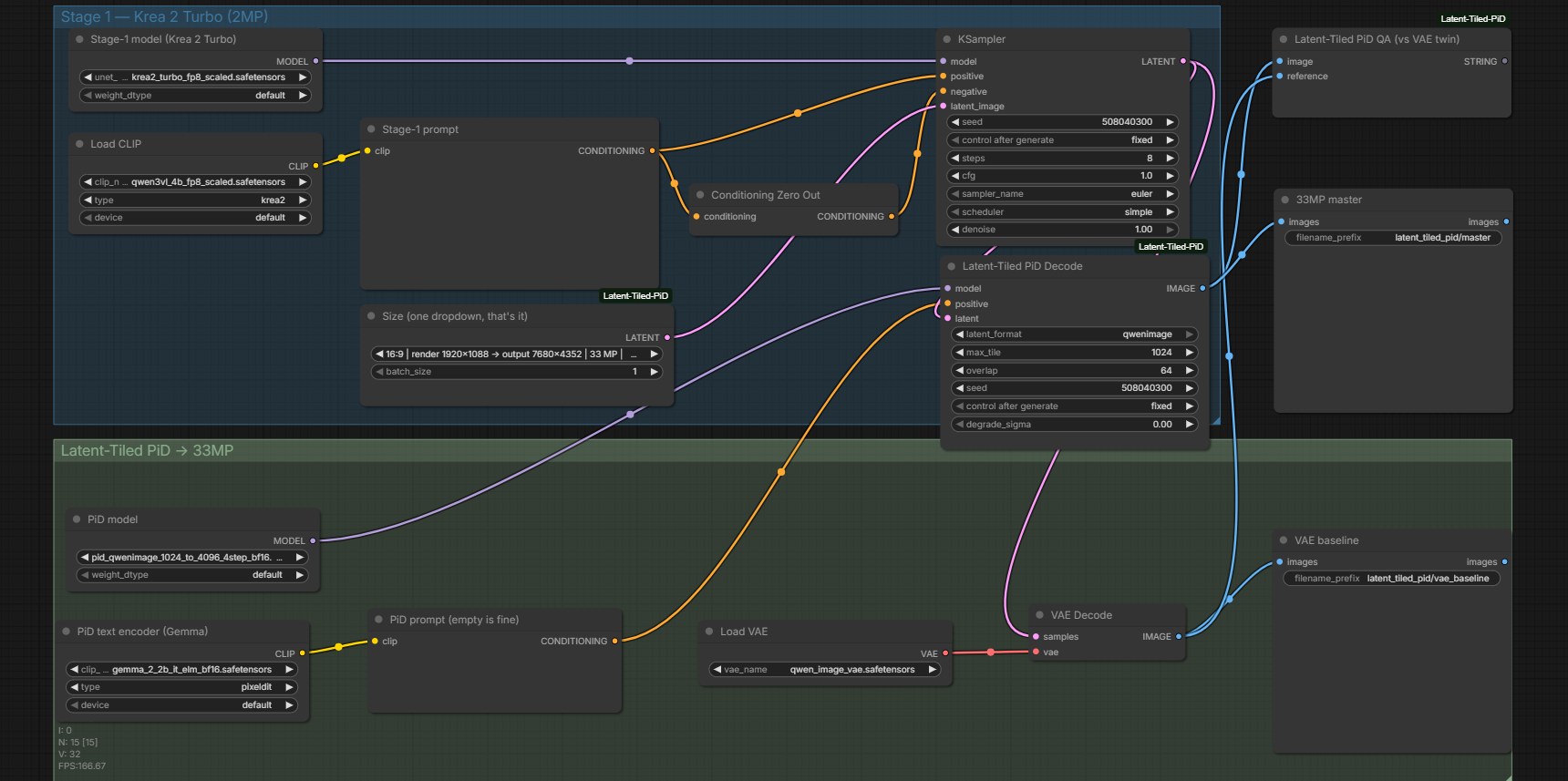
example_workflows/krea2_turbo_sizepicker.json —
the recommended one: full Krea 2 Turbo pipeline with the Size Picker in front (one dropdown →
KSampler → tiled decode → master), VAE baseline and QA node wired in.
example_workflows/krea2_turbo_2mp_to_33mp.json —
the same pipeline with a stock EmptySD3LatentImage at fixed 1920x1088, for people who prefer
typing numbers.
example_workflows/flux2_klein_4b_tiled_pid.json
— FLUX.2 Klein 4B distilled end-to-end: the flux2 Size Picker (width/height wired into
Flux2Scheduler, 4 steps, euler, CFG 1.0) → tiled PiD decode with the flux2 checkpoint → 33MP
master, VAE baseline + QA included. Models: flux-2-klein-4b.safetensors, qwen_3_4b.safetensors
(CLIPLoader type flux2), flux2-vae.safetensors, pid_1.5_flux2_1024_to_4096_4step_bf16.safetensors.
example_workflows/flux2_klein_9b_tiled_pid.json
— the same graph on Klein 9B distilled fp8 (flux-2-klein-9b-fp8.safetensors +
qwen_3_8b_fp8mixed.safetensors). Non-commercial license on the 9B weights. Validated clean
through the 59MP rungs — pick the 1/2/4/6-tile dropdown lines; for anything bigger use the 4B
workflow, which sweeps clean to 244MP.
example_workflows/zimage_turbo_sizepicker_pid.json
— Z-Image-Turbo / FLUX.1 end-to-end: Size Picker → Z-Image stage-1 (qwen_3_4b.safetensors
on CLIPLoader type lumina2, ModelSamplingAuraFlow shift 3.0, 8 steps res_multistep) → tiled
PiD decode with pid_1.5_flux1_1024_to_4096_4step_bf16.safetensors (latent_format: flux) →
33MP master, ae.safetensors VAE baseline + QA included.
example_workflows/zimage_turbo_simple_pid.json
— core-nodes-only single-shot companion for flux1, pinned at its envelope: Z-Image at 1024×1024
→ PiDConditioning → 4-step decode → 4096×4096. Needs
example_workflows/pixel_space_vae.safetensors
(84-byte marker file, included) copied into ComfyUI/models/vae/. flux1's single-shot ceiling
is real — square-at-4096 is the one good rung; for 16:9 or bigger use the tiled workflow above.
Loaded in ComfyUI:
Tested on
Works on my machine. Here is the machine, in its entirety — if your setup differs and something breaks, this table is the first thing to check, not the issue tracker:
| component | exact version |
|---|---|
| ComfyUI | 0.31.1 (also validated on 0.30.1; built against comfy.sample.sample_custom, the pixel-space VAE, and core PiD support) |
| Python | 3.13.12 |
| PyTorch | 2.13.0+cu130 |
| stage-1 models | Krea 2 Turbo — krea2_turbo_fp8_scaled.safetensors + qwen3vl_4b_fp8_scaled text encoder (CLIPLoader type krea2), 8 steps euler/simple cfg 1.0 · FLUX.2 Klein 4B distilled — flux-2-klein-4b.safetensors + qwen_3_4b.safetensors (CLIPLoader type flux2), Flux2Scheduler 4 steps euler cfg 1.0 · FLUX.2 Klein 9B distilled fp8 — flux-2-klein-9b-fp8.safetensors + qwen_3_8b_fp8mixed.safetensors, spot-validated PASS at the 9/33/59MP rungs, flagged at 111/137/244MP (keep 9B to ≤59MP outputs) |
| PiD checkpoints | v1.5 — pid_1.5_qwenimage_1024_to_4096_4step_bf16.safetensors (qwen lane) and pid_1.5_flux2_1024_to_4096_4step_bf16.safetensors (FLUX.2 lane); v1 is deprecated upstream; on identical latents v1.5 roughly halved our midtone chroma delta and zeroed shadow green-bias |
| GPU | RTX 5090 32 GB, --use-sage-attention, cudaMallocAsync |
| verified outputs | qwen ladder: full 56-preset sweep to 244MP (docs/preset_sweep_report.md) · flux2 ladder: full 56-preset sweep to 244MP on Klein 4B (docs/preset_sweep_report_flux2.md) |
| test dates | 2026-08-04 → 2026-08-06 (qwen) · 2026-08-10 (FLUX.2/Klein) |
On the v1 checkpoint the biggest rungs (107MP+) showed a +3.5–3.9 shadow green-bias tone stretch, disclosed in earlier releases; on v1.5 those same rungs measure near zero (−0.5 to +0.02). If ComfyUI moves its sampling internals in some future version, that is when this pack needs a patch, not an argument — open an issue with your versions and it gets fixed.
Measurements, methodology, headless version
The full evidence set — reproducible demo, calibration numbers, the past-envelope collapse characterization, and a headless driver that does the same thing over the ComfyUI API for pipeline use — lives in the companion repo: pid-tiled-decode.
Also documented there: core ComfyUI LatentCrop silently corrupts 5-dim qwen/Wan-family latents
(indexes T/H as if they were H/W). This pack slices latents rank-agnostically and is not affected.
Credit
- NVIDIA — PiD itself: Lu, Wu, Wu, Wang, Ling, Fidler, Ren (nv-tlabs/PiD). The decoder is theirs; this pack just refuses to leave its comfort zone.
- Merserk/ComfyUI-PiD — the image-space tiled upscaler design point, credited as prior art.
- Concept, direction and testing: BennyDaBall930.
License & compliance
This repo's code and images (our own generations) are MIT. It ships no NVIDIA model weights and no NVIDIA code — the PiD checkpoints come from NVIDIA under the NVIDIA License (non-commercial: research and evaluation use); read it before pointing this at anything commercial. Independent project — not affiliated with, sponsored by, or endorsed by NVIDIA or Comfy Org.
Built & tested locally with care by BennyDaBall930.