
ComfyUI-HiCache
Training-free Hunyuan3D shape-generation acceleration: skip DiT steps and forecast the flow-matching velocity instead (HiCache Hermite / HiCache++ DMD, via hicache-pp). Pairs with kijai/ComfyUI-Hunyuan3DWrapper.
Nodes (1)
ComfyUI-HiCache
<p> <a href="https://github.com/Archerkattri/ComfyUI-HiCache/releases"><img alt="Release" src="https://img.shields.io/github/v/release/Archerkattri/ComfyUI-HiCache?color=1f6feb"></a> <a href="https://registry.comfy.org/nodes/comfyui-hicache"><img alt="Comfy installs" src="https://img.shields.io/badge/dynamic/json?url=https%3A%2F%2Fapi.comfy.org%2Fnodes%2Fcomfyui-hicache&query=%24.downloads&label=comfy%20installs&color=4b8bbe"></a> <a href="https://registry.comfy.org/publishers/archerkattri/nodes/comfyui-hicache"><img alt="Comfy Registry" src="https://img.shields.io/badge/Comfy%20Registry-comfyui--hicache-4b8bbe"></a> <a href="LICENSE"><img alt="License" src="https://img.shields.io/github/license/Archerkattri/ComfyUI-HiCache?color=0d9488"></a> </p>Training-free Hunyuan3D shape-generation acceleration for ComfyUI — skip DiT
forwards during flow-matching sampling and forecast the velocity instead, using
the hicache-pp library
(HiCache Hermite-polynomial and HiCache++
DMD/Prony-exponential forecasters).
Status: GPU-validated end-to-end inside ComfyUI (2026-06-11, RTX 5090, real ComfyUI + kijai/ComfyUI-Hunyuan3DWrapper + Hunyuan3D-2mini fp16): the patch engages on schedule, sampling runs 2.7x faster at the recommended
hermite interval=3, the accelerated mesh stays well above the different-seed noise floor in F-score against the unaccelerated mesh, and repeated runs in one session reset state correctly. Measured details in Validated on below.
Runtime path
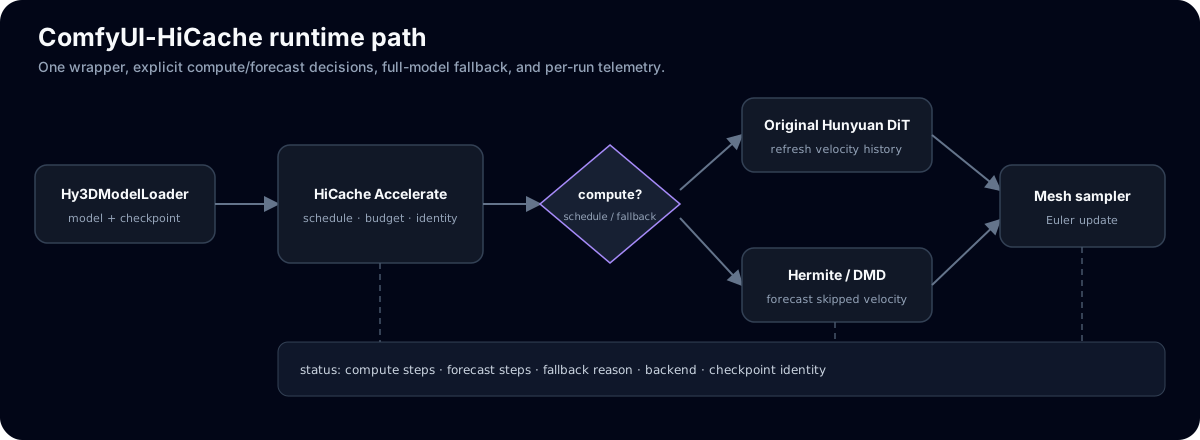
Scheduled Hunyuan3D model evaluations anchor the velocity history. Forecasted steps reuse that history, while incompatible schedules and failed forecasts return to the full model and report the fallback.
What it does
One node, HiCache Accelerate (Hunyuan3D), wired between
kijai/ComfyUI-Hunyuan3DWrapper's
Hy3DModelLoader and its mesh sampler (Hy3DGenerateMesh /
Hy3DGenerateMeshMultiView):
Hy3DModelLoader ──pipeline──▶ HiCache Accelerate ──pipeline──▶ Hy3DGenerateMesh
The node patches pipeline.model (the shape DiT). On compute steps the DiT
runs normally and its output is cached as a forecast anchor; on skipped steps
the DiT is not called at all — the flow-matching velocity is forecast from
the cached anchors. With interval = N, roughly (N-1)/N of the DiT forwards
are skipped. The patch needs nothing from ComfyUI internals and works on any
pipeline object whose denoise loop calls
self.model(latent_model_input, timestep, cond, ...) once per step — which
covers the wrapper's vendored hy3dgen (Hunyuan3D 2.0) and hy3dshape
(Hunyuan3D 2.1) pipelines, including the mini/turbo checkpoints
(wrapper issue #97
— the patch is checkpoint-agnostic; only the loop shape matters).
Methods
| method | basis | when to use |
|---|---|---|
| hermite (default) | HiCache, dual-scaled physicist's Hermite polynomial (arXiv:2508.16984) | interval 3; the best-measured setting inside ComfyUI and on both upstream checkpoints |
| dmd | HiCache++, Dynamic Mode Decomposition / Prony exponential basis | larger intervals (4 to 5) on the big 2.1 DiT; on mini it measured below the seed-noise floor inside ComfyUI (see Validated on) |
| auto | holdout-selected per compute step: serves DMD only when it demonstrably beats the polynomial on the cached window | when unsure |
Inputs
| input | default | meaning |
|---|---|---|
| pipeline | — | HY3DMODEL from Hy3DModelLoader |
| method | hermite | forecast basis (above) |
| interval | 3 | compute 1 step, forecast interval-1. 1 disables caching |
| warmup_steps | 2 | always compute the first N steps (floored at 1 — the first step has nothing to forecast from) |
| enable | true | off = unpatch, restore the original DiT |
| max_order | 1 | Hermite / finite-difference order |
| sigma | 0.5 | Hermite contraction factor in (0,1) |
| dmd_history | 5 | DMD snapshot window length |
Re-running the node with new parameters re-patches cleanly; enable=false (or
interval=1) restores the original model. State resets automatically at each
new sampling run.
First-result acceptance checklist
Use a fixed small input and record the exact ComfyUI, wrapper, checkpoint, node commit, method, interval, seed, and torch/CUDA versions. Before treating a run as accelerated, verify all of the following:
- Baseline: run once with
enable=false(orinterval=1) and save the output plus the unaccelerated DiT-forward count. - Accelerated: run the same input and seed with the node enabled; confirm
pipeline.model.branch_idisstacked_pre_cfg, therun_idchanges on a retry, andpipeline.model.telemetryreports the actual decision and method counters. DMD/auto history below their method-specific floors is rejected; short or non-uniform windows remain visible as Hermite fallback counts. - Lifecycle: repeat the run, including a one-step
t=0retry, and confirm the run starts with a fresh full decision rather than a stale forecast. - Comparison: compare baseline and accelerated outputs and retain the raw per-run counts. GPU timing/quality and a clean-host workflow import are separate gates; this CPU package check does not establish a speed or quality claim.
The node never mutates the pipeline it receives: it returns a shallow copy
whose model attribute is the patch (weights stay shared, so this costs no
VRAM). This matters because ComfyUI caches node outputs keyed on node inputs;
an in-place patch lets a cached output alias a pipeline that a later run
re-patched with different settings. That failure was actually observed during
GPU validation (a cached hermite interval=3 output silently ran
dmd interval=5) and is covered by a regression test.
Measured inside ComfyUI (this node, end-to-end)
Setup: ComfyUI 0.24.0, kijai/ComfyUI-Hunyuan3DWrapper master, Hunyuan3D-2mini fp16 single-file checkpoint, RTX 5090, torch 2.12 cu128. Workflow: LoadImage (518x518 RGBA crop) -> InvertMask -> Hy3DModelLoader -> HiCacheAccelerate -> Hy3DGenerateMesh (30 steps, cfg 5.5) -> Hy3DVAEDecode (octree 384) -> Hy3DExportMesh. Quality metric: [email protected] of the accelerated mesh against the unaccelerated mesh from the same seed (50k surface samples each, shared canonical frame, no alignment needed); as a floor, two unaccelerated runs that differ only in seed score 0.751 on the same metric.
| config | DiT steps run | sampling | sampling speedup | [email protected] vs baseline |
|---|---|---:|---:|---:|
| baseline (enable=false) | 30/30 | 1.87 s (16.1 it/s) | 1.00x | 1.000 |
| hermite interval=3 | 11/30 | 0.70 s (43.1 it/s) | 2.68x | 0.825 |
| dmd interval=5 | 7/30 | 1.10 s (27.2 it/s) | 1.69x | 0.719 |
Reading: hermite i3 is comfortably above the 0.751 different-seed floor
(the accelerated mesh is closer to its baseline than a fresh seed is), at a
2.7x sampling speedup. dmd i5 lands at the floor on mini inside ComfyUI;
its forecast also costs more per skipped step (an SVD), which eats into the
speedup on a DiT this small. Hence the node defaults are hermite / 3.
On mini the end-to-end win is modest in absolute terms (about 1.2 s of a
roughly 9 s run) because VAE decode and marching cubes dominate; the larger
the shape DiT and the higher the step count, the larger the end-to-end share
the node saves.
Measured numbers (from the adapter repos, outside ComfyUI)
The same forecasters, wired into the upstream Hunyuan3D pipelines (outside ComfyUI), measured on Toys4K image-to-3D with geometry-preserving A/B ([email protected] vs. the uncached baseline, solo re-timed speedups). Full tables and methodology: hicache-plus-plus results.
Hunyuan3D-2.1 (baseline F-score 0.911):
| interval | Hermite (HiCache) | DMD (HiCache++) | speedup | |---:|---:|---:|---:| | i3 | 0.876 | 0.852 | 1.72× | | i4 | 0.776 | 0.827 | 1.80× | | i5 | 0.735 | 0.860 | 1.79× |
Hunyuan3D-2-mini (baseline F-score 0.794, 1.89 s/gen): DMD i5 is exactly lossless (0.794) at 1.69 s; HiCache i3 0.792 at 1.58 s.
Source adapter repos (measured, runnable): hunyuan2-plus-plus (2.0 + mini), hunyuan2.1-plus-plus (2.1).
These numbers come from first-class pipeline wiring (the forecast caches the
CFG-combined velocity); the ComfyUI node is a model-level patch that caches
the pre-CFG stacked output instead. For Hermite the two are mathematically
identical. For DMD they are not, and the inside-ComfyUI measurement above
confirms the difference is real on mini: prefer hermite in this node unless
you re-A/B dmd on your own checkpoint.
Install
Via ComfyUI-Manager: search for ComfyUI-HiCache (once indexed), or
Install via Git URL → https://github.com/Archerkattri/ComfyUI-HiCache.
Manual:
cd ComfyUI/custom_nodes
git clone https://github.com/Archerkattri/ComfyUI-HiCache
pip install -r ComfyUI-HiCache/requirements.txt   # just: hicache-pp
Requires ComfyUI-Hunyuan3DWrapper
to provide the HY3DMODEL pipeline the node accelerates.
Validated on
What has actually been verified, and how:
- CPU node-pack integration smoke:
pytest -q tests/test_nodes.pyimports the package as ComfyUI does, checks its node mappings and input schema, and verifies patch/unpatch behavior without requiring a ComfyUI installation. Forecast and budget unit tests are not included in this review branch. - End-to-end GPU validation inside ComfyUI (2026-06-11, RTX 5090, ComfyUI
0.24.0, wrapper master, Hunyuan3D-2mini fp16):
- headless ComfyUI boots with the pack installed, zero import errors, and
HiCacheAccelerateappears in/object_info; - the full image-to-mesh workflow executes through the ComfyUI API with the
node wired in, and the patch demonstrably engages: with 30 sampling steps
the run-boundary log reports
11 computed + 19 skippedforhermite interval=3and7 computed + 23 skippedfordmd interval=5, exactly the library schedule, with the sampling rates and meshes in the table above; - repeated runs in one server session (the same patched pipeline served from ComfyUI's node-output cache across prompts) each reset the forecast state at the run boundary and produce fresh, seed-dependent meshes;
- two bugs were found during this validation and fixed: (1) ComfyUI cache aliasing, fixed by copy-on-patch (see Inputs); (2) back-to-back single-step runs both start at t=0, which the old strictly-decreasing run-boundary check missed, so the second run could be served a stale anchor; the boundary check is now non-increasing.
- headless ComfyUI boots with the pack installed, zero import errors, and
- Adapter-repo GPU measurements: the identical forecasters and schedule, measured in the upstream (non-ComfyUI) Hunyuan3D pipelines (tables above).
Not yet measured: the full-size Hunyuan3D 2.0/2.1 checkpoints inside
ComfyUI (the mechanism is identical and checkpoint-agnostic, and the adapter
repos measured those checkpoints upstream, but the in-Comfy numbers above are
mini-only), and the multiview sampler path (Hy3DGenerateMeshMultiView).
One honest design note
The adapter repos wire the forecast into the pipeline loop and cache the CFG-combined velocity; a model-level patch (the only non-invasive option for a ComfyUI node) caches the pre-CFG stacked DiT output instead. For the Hermite forecaster the two are mathematically identical (forecast and CFG combine are both linear); for DMD the fit runs on the stacked trajectory rather than the combined one. The inside-ComfyUI A/B above shows this matters in practice: DMD's upstream "lossless at interval 5 on mini" result does NOT transfer to the model-level patch, so this README does not claim it. Hermite numbers transfer exactly, and that is what the defaults use.
License
MIT. Not affiliated with Tencent (Hunyuan3D) or kijai (ComfyUI-Hunyuan3DWrapper).
Current release status
The current adapter includes the shared HiCache++ budget/identity/manifest bridge, timing and fallback accounting. Its CPU contract suite passes 45 tests. ComfyUI execution with the real CUDA model workflow was not run in this environment, so no image-quality or speedup claim is made.