
Comfyui-lora-weight-auto-optimization
A lightweight ComfyUI custom node for LoRA weight optimization using CMA-ES and Tournament GA algorithms.
lora-gradient-node
A lightweight ComfyUI custom node pack for LoRA weight optimization using algorithms: CMA-ES and Tournament GA.
Nodes
LoraWeightAutoOptimizer
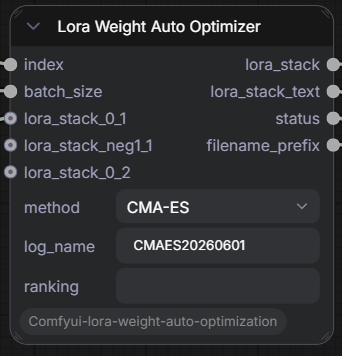
Optimizes LoRA weights by sampling candidate weight combinations, letting you rank the visual results, and evolving toward better combinations over successive generations(not grid searching).
| Input | Type | Description |
|---|---|---|
| index | INT (forced) | Current image index within the batch (0-based). Connect to an Int node that increments per image. |
| batch_size | INT (forced) | Number of candidates per generation (≥2). |
| method | dropdown | Optimization algorithm: CMA-ES or Tournament GA. |
| lora_stack_0_1 | LORA_STACK (optional) | LoRAs with weight bounds [0, 1]. |
| lora_stack_neg1_1 | LORA_STACK (optional) | LoRAs with weight bounds [-1, 1]. |
| lora_stack_0_2 | LORA_STACK (optional) | LoRAs with weight bounds [0, 2]. |
| log_name | STRING (optional) | Name for the optimization session. New runs create logs/<log_name>/. Existing logs are auto-resumed if LoRA names and method match. |
| ranking | STRING (optional) | Comma-separated ranking like "3,1,2", where each number is the rank (1 = best) of the corresponding candidate. Only processed when index=0. |
| Output | Type | Description |
|---|---|---|
| lora_stack | LORA_STACK | The selected candidate's LoRA weights for the current index. |
| lora_stack_text | STRING | Human-readable candidate vs. estimated weights. |
| status | STRING | Current sigma, mean change, convergence hints, generation info. |
| filename_prefix | STRING | <log_name>/<log_name>_<gen>-<index>, you may want to link this to filename_prefix in image savers. |
Workflow
- Connect LoRA stacks to the optimizer (use the appropriate bounds input).
- Set
batch_sizeto the number of images you'll generate per generation. Use a number equal or greater than Lora numbers. - Provide a
log_nameto identify the optimization run. - Generate a batch of images — each uses a different candidate weight vector.
- You rank the results (1 = best) and input ranking as comma-separated string in every runs (execpt first run).
- The optimizer updates a new combination of weights based on it.
- Repeat until satisfied or converged.
Optimization Methods
CMA-ES (Covariance Matrix Adaptation Evolution Strategy)
A population-based black-box optimizer that adapts a full covariance matrix to model the search distribution. Well-suited for continuous weight tuning with correlated dimensions. Converges when sigma drops below a threshold, with visual hints (converged / near).
Tournament GA (Genetic Algorithm)
Uses tournament selection, blend crossover (BLX-α), and per-gene Gaussian mutation with elitism. A simpler alternative that explores via discrete generations rather than distribution adaptation.
Log Format
All state is persisted to <log_name>/optimization_log.json, including:
- Current generation, sigma/mean-change metrics
- LoRA names and bounds
- All candidate weight vectors for the current generation
- Full optimizer state for exact resumption
Notes
- Rankings must be a complete permutation of
1..batch_size— no ties, no gaps. - All three LoRA stack inputs are combined; each input type maps to specific weight bounds.
- The optimizer skips the update step when
index > 0or when no ranking is provided, simply returning the stored candidate for that index. - When resuming a log, the LoRA name list and method must match exactly, otherwise an error is raised.
- Maybe not as good as manually selecting every lora weight by observing behaviours and stacking.