
comfyui-minimax-h3-parallel
Exact activation-only multi-GPU attention head sharding for MiniMax H3 in ComfyUI.
ComfyUI MiniMax H3 Parallel Attention
Exact activation-only attention-head sharding for MiniMax H3 Ref2VA. The MiniMax model, text encoder, and VAEs stay on their normal devices; helper GPUs receive only packed INT8 Q/K/V head slices and return BF16 attention outputs.
Requirements
- ComfyUI 0.33.0 or newer
- Comfy Kitchen 0.2.31 or a compatible newer release with CUDA INT8 attention
- two to four visible NVIDIA CUDA GPUs with bidirectional peer access
- a MiniMax H3 model using the native ComfyUI integration
The tested system used four RTX PRO 6000 Blackwell GPUs. Other NVIDIA devices supported by Comfy Kitchen should work, but have not been benchmarked here.
Install
Clone the repository into ComfyUI/custom_nodes and restart ComfyUI:
cd ComfyUI/custom_nodes
git clone https://github.com/AesSedai/ComfyUI-MiniMaxH3-Parallel.git
ComfyUI Manager can install the same repository URL with Install via Git URL. Public Manager/Registry listing additionally requires publishing the repository and adding the publisher metadata assigned by the Comfy Registry.
No additional Python packages are installed; the node uses the Comfy Kitchen version supplied by ComfyUI.
Launch and use
Expose every participating GPU to the one ComfyUI process:
CUDA_VISIBLE_DEVICES=0,1,2,3 python main.py --use-ck-attention
Wire the model path as:
Load Diffusion Model -> MiniMax H3 Attention Parallel -> scheduler and guider
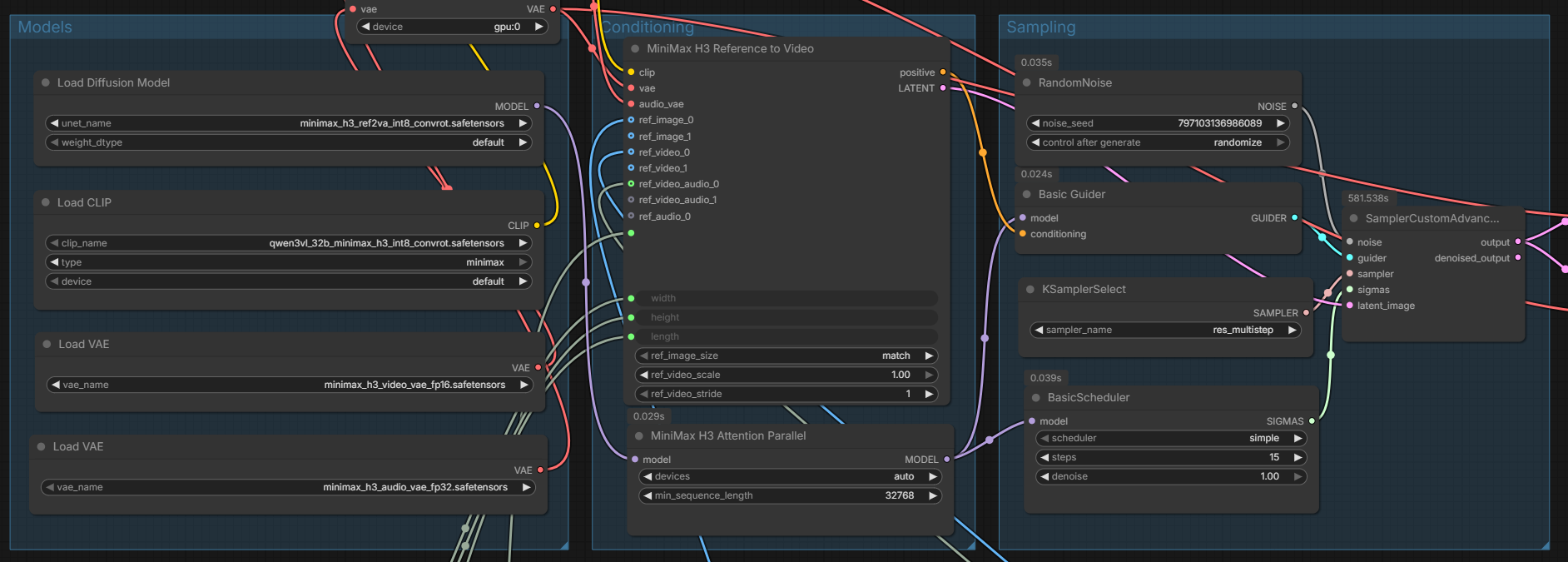
devices counts the model GPU as well as helpers. For example, 4 means one
model GPU plus three activation-only helpers. auto uses up to four suitable
visible GPUs and honors min_sequence_length; an explicit count fails early
if that many peer-accessible CK-capable GPUs are not available.
Launch ComfyUI with --use-ck-attention so the model uses the required Comfy
Kitchen INT8 attention path. Do not add Torch Compile Model to this graph:
measured four-step Ref2VA runs gained only about 1.5% in steady state and
diverged substantially from the eager trajectory.
Measured reference results
Test system and workload
- four NVIDIA RTX PRO 6000 Blackwell Max-Q 96 GB GPUs
- ComfyUI 0.33.0, PyTorch 2.10.0+cu130, Comfy Kitchen 0.2.31
minimax_h3_ref2va_int8_convrot.safetensors- 0.7 MP portrait output: 640x1152, 158 frames, 6.58 seconds
- reference image, reference video, and its audio
res_multistep,simple, four sampling steps, fixed seed, no compile- packed attention shape
[1, 56, 93312, 128]
The server was warmed with one complete one-step prompt. Each measured prompt used fresh graph IDs, forcing reference conditioning, sampling, decode, and save to execute while retaining normal resident model/file caches. Timings below are wall-clock node-transition measurements from ComfyUI's websocket.
Ref2VA workflow
| Devices | Head split | Conditioning | Denoising | Seconds/step | Decode | Create/save | End-to-end | Denoiser speedup | End-to-end speedup | |---:|:---|---:|---:|---:|---:|---:|---:|---:|---:| | disabled | 56 | 56.78 s | 153.78 s | 38.45 s | 9.68 s | 3.78 s | 224.04 s | 1.00x | 1.00x | | 2 | 28/28 | 57.37 s | 102.26 s | 25.56 s | 24.79 s | 3.55 s | 187.98 s | 1.50x | 1.19x | | 3 | 19/19/18 | 56.61 s | 84.32 s | 21.08 s | 24.78 s | 3.81 s | 169.54 s | 1.82x | 1.32x | | 4 | 14/14/14/14 | 57.16 s | 76.01 s | 19.00 s | 24.84 s | 3.40 s | 161.41 s | 2.02x | 1.39x |
disabled used the stock globally selected CK backend. The four-GPU mode cut
denoising time by 50.6% and total workflow time by 28.0%. Conditioning and VAE
decode remain single-device work, so they limit end-to-end scaling. Decode was
also variable in this run: the disabled control took 9.68 seconds while the
subsequent measurements took about 24.8 seconds. Denoiser timing is therefore
the cleaner comparison between device counts.
All four saved outputs had identical decoded video and audio SHA-256 hashes. The device setting changed performance without changing the generated result.
Attention-only synthetic benchmark
Median steady-state critical-path time at the same packed attention shape:
| Devices | Head split | Attention | Speedup | |---:|:---|---:|---:| | 1 | 56 | 534.4 ms | 1.00x | | 2 | 28/28 | 326.6 ms | 1.64x | | 3 | 19/19/18 | 235.7 ms | 2.27x | | 4 | 14/14/14/14 | 197.2 ms | 2.71x |
Measured helper peak allocation was 1.56 GiB for the 28-head split, about 1.06/1.01 GiB for the 19/18-head helpers, and 0.78 GiB per helper for the 14-head split. Helper GPUs did not load model weights.
Limitations
- CUDA and Comfy Kitchen INT8 attention only
- no attention masks or grouped-query head mismatch
- helpers share the process and must have bidirectional CUDA peer access
- the packed-head adapter is tested against Comfy Kitchen 0.2.31; retest exact output when changing Comfy Kitchen versions