
ComfyUI_DWposeDeluxe
A custom ComfyUI node integrating DW-Pose (Denoising Whole-Body Pose Estimation) for high-quality pose detection with CPU (ONNX) and GPU (TensorRT) support. Features 20x faster performance with TensorRT acceleration, automatic model downloading, customizable pose visualization, keypoint conversion, and video workflow integration.
Nodes (15)
Stitch two pose clips into one timeline
Beat pose jitter by over-sampling, then cherry-picking
Blend two pose detections, keep the best of each
Fine-tune the skeleton look without touching the estimator
The DWpose node that actually keeps up with video
Stamp frame numbers on a video so you can actually find the good bit
The utility node that keeps pose data honest
Did that conversion break your pose data? This node tells you.
Re-render saved poses without re-running detection
Pull one clip out of a longer pose sequence
Load a saved pose dataset back into your workflow
Put two dancers on the same canvas
Smooth motion between two poses, without a video model
Resize, crop, and reposition pose data without losing quality
Play your pose sequence backwards
ComfyUI DWpose Deluxe
A pimped up custom node for ComfyUI that integrates the DW-Pose (Denoising Whole-Body Pose Estimation) model for high-quality pose detection. This node supports both CPU (ONNX) and high-performance GPU (TensorRT) execution, with automatic model downloading and engine building. Runs on average 20x faster than pose estimators without TensorRT engine booster. Added functionality for drawing feet, composite image with optional frame count for pose debugging, json dataset output and json converter node which can convert pixel-absolute coordinates to canvas-relative format.
Key Features
-
Dual Execution Providers: Choose between CPU (ONNX) for broad compatibility and GPU (TensorRT) for maximum performance.
-
Automatic Setup:
- Automatically downloads the required ONNX models on first use.
- Automatically builds and caches optimized TensorRT engines when the GPU provider is selected for the first time.
-
Modular Workflow: Comes with 11 distinct nodes for a flexible and powerful workflow:
DWposeDeluxeNode: The core node for performing pose estimation.DWposeDeluxe Weight Options: Fine-tune the visual style of the rendered pose skeleton, such as dot size and line thickness.DWposeDeluxe Keypoint Converter: A utility node to convert keypoint data between absolute (pixel) and normalized (percentage) coordinates.DWposeDeluxe Frame Numbering: Prints frame numbers onto any video. Lets you set custom font, size and pick corner at wish.DWposeDeluxe Pose Printer: Renders raw keypoints to pose image/video.DWposeDeluxe Interpolation: Smooth transition between poses. Match pose to first frame of SteadyDancer or create looped pose driven videos.DWposeDeluxe Keypoint Loader: (Up) loads saved JSON pose datasets.DWposeDeluxe Keypoint Resize: Lossless scaling, cropping and padding of keypoint data.DWposeDeluxe Keypoint Range From Batch: Select frame range from batch.DWposeDeluxe Merge Keypoints: Adds 2 sets of keypoints onto one canvas.DWposeDeluxe Batch Keypoints: Adds frames from one set of keypoints to the end of another.
-
Rich I/O:
pose_image: The generated pose skeleton on a black background.blend_image: A 50/50 blend of the source image and the pose image.face_image: Face crop of source image (multipose)source_image: A passthrough of the original input image.audio: A passthrough for the audio channel from video inputs.frame_rate: The frame rate derived from thevideo_infoinput.keypoints: Raw pose keypoints in a structured JSON format.
-
Advanced Customization:
- Toggle visibility for face, hands, and feet in the final pose.
- Set confidence threshold per individual subset.
- Adjust size and thickness of pose elements.
- Save generated keypoint data directly to your ComfyUI output directory.
- Optional pretty JSON output (human-readible).
- Add a frame number overlay to batch outputs, helpful by pose debugging.
-
Video Workflow Ready: Includes
audioandvideo_infoinput,frame_countandframe_rateoutputs,source_imageandaudiopass-through to seamlessly integrate with video load/combine nodes. Croppedface_imageeasy face reference for models like WAN Animate (supports multiple poses).
Full Pose With Feet (optional)
Installation
Use ComfyUI-Manager and search for DWposeDeluxe
or install manually:
-
Navigate to your ComfyUI installation directory.
-
Clone this repository into the
custom_nodesfolder:cd ComfyUI/custom_nodes/git clone https://github.com/hobinrude/ComfyUI_DWposeDeluxe -
Navigate into the newly cloned directory:
cd ComfyUI_DWposeDeluxe -
Install the required dependencies:
pip install -r requirements.txt -
Start or restart ComfyUI.
How to Use
-
In ComfyUI, add the
DWposeDeluxeNodeto your workflow. -
Connect an image source (e.g., from a Load Image or Load Video node) to the
imageinput. -
Select the
provider_type:CPU: Uses the ONNX runtime. Models will be downloaded automatically if not found inComfyUI/models/dwpose/.GPU: Uses the TensorRT runtime. The first time you select this, the node will build optimized.trtengine files. This may take several (5-6) minutes, but subsequent runs will be significantly faster - 20x the speed of regular.onnxmodels.
-
(Optional) Add the
DWposeDeluxe Weight Optionsnode and connect itsoptionsoutput to theweight_optionsinput on the main node to customize the appearance of the pose by setting modifier values for dot size and bone thickness. -
(Optional) Connect the
keypointsoutput to theDWposeDeluxe Keypoint Converternode to transform the keypoint data if downstream nodes require different formats. -
Set
poses_to_detectto a specific number to eliminate detections of unwanted background photo-bombers. This works based on bounding box size so will only detect X biggest poses in each frame (can currently be a bit glitchy, but more stable and accurate pose tracking methods will be added soon) -
Connect
face_imageas face reference for models like WAN Animate or SteadyDancer. Can output multiple faces when more than one poses is detected. Use downstream crop node to get individual face. -
Some common user-side errors are suppressed with
InterruptProcessingExceptionso always check console output for error logs if your workflow gets quietly interrupted during pose detection.
Basic Example Workflow Included
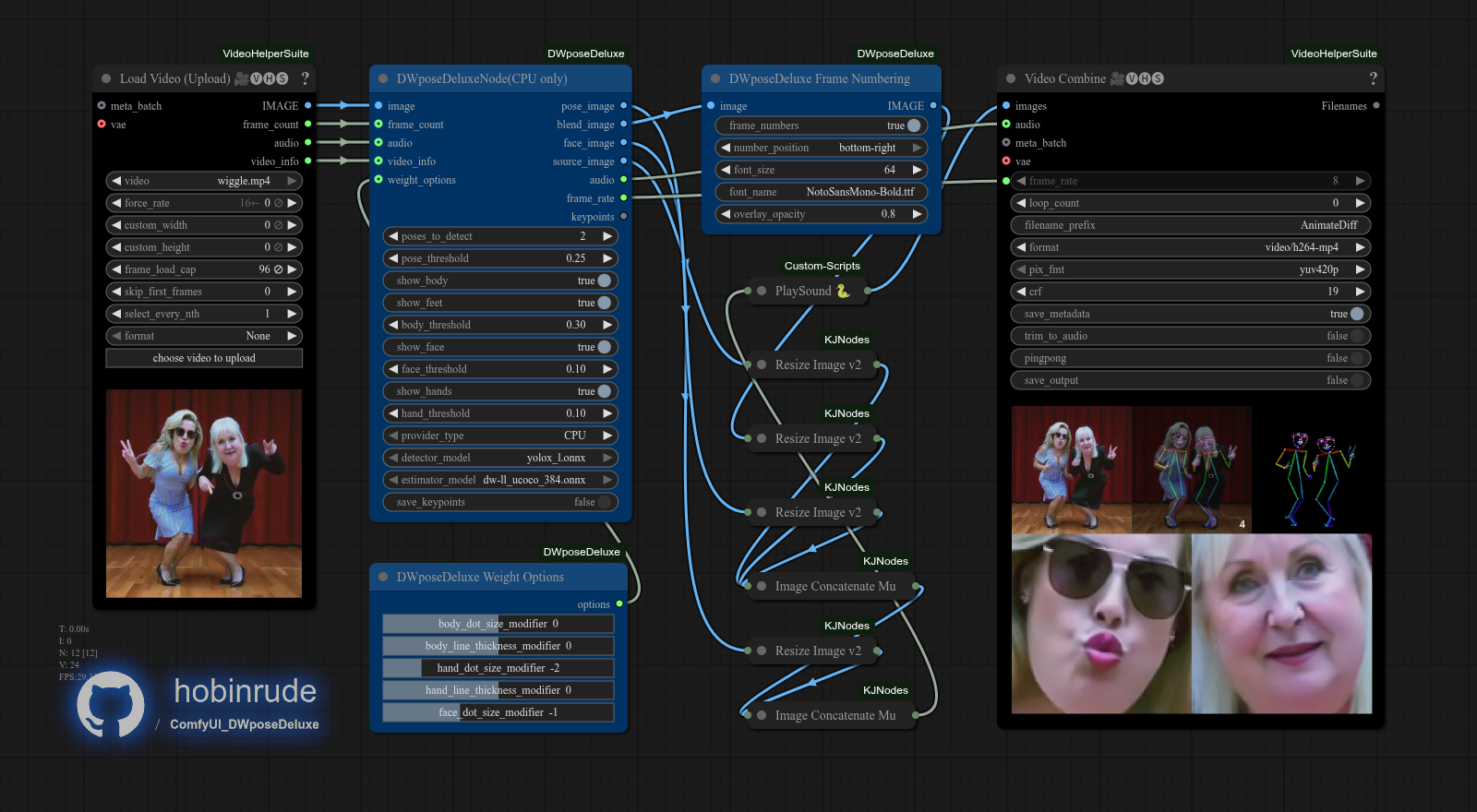
Dependencies
This node requires the following Python libraries:
onnxruntime-gpu
onnxruntime
opencv-python
matplotlib
polygraphy
colored
These can be installed by running pip install -r requirements.txt from within the node's directory.
TensorRT will be installed automatically if not detected on first run (requires one more ComfyUI restart upon install. If you encounter any problems with auto install, please open an issue and try toinstall manually with:
pip install tensorrt-cu11
or
pip install tensorrt-cu12
or
pip install tensorrt-cu13
IMPORTANT: There are no tensorrt builds for python version >= 3.14
Changelog
-
2025-12-16 v1.0.7
- Added 3 new keypoint editing nodes
- Optimized memory load of main output creation method
- Added description of each nodes function, inputs, parameters and outputs
-
2025-12-09 v1.0.6
- Resolved issues with manager install (hopefully all)
-
2025-12-04 v1.0.5
- Added PosePrinter and Interpolation nodes
-
2025-12-02 v1.0.4
- Added
face_imagecrop from source by bbox - Fixed normalized and pretty JSON output of Converter node
- Added visibility thresholds by detection confidence per keypoint in subset
- Added
-
2025-11-26 v1.0.3
- Major UI and inference bugfixes
- Improved console logging
- Separate node for frame numbers
Extras
- Keypoint Inspector - A simple TUI app for detailed frame-by-frame inspection of KP dataset
https://github.com/user-attachments/assets/f1870c3f-464f-4899-a58c-b31f1130ac20
Known issues
- UI is not optimized for Nodes 2.0
This node pack is still under development, so reporting any Issues is much apperciated.
Same goes for additional feature requests, which are more than welcome in Issues section.
Fun fact
It works even on prehistoric setups like Core 2 Duo (direct successor of 486 processors) with 4GB of DDR3 🥹
Other useful ComfyUI DW/OpenPose editing node packs:
ComfyUI Proportion Changer Includes a cool pose editing node allowing creation of oddly shaped pose skeletons. Perfect for creating motion drivers of animated cartoon characters, antropomorphic animals, robots and other humanoid creatures. https://github.com/grmchn/ComfyUI-ProportionChanger
ComfyUI Pose Interpolation Includes a more advanced algorithm for interpolating between 2 static poses as well as to adjust the length of each body part individually which can produce super-deformed, unnaturally funny human poses. https://github.com/fssorc/ComfyUI_pose_inter
Acknowledgements & License
This project is heavily based on the work of yuvraj108c and his original ComfyUI-Dwpose-Tensorrt repository. Big chunks of code have been repurposed straight from his project.
If you like this node pack and find it useful, please consider giving a star to the original repository and buying the original author a coffee, not me!
Licensing Notice
Due to the "ShareAlike" clause in the original project's license, this project is also licensed under the Creative Commons Attribution-NonCommercial-ShareAlike 4.0 International (CC BY-NC-SA 4.0).
This means:
- You must give appropriate credit (Attribution).
- You may not use this material for commercial purposes (NonCommercial).
- If you remix, transform, or build upon the material, you must distribute your contributions under the same license (ShareAlike).
Enjoy Responsibly